

Table of Contents

- 1. NetSuite Data Integration Tools for Automation & Reporting
- 2. Top 5 NetSuite Reporting Tools in 2026: Boost Your Analytics Game
- 3. Top 10 NetSuite Apps for Integration & Reporting for 2026
- 4. Best 6 NetSuite Connectors in 2025
- 5. Best HubSpot NetSuite Integration Software
- 6. Best NetSuite Salesforce Integration Software
- 7. Best NetSuite Snowflake Integration Software
- 8. Best NetSuite QuickBooks Integration Software
- 9. Best Zendesk NetSuite Integration Software
- 10. Best Zoho CRM NetSuite Integration Software
- 11. Best NetSuite Pipedrive Integration Software
- 12. Best SharePoint NetSuite Integration Software
- 13. Best Google Drive NetSuite integration software
-
14. Best Shopify NetSuite Integration Software
- Purpose of your Shopify NetSuite integration
- Ways to integrate Shopify and NetSuite
- Method 1: Shopify App Store integration apps
- Method 2: Coefficient - no-code spreadsheet connector
- Method 3: Enterprise integration platforms (iPaaS) & custom development
- Connect your e-commerce operations data today
- 15. Best Stripe NetSuite Integration Software
- 16. Best Chargebee NetSuite Integration Software
- 17. Best WooCommerce NetSuite Connector
- 18. Best BigCommerce NetSuite Integration Software
- 19. Best BambooHR NetSuite Integration Software
- 20. Best Klaviyo NetSuite integration software
- 21. Best Mailchimp NetSuite integration software
- 22. Best Square NetSuite Integration Software
- 23. Best NetSuite Gmail Integration Software
- 24. How to Connect NetSuite to Snowflake: A Step-by-Step Guide


Your Shopify store processes a sale. The customer leaves happy. Your inventory updates instantly. But your finance team won’t see that revenue in NetSuite until someone manually exports and imports the data. That gap between transaction and recognition creates headaches for finance teams trying to close books accurately while operations teams struggle to reconcile inventory across systems.
Purpose of your Shopify NetSuite integration
Connecting Shopify with NetSuite enables:
- Order-to-cash automation tracking Shopify transactions from sale through NetSuite invoicing to payment recognition without manual data entry
- Real-time inventory synchronization preventing overselling by keeping stock levels accurate across your e-commerce platform and ERP system
- Revenue recognition accuracy ensuring e-commerce sales, refunds, and cancellations follow proper accounting standards in NetSuite
- Multi-channel financial consolidation rolling up multiple Shopify stores and sales channels into unified NetSuite financial reporting
Ways to integrate Shopify and NetSuite
You have three primary paths to connect these platforms: Shopify App Store offers third-party integration apps with bidirectional sync capabilities, Coefficient’s spreadsheet-native connector brings e-commerce and financial data together for analysis and reporting, or enterprise iPaaS platforms and custom development handle complex automation workflows.
Method 1: Shopify App Store integration apps
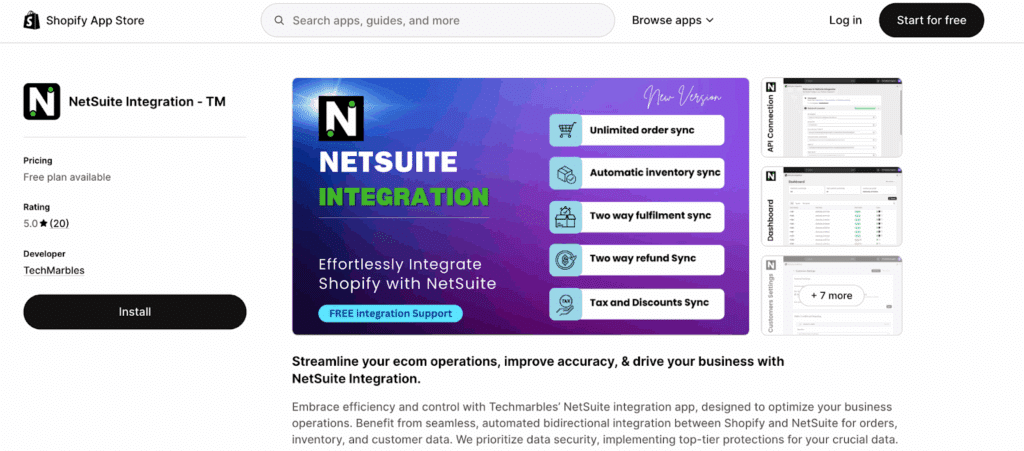
Shopify and NetSuite don’t provide a native, direct integration built by either company. Instead, the Shopify App Store features several third-party apps that connect the platforms. The leading option comes from TechMarbles, with a perfect 5-star rating across 20 reviews and pricing that starts free.
How it works
The NetSuite Integration app by TechMarbles installs directly from the Shopify App Store. After installation, you connect your NetSuite account through OAuth authentication. The app then provides configuration options for bidirectional data sync between your systems.
Order and customer sync:
- Orders flow from Shopify to NetSuite automatically, creating sales orders, invoices, or cash sales depending on your workflow preferences
- Customer records sync bidirectionally – new Shopify customers appear in NetSuite, while existing NetSuite customers can be imported to Shopify
- The app handles inventory updates from NetSuite to Shopify in real-time, ensuring your e-commerce storefront always reflects actual stock levels across single or multiple warehouse locations
Fulfillment and product management:
- Fulfillment and refund data syncs in both directions – when orders ship from your warehouse and get marked fulfilled in NetSuite, Shopify updates automatically with tracking information
- If customers request refunds through Shopify or adjustments happen in NetSuite, both systems stay synchronized
- Product imports from NetSuite to Shopify streamline catalog management, while order status updates, payment tracking, and detailed transaction logs provide visibility into every sync operation
Key features and considerations
The TechMarbles app delivers comprehensive integration capabilities without enterprise platform costs. Your Starter plan runs free for the first 50 orders or 30 days, letting you test the complete feature set. The $99/month Basic plan then provides unlimited orders, automatic inventory pulls, two-way fulfillment and refund flows, implementation support, and customer imports from NetSuite.
Pricing and support:
- The $199/month Enterprise plan adds advanced features like tax exclusions based on country, customer notifications on fulfillment, inventory quantity buffers, and priority support
- Multiple customers specifically praised the implementation assistance – one review from Cheap Sleep Wholesale noted: “Don’t pay thousands when this app and team provide the same service and better customer support”
- User reviews consistently highlight two strengths: exceptional technical support and customization capabilities
What users say:
- A reviewer from 7NShop (a complex organization requiring several customizations) called it “by far the best integration experience” and “highly recommend this connector over all the other NetSuite integrations that are out there”
- Pedego praised the support team as “best-in-class” for quickly resolving issues
- With 100% five-star reviews across all 20 ratings, the app demonstrates consistent reliability and satisfaction
The app handles real-time sync, multi-location inventory management, batch processing, order editing, and detailed logs. It supports accounts payable, accounts receivable, revenue management, and tax calculations. Custom workflows and conditional field mapping provide flexibility for businesses with specific operational requirements.
The developer launched it in March 2020 and has maintained it through five years of Shopify and NetSuite platform changes.
Best for
Small to mid-size e-commerce businesses running Shopify with NetSuite who need reliable bidirectional sync and value strong technical support. The free trial makes testing risk-free. Companies with complex operational requirements benefit from the customization support that reviews repeatedly emphasize.
At $99-$199 monthly, it costs substantially less than enterprise iPaaS platforms while delivering the core automation most e-commerce operations need.
Method 2: Coefficient – no-code spreadsheet connector
Coefficient takes a different approach to Shopify-NetSuite integration. Instead of syncing data between systems, it brings live data from both platforms directly into Google Sheets or Excel where finance and operations teams actually do their work.
How it works
Coefficient lives inside your spreadsheet. No separate platform. No new interface.
Getting started:
- Install Coefficient from the Google Workspace Marketplace or Microsoft AppSource in under a minute
- Connect Shopify with one-click OAuth – just grant permission
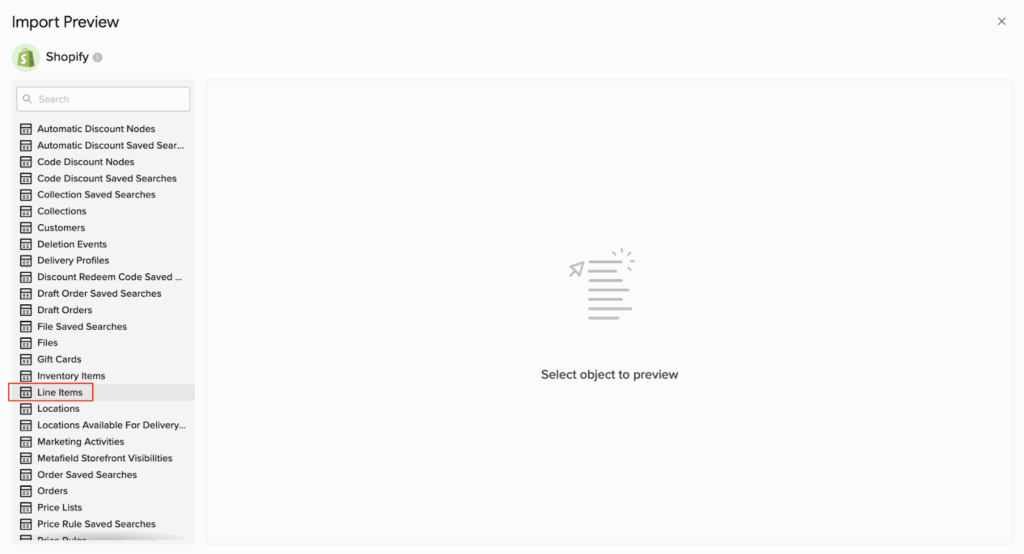
- Coefficient shows you available objects: orders, products, product variants, inventory items, customers, transactions
Connecting NetSuite:
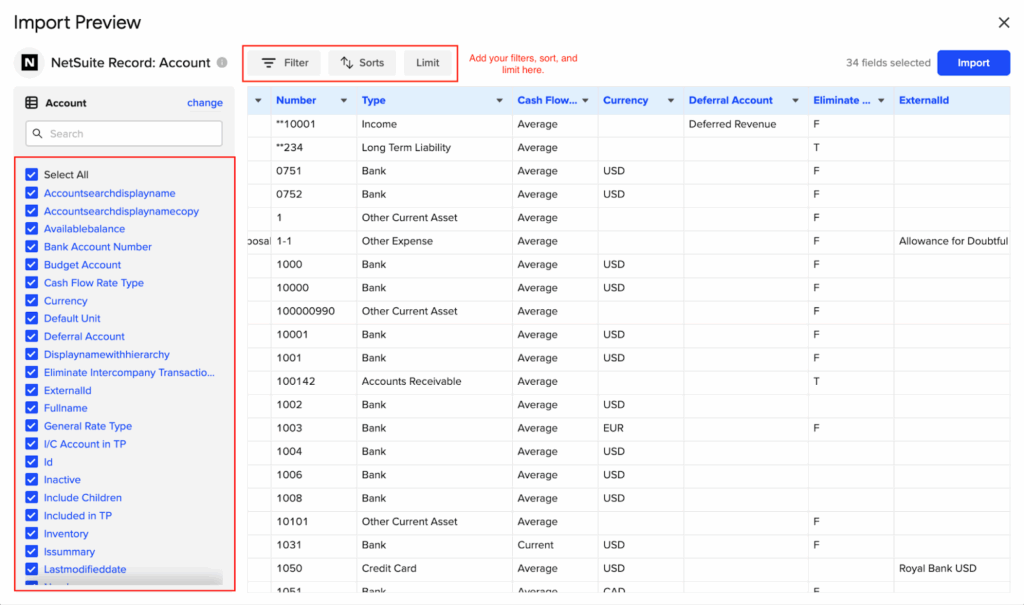
- The same process works for NetSuite, where you can pull income statements, general ledgers, saved searches, or write custom SuiteQL queries for complex financial data
- Click “Import from” in the Coefficient sidebar, choose your data source, preview before it lands in your sheet
- Your data appears in regular spreadsheet cells where you can immediately build pivot tables, create charts, write formulas, or combine it with other sources
The power shows up when you schedule automatic refreshes. Set your Shopify order report to refresh hourly. Your NetSuite financial actuals update daily. Your revenue operations dashboard stays current without you touching it.
Watch the integration in action:
See how quickly you can connect Shopify to your spreadsheet and start analyzing live data:
Quick integration walkthrough:
Steps 1-3: Connect Shopify
- Install Coefficient from Google Workspace Marketplace (60 seconds)
- Connect Shopify with one-click OAuth – no IT involvement needed
- Select your data: orders by status, product inventory, customer purchase history, variant performance
Steps 4-6: Connect NetSuite
- Connect NetSuite with OAuth 2.0 following the guided setup
- Import financial reports: income statements, trial balances, accounts receivable, custom saved searches
- Pull over 40 Shopify objects without row limitations
Steps 7-9: Build and automate
- Build dashboards that merge e-commerce velocity with financial actuals in one view
- Schedule hourly or daily automatic refreshes to keep data current
- Export data back to Shopify when you need bulk updates
Beyond just two systems:
Your e-commerce operations don’t stop at Shopify and NetSuite. Coefficient connects to 100+ business systems. Pull payment data from Stripe, advertising spend from Google Ads, shipping metrics from ShipStation, and support tickets from Zendesk. Build complete revenue operations dashboards that connect every touchpoint in your customer’s journey.
Limitations
Coefficient excels at data import, analysis, and dashboard creation. It’s not designed for complex, real-time workflow automation.
If you need automatic order routing rules that trigger when Shopify orders meet certain conditions and create NetSuite records with complex transformation logic, an iPaaS platform is better suited for these needs. Coefficient focuses on getting data into your hands for analysis, not on orchestrating multi-step automated workflows.
Ratings and reviews
Over 500,000 users across 50,000+ companies use Coefficient, including Spotify, Unity, Uber, Miro, and Klaviyo. With 142 reviews on G2, the platform ranks #2 overall in Big Data Integration and #3 in Data Extraction Tools. Coefficient earned recognition as Momentum Leader and High Performer across mid-market, enterprise, and Asia Pacific regions.
What customers say:
- Douglas Weltman from InfoSum shared: “Coefficient is exactly what we needed, after trying several different options on the market. This is a fantastic solution and I’m thrilled it’s available”
- Another user noted: “Awesome product. Coefficient improved my productivity so much!”
- Customer feedback emphasizes time savings and self-service capabilities
Best for
E-commerce finance teams, operations analysts, and revenue operations professionals who need to combine Shopify and NetSuite data for reporting and forecasting without deploying an enterprise integration platform. Ideal for companies wanting fast time to value without IT dependency and teams comfortable working in spreadsheets for analysis.
Perfect when you need to connect multiple data sources beyond just Shopify and NetSuite to understand complete e-commerce operations.
Method 3: Enterprise integration platforms (iPaaS) & custom development
When you need sophisticated workflow automation between Shopify and NetSuite with complex business rules, enterprise platforms deliver powerful solutions.
iPaaS platforms
Integration Platform as a Service (iPaaS) tools provide pre-built connectors with extensive customization options. These platforms excel at bidirectional, real-time sync with workflow orchestration.

Celigo offers a pre-built Shopify-NetSuite integration template specifically designed for e-commerce operations. Named a Visionary in the 2025 Gartner Magic Quadrant for iPaaS and ranked #1 for iPaaS on G2 (Fall 2025), Celigo’s integrator.io platform includes ready-to-deploy flows for the complete order-to-cash cycle.
Core integration flows:
- The integration handles 13+ prebuilt flows: orders from Shopify to NetSuite as sales orders or invoices, customers syncing bidirectionally, inventory updates from NetSuite to Shopify
- Fulfillment and billing information flowing back, and order cancellations and refunds syncing automatically
- Advanced features include fraud prevention through order risk metrics, promotions and gift cards tracking, Shopify POS support for buy-online-pickup-in-store scenarios, and payout reconciliation as an add-on
Scalability and features:
- Celigo processes hundreds, thousands, or millions of orders with infinite scalability and no restrictions on data volume
- The platform’s store-to-store cloning lets you replicate configurations across multiple Shopify stores instead of starting from scratch each time
- One manager at GTSE shared: “The more we used Celigo, the more we found it was actually very user-friendly, and it very quickly became our most favored piece of software”
Pricing isn’t publicly disclosed – it follows custom enterprise models. Expect to schedule a demo for pricing discussions. Implementation typically takes several weeks as you configure field mappings and customize flows for your business processes.
Workato takes a visual, recipe-based approach to integration. Their platform handles complex workflow needs with branching logic, data transformations, and detailed automation management.
The low-code interface lets business users build and maintain integrations after initial setup. Market leaders including Monday.com, Box, HP, and Cisco rely on Workato for integration needs. Pricing follows custom enterprise models based on usage and complexity.
Other iPaaS options:
- Other iPaaS options include Zapier for simpler automations and Tray.io for enterprise scenarios
- These platforms generally require $600-$7,800+ annually depending on complexity, plus implementation time and ongoing maintenance as both Shopify and NetSuite release updates
- iPaaS platforms work best when you need complex automation – like automatically creating NetSuite customer records when Shopify orders hit certain thresholds, applying specific field transformations, enforcing validation rules, or routing orders to different NetSuite subsidiaries based on shipping location or product category
Custom API development
Building custom integration using Shopify and NetSuite APIs offers maximum control. This path makes sense for highly specialized business processes, unique inventory management rules, or complex multi-channel attribution models that pre-built tools can’t handle.
API capabilities:
- Both platforms provide robust APIs – Shopify offers REST APIs for orders, products, inventory, and customer data
- NetSuite provides SuiteTalk SOAP Web Services, RESTlet endpoints, and SuiteQL for financial data access
- The technical challenges include OAuth implementation for both systems, data model mapping between e-commerce objects and financial records, rate limit management, and building logic that handles order timing versus fulfillment dates
Development costs and timelines:
- Development rates run $150+ hourly – a simple one-way integration pushing Shopify orders to NetSuite sales orders costs $25,000-$50,000 and takes 2-3 months
- Standard bidirectional sync with multiple objects, custom field mapping, and inventory automation runs $50,000-$100,000 over 3-4 months
- Complex implementations with sophisticated order routing rules and multi-channel attribution models exceed $250,000 and require 6+ months
Then add 15-20% of initial costs annually for maintenance, API updates, and enhancements.
Custom development delivers exactly what you need with complete flexibility. The trade-offs are substantial: high upfront costs, lengthy timelines, ongoing technical debt, and dependence on developers who understand your specific implementation.
Best for
iPaaS platforms work best for mid-market to enterprise e-commerce companies needing automated, bidirectional sync with workflow orchestration and business logic during data transfer. Custom development suits organizations with highly specialized inventory management processes or unique compliance requirements that pre-built solutions can’t accommodate, plus in-house technical teams capable of long-term maintenance.
Connect your e-commerce operations data today
Integrating Shopify with NetSuite eliminates the gap between your e-commerce velocity and financial accuracy. For most operations and finance teams, Coefficient provides the fastest path to complete visibility. Connect both systems in minutes, build comprehensive dashboards in the spreadsheets where you already work, and extend your analysis to 100+ other business systems without enterprise platform costs or IT dependencies.
Ready to see your complete order-to-cash cycle from Shopify transaction to NetSuite revenue recognition? Get started with Coefficient free and bring your e-commerce and financial data together today.