

Table of Contents

- 1. NetSuite Data Integration Tools for Automation & Reporting
- 2. Top 5 NetSuite Reporting Tools in 2026: Boost Your Analytics Game
- 3. Top 10 NetSuite Apps for Integration & Reporting for 2026
- 4. Best 6 NetSuite Connectors in 2025
- 5. Best HubSpot NetSuite Integration Software
- 6. Best NetSuite Salesforce Integration Software
- 7. Best NetSuite Snowflake Integration Software
- 8. Best NetSuite QuickBooks Integration Software
- 9. Best Zendesk NetSuite Integration Software
- 10. Best Zoho CRM NetSuite Integration Software
- 11. Best NetSuite Pipedrive Integration Software
- 12. Best SharePoint NetSuite Integration Software
- 13. Best Google Drive NetSuite integration software
- 14. Best Shopify NetSuite Integration Software
- 15. Best Stripe NetSuite Integration Software
- 16. Best Chargebee NetSuite Integration Software
- 17. Best WooCommerce NetSuite Connector
-
18. Best BigCommerce NetSuite Integration Software
- Purpose of Your BigCommerce NetSuite Integration
- Ways to Integrate BigCommerce and NetSuite
- Method 1: Celigo BigCommerce-NetSuite Integration App
- Method 2: Coefficient - No-Code Spreadsheet Connector
- Method 3: Enterprise Integration Platforms (iPaaS) and Custom Development
- Connect Your E-Commerce and Finance Systems Today
- 19. Best BambooHR NetSuite Integration Software
- 20. Best Klaviyo NetSuite integration software
- 21. Best Mailchimp NetSuite integration software
- 22. Best Square NetSuite Integration Software
- 23. Best NetSuite Gmail Integration Software
- 24. How to Connect NetSuite to Snowflake: A Step-by-Step Guide


Your BigCommerce orders pile up while someone manually keys them into NetSuite, causing inventory counts to drift out of sync, shipment tracking to lag behind customer inquiries, and finance to fall three days behind on reconciliation. This disconnect between your eCommerce storefront and ERP backend isn’t just inefficient—it’s limiting your ability to scale and costing you money in lost sales from stockouts and poor customer experiences.
This guide shows you how to connect BigCommerce and NetSuite to automate order flow, sync inventory in real-time, and give your team unified visibility across sales channels. We’ll compare native integration apps, spreadsheet-based reporting solutions, and enterprise automation platforms so you can choose the right approach based on your order volume, product catalog complexity, and technical resources.
Purpose of Your BigCommerce NetSuite Integration
Connecting BigCommerce with NetSuite eliminates manual data entry and creates a single source of truth for your e-commerce operations:
- Automated order management: Sales orders flow automatically from BigCommerce into NetSuite for processing and fulfillment
- Real-time inventory synchronization: Stock levels update across both platforms to prevent overselling and stockouts
- Unified customer data: Customer information stays consistent between your storefront and back office systems
- Streamlined financial operations: Revenue, payments, and tax data flow into NetSuite for accurate accounting and reporting
Ways to Integrate BigCommerce and NetSuite
You have three main approaches to connect BigCommerce with NetSuite:
- Pre-built integration apps like Celigo provide comprehensive operational sync out of the box
- Spreadsheet connectors like Coefficient offer NetSuite financial analysis capabilities (though without direct BigCommerce connectivity)
- iPaaS platforms or custom development deliver maximum flexibility for complex requirements
Method 1: Celigo BigCommerce-NetSuite Integration App
Celigo has built the industry-standard BigCommerce-NetSuite integration that handles everything from order synchronization to inventory management. This pre-built solution connects directly to both platforms through their APIs and automates your entire order-to-cash process.
How It Works
Celigo’s integration app installs as SuiteApp bundles in both NetSuite and BigCommerce. You configure data mappings through a guided setup process in integrator.io, Celigo’s integration platform. Once configured, the integration runs continuously in the background, syncing data between systems based on your rules and schedules.
The integration monitors BigCommerce for:
- New orders
- Customers
- Inventory changes
Then automatically creates or updates corresponding records in NetSuite. In reverse, it watches NetSuite for fulfillments, refunds, and price changes, pushing those updates back to BigCommerce in real-time.
You don’t need developers to maintain the integration. Celigo provides pre-built data flows that you can modify through a visual interface. When you need to adjust field mappings or add custom logic, you work through configuration screens rather than writing code.
Key Benefits
Comprehensive operational sync across all critical data. The integration handles:
- Customers
- Sales orders
- Fulfillments
- Inventory levels
- Items, billing, refunds, and cancellations
This eliminates the manual data entry that creates delays and errors in your operations.
Omnichannel e-commerce support for complex selling strategies. If you sell through:
- Marketplaces
- POS systems
- Social commerce
- Phone orders in addition to BigCommerce
Celigo consolidates all those orders into NetSuite. You get a unified view of inventory and fulfillment regardless of where the sale originated.
Advanced inventory management with multi-location support. The integration:
- Updates inventory levels from single or multiple warehouse locations
- Handles all NetSuite item types including inventory items, matrix items, and kits
- Ensures your BigCommerce storefront always reflects accurate availability
Financial automation that accelerates month-end close. Payments captured in BigCommerce flow automatically into NetSuite at the time of sale or fulfillment. The integration:
- Handles sales tax calculations through either NetSuite’s SuiteTax or BigCommerce’s tax engine
- Ensures accurate tax reporting on every transaction
- Eliminates manual reconciliation work
Promotion and gift card handling without manual intervention. Cart-level and line-item discounts from BigCommerce map to:
- NetSuite coupon codes
- Promotions
- Individual line items
Redeemed gift cards track as line items in NetSuite sales orders, maintaining accurate revenue recognition.
Limitations
Enterprise pricing structure that scales with your business. Celigo doesn’t publish pricing publicly because it varies based on:
- Transaction volume
- Complexity
- Customization needs
Smaller businesses might find the investment significant, though the operational efficiency gains typically justify the cost.
Implementation requires NetSuite administration access. You need to:
- Install SuiteApp bundles
- Configure external URL settings in NetSuite
While Celigo provides guided setup, you’ll want your NetSuite admin involved in the initial configuration. Some businesses engage Celigo partners for implementation support.
Customization may require additional development. The pre-built integration handles standard BigCommerce and NetSuite fields well. If you use heavily customized records or complex business logic, you might need Celigo professional services or a partner to build custom flows.
Best For
Celigo’s BigCommerce-NetSuite integration works best for mid-market and enterprise retailers who need comprehensive operational integration between their e-commerce platform and ERP. It’s ideal for businesses:
- Processing significant order volumes
- Managing multiple warehouse locations
- Selling across multiple channels beyond just BigCommerce
Method 2: Coefficient – No-Code Spreadsheet Connector
Coefficient doesn’t have a BigCommerce connector. That’s important to say up front.
But here’s what it does offer: powerful NetSuite integration that brings your e-commerce financial data directly into Google Sheets and Excel, where your finance team already works. If you’ve already solved the operational integration between BigCommerce and NetSuite (through Celigo or another solution), Coefficient adds a financial analysis layer that transforms how you report on and understand your e-commerce performance.
How It Works
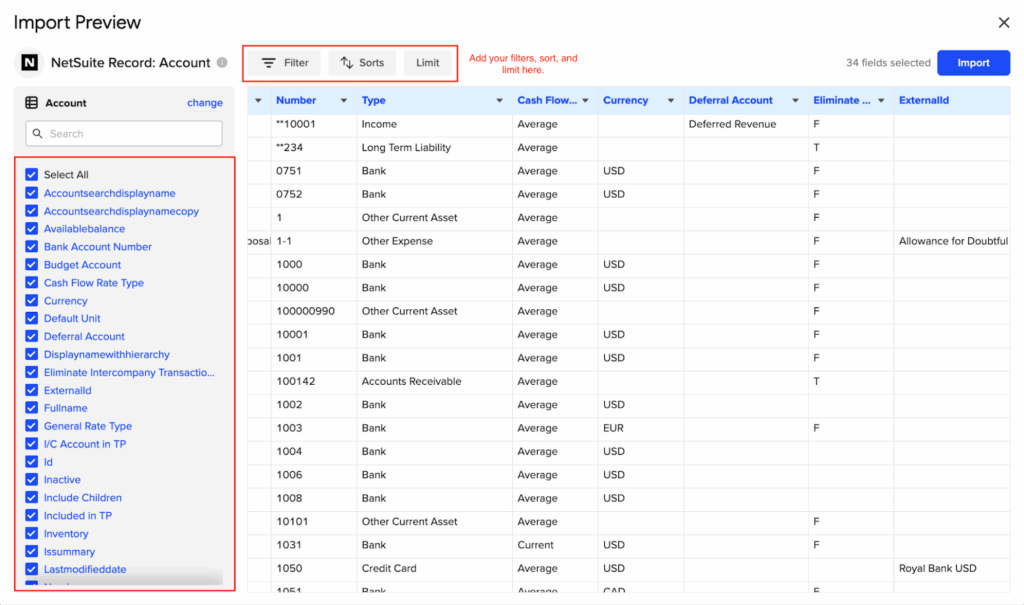
Coefficient connects to NetSuite through OAuth authentication and pulls data into spreadsheets using multiple import methods.
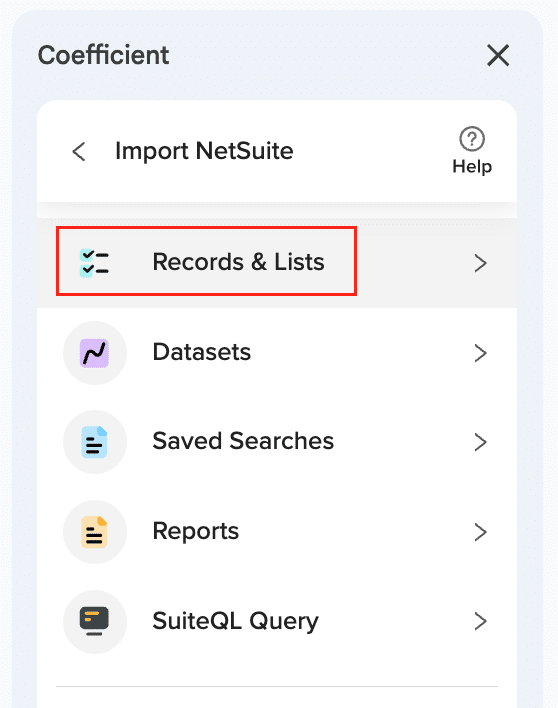
You choose between:
- Records & Lists: Access transaction records and account balances
- Financial Reports: Import standard NetSuite reports like Income Statement and General Ledger
- SuiteQL Query: Complex custom queries joining multiple tables
- Saved Searches: Pull existing NetSuite reports
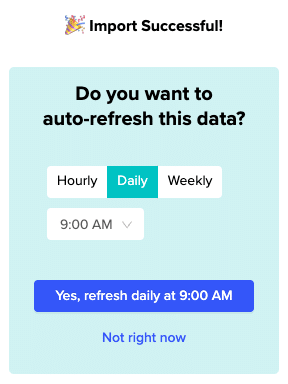
The connection stays live. When you set up a spreadsheet with NetSuite data, you configure automatic refresh schedules—hourly, daily, or weekly. Your spreadsheets update themselves without manual exports or copy-pasting. You’re working with real-time NetSuite data in the familiar spreadsheet environment.
For e-commerce businesses running BigCommerce with NetSuite backend, this means your:
- Sales data
- Inventory financials
- Customer profitability
- Revenue trends
Flow into spreadsheets automatically. You build dashboards combining NetSuite data with marketing spend from Google Ads, payment processing data from Stripe, and website analytics from Google Analytics. It’s unified e-commerce financial analysis without expensive BI tools.
One important positioning note: If you’re still evaluating e-commerce platforms, Coefficient has a direct Shopify connector in addition to NetSuite. For businesses using or considering Shopify, that creates end-to-end connectivity from storefront through financial analysis.
Key Benefits
NetSuite e-commerce financial analysis in your existing workflow. Finance teams don’t need to learn new BI tools or wait for IT to build dashboards. You pull:
- Order data
- Revenue trends
- Inventory valuations
- Customer profitability
Directly into the spreadsheets where you already do variance analysis and financial planning.
Multi-source e-commerce analytics combining 70+ connectors.
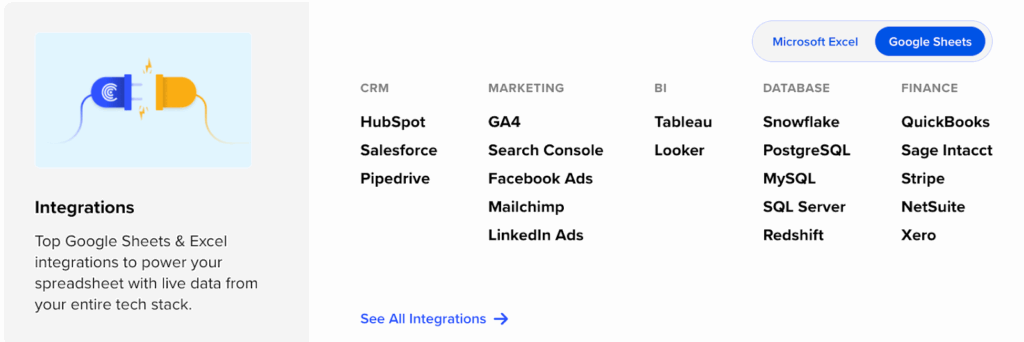
Here’s where Coefficient’s real power shows up. You combine NetSuite financial data with:
- Marketing spend from ad platforms
- Conversion data from Google Analytics
- Payment processing metrics from Stripe
This creates unified CAC calculations, marketing ROI analysis, and customer lifetime value tracking that no single system provides.
Spreadsheet-native experience with no-code setup.
You don’t write API calls or manage authentication tokens. Coefficient handles:
- OAuth 2.0
- Token refresh
- API rate limiting
- Retry logic automatically
Your team focuses on analysis, not integration maintenance.
Financial reporting automation that eliminates monthly manual work.
Budget versus actuals, variance analysis, and trend reporting update automatically as NetSuite data changes. Templates for:
- Financial forecasting
- Transaction-level variance analysis
- Time-series metrics tracking
Come pre-built. You customize them for your business without starting from scratch.
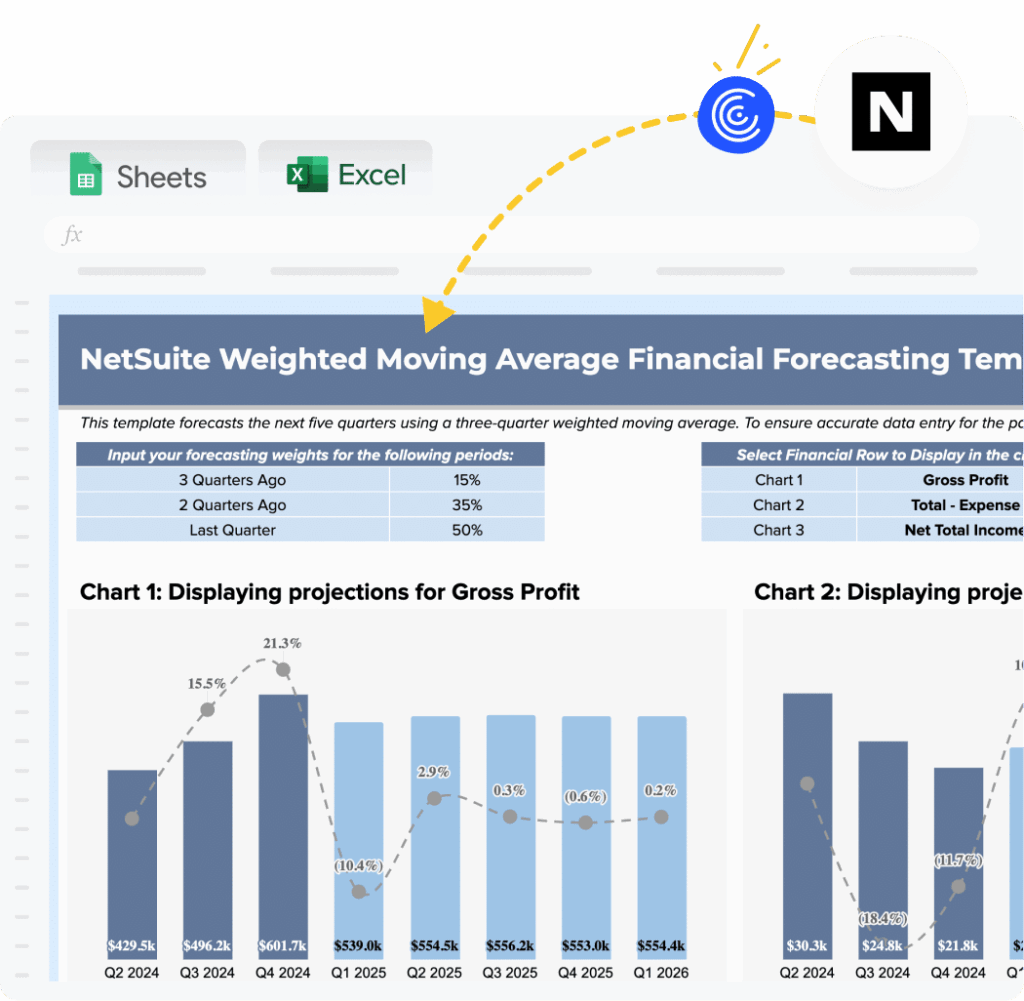
For example, here’s a pre-built NetSuite Finance Forecasting Dashboard template using live NetSuite data in Spreadsheets.
Real-time data refresh without manual exports. Set schedules for:
- Hourly updates
- Daily updates
- Weekly updates
- Single-click refresh when you need current numbers
Your stakeholders always see live data, eliminating version control issues with static exports.
Limitations
No BigCommerce connector means no direct storefront data. Coefficient can’t pull:
- Product catalog
- Customer data
- Order information directly from BigCommerce
You’re limited to what flows through to NetSuite. For most e-commerce financial analysis, that’s sufficient since NetSuite becomes the system of record once orders are integrated.
Not suitable for operational integration. Coefficient doesn’t:
- Sync orders
- Update inventory
- Process fulfillments
It’s an analytics and reporting tool, not a transactional integration platform. You still need Celigo or another solution for operational sync between BigCommerce and NetSuite.
Ratings and Reviews
Coefficient ranks #2 overall in G2’s Big Data Integration category and #3 in Data Extraction Tools (Fall 2024). The platform earned:
- Best Relationship recognition
- High Performer status across mid-market, enterprise, and Asia Pacific regions
Users highlight Coefficient’s ability to “weave together diverse data sources into Google Sheets with real-time synchronization” and note it solves “the challenge of connecting complex data sources directly into Google Sheets without manual exports.” Evan Cover, Director of BI Engineering at Klaviyo, calls connected spreadsheets “the next step in spreadsheet evolution.”
The main concern in reviews centers on pricing for smaller teams. While enterprise and mid-market customers find value in the platform, individual users and very small organizations report budget constraints.
Best For
Coefficient works best for e-commerce finance teams who:
- Already have operational integration between BigCommerce and NetSuite
- Need sophisticated financial analysis capabilities
- Want to combine NetSuite financial data with multiple other sources (marketing platforms, payment processors, analytics tools)
- Build unified e-commerce dashboards
It’s also worth considering if you’re evaluating e-commerce platforms and NetSuite. Coefficient’s Shopify connector provides direct storefront connectivity, while the NetSuite connector handles backend financial analysis. That combination delivers end-to-end analytics from order through financial reporting.
Method 3: Enterprise Integration Platforms (iPaaS) and Custom Development
Beyond pre-built apps like Celigo, you can build BigCommerce-NetSuite integration using iPaaS platforms or custom development. These approaches offer maximum flexibility for unique business requirements, though they require more technical resources.
iPaaS Platforms
Workato provides BigCommerce and NetSuite connectors with visual workflow builders.
You design integration flows using triggers and actions—for example, “when new order created in BigCommerce, create sales order in NetSuite and invoice in billing system.”
Workato handles:
- Fulfillment coordination
- Inventory checks before payment acceptance
- Automatic order updates across platforms
The visual interface reduces development complexity, though you’ll need some technical knowledge to map data fields and handle business logic.
Boomi offers enterprise-grade integration with pre-built connectors for both BigCommerce and NetSuite.

Their integration accelerators provide:
- Starting templates that you customize for your specific data mappings and workflows
- High-volume transaction scaling
- Complex multi-system integration support
The platform targets larger enterprises with dedicated integration teams.
Both platforms charge subscription fees based on:
- Connections
- Data volume
- Usage patterns
Pricing scales with your business, making them cost-effective for mid-market and enterprise companies with complex integration needs. Implementation typically requires consulting services or internal integration specialists.
Custom Development
Custom-built integration gives you complete control over integration logic and data transformation. Both BigCommerce and NetSuite provide robust APIs:
- BigCommerce: REST and GraphQL APIs
- NetSuite: SuiteTalk REST, SOAP, and RESTlets
You build middleware that:
- Monitors BigCommerce webhooks for events like new orders or inventory changes
- Transforms that data according to your business rules
- Creates or updates NetSuite records through API calls
In reverse, your code watches NetSuite for fulfillments and pricing changes, pushing those updates to BigCommerce.
Custom development makes sense when you have:
- Unique business processes
- Complex data transformations
- Integration requirements that pre-built solutions don’t handle
The approach requires ongoing investment in developer resources for:
- Maintenance
- Updates
- Monitoring
You’re responsible for:
- Error handling
- Retry logic
- API rate limiting
- Security
- Keeping up with API changes from both platforms
Budget for both initial development (typically $15,000-50,000+ depending on complexity) and ongoing maintenance costs. You’ll need developers with both BigCommerce and NetSuite expertise, which can be challenging to find and retain.
Best For
iPaaS platforms work well for businesses with integration teams who need to connect BigCommerce and NetSuite along with several other systems. They’re cost-effective when you’re building multiple integrations, not just one.
Custom development makes sense for enterprises with:
- Complex, proprietary processes that pre-built solutions can’t accommodate
- Commitment to ongoing maintenance
- Access to specialized development talent
Most businesses find pre-built solutions like Celigo more practical and cost-effective.
Connect Your E-Commerce and Finance Systems Today
Your BigCommerce-NetSuite integration choice depends on what you’re trying to solve:
- Need comprehensive operational integration? Celigo’s pre-built app delivers everything from order sync to inventory management
- Want financial analysis and reporting in spreadsheets? Coefficient brings NetSuite data into Google Sheets and Excel (and offers direct Shopify connectivity if you’re evaluating platforms)
- Require custom workflows across multiple systems? iPaaS platforms or custom development provide maximum flexibility
Ready to eliminate manual e-commerce data entry? Start with Coefficient’s free trial to experience automated NetSuite financial reporting.