

Table of Contents

- 1. NetSuite Data Integration Tools for Automation & Reporting
- 2. Top 5 NetSuite Reporting Tools in 2026: Boost Your Analytics Game
- 3. Top 10 NetSuite Apps for Integration & Reporting for 2026
- 4. Best 6 NetSuite Connectors in 2025
-
5. Best HubSpot NetSuite Integration Software
- Purpose of Your HubSpot NetSuite Integration
- Ways to Integrate HubSpot and NetSuite
- Method 1: HubSpot's Native NetSuite Integration
- Method 2: Coefficient - No-Code Spreadsheet Connector
- Method 3: Enterprise Integration Platforms (iPaaS) & Custom Development
- Connect Your Revenue Operations Data Today
- 6. Best NetSuite Salesforce Integration Software
- 7. Best NetSuite Snowflake Integration Software
- 8. Best NetSuite QuickBooks Integration Software
- 9. Best Zendesk NetSuite Integration Software
- 10. Best Zoho CRM NetSuite Integration Software
- 11. Best NetSuite Pipedrive Integration Software
- 12. Best SharePoint NetSuite Integration Software
- 13. Best Google Drive NetSuite integration software
- 14. Best Shopify NetSuite Integration Software
- 15. Best Stripe NetSuite Integration Software
- 16. Best Chargebee NetSuite Integration Software
- 17. Best WooCommerce NetSuite Connector
- 18. Best BigCommerce NetSuite Integration Software
- 19. Best BambooHR NetSuite Integration Software
- 20. Best Klaviyo NetSuite integration software
- 21. Best Mailchimp NetSuite integration software
- 22. Best Square NetSuite Integration Software
- 23. Best NetSuite Gmail Integration Software
- 24. How to Connect NetSuite to Snowflake: A Step-by-Step Guide


Your marketing team runs campaigns in HubSpot, your sales team tracks deals through the pipeline, and your finance team closes the books in NetSuite. Each team sees only their piece of the puzzle. The result?
- Marketing can’t prove ROI with actual revenue numbers
- Sales lacks visibility into billing status
- Finance forecasts blindly without pipeline context
That disconnect costs you.
Purpose of Your HubSpot NetSuite Integration
Connecting HubSpot with NetSuite enables:
- Lead-to-cash workflow automation tracking the complete customer journey from first marketing touch through revenue recognition
- Marketing attribution with real ROI connecting campaign spend to actual revenue instead of just leads and opportunities
- Complete customer lifecycle visibility merging engagement metrics with billing history and payment patterns
- Revenue operations dashboards combining pipeline health with financial actuals for unified forecasting
Ways to Integrate HubSpot and NetSuite
You have three primary paths to connect these platforms:
- HubSpot’s native integration offers built-in sync with setup requirements
- Coefficient’s spreadsheet-native connector brings revenue operations data into your existing analysis workflow
- Enterprise iPaaS platforms and custom development handle complex automation needs
Method 1: HubSpot’s Native NetSuite Integration
HubSpot offers a built-in NetSuite integration through HubSpot Data Sync. Available directly from the HubSpot Marketplace with over 2,000 installations, this native connector provides two-way data synchronization between your marketing and finance systems.

How It Works
The integration requires setup work in both systems. Your NetSuite administrator installs the “HubSpot Sync Bundle” via SuiteBundler, then:
- Enables REST Web Services, OAuth 2.0, and server-side RESTlets
- Assigns the HubSpot Sync Role to appropriate users
- Generates access tokens for connection
After assigning the HubSpot Sync Role to appropriate users and generating access tokens, you connect the systems through HubSpot’s marketplace with token-based authentication.
Once connected, you configure one-way or two-way sync for specific objects:
- Contacts sync between HubSpot and NetSuite contacts/individuals
- Companies map to NetSuite companies
- Deals flow to opportunities
The integration also handles products, invoices, sales orders, support tickets, and activity records like calls and tasks.
Custom field mappings require Data Hub Starter or Professional plans. You can create NetSuite sales orders directly from HubSpot deals using workflows or manual actions, keeping the fulfillment process moving without switching systems. The integration even embeds HubSpot functionality within NetSuite for teams that prefer working in their ERP.
Key Features and Considerations
The native integration delivers fundamental sync capabilities without additional software costs beyond your HubSpot and NetSuite subscriptions. Benefits include:
- Marketing teams can use NetSuite customer data for email personalization and segmentation
- Sales gets visibility into billing status
- Finance receives closed-won opportunity data for revenue tracking
However, user reviews paint a mixed picture. With a 2.5 out of 5 star rating based on 26 reviews, customers report inconsistent sync behavior:
- Duplicate email addresses cause field pulls from incorrect contacts
- Field updates that should sync often don’t
- Performance issues surface when syncing large datasets – one user reported thousands of records taking over a week to sync completely
Multiple reviewers mentioned the integration worked for simple use cases with clean data but ultimately required custom development for production reliability. The setup is straightforward, but ongoing sync reliability concerns led some companies to seek alternatives.
Best For
Companies with straightforward sync needs, clean data without duplicates, and basic integration requirements may find the native option sufficient. The $0 additional cost makes it worth testing. Just monitor sync reliability closely and have a backup plan if consistency issues emerge in your environment.
Method 2: Coefficient – No-Code Spreadsheet Connector
Coefficient takes a completely different approach to HubSpot-NetSuite integration. Instead of syncing data between systems or creating another dashboard to check, it brings live data from both platforms directly into the spreadsheets where revenue operations teams actually do their work.
How It Works
Coefficient lives inside Google Sheets and Excel. No separate platform. No new interface.
Watch the Integration in Action:
See how quickly you can connect HubSpot to your spreadsheet and start analyzing live data. This tutorial walks through the complete setup from authentication to your first import:
Quick Integration Walkthrough:
- Install Coefficient from Google Workspace Marketplace or Microsoft AppSource (60 seconds)
- Connect HubSpot with one-click OAuth – no IT involvement needed
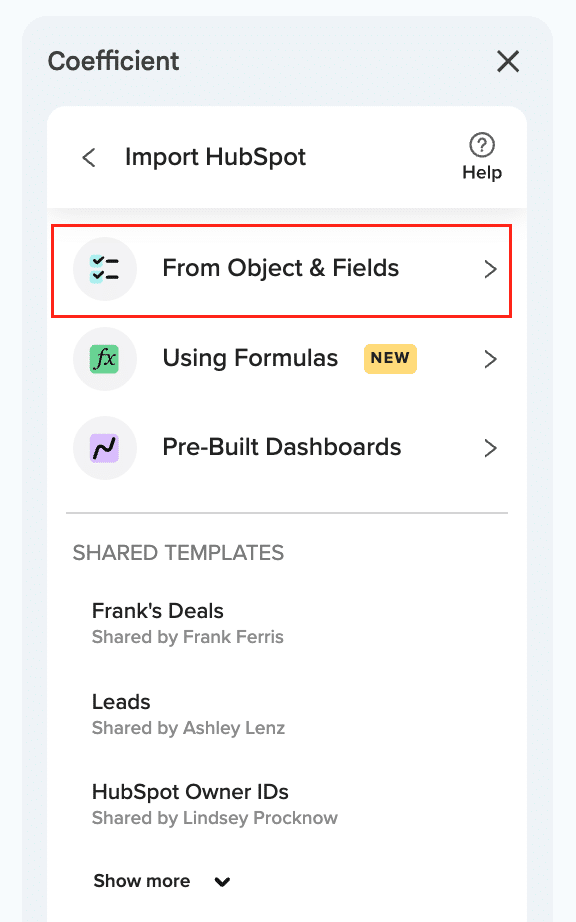
- Select your data: deals by stage, contact lists, campaign performance, custom objects
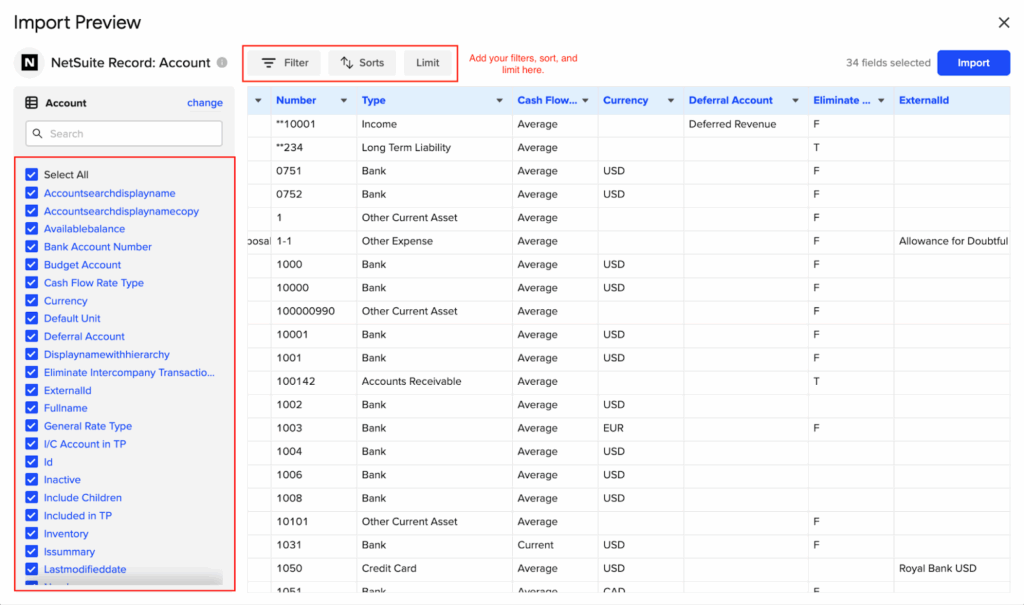
- Connect NetSuite with OAuth 2.0 following the guided setup
- Import financial reports: income statements, general ledger, accounts receivable, custom saved searches
- Build dashboards that combine marketing, sales, and finance data in one view
- Schedule hourly or daily automatic refreshes to keep data current
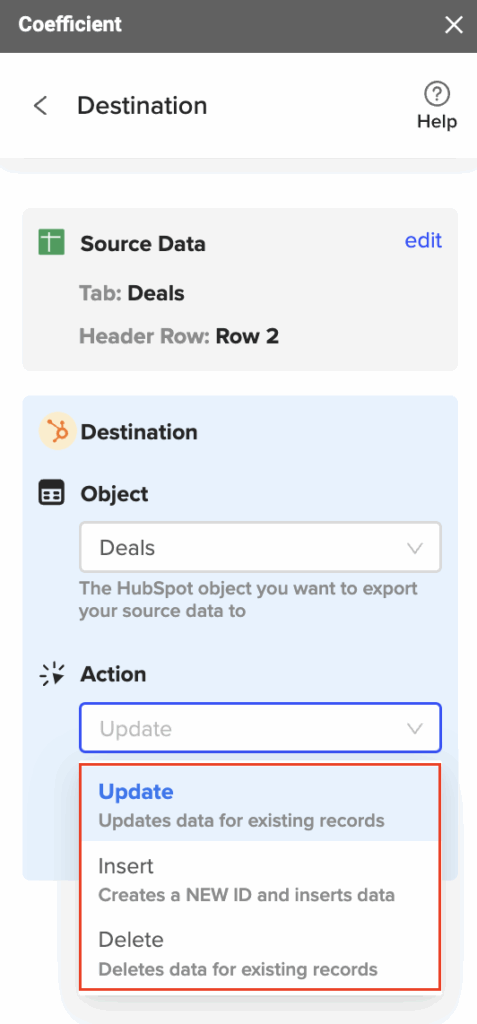
- Export data back to HubSpot when you need to update records in bulk
Limitations
Coefficient excels at data import, analysis, and dashboard creation. It’s not designed for complex, real-time workflow automation.
If you need automatic lead assignment rules that fire when HubSpot contacts hit certain scores and create NetSuite customer records with complex transformation logic, an iPaaS platform handles those needs better. Coefficient focuses on getting data into your hands for analysis, not on orchestrating multi-step automated workflows.
Ratings and Reviews
Over 500,000 users across 50,000+ companies use Coefficient, including Spotify, Unity, Uber, Miro, and Klaviyo. The platform earned G2 badges for Leader, Easiest To Use, Most Implementable, and Small Business Leader in Winter 2025.
Customer feedback emphasizes the time savings and self-service capabilities:
- “This really is an amazing tool for automating our reporting and alerts. Coefficient has helped me save so many hours!” – Revenue operations analyst
- “Coefficient is exactly what we needed, after trying several different options on the market.” – InfoSum user
Best For
Revenue operations teams, marketing operations professionals, and finance analysts who need to combine HubSpot and NetSuite data for reporting and forecasting without deploying an enterprise integration platform.
Ideal for:
- Companies wanting fast time to value without IT dependency
- Teams comfortable working in spreadsheets for analysis
- Organizations needing to connect multiple data sources beyond just two systems
Method 3: Enterprise Integration Platforms (iPaaS) & Custom Development
When you need sophisticated workflow automation between HubSpot and NetSuite with complex business rules, enterprise platforms deliver powerful solutions.
iPaaS Platforms
Integration Platform as a Service (iPaaS) tools provide pre-built connectors with extensive customization options. These platforms excel at bi-directional, real-time sync with workflow orchestration.
Celigo offers a pre-built HubSpot-NetSuite integration template specifically designed for marketing operations.
Their integrator.io platform includes ready-to-deploy flows:
- NetSuite opportunities to HubSpot deals
- Customers to companies
- Contacts to contacts
- Products to line items
The flows work bi-directionally with real-time exports available for time-sensitive data.
Celigo earned recognition as a Visionary in the 2025 Gartner Magic Quadrant for iPaaS and ranks #1 for iPaaS on G2 (Fall 2025). Customer testimonials highlight the user-friendly interface. One manager at GTSE shared: “The more we used Celigo, the more we found it was actually very user-friendly, and it very quickly became our most favored piece of software.”
Pricing starts at $600 monthly for the Standard plan that supports rapid app integration. Higher tiers provide:
- Additional flows
- Advanced features
- More complex automation capabilities
Implementation typically takes several weeks as you configure field mappings and customize flows for your business processes.
Workato takes a visual, recipe-based approach to integration.
Their platform handles complex workflow needs with:
- Branching logic
- Data transformations
- Detailed automation management
The low-code interface lets business users build and maintain integrations after initial setup. Market leaders including Monday.com, Box, HP, and Cisco rely on Workato for integration needs.
Workato excels at real-time integrations with advanced data mapping capabilities. The platform ranks highly for complex automation scenarios that go beyond simple data sync. Pricing isn’t publicly disclosed – it follows custom enterprise models based on usage and complexity. Expect to schedule a demo for pricing discussions.
Other iPaaS options include Zapier for simpler automations, Make for visual workflow building, and Tray.io for enterprise scenarios. These platforms generally require $600-$7,800+ annually depending on complexity, plus implementation time and ongoing maintenance.
iPaaS platforms require meaningful investment beyond licensing. Plan for 6-12 weeks of implementation time. You’ll need moderate IT resources for:
- Setup and configuration
- Ongoing management as both HubSpot and NetSuite release updates
- Maintenance of integration flows
But for companies needing complex automation – like automatically creating NetSuite customer records when HubSpot deals hit certain stages with specific field transformations and validation rules – iPaaS delivers the depth required.
Custom API Development
Building custom integration using HubSpot and NetSuite APIs offers maximum control. This path makes sense for:
- Highly specialized business processes
- Unique revenue recognition rules
- Complex multi-touch attribution models that pre-built tools can’t handle
Both platforms provide robust APIs. HubSpot offers REST APIs for CRM objects, marketing data, and analytics. NetSuite provides SuiteTalk SOAP Web Services, RESTlet endpoints, and SuiteQL for financial data access.
The technical challenges include:
- OAuth implementation for both systems
- Data model mapping between marketing objects and financial records
- Rate limit management
- Building logic that handles revenue recognition timing versus deal close dates
Development rates run $150+ hourly. Cost breakdown:
- Simple one-way integration pushing HubSpot deals to NetSuite opportunities: $25,000-$50,000 (2-3 months)
- Standard bidirectional sync with multiple objects, custom field mapping, and marketing attribution logic: $50,000-$100,000 (3-4 months)
- Complex implementations with sophisticated revenue recognition rules and multi-touch attribution models: $250,000+ (6+ months)
Then add 15-20% of initial costs annually for:
- Maintenance
- API updates
- Enhancements
Custom development delivers exactly what you need with complete flexibility. The trade-offs are substantial:
- High upfront costs
- Lengthy timelines
- Ongoing technical debt
- Dependence on developers who understand your specific implementation
Projects frequently exceed budgets and timelines when requirements evolve during development.
Best For
iPaaS platforms work best for mid-market to enterprise companies needing automated, bi-directional sync with workflow orchestration and business logic during data transfer.
Custom development suits organizations with:
- Highly specialized revenue recognition processes
- Unique compliance requirements that pre-built solutions can’t accommodate
- In-house technical teams capable of long-term maintenance
Connect Your Revenue Operations Data Today
Integrating HubSpot with NetSuite eliminates the disconnects between your marketing, sales, and finance teams. For most revenue operations teams, Coefficient provides the fastest path to complete visibility.
Connect both systems in minutes, build comprehensive dashboards in the spreadsheets where you already work, and extend your analysis to 100+ other business systems without enterprise platform costs or IT dependencies.
Ready to see your complete customer lifecycle from first touch to revenue recognition? Get started with Coefficient free and bring your HubSpot and NetSuite data together today.