
Table of Contents

- 1. 10 Multi-Entity Accounting Automation Tips
- 2. Fast close accounting: How to close your books in 3 days or less
- 3. Intercompany reconciliation: 7 steps for accurate financial reporting
-
4. Strategic Scenario Planning: A Practical Guide for Finance Teams
- What Is Strategic Scenario Planning?
- Why Scenario Planning Matters
- Types of Scenario Planning
- The Scenario Planning Process (5 Steps)
- Scenario Planning Tools and Frameworks
- 4 Common Scenario Planning Mistakes
- How to Use Scenarios in Strategic Planning
- Scenario Planning vs Forecasting
- Start Planning for Multiple Futures
- 5. Incremental Budgeting: A Complete Guide for Finance Teams
- 6. FP&A AI: Complete Guide to Artificial Intelligence in Financial Planning
- 7. Strategic budgeting: A complete guide to aligning finances with long-term goals
- 8. How to Create an Operating Budget (Step-by-Step Guide)
- 9. How to Do Vertical Analysis of a Balance Sheet
- 10. How to Do Sensitivity Analysis in Excel: A Complete Guide
- 11. CFO Reports to the Board of Directors: A Complete Guide
- 12. Cost volume profit analysis: A complete guide for finance teams
- 13. Workflow Automation for Fractional CFOs & Finance Service Firms
- 14. 11 Account Reconciliation Best Practices
- 15. How to build budget vs. actual reporting in spreadsheets
- 16. Automate Your Month End Close Process: A CFO’s 5-Step Playbook
- 17. 8 Must Automate Processes for Fractional CFO & Accounting firms
- 18. 6 Ways for CFO Firms to Provide Better Client Reporting
- 19. 6 Great Excel Report Templates for Fractional CFOs
- 20. How to Perform Price‑Volume‑Mix (PVM) Analysis in Excel — Free Template
- 21. How to Build a 13‑Week Cash‑Flow Forecast in Excel (Free Template)
- 22. How to Calculate Trailing‑12‑Month (TTM) Metrics in Spreadsheets + Free Template
- 23. How to do Scenario Analysis in Spreadsheets
- 24. Best Practices for Consolidating Financial Statements



Finance leaders face a hard truth. The old rules don’t work anymore. You can’t predict the future from past data when markets shift overnight, regulations change mid-quarter, and competitors appear from nowhere.
Strategic scenario planning helps you prepare for multiple futures instead of betting everything on a single forecast. This guide shows you how to build scenarios, test your strategy against different outcomes, and make smarter decisions when the future is unclear.
What Is Strategic Scenario Planning?
Strategic scenario planning is a method that helps you explore multiple possible futures instead of trying to predict one outcome. Think of it as asking “what if” questions about your business. What if demand drops 30%? What if a new competitor enters your market? What if regulations change next quarter?
This differs sharply from forecasting. Forecasts use past data to predict a single most-likely outcome. They work well in stable markets with clear trends. Scenario planning takes a different view—it assumes the future is uncertain and explores a range of possible outcomes based on key unknowns.
The goal is not prediction. You can’t know which scenario will happen. Instead, you build resilience by understanding the broad spectrum of possibilities. When you’ve already thought through four different futures, you adapt faster when change hits.
Shell Oil pioneered this approach in the 1970s. Their planning team developed scenarios around potential oil price shocks from political tensions. When prices spiked in 1973, Shell was ready—they had already mapped responses to that future.

Why Scenario Planning Matters
It Builds Strategic Resilience
Most companies plan for one future, then scramble when reality looks different. The scenario planning process forces you to build flexibility into your strategy. You prepare for multiple paths instead of one.
This creates what some call “muscle memory” for change. Your team has already discussed different futures and thought through responses. When disruption hits, no one panics because you’ve rehearsed the playbook. Organizations that used scenario planning before COVID adapted faster—they had already considered supply chain failures, demand shocks, and remote work transitions.
It Challenges Assumptions
Your leadership team holds beliefs about the future. Some are explicit. Most are invisible. Scenario scenario planning surfaces these assumptions and tests them. It forces you to ask: What if our core beliefs are wrong?
This process reveals blind spots. When you build diverse scenarios, you explore futures that feel unlikely or uncomfortable. That discomfort is the point—it broadens perspective and prevents tunnel vision.
It Improves Risk Management
Good scenario planning identifies risks before they materialize. You spot early warning indicators. You build proactive responses instead of reactive firefighting.
When you test strategic options against multiple scenarios, you make better resource allocation decisions. You see which investments pay off across different futures and which only work if one specific scenario plays out.
It Facilitates Better Alignment
Scenarios create a common framework for discussing uncertainty across your organization. They align leadership around key uncertainties and priorities.
When everyone understands the four scenarios, conversations get more productive. You can say “this decision makes sense in the Regulated Growth scenario but not in Market-Driven Expansion.” Complex strategic concepts become accessible to all stakeholders.
Types of Scenario Planning
Different situations require different approaches to the scenario planning process.
Operational Scenario Planning
Operational scenarios focus on short to medium-term decisions, typically one to three years ahead. This type tests operational strategies against different market conditions—supply chain disruptions, demand fluctuations, or resource constraints. It’s more quantitative and data-driven than other types.
Retailers use this for inventory planning. They model consumer demand in different scenarios: strong holiday sales, weak consumer spending, or supply delays. You often see three scenarios: best case, base case, and worst case.
Normative Scenario Planning
Normative planning works backward from a desired future. You define where you want to be in 5 to 20 years, then identify the steps needed to get there. This approach is values-driven and goal-oriented.
Cities use normative planning for sustainability goals. They might envision a public transportation system that cuts carbon emissions by 50% in 2040, then map the policy changes, infrastructure investments, and behavior shifts required to reach that future.
Exploratory Scenario Planning
Exploratory planning remains open to many possible futures without favoring one. You explore a wide range of outcomes, identifying critical uncertainties and their potential impacts. Time horizons range from 5 to 30 years.
Tech companies use this when evaluating long-term R&D investments. They explore how different technology adoption curves, regulatory environments, and competitive dynamics might play out—helping them invest in capabilities that remain valuable across multiple futures.
Quantitative Scenario Planning
Quantitative scenarios emphasize numerical modeling and data analysis. You assign probabilities to different outcomes, build financial models for each scenario, and calculate expected values across the range of possibilities.
This approach works well when you have reliable historical data and measurable variables. Finance teams use it for capital allocation decisions, valuation modeling, and risk quantification. The scenarios become inputs for Monte Carlo simulations or sensitivity analyses.
The Scenario Planning Process (5 Steps)
Step 1: Define Scope and Time Horizon
Start with your strategic question. What decision are you trying to inform? Specificity matters here. “How should we grow?” is too vague. “Should we invest in building direct-to-consumer channels over the next five years?” gives you focus.
Choose your timeframe based on the decision at stake:
- Operational questions: 1-3 years
- Strategic questions: 5-10 years
- Transformational questions: 10-30 years (for slow-moving industries like energy or pharmaceuticals)
Identify your stakeholders. Who needs to be part of this process? Include people with diverse perspectives—operations, finance, strategy, and business unit leaders. Consider customers, partners, or industry experts who can challenge assumptions.
Step 2: Identify Driving Forces
List all factors that could significantly impact your strategic question. Look broadly across categories.
- Economic forces include interest rates, GDP growth, consumer spending patterns, and global trade dynamics.
- Technological forces cover emerging technologies, adoption rates, and infrastructure development.
- Social forces examine demographic shifts, cultural changes, and workforce dynamics.
- Political and regulatory forces track policy changes, geopolitical tensions, and government interventions.
- Environmental forces consider climate change, resource scarcity, and sustainability pressures.
Research and validate these forces. Use historical data, expert opinions, trend analysis, and external research. Talk to people close to different aspects of the business—a supply chain leader sees different forces than a sales leader. This diversity reveals blind spots.
Step 3: Select Critical Uncertainties
Not all driving forces deserve equal attention. Some are relatively certain—you know they’ll happen, you just don’t know the magnitude. Other forces are both uncertain and high-impact. These become your critical uncertainties.
Map driving forces on two dimensions: impact on your strategic question and level of uncertainty.
High-impact, low-uncertainty forces are predetermined elements. They form the backdrop of all your scenarios—think aging populations, climate change, or digital transformation. High-impact, high-uncertainty forces are your critical uncertainties. These shape distinctly different scenarios.
Select two critical uncertainties for your scenario matrix. Choose uncertainties that are independent of each other. If one happens, it shouldn’t determine whether the other happens.
Step 4: Develop Scenario Narratives
Name each scenario in a memorable way. Avoid generic labels like “optimistic” and “pessimistic.” Use evocative names that capture the essence—”Regulated Growth,” “Innovation Boom,” “Fragmented Markets,” and “Consolidation Wave” tell you something about each future.
Build rich narratives for each scenario. Describe the world in detail:
- How did we get here?
- What happened to drive this outcome?
- What does daily business look like in this world?
- Who are the winners and losers?
Make scenarios plausible but distinct. Each scenario should feel possible, even if unlikely. Someone should be able to argue credibly that this future could unfold. At the same time, scenarios should be clearly different from each other. If two scenarios feel similar, you haven’t pushed the boundaries far enough.
Quantify where possible. Add specifics like market size, growth rates, cost structures, or regulatory requirements. Numbers make scenarios concrete and help you later when testing strategic options.
Step 5: Analyze Implications and Create Strategies
Test your current strategy against each scenario. How does it perform? Are there scenarios where it fails completely? Are there scenarios where it thrives? This reveals strategic vulnerabilities and over-dependencies on specific futures.
Identify robust strategies. What actions make sense across all scenarios? These are “no-regret” moves. They might not be optimal for any single scenario, but they work reasonably well across all futures. These form the core of your strategic response.
Develop contingent strategies. For each scenario, what specific actions would you take if that future materializes? Create decision trees: if X scenario emerges, we do Y. This builds organizational readiness.
Establish monitoring systems. What early warning indicators signal which scenario is unfolding? Create a dashboard of leading indicators—market signals like customer behavior, competitive moves, or pricing trends; external signals like regulatory announcements, technology adoption rates, or macroeconomic data. When thresholds are crossed, activate the appropriate strategic responses.
Scenario Planning Tools and Frameworks
2×2 Matrix Method
This is the most common scenario planning framework. You select two critical uncertainties, each with two possible outcomes. This creates four distinct scenarios.
For example, a retail company might choose “Consumer Spending Power” (high or low) and “Shopping Channel Preference” (physical or digital). This generates four scenarios: Prosperous In-Person, Prosperous Digital, Constrained In-Person, and Constrained Digital.
The 2×2 matrix works well for quick strategic conversations. It’s simple enough that executives grasp it immediately and forces you to think beyond a single most-likely outcome. The limitation is that it can oversimplify complex situations.
Three Horizons Framework
This framework thinks about time differently. Horizon 1 represents your current business and short-term optimization. Horizon 2 covers emerging opportunities and adjacencies. Horizon 3 explores transformational possibilities and future disruptions.
You build scenarios for each horizon. This helps you balance today’s performance with tomorrow’s positioning—preventing the trap of optimizing current business while missing fundamental shifts. Strategy teams use this to allocate resources across innovation portfolios.
Cross-Impact Analysis
Cross-impact analysis examines how different driving forces interact with and influence each other. Instead of treating uncertainties as independent, you map the relationships between them.
Start by listing your key driving forces. Then assess: if Force A occurs, how does it change the probability or impact of Force B? This creates a matrix of interdependencies that reveals second-order effects you might otherwise miss.
This approach works well when your driving forces are interconnected—for example, when regulatory changes might accelerate or slow technology adoption, which in turn affects competitive dynamics.
4 Common Scenario Planning Mistakes
1/ Creating Scenarios That Are Too Similar
Scenarios cluster around a single expected future with insufficient differentiation. All scenarios share the same underlying assumptions—defeating the purpose of scenario planning.
Avoid this by ensuring scenarios are divergent and meaningfully different. Test: Could you confuse one scenario for another? If yes, they’re too similar. Use “extreme but plausible” thinking to push boundaries. Warning sign: scenarios are just “optimistic,” “realistic,” and “pessimistic” versions of the same story.
2/ Failing to Connect Scenarios to Decisions
Scenarios become interesting intellectual exercises but don’t inform strategy. There’s no clear link between insights and actions. The organization develops scenarios but never uses them.
Begin with a clear strategic question. Develop specific strategies for each scenario. Identify robust actions that work across scenarios. Create trigger points that activate different responses. Integrate scenarios into annual planning and budget cycles.
3/ Letting Process Override Purpose
Teams become overly focused on methodology and frameworks, spending more time on process than strategic insights. Analysis paralysis prevents timely decisions.
Remember the purpose: better decisions, not perfect scenarios. Keep it simple—three to four scenarios are usually sufficient. Know when “good enough” is sufficient. Focus on insights and strategic implications, not process elegance.
4/ Not Updating Scenarios Over Time
Scenarios become outdated as the world changes. There’s no system to track which scenario is unfolding. The organization misses early warning signals and scenarios gather dust after initial development.
Establish a regular scenario review cycle (quarterly or semi-annually). Create a dashboard of early warning indicators. Assign owners for monitoring each scenario. Update scenarios as major events occur and retire outdated ones as needed.
How to Use Scenarios in Strategic Planning
Strategic scenario planning becomes exponentially more powerful when you integrate it into your ongoing strategy process.
- Stress-test your current strategy. Evaluate how well your existing strategy performs in each scenario. Identify vulnerabilities and blind spots. Determine which scenarios pose the greatest threats and which create new opportunities.
- Develop robust strategies. Identify “no-regret” moves that make sense across all scenarios. Focus on building capabilities that provide value in multiple futures. Create flexible strategies that can adapt as the future unfolds.
- Create contingency plans. Develop specific response strategies for each scenario. Establish trigger points and early warning indicators. Define decision rules for when to activate different strategies.
- Build monitoring systems. This is where most organizations fail. They develop scenarios, then never track which one is materializing. Use automated data feeds to track early indicators and monitor which scenario is becoming reality.
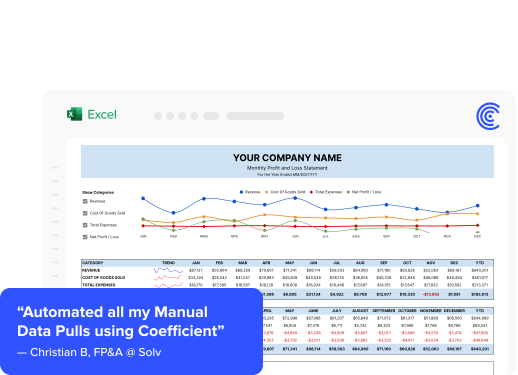
Coefficient enables finance teams to operationalize scenario planning with live data. The What-if scenario analysis template connects to QuickBooks, NetSuite, Salesforce, or other business systems to automatically pull revenue, costs, and operational metrics.

Rather than building static scenario models that quickly become outdated, you can:
- Track actual performance against scenario assumptions in real time
- Identify divergences that signal which scenario is materializing
- Compare scenarios side-by-side with actual results
- Update projections automatically as new data flows in
This transforms the scenario planning process from a periodic exercise into a continuous strategic monitoring system.
Scenario Planning vs Forecasting
Many finance teams confuse scenario planning with forecasting. They’re different tools with different purposes.
- Forecasting predicts the most likely future. It produces a single projection using historical data, works best for short to medium-term horizons (1-3 years), and assumes predictable patterns. Use it for budgeting and operational planning where precision matters.
- Scenario planning explores a range of possible futures. It produces multiple distinct scenarios, considers structural uncertainties, and extends medium to long-term (3-30 years). Use it for strategic decisions where you face significant uncertainty.
The best approach uses both tools together. Forecasts inform the baseline or most-likely scenario. Scenarios provide context and boundaries for forecasts. Forecasts tell you what is likely to happen. Scenarios help you prepare for what could happen.
Start Planning for Multiple Futures
Strategic scenario planning is not about predicting what will happen. It’s about being ready for whatever does happen. When you explore multiple futures, test your strategy against different outcomes, and build monitoring systems to track which scenario is emerging, you gain a decisive advantage.
The five-step process works: define your scope, identify driving forces, select critical uncertainties, develop narratives, and analyze implications. Avoid the common mistakes of making scenarios too similar, failing to connect them to decisions, or letting them gather dust.
Most important, connect your scenarios to live data. This transforms static planning exercises into dynamic monitoring systems that keep your strategy aligned with reality as it unfolds.
Get started with Coefficient to build scenario models that stay current automatically.