


Table of Contents

- 1. 8 Ways to Improve Query Optimization in Snowflake (With Examples)
- 2. How to Prevent Data Silos Using Snowflake Semantic Views
- 3. Snowflake Semantic Views vs Semantic Model: Key Differences Explained
- 4. What Is Snowsight? A Complete Guide to Snowflake’s Web Interface
- 5. How Snowflake Customers Can Unlock More Value through Last-Mile Activation
- 6. From Snowflake Intelligence to the Spreadsheet: A Builder’s Guide to Last-Mile Data Activation
- 7. How to Ingest Data into Snowflake: Methods, Tools, and Best Practices
- 8. How to Query JSON Data in Snowflake
- 9. How to Copy Data from One Table to Another Table in Snowflake
- 10. How to Load Unstructured Data in Snowflake: Files, Documents, and AI Pipelines
- 11. How to Flatten JSON Data in Snowflake
- 12. How to Load Data into Snowflake
- 13. How to Parse JSON Data in Snowflake?


Modern data platforms like Snowflake have fundamentally changed how organizations store, govern and activate data. But one of the biggest remaining gaps in the ecosystem isn’t storage or compute – its last-mile usability. Getting governed, real-time Snowflake data into the hands of business users in the tools where decisions actually happen – spreadsheets.
The organizations getting the most value out of Snowflake aren’t just centralizing data but are extending it into business workflows and turning intelligence into execution.At Coefficient, we solve this gap for 700+ Snowflake customers.
Bridging Snowflake Intelligence with Business Execution
Snowflake Intelligence powered by semantic layers, governed AI and Cortex is changing how users interact with data. Instead of querying tables, teams can increasingly ask questions in natural language and receive trusted answers directly from Snowflake.
At the same time, Snowflake is becoming the system of record for enterprise analytics: finance metrics, revenue reporting, operational KPIs and AI-ready datasets are increasingly centralized inside the platform.
But a gap still remains. Intelligence and data may live in Snowflake but day-to-day execution still happens elsewhere. Most often in spreadsheets like Excel and Google Sheets, where finance, operations and revenue teams actually do their work.
This creates a disconnect where Snowflake generates insights, BI and AI surface them but business decisions are still made in spreadsheets that are disconnected from live data.
The Last-Mile Problem: Where Snowflake Value Gets Lost
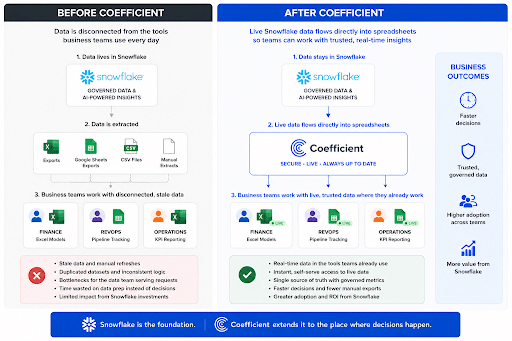
Despite Snowflake’s growing intelligence and governance capabilities, most organizations still rely on exporting data out of Snowflake to operationalize it. This creates duplicated datasets, inconsistent metrics & logic, and decisions made with outdated data.
The core issue is simple. The most trusted data platform in the stack is still not where business users actually work.
As Snowflake becomes more central to enterprise data strategy, value is no longer limited by what’s stored in the platform but by how easily people can use it in their daily workflows.
Extending Snowflake into Spreadsheets
Excel and Google Sheets remain the default environment for financial modeling, revenue tracking, forecasting, and operational analysis. The challenge isn’t replacing those workflows – it’s connecting them to governed, real-time Snowflake data.
This is where tools like Coefficient come in. They bring live Snowflake data directly into spreadsheets so business users can work with trusted, up-to-date information without exports, extracts, or manual refreshes.
The result is straightforward: Snowflake data becomes immediately usable by the teams making daily decisions, without changing how those teams already work.
Why Snowflake Becomes More Powerful in This Model
When Snowflake data is accessible directly inside spreadsheets, it stops being a backend system used by analysts and becomes a shared foundation for the entire business.
Snowflake remains the governed source of truth, but now it is also directly embedded in the workflows where decisions are made. This increases trust, consistency, and speed across finance, operations, and revenue teams.
What High-Performing Snowflake Customers Focus On
The most effective Snowflake customers prioritize making governed data accessible where work already happens. Instead of building parallel systems or pushing users into new tools, they focus on eliminating friction between Snowflake and spreadsheets.
Tools like Coefficient help make this practical by turning Excel and Google Sheets into live, connected surfaces for Snowflake data.
Customers that successfully connect Snowflake to spreadsheet-based workflows typically see faster decision cycles, less time spent on manual data management, and stronger alignment on metrics across teams. They also see higher adoption of governed datasets, since business users are no longer forced to rely on stale or duplicated data sources.
In practice, data stops being something teams request and wait for and becomes something they actively use in real time.
The Winning Snowflake Strategy
The next phase of Snowflake’s value is not just about better querying, AI, or governance. It’s about activation everywhere.
The customers who win will extend Snowflake into everyday workflows, reduce friction between warehouse and spreadsheet users, and make governed data accessible directly where decisions are made.
Snowflake provides the foundation. The value customers realize depends on how easily business users can work with it.
And the closer it gets to where decisions are made, the more indispensable it becomes. And if you’d like to solve for the last mile problem for spreadsheets, you can try Coefficient today,
