

Turnover Rate = (Number of Separations ÷ Average Number of Employees) × 100
This free turnover rate calculator cuts the math time. Whether you need a quick check on staff exits or want to automate ongoing HR metrics, you’ll learn how to calculate, interpret, and track turnover rates fast.
Track your team’s stability better.
We’ve also added a free Excel and Google Sheets template you can download and use right away.
Turnover Rate Formula Explained
Turnover Rate = (Number of Separations ÷ Average Number of Employees) × 100
Let’s break down each part:
Number of Separations: All employees who left during the period. This includes voluntary quits, involuntary terminations, retirements, and layoffs. Do not count leaves of absence, sabbaticals, or transfers within the company.
Average Number of Employees: The mean headcount across the measurement period. Calculate this by adding your employee count at the start of the period to your count at the end, then divide by two. This accounts for hiring that happens during the period.
Why use an average? Your headcount changes as you hire and lose staff. Using the average gives a fair baseline that reflects your actual exposure to turnover throughout the period, not just a snapshot at one point in time.
Time period flexibility: You can measure turnover monthly, quarterly, or annually. Annual calculations are most common for benchmarking, while monthly tracking helps spot trends early. Just stay consistent with your chosen period for valid comparisons.
What Is Turnover Rate?
Turnover rate measures the percentage of your workforce that leaves during a specific time period. It answers a key question: how stable is your team?
High turnover signals problems like poor culture, weak pay, bad management, or limited growth paths. Low turnover often means staff feel valued and see a future at your firm. But context matters—some turnover is healthy when low performers exit, while losing top talent to competitors is costly.
Turnover affects more than just HR. It impacts project timelines, team morale, training budgets, and your ability to serve clients well. Each departure costs between 50% to 200% of the employee’s salary when you factor in recruiting, onboarding, and lost productivity.
Who uses this metric?
CFOs and Finance Directors track labor costs and workforce efficiency.
HR Managers and People Operations Leaders monitor retention strategies and staffing stability.
Operations Managers forecast hiring needs and maintain service levels.
Fractional CFOs track workforce metrics across multiple client companies.
Business Owners benchmark their retention against competitors.
How to Calculate Turnover Rate: Step-by-Step
Let’s walk through a real example:
- Set your time period
Choose the period you want to measure. We’ll use one year: January 1 to December 31.
- Count employees at period start
Look at your payroll on January 1. Our example company had 80 employees.
- Count employees at period end
Check payroll again on December 31. The company now has 100 employees.
- Calculate average employees
Add the start and end counts, then divide by two:
(80 + 100) ÷ 2 = 90 average employees
This 90 is your baseline for the year. It accounts for the 20 people hired during the year.
- Count all separations
Review all exits during the year. Include voluntary quits, terminations, retirements, and layoffs. Exclude transfers to other locations or departments. Our example had 18 separations total.
- Apply the formula
Divide separations by average employees, then multiply by 100:
(18 ÷ 90) × 100 = 20% turnover rate
- Interpret the result
A 20% annual turnover means one in five positions turned over during the year. This is above the 10% healthy threshold and slightly higher than the U.S. average of 17.3%. The company should investigate root causes and compare against industry peers.
How to Interpret Your Turnover Rate Number
| Rate Range | Interpretation | Recommended Actions |
| Below 5% | Excellent retention – Very stable workforce with strong culture and competitive benefits | • Document what’s working<br>• Share best practices across teams<br>• Watch for stagnation risks |
| 5% – 10% | Healthy range – Good retention with normal, manageable turnover | • Maintain current practices<br>• Track trends monthly<br>• Focus on exit interview insights |
| 10% – 20% | Moderate concern – Above ideal but still manageable; investigate if climbing | • Analyze exit interview data<br>• Review compensation against market<br>• Assess manager effectiveness<br>• Improve onboarding process |
| 20% – 30% | High turnover – Significant cost and disruption; urgent attention needed | • Conduct stay interviews with top performers<br>• Benchmark pay and benefits<br>• Evaluate leadership quality<br>• Review workload and burnout risks |
| Above 30% | Critical issue – Major cultural, compensation, or leadership problems | • Emergency retention plan required<br>• Consider external HR audit<br>• Address immediate pain points<br>• Implement retention bonuses for key staff |
Turnover Rate Benchmarks by Industry
Turnover varies widely by sector. What’s normal for retail would signal a crisis in government work.
| Industry | Typical Range | Notes |
| Healthcare | 15% – 25% | High stress, burnout, and better opportunities elsewhere drive exits; hospitals average 22.7% |
| Retail & Wholesale | 20% – 30% | Seasonal work, part-time staff, and entry-level roles create natural churn |
| Hospitality & Food Service | 25% – 35% | Lowest pay and most demanding schedules result in highest turnover across all sectors |
| Technology & SaaS | 13% – 17% | Competitive market for talent; remote work increases job switching |
| Manufacturing | 10% – 15% | More stable due to specialized skills and union presence in some facilities |
| Professional Services | 12% – 18% | High performers leave for better projects or work-life balance |
| Government | 8% – 12% | Job security and benefits keep turnover low despite competitive private sector pay |
| Financial Services | 10% – 15% | Stable but competitive; top performers often recruited aggressively |
Why benchmarks matter: A 20% turnover rate is a red flag for a government agency but normal for a restaurant chain. Your industry context determines whether your number signals trouble or typical operations.
Regional variations: Urban markets with more job options see higher turnover than rural areas. Tech hubs like San Francisco and Austin experience 2-4 percentage points higher turnover than national averages.
Benchmark Citations
Built In – Turnover Rate Formula and Benchmarks
AIHR – How to Calculate Employee Turnover Rate
Corporate Navigators – Average Turnover Rate by Industry 2025
Automating Turnover Rate Tracking with Coefficient
Stop exporting CSV files from BambooHR, Workday, or your HRIS every month.
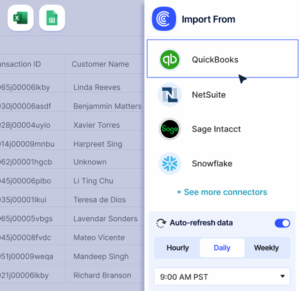
Coefficient connects your HR system directly to Excel or Google Sheets, automatically pulling headcount data and exit records. Your turnover rate calculates itself from live data.
Set up takes five minutes. Connect your HRIS, map the employee count and separation fields, and add a simple formula. Schedule daily, weekly, or monthly refreshes. Your dashboard updates automatically. Perfect for fractional CFOs and HR managers tracking metrics across multiple companies or locations.
Get started with Coefficient and download the free template.
How to Improve Your Turnover Rate
Fix your pay and benefits
Audit your compensation against market data for each role. Use tools like Payscale or Salary.com to compare. If you’re more than 10% below market, you’re losing people to better offers. Also review health insurance, retirement matches, and paid time off. Small increases in base pay beat big signing bonuses for retention.
Train and support managers
Most people quit bad managers, not bad companies. Invest in management training focused on feedback, recognition, and development conversations. Track turnover by manager to find problem areas. Hold managers accountable for retention just like you do for other performance metrics.
Improve onboarding
Half of all employee turnover happens in the first year. A strong onboarding program cuts this dramatically. Assign mentors, set clear 30-60-90 day goals, and check in weekly for the first month. Don’t just cover paperwork—build relationships and show new hires how to succeed.
Create clear career paths
People leave when they can’t see growth. Map out progression paths for each role with specific skills and timelines. Discuss career goals in every review. Offer stretch projects and training budgets. Show your team they can build a career with you, not just hold a job.
Conduct stay interviews
Don’t wait for exit interviews. Ask your best people quarterly what keeps them engaged and what might make them consider leaving. Act on what you hear. A stay interview that leads to changes shows people you value their input and are willing to adapt.
Turnover Rate vs. Attrition Rate vs. Retention Rate
People often confuse these three metrics. Here’s how they differ and when to use each.
Turnover Rate
Measures all departures—voluntary and involuntary. It includes quits, terminations, layoffs, and retirements. Use this for the broadest view of workforce stability and to benchmark against industry standards.
Attrition Rate
Tracks only voluntary departures that aren’t replaced. This applies when you’re intentionally shrinking headcount or when positions stay open after someone leaves. It’s useful for workforce planning and understanding organic headcount reduction.
Retention Rate
Flips the perspective, showing what percentage of employees stayed during a period. Calculate it as: (Employees at period end ÷ Employees at period start) × 100. Retention rate is better for positive framing in reports and presentations.
When to use each
Example to clarify: If you start with 100 employees, lose 15, and end with 95 (hiring 10 replacements), your turnover rate is 15%, your retention rate is 95%, and if only 12 of the 15 departures were voluntary and unreplaced, your attrition rate is 12%.
Pro tip for fractional CFOs: Report all three metrics to clients with different contexts. Use turnover for board reports and industry comparisons, retention for employee communications, and attrition for strategic workforce planning discussions.
Build a stable team
Turnover rate shows how well you retain talent. Track it monthly. Compare it to industry benchmarks. Use it to improve culture, compensation, and management.Get started with Coefficient and automate your turnover tracking today.
 Sync Live Finance Data into Your Spreadsheet