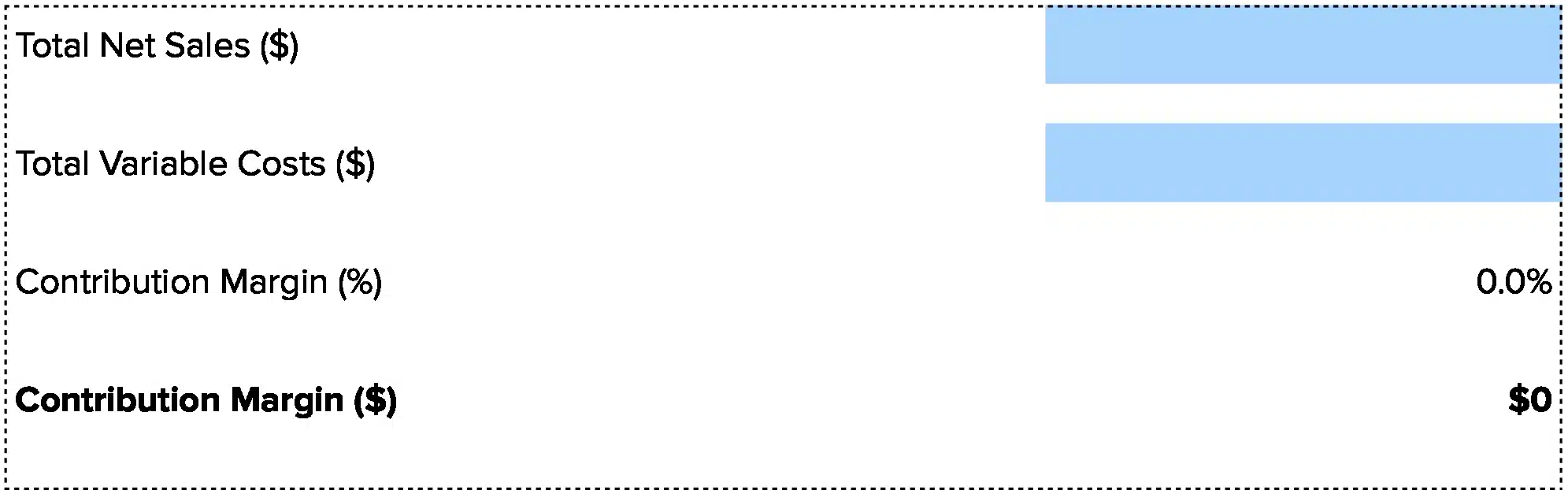




Contribution Margin = Revenue – Variable Costs
Let’s break this down piece by piece.
Revenue: This is the money you get from sales. You sell one unit at $50, that’s your revenue per unit. Sell 100 units, you have $5,000 in total revenue. Nothing fancy here.
Variable Costs: These are costs that move with volume. Make more, costs go up. Make less, costs drop. This includes raw materials you buy to build your product, direct labor costs like workers who assemble items, shipping costs to get products to customers, and credit card fees tied to each sale.
Why subtract variable costs: After you cover variable costs, what’s left pays your rent, salaries, software, and other fixed costs. Then comes profit. The higher this number, the more you have to work with. The lower it gets, the less room you have for error.
You need this margin healthy. Without it, your business can’t cover fixed costs. That means no profit. That means trouble.
What Is Contribution Margin?
Your margin shows what’s left after each sale covers its direct costs. It’s the money that helps pay for things that don’t change month to month.
Think of it this way: Every sale has to pull its weight. Some costs stick around no matter what—rent, full-time staff, insurance. Those are fixed costs. Contribution margin is what you use to pay those bills, then keep what’s left.
This number guides big choices. Should you drop a product line? Can you afford new hires? What price makes sense? You need this margin to answer those questions well.
Who uses this metric?
CFOs and Controllers making calls on which products to push and which to cut based on real profit data.
Fractional CFOs who need fast reads on client health across a portfolio of businesses they advise.
Product Managers who must decide if a new product line will make money or drain resources.
FP&A Analysts building models that show what happens if costs rise or sales drop in different scenarios.
Business Owners who want to know if their company can grow or if they’re stuck treading water.
How to Calculate Contribution Margin: Step-by-Step
Here’s a real example so you can see exactly how this works. We’re using numbers from an actual business scenario.
- Start with your unit price
Let’s say you sell coffee makers. Each one sells for $150. That’s your revenue per unit.
- List your variable costs per unit
For each coffee maker, you have raw materials (parts, packaging) at $45, direct labor (assembly time) at $20, shipping per unit at $10, and credit card processing (2% of $150) at $3.
Total variable costs = $45 + $20 + $10 + $3 = $78 per unit
- Calculate contribution margin per unit
Take your unit price and subtract variable costs:
$150 – $78 = $72
Each coffee maker contributes $72 toward your fixed costs and profit.
- Calculate contribution margin ratio
Divide contribution margin by revenue:
$72 ÷ $150 = 0.48 or 48%
This means 48 cents of every dollar stays in your business after variable costs.
- Apply to monthly volume
If you sell 200 coffee makers per month:
200 units × $72 = $14,400 total contribution margin
- See if it covers fixed costs
Your monthly fixed costs (rent, salaries, software, insurance) total $10,000.
$14,400 – $10,000 = $4,400
That’s your operating profit for the month.
- Interpret the result
With a 48% margin and enough volume, you’re in good shape. You cover fixed costs and still make profit. If your margin dropped to 30% or volume fell by half, you’d be in the red fast.
How to Interpret Your Contribution Margin Number
Your margin ratio reveals product economics and business health.
| Ratio Range | Interpretation | Recommended Actions |
| Below 20% | Critical concern – Product barely covers variable costs, leaving little for fixed expenses | • Review pricing strategy immediately<br>• Cut variable costs or switch suppliers<br>• Consider discontinuing the product line |
| 20% – 40% | Acceptable for some industries – Moderate cushion, but limited room for error | • Look for cost reduction opportunities<br>• Test modest price increases<br>• Focus on volume to spread fixed costs |
| 40% – 60% | Healthy range – Strong contribution to fixed costs and profit generation | • Maintain current pricing and cost structure<br>• Consider strategic investments<br>• Explore market expansion |
| 60% – 75% | Excellent performance – Product generates substantial margin with efficient operations | • Maximize marketing and sales efforts<br>• Evaluate opportunities to increase volume<br>• Monitor competitor reactions to pricing |
| Above 75% | Exceptional margin – Very high-value product or highly efficient operations | • Assess if pricing can be optimized further<br>• Reinvest in product development<br>• Protect market position from new entrants |
These ranges are based on research from NYU Stern’s margin database and Vena Solutions’ profitability analysis. Software and financial services often see higher margins (60-75%), while retail and manufacturing typically fall in the 30-50% range.
Contribution Margin Benchmarks by Industry
Margins vary widely by sector. Your business model and cost structure drive these differences.
| Industry | Typical CM Range | Notes |
| SaaS / Software | 65% – 80% | Low variable costs, high margins, mostly server and support costs |
| E-commerce | 30% – 50% | Variable costs include COGS, shipping, processing fees |
| Manufacturing | 35% – 50% | Raw materials and direct labor make up bulk of variable costs |
| Professional Services | 50% – 70% | Variable costs primarily direct labor on client projects |
| Retail | 25% – 45% | Product costs and fulfillment expenses reduce margins |
| Food & Beverage | 60% – 70% | High markup on food ingredients, labor typically fixed |
| Wholesale Distribution | 15% – 30% | Low margins due to competitive pricing on bulk goods |
| Healthcare Services | 40% – 60% | Supplies and contract labor vary with patient volume |
Benchmark Citations
NYU Stern Margin by Industry Database
Vena Solutions Industry Profit Margin Analysis
Investopedia Contribution Margin Guide
Automating Contribution Margin Tracking with Coefficient
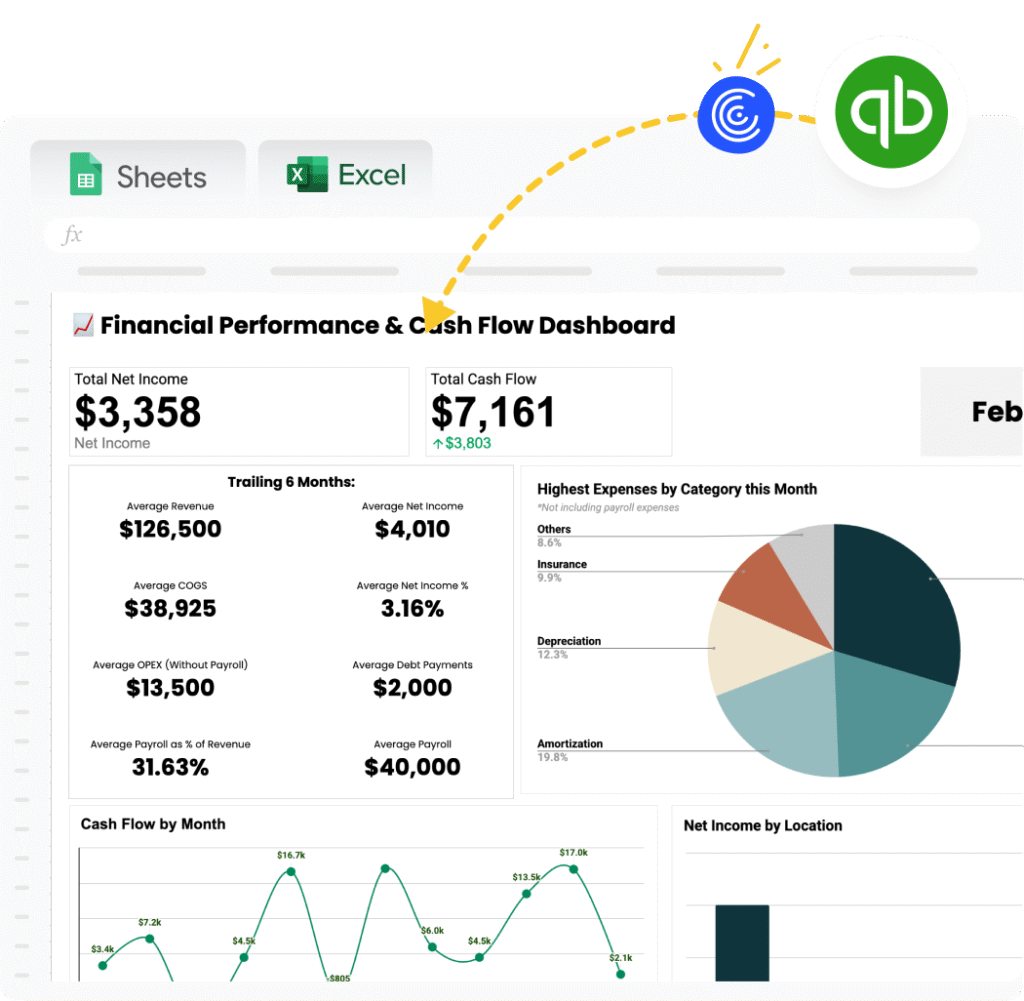
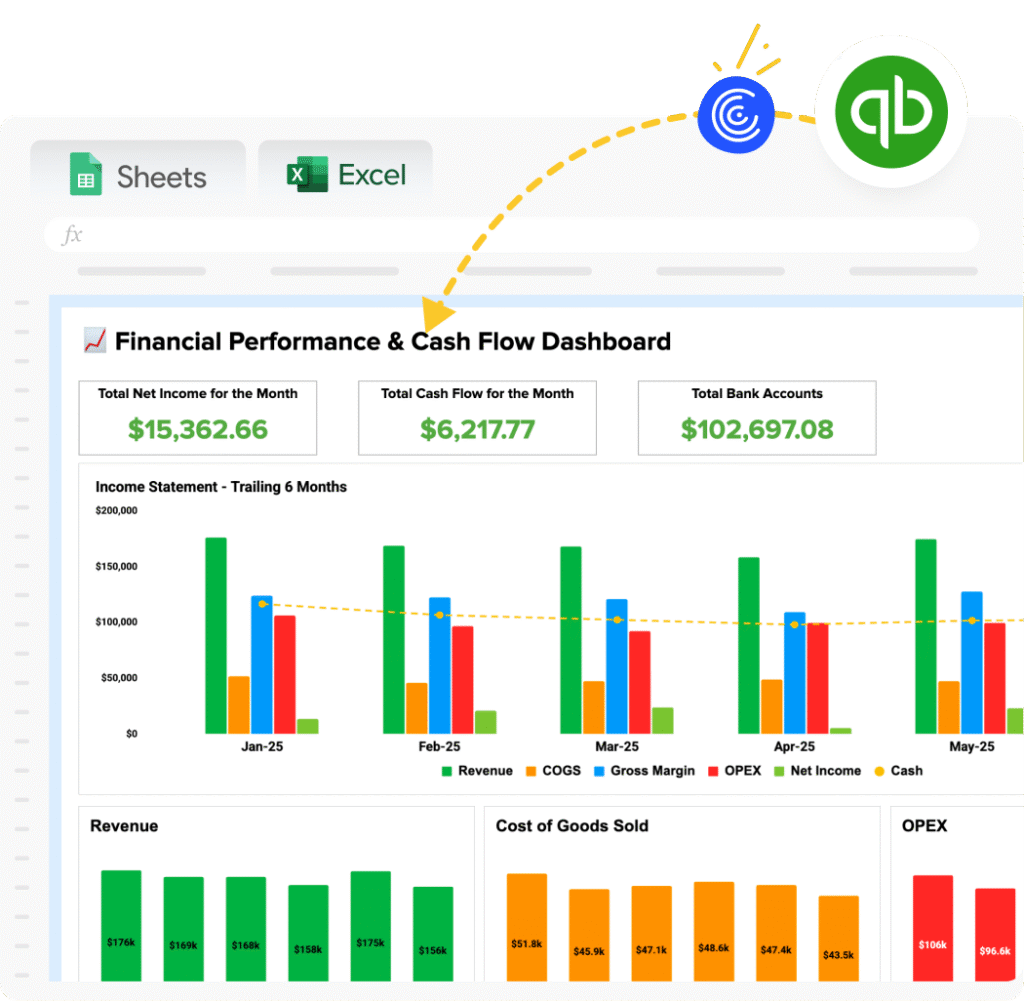
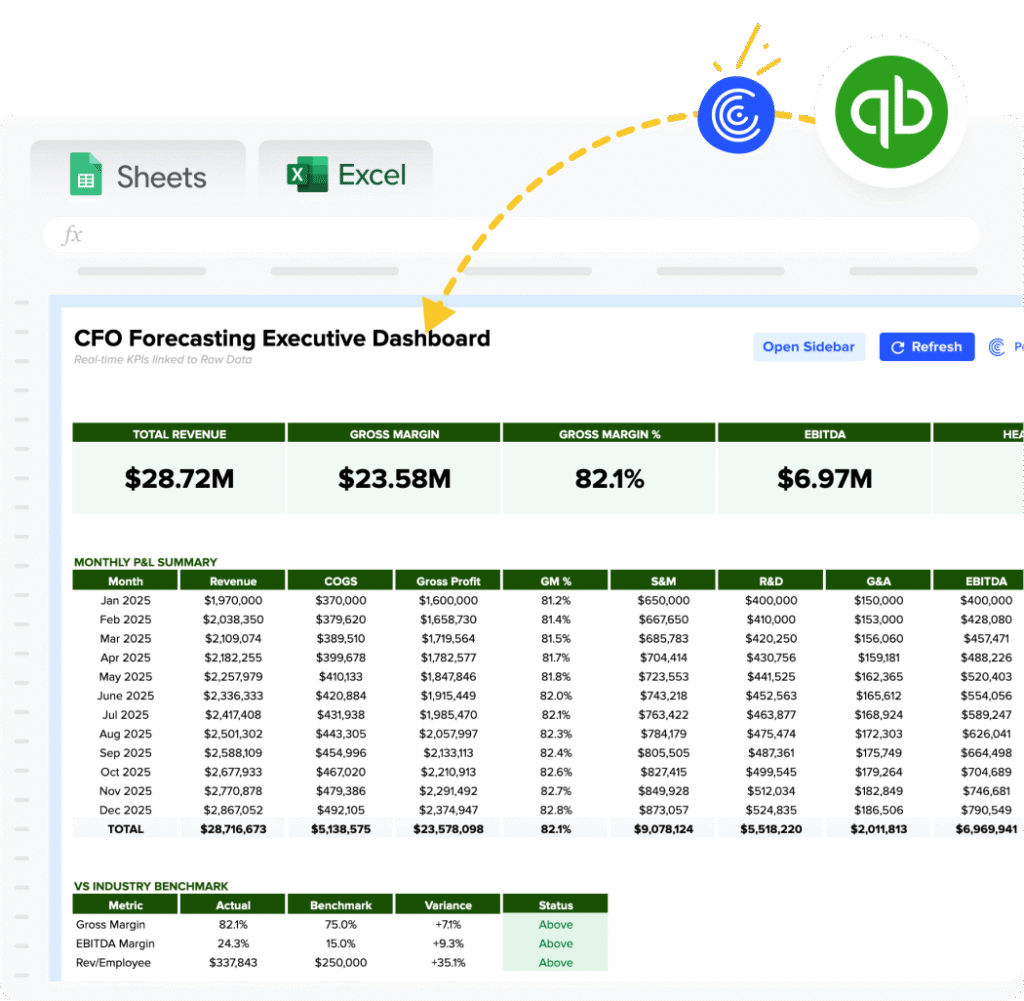
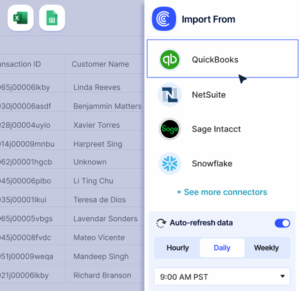
Stop pulling CSV files from QuickBooks or NetSuite every week. Coefficient links your accounting data straight to Google Sheets or Excel. Your contribution margin updates itself with live data.
Save 2-3 hours per week on manual data pulls. Catch margin problems before they hurt profit. See real-time updates when costs or pricing change. Build dashboards that update automatically. Perfect for fractional CFOs managing multiple clients.
Try Coefficient free and connect your first data source in under 5 minutes. No credit card needed.
How to Improve Your Contribution Margin
A weak margin doesn’t have to stay that way. Here are proven ways to strengthen it.
Raise prices strategically
Even a 5% price increase can boost your margin by 15-20% if volume stays steady. Test increases on your best customers first. Bundle products together. Create premium versions. Most businesses can raise prices more than they think without losing customers.
Cut variable costs
Negotiate with suppliers for better rates. Buy in larger quantities to get discounts. Find alternative suppliers for key materials. Reduce shipping costs by optimizing packaging size. Switch to cheaper payment processors that charge less per transaction. Every dollar saved here goes straight to your margin.
Shift your product mix
Focus sales and marketing on your highest-margin products. Cut or minimize low-margin items that drag down overall performance. Create bundles that combine high and moderate margin products. Phase out products that can’t hit your minimum margin threshold.
Reduce returns and refunds
Returns eat into margin fast. Improve product descriptions to set accurate expectations. Add more photos and details to product pages. Enhance quality control to catch defects before shipping. Make sizing guides clearer. Each prevented return saves both the product cost and shipping twice.
Automate labor where possible
Direct labor is a variable cost. Find tasks you can automate or streamline. Use software to handle repetitive work. Cross-train team members so they can handle multiple roles efficiently. This reduces per-unit labor costs as you scale.
Contribution Margin vs. Gross Margin vs. Operating Margin
These three metrics sound similar but show different things. Know the difference.
Contribution Margin
Revenue minus variable costs. Includes ONLY costs that change with volume. Best for product-level profitability and break-even analysis.
Gross Margin
Revenue minus COGS (cost of goods sold). May include some fixed factory costs. Best for overall product profitability and pricing strategy.
Operating Margin
Operating income divided by revenue. Includes ALL operating expenses (including fixed costs). Best for total business profitability and investor comparisons.
When to use each
Start with contribution margin for product decisions. It shows which items actually make money. Then use gross margin to evaluate overall pricing strategy. Finally, check operating margin to see if the whole business model works. This sequence helps you spot problems at each level.
Pro tip for fractional CFOs: When advising clients, start with contribution margin for product decisions. It shows which items actually make money. Then use gross margin to evaluate overall pricing strategy. Finally, check operating margin to see if the whole business model works. This sequence helps you spot problems at each level and give better advice.
Control your costs
A 10-point improvement in contribution margin can double your operating profit. The math is simple: higher margin per unit means more money left after covering fixed costs.
Focus on your biggest variable costs first. A 5% reduction in your top three cost categories typically improves margin by 3-5 percentage points.
Get started with Coefficient to track your contribution margin in real-time and catch cost problems before they kill your profit.
 Sync Live Finance Data into Your Spreadsheet