



Receivables Turnover Ratio Formula Explained
Receivables Turnover Ratio = Net Credit Sales / Average Accounts Receivable
Let’s break down each part:
Net Credit Sales: This is your total sales on credit minus returns and allowances. Cash sales don’t count here because they create no receivables. You only want credit sales—transactions where customers owe you money. This number comes straight from your income statement or sales ledger.
Average Accounts Receivable: Take your starting accounts receivable plus ending accounts receivable for a period, then divide by two. This gives you a balanced view over time rather than a single snapshot. Most teams use monthly or yearly periods for this calculation.
Why average instead of a point in time? Because receivables change daily. A single month-end number might be unusually high or low due to timing of large invoices or payments. The average smooths out these swings and gives a truer picture of your typical balance throughout the period.
What Is Receivables Turnover Ratio?
The receivables turnover ratio shows how many times per year you collect your full accounts receivable balance. A ratio of 8 means you collect the equivalent of your entire receivable balance eight times in a year.
This metric tells you how fast customers pay their invoices. A high ratio means quick collection—you’re converting credit sales to cash efficiently. A low ratio signals slow payment, weak collection processes, or credit policy problems. It’s one of the most direct ways to gauge collection efficiency and cash flow health.
Think of it as a speedometer for your accounts receivable. The faster it spins, the quicker cash comes in the door. Slow turnover means cash sits in customer hands instead of your bank account, limiting your ability to pay bills, invest, or grow.
The ratio also reveals credit risk. Very low ratios often mean you’re extending credit to customers who can’t or won’t pay on time. This early warning lets you fix problems before they become write-offs.
Who uses this metric?
CFOs and Controllers track it to manage working capital and forecast cash flow.
Credit Managers use it to set credit terms and evaluate customer risk.
Fractional CFOs monitor it across client portfolios to spot trouble early.
Lenders and Investors review it to assess how well a company can convert sales into cash.
Financial Analysts include it in liquidity models and credit analysis.
How to Calculate Receivables Turnover Ratio: Step-by-Step
Let’s walk through a real example using a mid-market software company.
- Pull your annual credit sales figure
From your income statement or sales reports, get total credit sales for the year. For our example: $2,400,000 in net credit sales for 2024.
- Locate beginning accounts receivable
Check your balance sheet from January 1, 2024. Accounts receivable: $180,000.
- Locate ending accounts receivable
Check your balance sheet from December 31, 2024. Accounts receivable: $220,000.
- Calculate average accounts receivable
Add beginning and ending balances, then divide by two:
($180,000 + $220,000) / 2 = $200,000 average accounts receivable.
- Apply the formula
Divide net credit sales by average accounts receivable:
$2,400,000 / $200,000 = 12
- Interpret the result
A receivables turnover ratio of 12 means this company collects its full receivable balance 12 times per year. That’s about once per month. If industry average is 10, they’re collecting faster than peers. If industry average is 15, they’re slower.
- Convert to days (optional)
To see this in days: 365 / 12 = 30 days. Customers pay within about 30 days on average. This helps you compare against payment terms like Net 30 or Net 45.
How to Interpret Your Receivables Turnover Ratio Number
| Ratio Range | Interpretation | Recommended Actions |
| Below 4 | Critical issue – Collection process is broken. Customers take 90+ days to pay, severely hurting cash flow. | • Review all overdue accounts immediately<br>• Tighten credit approval process<br>• Consider factoring or invoice financing<br>• Hire collection agency for old debts |
| 4 – 7 | Below average – Collection is slow. Customers pay in 50-90 days. Working capital is tied up longer than it should be. | • Send payment reminders at 15, 30, 45 days<br>• Offer early payment discounts (2% net 10)<br>• Review credit terms and enforcement<br>• Track collection metrics weekly |
| 8 – 12 | Healthy range – Most industries fall here. Collections happen in 30-45 days, which aligns with standard payment terms. | • Maintain current processes<br>• Monitor month-over-month trends<br>• Benchmark against direct competitors<br>• Automate invoicing and reminders |
| 13 – 20 | Strong performance – Fast collection, typically 18-30 days. Good cash conversion and credit discipline. | • Document what’s working<br>• Share best practices across teams<br>• Consider if terms are too strict<br>• Balance growth vs. risk |
| Above 20 | Exceptionally high – Either very strict credit terms or mostly cash business. May limit sales growth. | • Assess if credit policy is too restrictive<br>• Evaluate if you’re turning away good customers<br>• Consider loosening terms for A-rated clients<br>• Review industry norms for context |
Receivables Turnover Ratio Benchmarks by Industry
What counts as “good” depends heavily on your industry. Payment cycles, customer types, and business models all affect typical ratios.
| Industry | Typical Range | Notes |
| Software/SaaS | 8 – 15 | High due to subscription billing and automated payments. Customers often pay upfront or monthly. |
| Retail | 8 – 12 | Fast turnover from consumer purchases and limited credit terms. Many transactions are cash or card. |
| Manufacturing | 4 – 7 | Slower due to large orders, customer financing, and longer payment terms like Net 60 or Net 90. |
| Healthcare | 5 – 7 | Complex billing with insurance, government reimbursements, and payment delays from third parties. |
| Construction | 7 – 9 | Moderate pace influenced by progress billing, retainage, and project-based payment schedules. |
| Professional Services | 6 – 10 | Varies widely based on client type. Corporate clients pay faster than government or small businesses. |
| Wholesale Distribution | 10 – 14 | High volume with shorter payment terms, though depends on relationships with retail buyers. |
| Food & Beverage | 7 – 14 | Fast-moving goods with quick payment cycles, especially for distributors and restaurants. |
Why benchmarks vary: Industries with recurring revenue and subscription models see higher ratios because payments are automated and predictable. Industries with large capital purchases or complex contracts see lower ratios because invoices are bigger and payment cycles are longer.
Customer mix matters too. Selling to consumers or small businesses usually means faster payment than selling to enterprise clients with 60-day purchase order cycles. Government contracts can push collection times even longer.
Benchmark Citations
CSI Market Receivables Turnover Data
ReadyRatios Industry Benchmarking
Analyst Interview Industry Standards
Automating Receivables Turnover Tracking with Coefficient
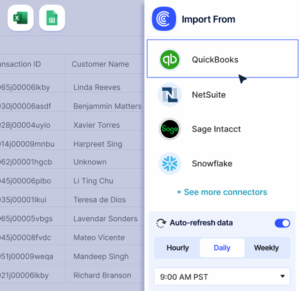
Stop pulling CSV files from NetSuite or QuickBooks every month just to update your receivables report.
Coefficient connects your accounting system straight to Excel or Google Sheets, pulling sales and accounts receivable data live.
Your receivables turnover ratio updates itself from real data. Set it to refresh daily, weekly, or monthly—whatever you need. No more manual exports or formulas that break when data changes.
Perfect for fractional CFOs managing multiple clients or finance teams running month-end reporting. Set it once, and the numbers stay current.
Get started with Coefficient today.
How to Improve Your Receivables Turnover Ratio
Tighten your credit approval process
Run credit checks before extending terms. Set clear limits based on customer history and creditworthiness. Don’t offer Net 60 to everyone just because they ask. New customers should prove themselves with shorter terms or deposits first.
Send invoices immediately
Bill the same day you deliver goods or finish services. Every day you wait adds a day to collection time. Use automated invoicing from your accounting system so invoices go out without manual steps.
Follow up fast on overdue accounts
Send reminders at 15, 30, and 45 days. Call customers with balances over 60 days old. The longer an invoice sits, the less likely you’ll collect it. Most uncollected receivables started as small oversights that no one chased.
Offer early payment discounts
Try 2% discount for payment within 10 days (2/10 Net 30). This costs less than financing costs and speeds up cash flow. Many customers will take the discount, cutting your collection cycle by two-thirds.
Accept multiple payment methods
Make it easy to pay you. Credit cards, ACH transfers, digital wallets—whatever customers prefer. Friction in payment process slows everything down. One extra click or missing payment option can delay payment by weeks.
Review and adjust payment terms
If your standard terms are Net 60 but competitors offer Net 30, you’re automatically slower. Match or beat industry norms. For strong customers, consider shortening terms to Net 30 or even Net 15.
Receivables Turnover Ratio vs. Days Sales Outstanding vs. Collection Period
These three metrics measure the same thing from different angles: how fast you collect customer payments.
Receivables Turnover Ratio
Tells you how many times per year you collect your full receivable balance. It’s expressed as a multiple (like 10x or 12x). Higher is better. Use this when comparing to industry benchmarks or tracking trends over years.
Days Sales Outstanding (DSO)
Tells you the average number of days it takes to collect payment. It’s expressed in days (like 30 days or 45 days). Lower is better. Calculate it as: (Accounts Receivable / Total Credit Sales) × Number of Days in Period. Use this when you want to see collection speed in concrete terms.
Average Collection Period
Same as DSO but calculated differently: 365 / Receivables Turnover Ratio. This gives you days from the turnover ratio. Lower is better. Use this when you already have the turnover ratio and want to convert it to days.
When to use each metric
Use receivables turnover ratio for year-over-year comparisons and when comparing against industry data. Most benchmark sources report turnover ratios, not days.
Use DSO when setting internal goals or talking to operations teams. “Reduce DSO from 45 to 35 days” is clearer than “increase ratio from 8 to 10.”
Use collection period when you need a quick conversion from an existing turnover ratio or when reporting to stakeholders who think in days rather than multiples.
Pro tip for fractional CFOs: Present all three to clients. Show the ratio for industry context, DSO for internal tracking, and explain they’re two views of the same metric. This prevents confusion when clients see different numbers from different sources.
Speed up collections
Receivables turnover ratio shows how fast you convert credit sales to cash. Track it monthly. Compare it to industry benchmarks. Use it to improve working capital and cash flow.
Get started with Coefficient and automate your receivables tracking today.
 Sync Live Finance Data into Your Spreadsheet