

PEG Ratio Formula Explained
PEG Ratio = P/E Ratio / Annual Earnings Growth Rate
Let’s break down each part of this formula.
P/E Ratio: This is the price-to-earnings ratio. You get it by taking the stock price and dividing it by earnings per share (EPS). It shows how much you’re paying for each dollar of profit. A stock trading at $50 with EPS of $5 has a P/E of 10.
Annual Earnings Growth Rate: This is how fast the company’s earnings are expected to grow each year. You can use last year’s growth rate, or better yet, use analyst forecasts for the next 1-5 years. Growth is shown as a whole number—if growth is 15%, you use 15, not 0.15.
The PEG ratio adjusts for growth. A company with a P/E of 30 might look pricey. But if it’s growing earnings at 30% per year, the PEG ratio is 1.0, which signals fair value. Without growth in the picture, you might pass on a great stock.
What Is a PEG Ratio?
A PEG ratio tells you if a stock is cheap or pricey based on how fast it’s growing. Think of it as a reality check on the P/E ratio. Two stocks can have the same P/E, but if one is growing twice as fast, it might be the better buy.
Peter Lynch made this metric famous. He said a fair stock should have a PEG near 1.0. Below 1.0 means you’re getting growth on the cheap. Above 1.0 means you’re paying a premium. The ratio works best for comparing companies in the same industry with stable, positive growth.
Who uses this metric?
Equity Analysts use PEG ratios to screen stocks and build valuation models for buy or sell calls.
Portfolio Managers compare PEG ratios across sectors to find undervalued growth stocks for fund positions.
CFOs and Investor Relations track their company’s PEG against peers to understand how the market values their growth story.
Fractional CFOs use PEG ratios when advising clients on strategic acquisitions or evaluating investment opportunities.
Individual Investors rely on PEG ratios to filter through thousands of stocks and focus on those with strong growth at fair prices.
How to Calculate PEG Ratio: Step-by-Step
Let’s walk through a real calculation so you see exactly how this works.
- Find the stock price and EPS
Pull up the company’s latest financials. Let’s say the stock trades at $80 per share and reported diluted EPS of $4.00.
- Calculate the P/E ratio
Divide the stock price by EPS:
$80 / $4.00 = 20
The P/E ratio is 20.
- Get the expected earnings growth rate
Check analyst forecasts or the company’s guidance. Let’s say analysts expect 25% annual earnings growth over the next three years.
- Apply the PEG formula
Divide the P/E ratio by the growth rate:
20 / 25 = 0.80
- Interpret the result
A PEG of 0.80 means the stock looks undervalued. You’re paying $20 for every dollar of earnings, but the company is growing at 25% per year. That’s a good deal by PEG standards.
How to Interpret Your PEG Ratio Number
Understanding what your PEG number means is key to making smart investment calls. The ratio gives you a quick read on value, but context matters. Industry norms, company stage, and economic conditions all play a role.
A PEG below 1.0 signals the market is pricing in less growth than the company is actually delivering. This creates opportunity. But check why—is the business facing hidden risks, or is it simply overlooked?
A PEG above 2.0 means you’re paying a premium. This can work for market leaders with strong competitive moats, but it’s risky if growth slows. High PEG stocks get punished hard when they miss earnings.
| Ratio Range | Interpretation | Recommended Actions |
| Below 0.5 | Strong undervaluation – Stock may be deeply discounted or growth is underestimated by the market. | • Verify growth assumptions are realistic<br>• Check for hidden risks or business headwinds<br>• Consider a position if fundamentals are solid |
| 0.5 – 1.0 | Attractive valuation – Good balance between price and growth. | • Compare against industry peers<br>• Review earnings quality and guidance<br>• Strong candidate for growth portfolios |
| 1.0 – 2.0 | Fair to moderately high – Stock is priced in line with or slightly above growth expectations. | • Monitor quarterly results closely<br>• Ensure growth rate remains on track<br>• Acceptable for high-quality businesses |
| 2.0 – 3.0 | Overvalued – You’re paying a premium relative to growth. | • Reassess position sizing<br>• Look for better risk-reward elsewhere<br>• Only justified for market leaders with durable moats |
| Above 3.0 | Significantly overvalued – High risk unless growth accelerates dramatically. | • Consider trimming or exiting position<br>• Evaluate if market expects much faster growth<br>• Watch for any signs of slowdown |
A PEG near 1.0 is the sweet spot. Below 1.0 signals value. Above 2.0 means you’re betting on growth that might not show up.
Always compare PEG ratios within the same industry. A tech stock with a PEG of 1.5 might be pricey, while a utility with the same PEG could be expensive. Growth expectations vary dramatically across sectors.
PEG Ratio Benchmarks by Industry
PEG ratios vary widely by sector. Growth expectations and business models drive these differences. A tech startup and a steel manufacturer shouldn’t have the same PEG. Here’s what you need to know.
High-growth industries like software and biotech can support lower PEG ratios because earnings growth rates are fast. A software company growing at 40% per year might trade at a PEG of 0.8 and still be fairly valued. The market prices in that rapid expansion.
Mature, cyclical industries like banking, retail, and manufacturing typically show higher PEGs. Growth is slower—often in the single digits—so even a modest P/E ratio produces a higher PEG. These companies trade on stability and dividends, not explosive growth.
Capital intensity also matters. Semiconductor equipment makers need huge investments to grow, which pressures margins and makes high PEGs harder to justify. Software firms scale with minimal capital, supporting lower PEGs even at high valuations.
| Industry | Typical PEG Range | Notes |
| Software (Internet) | 0.8 – 1.5 | High growth rates justify lower PEGs; recurring revenue models |
| Semiconductor Equipment | 1.1 – 2.0 | Cyclical but strong long-term growth; capital intensive |
| Biotechnology | 1.5 – 2.5 | High R&D costs, binary outcomes on drug approvals |
| Retail (Special Lines) | 1.2 – 2.0 | Moderate growth, competitive pressure on margins |
| Insurance (General) | 1.5 – 2.0 | Stable but slower growth, regulated industry |
| Steel & Metals | 1.0 – 1.5 | Commodity cycle exposure, capital-intensive operations |
| Banks (Regional) | 1.8 – 2.5 | Interest rate sensitivity, mature growth profiles |
| Retail (General) | 1.5 – 3.0+ | Low margins, intense competition, slower growth |
Use these benchmarks as a starting point. Compare companies within the same industry, not across different sectors. A PEG of 1.5 might be great for a bank but expensive for a software firm.
Benchmark Citations
NYU Stern – Damodaran PE Ratio Data by Sector
Eqvista PEG Ratio by Industry 2025
Automating PEG Ratio Tracking with Coefficient
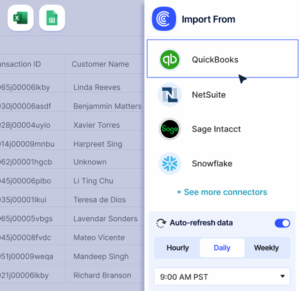
Stop pulling stock data manually from your brokerage or financial sites. Coefficient connects Excel and Google Sheets to live market data, so your PEG ratios update automatically.
Pull stock prices, EPS, and growth forecasts straight into your spreadsheet. Build a watchlist that refreshes daily. Track your portfolio or client holdings without touching a CSV file. Set alerts when a PEG crosses your buy or sell threshold.
Finance teams save hours each week. Fractional CFOs manage multiple client portfolios from one dashboard. Get started with Coefficient and automate your analysis.
How to Improve Your PEG Ratio
If you’re a company worried about your PEG ratio, here’s how to make it better.
Accelerate earnings growth
Hit your revenue targets and expand margins. Launch new products, enter new markets, and improve operational efficiency. Growth is the biggest lever. If you can grow earnings 20% instead of 10%, your PEG gets cut in half.
Beat earnings expectations consistently
When you beat forecasts, analysts raise their growth estimates. Higher growth estimates lower your PEG. Guide conservatively and deliver strong results each quarter.
Improve capital efficiency
Generate more earnings per dollar of invested capital. This means better returns on equity and assets. Investors reward efficient growth with higher valuations and lower PEGs.
Communicate your growth story clearly
If the market doesn’t understand your growth plan, your stock might trade at a high PEG. Host investor calls, publish clear guidance, and show the path to future earnings.
Buy back shares strategically
Share buybacks increase EPS by reducing the share count. Higher EPS means a lower P/E, which drops your PEG. But only do this if shares are undervalued and you have excess cash.
PEG Ratio vs. P/E Ratio vs. P/S Ratio
These three metrics all value stocks, but they focus on different things. Each has its place, and smart investors use all three depending on the situation.
P/E Ratio
The P/E ratio is the most basic. It tells you valuation but ignores growth. A P/E of 50 could be cheap if growth is 60%, or pricey if growth is 5%. You’re flying blind without the growth context.
PEG Ratio
The PEG ratio fixes that. It adjusts for growth, so you can compare a fast-growing startup to a mature giant. This makes it perfect for screening growth stocks and spotting value where P/E ratios alone might mislead you.
P/S Ratio
The P/S ratio steps in when earnings are negative. SaaS companies or biotech firms often burn cash while building revenue. P/S lets you value them based on sales instead. It’s also useful for comparing companies with very different margins.
When to use each
P/E Ratio (Stock Price / EPS): Quick valuation snapshot for profitable companies. Shows how much you pay per dollar of earnings.
PEG Ratio (P/E Ratio / Growth Rate): Comparing growth stocks with different growth rates. P/E adjusted for earnings growth.
P/S Ratio (Market Cap / Revenue): Unprofitable companies or early-stage growth firms. Valuation relative to sales.
Pro tip for fractional CFOs: Present all three ratios to clients. For a client looking at acquisition targets, show P/E for the baseline, PEG to understand growth value, and P/S for pre-profitable targets. Context matters. A PEG of 1.2 for a SaaS firm with 40% growth and strong unit economics beats a PEG of 0.9 for a declining retailer.
Track What Matters
Understanding PEG ratios helps you value stocks with growth in mind. Below 1.0 signals opportunity. Above 2.0 means you’re paying a premium. Always compare within the same industry.
The ratio works best when you combine it with other metrics. Look at P/E for baseline valuation, check unit economics, and verify that growth projections are realistic.
Get started with Coefficient to automate your PEG ratio tracking and build dashboards that update themselves.
 Sync Live Finance Data into Your Spreadsheet