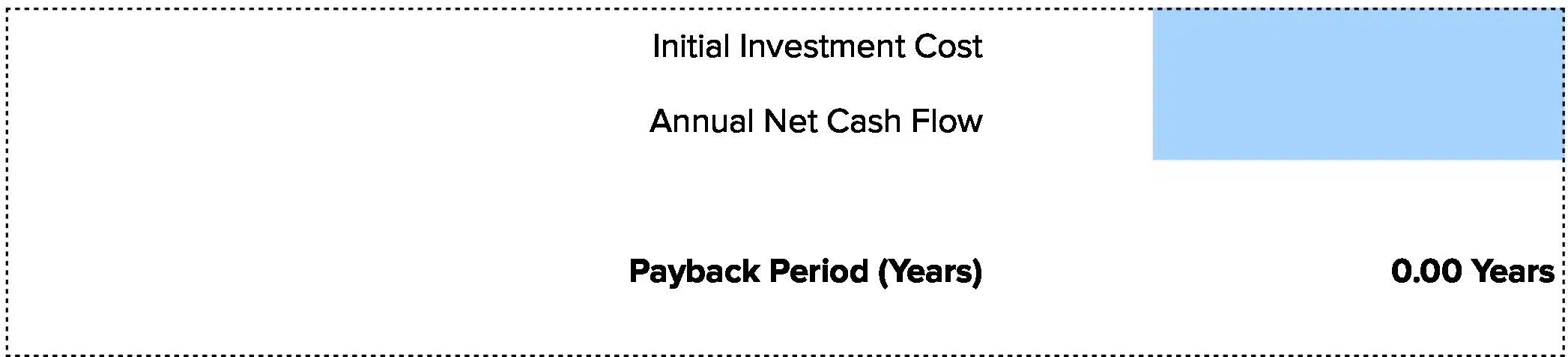




Payback Period = Initial Investment / Annual Cash Inflows
You need to know when your investment will pay for itself. The payback period shows how long it takes to recover what you spent. Use our calculator to find your payback time, learn how to read the number, and track your results in real time.
Download our free Excel and Google Sheets template to track multiple investments at once.
Payback Period Formula Explained
Payback Period = Initial Investment / Annual Cash Inflows
For uneven cash flows, add up each period’s cash flow until you reach your initial investment amount.
Initial Investment: The total cost you pay upfront. This includes equipment, software, labor, and any other costs to get the project running.
Annual Cash Inflows: The money or savings the investment brings in each year. Use the average if cash flows stay steady. For uneven flows, track each period separately.
Why This Formula Works: The formula tells you how many years (or months) until you break even. A shorter payback period means you get your money back faster. This matters when you need cash on hand or want to reduce risk.
Most companies prefer investments that pay back within three years. Software and equipment often pay back within one to two years. Large capital projects may take five to ten years.
What Is Payback Period?
Payback period measures the time it takes to recover your initial investment through cash inflows. It answers a simple question: when will I get my money back?
Businesses use this metric when they need to make smart choices about where to spend limited capital. Cash-strapped companies rely on it to avoid tying up funds for too long. Even cash-rich firms use it to compare projects and pick the ones that free up capital fastest for the next opportunity.
The metric gained popularity because it’s easy to calculate and understand. You don’t need complex financial models or discount rate assumptions. Just divide your cost by your annual return and you have your answer.
The main appeal: it focuses on risk and liquidity. Projects that pay back fast carry less risk. Market conditions change. Technology evolves. A two-year payback is safer than a ten-year payback.
Who uses this metric?
CFOs use payback period to prioritize capital projects and manage cash flow constraints.
Finance Managers compare payback periods across projects to decide where to allocate limited budgets.
Investment Analysts evaluate payback time alongside ROI and NPV to assess risk versus reward.
Small Business Owners rely on payback period when cash is tight and they need fast returns.
Fractional CFOs recommend projects with shorter payback periods to clients who need to preserve working capital.
How to Calculate Payback Period: Step-by-Step
Let’s walk through a real example. A company wants to buy new software that costs $50,000.
- Identify your initial investment
In this case, $50,000 for the software purchase and setup.
- Determine annual cash inflows
The software will save $18,000 per year in labor costs.
- Apply the formula
Divide $50,000 by $18,000.
- Calculate
$50,000 ÷ $18,000 = 2.78 years
- Convert to months if needed
0.78 × 12 = 9.4 months
- State the full result
The payback period is 2 years and 9 months.
- Interpret the result
The company will recover its $50,000 investment in less than three years. After that point, the software generates pure savings. This is a solid payback time for most businesses.
How to Interpret Your Payback Period Number
Your payback period tells you how long capital stays tied up in a project. Here’s what different ranges mean.
| Payback Period | Interpretation | Recommended Actions |
| Under 1 year | Excellent – Very low risk and fast capital recovery | • Prioritize this investment<br>• Consider scaling similar projects<br>• Use saved cash for growth |
| 1-3 years | Good – Standard range for most projects | • Proceed with confidence<br>• Monitor actual vs projected cash flows<br>• Document lessons learned |
| 3-5 years | Moderate – Acceptable for large capital investments | • Verify cash flow projections carefully<br>• Build in contingency plans<br>• Compare against alternative uses of capital |
| Over 5 years | High Risk – Long time to recover investment | • Reassess project viability<br>• Look for ways to accelerate returns<br>• Consider if strategic value justifies long wait |
Keep in mind that industry, project type, and company size affect what counts as “good.” A manufacturing plant with a seven-year payback might make sense. A marketing campaign should pay back in months, not years.
Cash flow stability matters too. Predictable cash flows make longer payback periods more acceptable. Uncertain cash flows demand shorter payback times.
Payback Period Benchmarks by Industry
Different industries have different standards for acceptable payback periods.
| Industry | Typical Range | Notes |
| SaaS (B2B) | 12-18 months | CAC payback for customer acquisition; under 12 months is excellent |
| Retail | 6-24 months | Store renovations and inventory systems on the shorter end |
| Manufacturing | 3-7 years | Heavy equipment and facility upgrades require longer periods |
| Technology Hardware | 2-4 years | R&D investments and production equipment |
| Healthcare | 3-5 years | Medical equipment and facility improvements |
| Real Estate | 7-15 years | Property acquisitions and major developments |
| Solar/Renewable Energy | 4-8 years | System installation costs vs energy savings |
Why these ranges vary
Capital intensity drives the differences. Industries with high upfront costs and stable long-term cash flows accept longer payback periods. Fast-moving industries with rapid obsolescence need quick returns.
Companies in competitive markets prefer shorter payback periods. They can’t afford to tie up capital for years when conditions change fast.
Market maturity plays a role too. Established industries with proven models accept longer payback times. Newer industries with uncertain outcomes demand faster returns.
Benchmark Citations
First Page Sage – SaaS CAC Payback Benchmarks 2025
Wall Street Prep – Payback Period Formula
Investopedia – Payback Period Definition
Automating Payback Period Tracking with Coefficient
Most finance teams export data from their accounting system every month, paste it into Excel, and recalculate payback periods manually. This wastes hours.
Coefficient connects your financial data directly to Google Sheets and Excel. Your cash flow numbers update in real time. Your payback calculations refresh automatically. You see which projects are tracking ahead or behind schedule without touching a CSV file.
Get started with Coefficient and spend less time on data entry.
How to Improve Your Payback Period
Shortening your payback period means getting your money back faster. Here’s how to do it.
Reduce upfront costs
Look for ways to cut initial investment without sacrificing results. Lease equipment instead of buying it. Start with a smaller pilot before full rollout. Negotiate better vendor terms. Every dollar you save upfront shortens the payback time.
Increase cash inflows
Find ways to generate more revenue or savings from the investment. Raise prices if the market allows it. Expand usage across more departments. Add complementary services that boost returns. Higher cash inflows mean faster payback.
Accelerate implementation
The sooner you launch, the sooner cash starts flowing. Cut delays in setup and training. Remove approval bottlenecks. Get stakeholders aligned early. Every month you shave off implementation shortens your payback period.
Focus on high-margin opportunities
Projects with better profit margins pay back faster. A 70% margin project pays back much faster than a 30% margin project with the same revenue. Prioritize investments that deliver the highest margins.
Improve cash collection
Getting paid faster shortens payback time. Tighten payment terms. Offer early payment discounts. Follow up on overdue invoices quickly. Better collections mean cash flows in sooner.
Payback Period vs. ROI vs. NPV
These three metrics serve different purposes. Use them together for complete analysis.
Payback Period
Measures time to recover your investment. It’s simple and focuses on liquidity. But it ignores cash flows after payback and doesn’t account for time value of money.
ROI (Return on Investment)
Measures total profitability as a percentage. It shows how much you gain relative to what you spend. But it doesn’t tell you when you’ll get the money back.
NPV (Net Present Value)
Accounts for the time value of money by discounting future cash flows. It gives you the true economic value of an investment. But it requires assumptions about discount rates and is more complex to calculate.
When to use each
Use payback period when cash flow and risk matter most. Use ROI to compare profitability across projects. Use NPV for long-term strategic decisions where timing of cash flows matters.
Pro tip for fractional CFOs: Present all three metrics to clients. Show payback period to address their cash concerns. Show NPV to prove long-term value. Show ROI to compare against other opportunities. This builds confidence in your recommendations.
Recover faster
A one-year difference in payback period can mean the difference between funding your next growth initiative or missing the opportunity. Projects that pay back in 18 months free up capital twice as fast as those that take 36 months.
Focus on the levers you control: cut upfront costs, boost cash inflows, and speed up implementation. Each improvement compounds.Get started with Coefficient to track payback periods across all your projects and catch delays before they extend your recovery time.
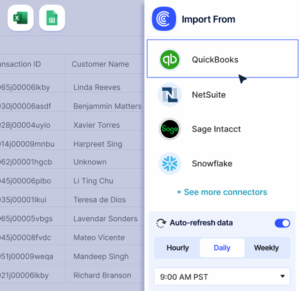 Sync Live Finance Data into Your Spreadsheet