



Enterprise Value Formula Explained
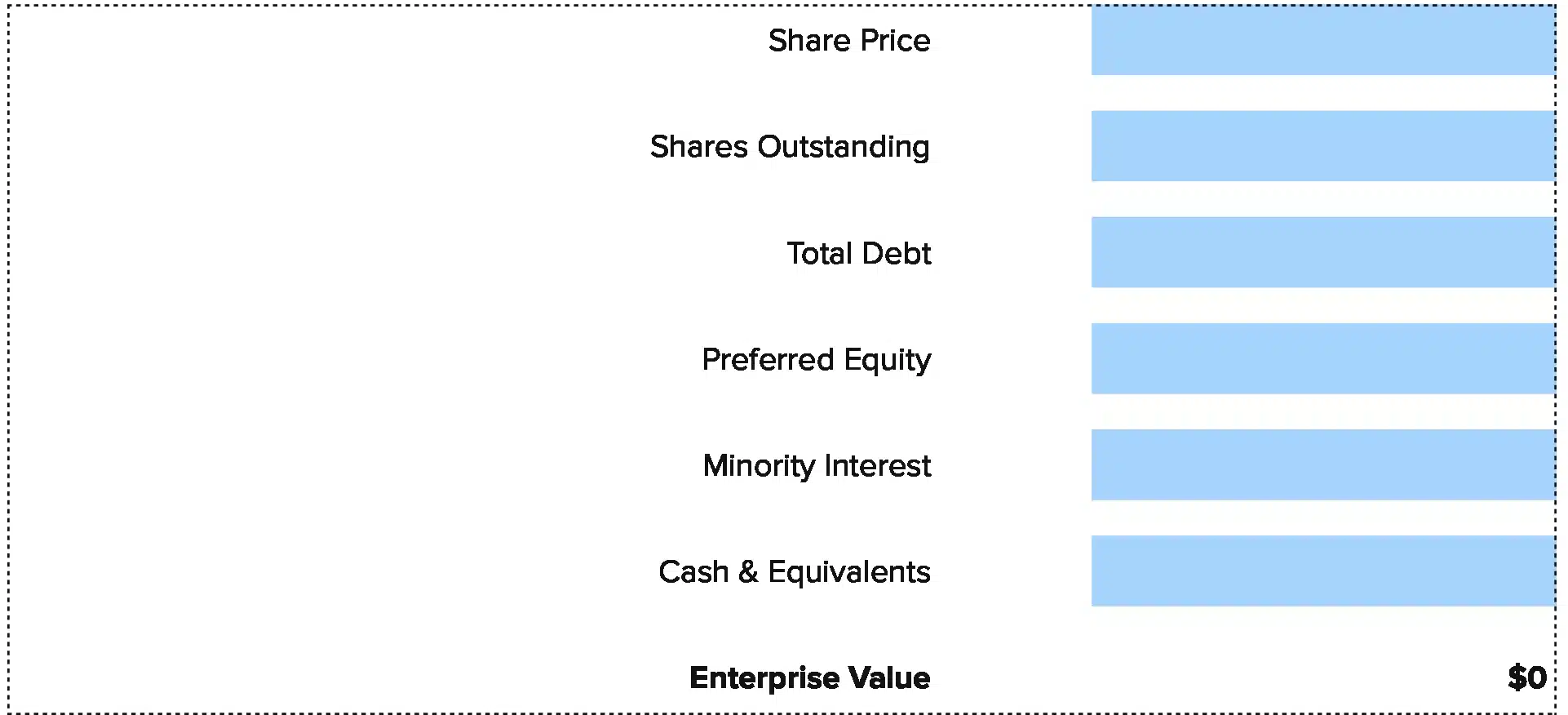
Enterprise Value = Market Capitalization + Total Debt – Cash and Cash Equivalents
Let’s break down each part:
Market Capitalization: The total value of all outstanding shares. Calculate this by multiplying your current share price by the number of shares outstanding. This represents what equity investors think your company is worth.
Total Debt: All short-term and long-term debt obligations. Include bank loans, bonds payable, notes payable, and lease obligations. This represents money you owe to lenders that an acquirer would need to assume or pay off.
Cash and Cash Equivalents: Liquid assets on your balance sheet. Include cash on hand, marketable securities, and short-term investments. We subtract cash because an acquirer gets this money when buying your company, effectively reducing their net purchase price.
Why this formula works: Enterprise value shows what someone would actually pay to own your entire business, not just the equity portion.
What Is Enterprise Value?
Enterprise value measures your company’s total worth to all stakeholders. It answers this question: “How much would it cost to buy this entire business outright?”
Unlike market cap, which only shows equity value, enterprise value captures the full picture. It accounts for debt that must be paid and cash that offsets the cost. Think of it as the real acquisition price.
Who uses this metric?
CFOs and Controllers tracking total company value for board reports and strategic planning decisions.
Investment Bankers valuing companies for mergers, acquisitions, and fairness opinions.
Private Equity Investors evaluating acquisition targets and calculating purchase multiples.
Equity Research Analysts comparing companies with different capital structures across industries.
Corporate Development Teams assessing potential acquisition targets and running scenario analyses.
How to Calculate Enterprise Value: Step-by-Step
Let’s walk through a real calculation using a mid-market manufacturing company.
- Find your market capitalization
Look up your current share price and multiply by total shares outstanding. Our example company trades at $42.50 per share with 15 million shares outstanding.
Market Cap = $42.50 × 15,000,000 = $637.5 million
- Add up total debt
Pull your balance sheet and sum all debt obligations. Our company has $85 million in long-term debt, $15 million in short-term borrowings, and $8 million in current portion of long-term debt.
Total Debt = $85M + $15M + $8M = $108 million
- Find cash and equivalents
Check the current assets section of your balance sheet. Our company holds $42 million in cash and $13 million in marketable securities.
Cash and Equivalents = $42M + $13M = $55 million
- Calculate enterprise value
Plug the numbers into the formula:
EV = $637.5M + $108M – $55M = $690.5 million
- Interpret the result
This company’s enterprise value of $690.5 million exceeds its market cap by $53 million. This tells us the company carries more debt than cash, which an acquirer must account for. The true cost to buy this business is $690.5 million, not just the $637.5 million equity value.
How to Interpret Your Enterprise Value Number
Your EV relationship to market cap reveals capital structure and acquisition implications.
| EV vs Market Cap | Interpretation | Recommended Actions |
| EV significantly below Market Cap | Strong cash position – Company holds more cash than debt | • Evaluate deployment opportunities<br>• Consider share buybacks<br>• Assess dividend potential<br>• Review investment pipeline |
| EV equals Market Cap | Neutral position – Debt and cash roughly offset | • Maintain current capital structure<br>• Monitor leverage ratios<br>• Continue regular financial planning |
| EV moderately above Market Cap (10-30%) | Manageable leverage – Normal debt levels for operations | • Monitor debt service coverage<br>• Plan refinancing ahead of maturity<br>• Maintain credit facility relationships |
| EV significantly above Market Cap (30%+) | High leverage – Substantial debt relative to equity value | • Prioritize debt reduction<br>• Review all capital expenditures<br>• Consider asset sales<br>• Renegotiate terms if needed |
Context matters immensely. Capital-intensive industries like manufacturing and utilities naturally carry higher debt loads. Compare your EV ratio to industry peers, not across different sectors.
Enterprise Value Benchmarks by Industry
Understanding how enterprise value varies by industry provides crucial context for your valuation.
| Industry | Typical EV/EBITDA Range | Notes |
| SaaS / Software | 8x – 15x | High multiples reflect recurring revenue and scalability |
| Technology Hardware | 6x – 12x | Capital requirements lower valuations versus pure software |
| Manufacturing | 5x – 9x | Asset-heavy operations and cyclical demand impact multiples |
| Healthcare Services | 7x – 12x | Regulatory environment and reimbursement models drive variation |
| Financial Services | 6x – 10x | Interest rate sensitivity and credit quality affect valuations |
| Retail | 4x – 8x | Low margins and inventory requirements compress multiples |
| Energy / Utilities | 6x – 11x | Regulated returns and capital intensity influence valuations |
| Professional Services | 7x – 13x | People-dependent model with lower capital needs |
These ranges reflect 2024-2025 market data for mid-market companies. Several factors cause variation: growth rate, profit margins, competitive position, and management quality all impact where a specific company falls within its industry range.
Benchmark Citations
Equidam EBITDA Multiples by Industry 2025
NYU Stern Enterprise Value Multiples by Sector
First Page Sage EBITDA Multiples Report 2025
Automating Enterprise Value Tracking with Coefficient
Stop manually exporting data from QuickBooks or NetSuite each month. Coefficient connects your accounting system directly to Excel or Google Sheets, pulling live balance sheet data automatically. Your enterprise value updates itself.
Set up once and forget it. Schedule refreshes daily, weekly, or monthly. Perfect for CFOs tracking metrics across multiple entities or preparing board materials. No more copy-paste errors or version control nightmares.
Get started with Coefficient and automate your enterprise value tracking.
How to Improve Your Enterprise Value
Enterprise value isn’t static. Strategic actions can increase your total company worth.
Reduce net debt position
Pay down high-interest debt first. Refinance expensive loans into lower-rate instruments. Every dollar of debt reduced increases enterprise value dollar-for-dollar. Focus on debt with restrictive covenants that limit operational flexibility.
Build cash reserves strategically
Strong cash positions signal financial health to acquirers. Target 3-6 months of operating expenses in cash. But don’t hoard excessively—cash earning 2% while you could invest in 15% ROI projects destroys value.
Improve EBITDA margins
Enterprise value multiples apply to EBITDA. Increase margins by 2%, and your EV jumps proportionally. Focus on high-leverage areas: renegotiate supplier contracts, eliminate waste, raise prices where possible, automate manual processes.
Expand into higher-multiple markets
Some business lines trade at higher multiples than others. If your core business trades at 6x EBITDA, but adjacent markets trade at 10x, strategic expansion directly increases enterprise value. Research your industry’s premium segments.
Strengthen recurring revenue
Acquirers pay premiums for predictable cash flows. Convert one-time sales into subscription models. Add maintenance contracts. Build customer retention programs. Recurring revenue commands higher multiples than project-based revenue.
Enterprise Value vs. Market Cap vs. Equity Value
These terms get confused constantly. Here’s the distinction.
Market Capitalization
Shows what public shareholders collectively paid for their equity stake. Calculate it as share price times shares outstanding. Market cap ignores debt completely.
Equity Value
Represents the value belonging to common shareholders. For public companies, equity value equals market cap. For private companies, you derive equity value through valuation methods like DCF analysis.
Enterprise Value
Captures total business value across all capital providers—both equity and debt holders. EV shows what an acquirer pays to own the entire operation.
When to use each
Use market cap when analyzing stock performance. Use equity value when valuing private companies. Use enterprise value when comparing companies across different capital structures or evaluating acquisitions.
Pro tip for fractional CFOs: Always present both metrics to clients. Show equity value (what shareholders own) alongside enterprise value (what the business would sell for). The difference between these two numbers tells an important story about leverage and financial structure.
Know your worth
A $50M difference between market cap and enterprise value changes deal negotiations. Buyers look at enterprise value. Shareholders focus on equity value. You need both numbers ready.
Track your enterprise value quarterly. Watch how debt and cash levels shift the number. Use it to guide capital structure decisions.
Get started with Coefficient to automate your enterprise value calculations and keep your valuation metrics current for board meetings and strategic planning.
 Sync Live Finance Data into Your Spreadsheet