

Economic Profit Formula Explained
Economic Profit = NOPAT – (Invested Capital × WACC)
Or, using the spread method:
Economic Profit = (ROIC – WACC) × Invested Capital
Let’s break down each part:
NOPAT (Net Operating Profit After Tax): Your operating profit after taxes but before interest costs. Calculate it as EBIT × (1 – Tax Rate). This shows how much cash your operations generate after taxes but before you pay lenders.
Invested Capital: The total cash invested in your business. This includes fixed assets like equipment and buildings, net working capital, plus any goodwill or acquired intangibles. Think of it as all the money tied up to run operations.
WACC (Weighted Average Cost of Capital): What it costs you to get that capital. This blends your debt cost and equity cost, weighted by how much of each you use. If you borrow at 6% and equity holders expect 12%, your WACC falls between them.
ROIC (Return on Invested Capital): How much return you get on that capital, calculated as NOPAT ÷ Invested Capital. If ROIC beats WACC, you create value. If not, you destroy it.
What Is Economic Profit?
Economic profit measures true value creation. Unlike accounting profit that just subtracts costs from revenue, economic profit asks: are you earning more than your capital costs?
Your company made $2 million in accounting profit. Sounds great. But what if the capital invested to earn that profit cost $3 million? You’re destroying $1 million in value. Economic profit captures this reality.
This metric goes by other names: EVA (Economic Value Added), residual income, or excess return. They all measure whether your returns beat your cost of capital.
Who uses this metric?
CFOs and Controllers tracking if business units create or destroy shareholder value.
Fractional CFOs evaluating capital efficiency across client portfolios.
Private Equity Firms measuring portfolio company performance and exit readiness.
Strategy Teams making capital allocation decisions between divisions.
Corporate Development assessing M&A targets and post-deal value creation.
How to Calculate Economic Profit: Step-by-Step
Let’s walk through a real example with a mid-market SaaS company.
- Calculate NOPAT
Start with EBIT from your income statement: $8,500,000
Apply your tax rate (25% in this example):
NOPAT = $8,500,000 × (1 – 0.25) = $6,375,000
- Determine Invested Capital
Add up these balance sheet items: Fixed Assets ($12,000,000), Net Working Capital ($3,500,000), and Goodwill and Intangibles ($4,500,000).
Total Invested Capital = $20,000,000
- Calculate Cost of Debt
Your company borrowed $8,000,000 at 7% interest.
After-tax cost of debt = 7% × (1 – 0.25) = 5.25%
- Estimate Cost of Equity
Using CAPM or investor expectations, equity holders want 14% returns.
Cost of Equity = 14%
- Calculate WACC
Debt = $8,000,000, Equity = $12,000,000
WACC = (8/20 × 5.25%) + (12/20 × 14%) = 2.1% + 8.4% = 10.5%
- Calculate Capital Charge
Multiply Invested Capital by WACC:
$20,000,000 × 10.5% = $2,100,000
- Calculate Economic Profit
Economic Profit = NOPAT – Capital Charge
$6,375,000 – $2,100,000 = $4,275,000
You created $4.3 million in shareholder value. Your ROIC of 31.9% far exceeds your 10.5% cost of capital. That 21.4 point spread shows strong performance.
How to Interpret Your Economic Profit Number
Your economic profit reveals whether you create or destroy value.
| Range | Interpretation | Recommended Actions |
| Below -$500K or ROIC-WACC < -5% | Value destruction – Capital costs exceed returns. Better to return cash to shareholders. | • Review and exit poor divisions<br>• Cut capital on low returns<br>• Consider asset sales<br>• Check if debt is too high |
| -$500K to $0 or ROIC-WACC -5% to 0% | Break-even zone – Barely covering capital costs. No value created or destroyed. | • Find margin improvements<br>• Better working capital use<br>• Review pricing strategy<br>• Seek efficiency gains |
| $0 to $1M or ROIC-WACC 0% to 3% | Modest value – Positive but vulnerable. Small changes can flip you negative. | • Protect existing margins<br>• Focus on high-ROIC growth<br>• Watch capital efficiency<br>• Consider refinancing |
| $1M to $5M or ROIC-WACC 3% to 10% | Strong value – ROIC consistently beats WACC. You have real advantages. | • Keep operational focus<br>• Invest in growth carefully<br>• Build on strengths<br>• Track performance trends |
| Above $5M or ROIC-WACC > 10% | Rare performance – Top-tier capital efficiency. Protect this position. | • Document what works<br>• Expand winners carefully<br>• Watch for mean reversion<br>• Eye strategic deals |
Economic Profit Benchmarks by Industry
Economic profit varies by industry structure. Capital-light businesses like software generate massive returns with small invested capital. Asset-heavy industries face a tougher climb.
| Industry | Typical ROIC | Typical WACC | Notes |
| Software (SaaS) | 35% – 50% | 9% – 12% | High margins, low capital needs, recurring revenue |
| Healthcare Services | 15% – 25% | 8% – 11% | Moderate capital, regulatory pressures on margins |
| Professional Services | 20% – 35% | 10% – 13% | Talent-driven, low assets, equity demands returns |
| Manufacturing | 8% – 15% | 7% – 10% | Heavy capital, thin margins, supply challenges |
| Retail | 10% – 18% | 8% – 11% | Inventory and real estate capital intensive |
| Financial Services | 12% – 20% | 9% – 12% | Regulatory capital needs, rate sensitivity |
| Real Estate | 5% – 12% | 6% – 9% | Asset-heavy, leverage-driven, cyclical |
| Telecom | 8% – 14% | 7% – 10% | Massive infrastructure costs, slow turnover |
Software dominates economic profit rankings. With 80%+ gross margins and minimal capital needs, they hit 40%+ ROIC. A SaaS business with $10M invested at 45% ROIC against 10% WACC creates $3.5M annually.
Manufacturing struggles by comparison. Heavy equipment and working capital tie up cash. ROIC often hits just 12%. A manufacturer with $50M invested at 12% ROIC and 8% WACC creates only $2M—less value with 5x the capital.
Benchmark Citations
NYU Stern School of Business – Return on Capital by Industry (2025)
Wall Street Prep – Economic Profit Analysis
ReadyRatios – Industry Financial Benchmarks
Automating Economic Profit Tracking with Coefficient
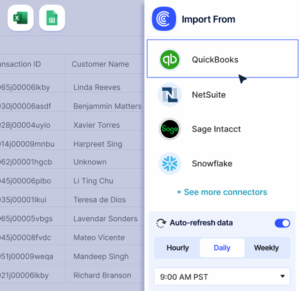
Stop pulling monthly data from NetSuite or your data warehouse for calculations. Coefficient connects your systems directly to Excel or Google Sheets. Your NOPAT, invested capital, and debt figures update automatically on your schedule.
Set up economic profit calculations once with live data. Schedule refreshes daily, weekly, or monthly. Track trends across business units and catch deteriorating efficiency before it becomes a crisis.
Start your free trial and automate your economic profit tracking today.
How to Improve Your Economic Profit
Economic profit is just math. Increase ROIC, lower WACC, or both.
Boost NOPAT without adding capital
Grow operating profit without investing more. Raise prices where you have power. Cut costs through automation. A $500K increase in NOPAT with same capital adds $500K to economic profit directly.
Reduce working capital
Collect receivables faster. Negotiate longer payment terms. Cut excess inventory. Each dollar freed reduces invested capital and boosts ROIC. A manufacturer cutting inventory from 90 to 60 days frees millions.
Exit low-return businesses
Shut down divisions where ROIC falls below WACC. Redeploy that capital into higher returns. If a unit can’t earn above capital cost, it destroys value. Act on it.
Lower your cost of capital
Refinance expensive debt when rates drop. Improve your credit rating for cheaper capital. Optimize capital structure—sometimes adding debt lowers WACC by replacing pricey equity. A 1% drop in WACC on $20M adds $200K to economic profit.
Focus capital on high-ROIC projects
Not all growth creates value. Invest only where expected ROIC exceeds WACC by good margins. Say no to marginal projects, even if profitable on paper. This discipline separates value creators from destroyers.
Economic Profit vs. Accounting Profit vs. EVA vs. ROIC
These metrics measure different things. Know when to use each.
Accounting Profit
Subtracts explicit costs from revenue. It appears on your income statement. But it ignores capital costs. You can show $5M in accounting profit while destroying value if that needs $50M in capital at 12% cost.
Economic Profit
Subtracts both explicit costs and capital’s opportunity cost. If capital costs $2M annually, that comes off accounting profit. This shows real value creation.
EVA (Economic Value Added)
Stern Stewart’s branded version with specific GAAP adjustments. EVA makes dozens of tweaks—capitalizing R&D, adjusting goodwill, etc. The core idea matches economic profit, just more refined.
ROIC
Measures efficiency as a percentage—return per dollar of capital. Economic profit measures absolute dollar value. You need both. A small business with 40% ROIC on $1M creates $300K in economic profit (at 10% WACC). A large business with 15% ROIC on $100M creates $5M at same WACC.
When to use each
Show economic profit alongside accounting profit. Most owners only see accounting profit and think they’re killing it. Show them $2M accounting profit only created $400K in economic profit after capital costs. You just revealed hidden value destruction.
Pro tip for fractional CFOs: Show economic profit alongside accounting profit to clients. Most owners only see accounting profit and think they’re killing it. Show them $2M accounting profit only created $400K in economic profit after capital costs. You just revealed hidden value destruction.
Create real value
A 5-point improvement in ROIC-WACC spread can double your economic profit. Focus on the biggest levers: margin expansion, working capital efficiency, and disciplined capital allocation.
Track your economic profit quarterly. If it’s negative, you’re destroying value no matter what accounting profit says.
Get started with Coefficient to automate your economic profit tracking and see your true value creation in real-time.
 Sync Live Finance Data into Your Spreadsheet