



Earnings Per Share Formula Explained
EPS = (Net Income – Preferred Dividends) / Weighted Average Shares Outstanding
Let’s break down each component:
Net Income: This is your company’s total profit after all expenses, taxes, and costs. You’ll find this at the bottom of your income statement. It represents what’s left after paying suppliers, employees, rent, interest, and taxes.
Preferred Dividends: Payments made to preferred shareholders before common shareholders receive anything. We subtract these because EPS measures profitability available to common shareholders only. If your company doesn’t have preferred stock, this number is zero.
Weighted Average Shares Outstanding: The average number of common shares that existed during the period, adjusted for any changes. If you issued or bought back shares mid-quarter, this accounts for the timing. It’s weighted because shares issued on day 1 count more than shares issued on day 89.
What Is Earnings Per Share?
EPS measures profit per share of stock. It answers a simple question: “If we split our profit evenly among shareholders, how much would each share receive?”
This metric is the foundation of stock valuation. Higher EPS typically means more value for shareholders. But context matters—a $5 EPS at a startup differs from $5 EPS at a mature bank.
Who uses this metric?
CFOs and Finance Directors monitoring quarterly performance against board targets and analyst expectations.
Equity Analysts building valuation models and setting price targets for institutional investors.
Public Company Controllers preparing SEC filings and earnings announcements each quarter.
Investment Managers comparing profitability across portfolio companies and screening for new investments.
Board Members evaluating management performance and determining executive compensation tied to EPS growth.
How to Calculate Earnings Per Share: Step-by-Step
Let’s walk through calculating EPS with a practical example.
- Gather your income statement
You need the most recent quarterly or annual income statement. Make sure all figures are from the same reporting period.
- Identify net income
Locate “Net Income” at the bottom. For our example: $8,500,000
- Find preferred dividends
Check if your company paid preferred shareholders. Look for “Preferred Dividends” in the equity section. In our example: $200,000
- Calculate income for common shareholders
Subtract preferred dividends from net income:
$8,500,000 – $200,000 = $8,300,000
This $8,300,000 is what common shareholders can claim.
- Determine weighted average shares outstanding
Find this on your balance sheet. This accounts for shares issued or repurchased during the period. For our example: 2,500,000 shares
- Apply the EPS formula
Divide income available by shares:
$8,300,000 ÷ 2,500,000 = $3.32 EPS
- Interpret your result
An EPS of $3.32 means each share earned $3.32 in profit. Compare this to previous quarters and industry peers to gauge performance.
How to Interpret Your Earnings Per Share Number
Your EPS tells a specific story. Here’s how to read the numbers.
| EPS Range | Interpretation | Recommended Actions |
| Negative EPS | Company is losing money – Operating at a loss with no earnings to distribute | • Review cost structure immediately<br>• Evaluate path to profitability<br>• Consider cash runway and financing needs<br>• Communicate turnaround plan to investors |
| $0.00 – $1.00 | Low profitability – Minimal earnings per share, possibly early-stage or struggling | • Focus on revenue growth strategies<br>• Improve operational efficiency<br>• Reduce unnecessary expenses<br>• Monitor cash flow closely |
| $1.00 – $5.00 | Moderate profitability – Solid earnings typical of established mid-market companies | • Maintain current operations<br>• Invest in growth initiatives<br>• Compare against industry benchmarks<br>• Consider reinvestment vs. dividends |
| $5.00 – $15.00 | Strong profitability – Healthy earnings indicating efficient operations | • Explore expansion opportunities<br>• Maintain competitive advantages<br>• Reward shareholders through dividends or buybacks<br>• Continue innovation investments |
| Above $15.00 | Exceptional profitability – Very high earnings, often in mature, efficient companies | • Assess sustainability of margins<br>• Consider strategic acquisitions<br>• Return cash to shareholders<br>• Monitor for market saturation |
Earnings Per Share Benchmarks by Industry
EPS varies widely by industry. Understanding peer benchmarks helps you assess whether your numbers are strong or need work.
| Industry | Typical EPS Range | Notes |
| Technology (SaaS) | $2.00 – $8.00 | High margins and scalability drive strong EPS; growth companies often reinvest heavily |
| Banking & Financial Services | $3.00 – $12.00 | Mature banks show higher EPS; heavily regulated with stable, predictable earnings |
| Healthcare Services | $1.50 – $6.00 | Varies by segment; hospitals lower due to capital intensity, pharma higher with IP protection |
| Retail (General) | $0.50 – $3.00 | Thin margins and high competition keep EPS moderate; seasonal fluctuations common |
| Manufacturing | $1.00 – $5.00 | Heavy fixed costs impact profitability; cyclical with economic conditions |
| Energy | $2.00 – $10.00 | Commodity-dependent; extreme volatility based on oil and gas prices |
| Telecommunications | $1.50 – $5.00 | Infrastructure-heavy; stable but moderate growth due to market maturity |
| Consumer Goods | $2.00 – $7.00 | Established brands show strong EPS; pricing power drives profitability |
Capital-intensive industries require heavy asset investment. This reduces profit margins compared to service businesses like software. Competitive dynamics also matter—retail faces intense price competition while pharma benefits from patent protection. These structural factors explain why a $2 EPS in retail might be excellent while the same figure in banking suggests underperformance.
Benchmark Citations
Siblis Research P/E Ratio & Earnings by Sector
FactSet Earnings Insight Q3 2025
Automating Earnings Per Share Tracking with Coefficient
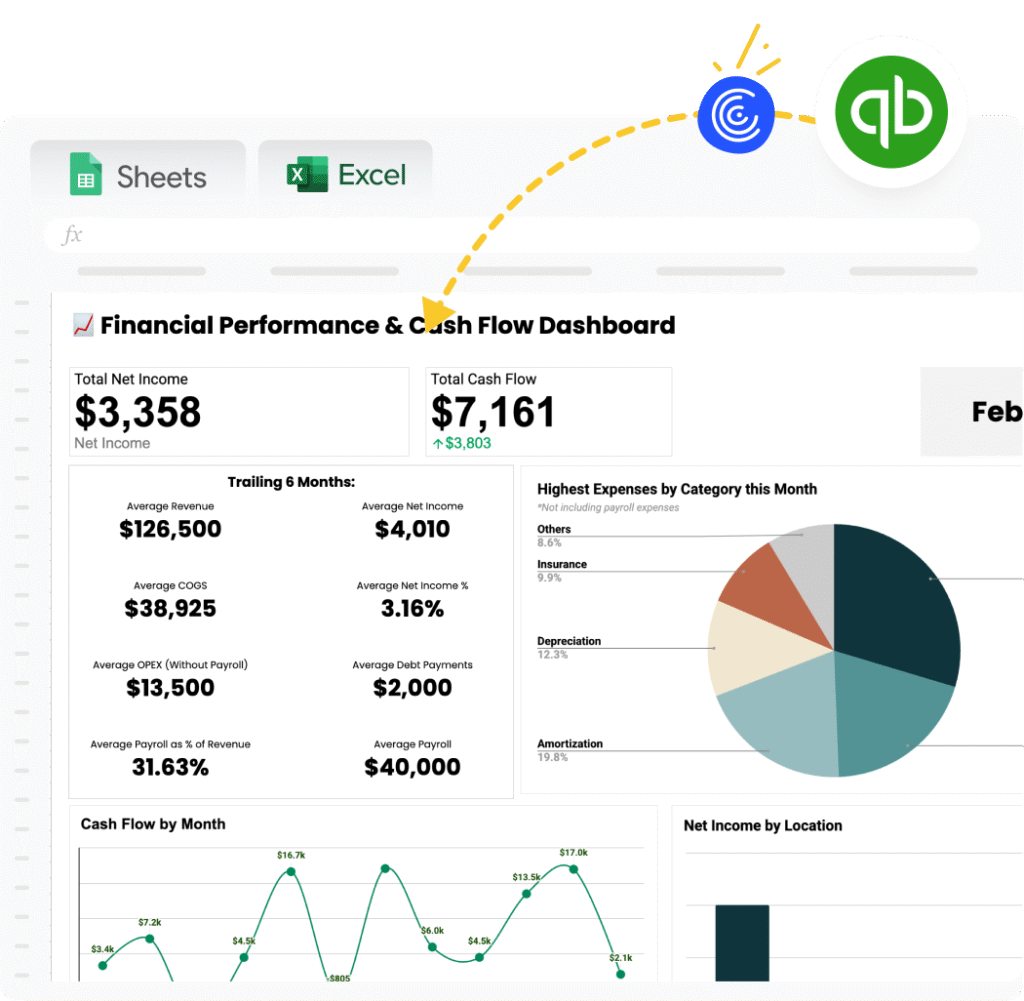
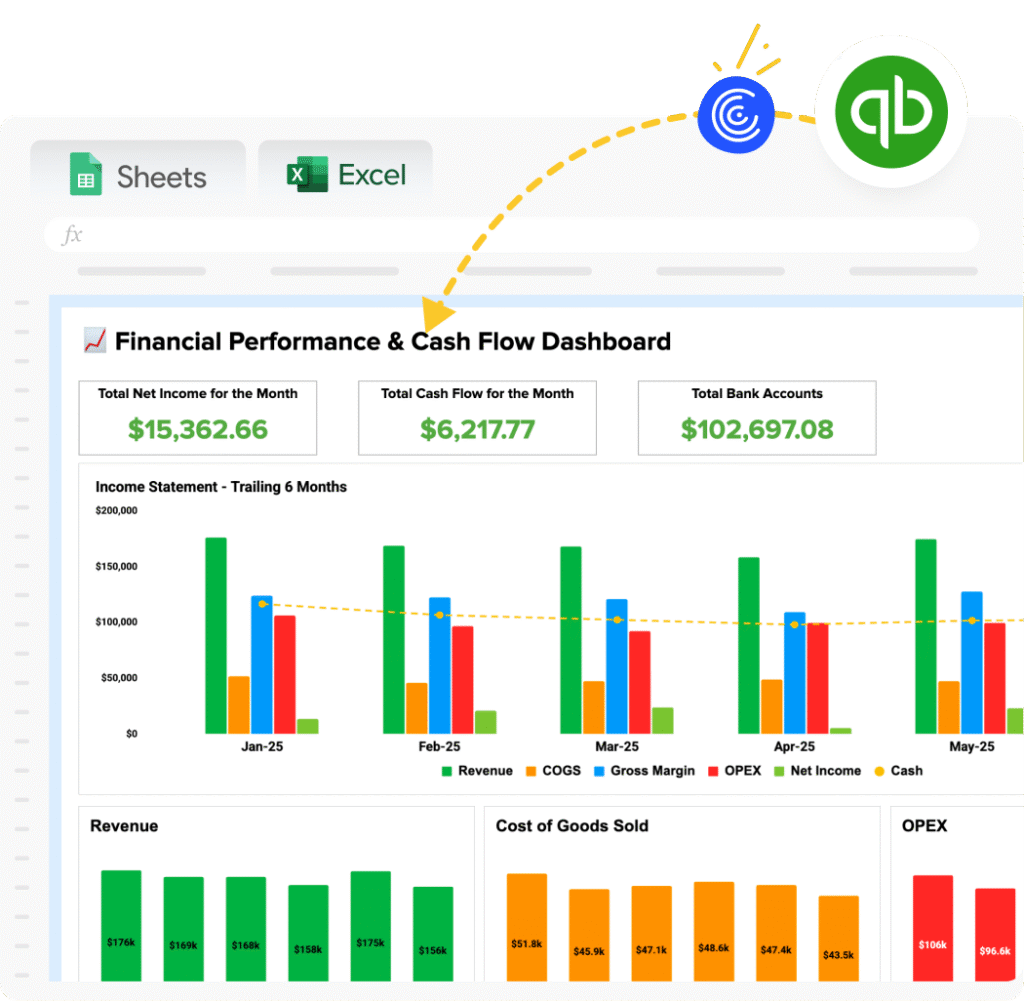
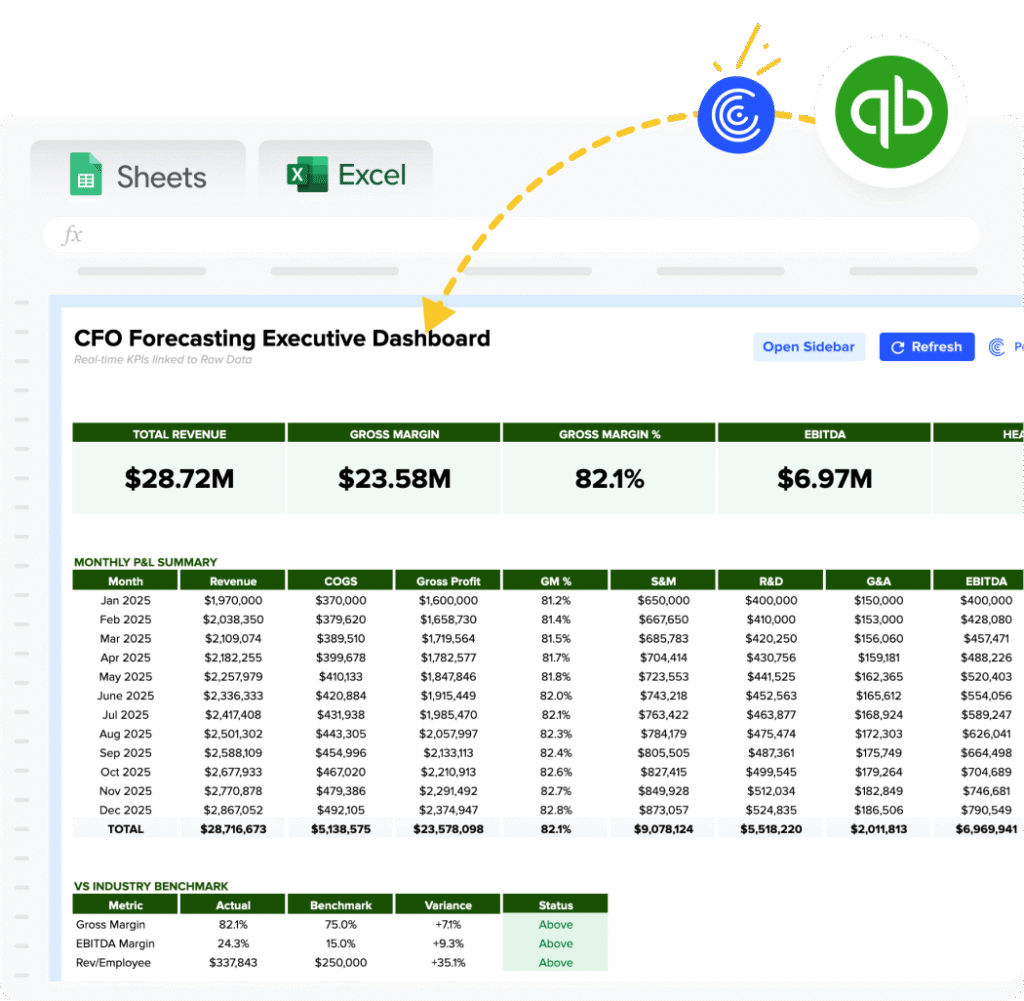
Manual CSV exports waste time. Coefficient connects your accounting system directly to Excel or Google Sheets, automatically importing net income, share counts, and preferred dividends. Your EPS calculates itself from live data.
Finance teams using Coefficient for finance operations save hours each quarter. Set up once, then your metrics update automatically.
Get started with Coefficient today.
How to Improve Your Earnings Per Share
A weak EPS signals opportunity. Here are five proven strategies.
Increase net income through revenue growth
Launch new products or expand markets. Growing revenue by 15-20% with controlled costs can boost EPS by 20-30%. Focus on high-margin offerings.
Reduce operating expenses
Audit your cost structure quarterly. Eliminate redundant subscriptions and renegotiate vendor contracts. Cutting expenses by $500K annually improves EPS immediately.
Execute share buyback programs
Repurchase common shares, reducing shares outstanding. Buy back 10% of shares while maintaining net income, and EPS increases roughly 11%. Most effective when stock trades below value.
Improve operational efficiency
Streamline production and reduce waste. Better efficiency means producing more with less. Manufacturing companies often see 5-10% margin improvement from operational programs.
Optimize capital structure
Refinance high-interest debt to lower rates. Every $100K in annual interest savings flows to net income. Consider preferred stock instead of common stock to raise capital without diluting EPS.
Earnings Per Share vs. Diluted EPS vs. Price-to-Earnings Ratio
These three metrics often confuse people. Here’s how they differ.
Basic EPS
Uses only current common shares. It’s straightforward but doesn’t account for potential dilution from stock options or convertible bonds. Most companies report this first.
Diluted EPS
Assumes all convertible securities convert to common shares. It shows worst-case earnings dilution. Public companies must report both basic and diluted EPS. Diluted EPS is always equal to or lower than basic EPS.
Price-to-Earnings (P/E) Ratio
Divides stock price by EPS. A stock at $50 with $5 EPS has a P/E of 10x. P/E ratios help compare valuations across companies. High P/E suggests investors expect growth; low P/E may indicate undervaluation.
When to use each
Basic EPS gives you the starting point. Diluted EPS shows the realistic picture including all potential share dilution. P/E ratio helps you understand market valuation relative to earnings.
Pro tip for fractional CFOs: Show both basic and diluted EPS with the percentage difference. For example: “Your basic EPS is $4.20, but diluted EPS is $3.85—an 8% dilution from stock options. Potential buyers will focus on diluted figures when valuing your company.”
Make every share count
A $0.50 improvement in EPS can drive 10-15% stock price appreciation when markets recognize the change. Small operational improvements compound into significant per-share value.
Track your EPS quarterly. Compare it to your industry benchmark. If you’re below average, focus on margin improvement and operational efficiency first.
Get started with Coefficient to automate your EPS tracking and see performance trends in real-time.
 Sync Live Finance Data into Your Spreadsheet