

Dividend Yield = (Annual Dividends Per Share / Current Stock Price) × 100
This free dividend yield calculator helps you measure income from stocks in seconds. You’ll learn how to calculate, interpret, and track dividend yields for better investment decisions. We’ve also included a free Excel and Google Sheets template you can download and use right away.
Skip the math. Focus on what the numbers mean.
Dividend Yield Formula Explained
Dividend Yield = (Annual Dividends Per Share / Current Stock Price) × 100
Let’s break down each part:
Annual Dividends Per Share: The total cash dividends a company pays per share over 12 months. Most companies pay quarterly, so you add up four payments. Some pay monthly or semi-annually. You want the full year amount.
Current Stock Price: The price per share at the time you calculate. Stock prices change daily. Your dividend yield changes with it, even if the dividend stays the same.
Multiplied by 100: Converts the decimal to a percentage. A 0.035 result becomes 3.5%.
Why use this formula? It shows you what percentage return you get from dividends alone, separate from stock price changes. A stock at $50 that pays $2 per year has a 4% yield. If that stock drops to $40 but the dividend stays at $2, the yield rises to 5%. Same dividend. Different yield. The formula captures this relationship.
What Is Dividend Yield?
Dividend yield measures the annual income you receive from a stock as a percentage of its current price. It answers one question: How much cash will this stock pay me relative to what I pay for it?
Think of it like rental income from real estate. A $500,000 property that generates $20,000 in annual rent has a 4% yield. Dividend yield works the same way for stocks.
Who uses this metric?
Income Investors who depend on dividends for cash flow in retirement or to meet monthly expenses.
Portfolio Managers who build dividend-focused strategies for clients seeking regular income.
Financial Analysts who compare stocks within sectors to identify value opportunities.
Corporate Finance Teams who track how their company’s dividend policy stacks up against competitors.
Fractional CFOs who advise clients on dividend sustainability and payout strategies.
How to Calculate Dividend Yield: Step-by-Step
Let’s walk through a real calculation using Verizon as an example.
- Find the annual dividend per share
Check the company’s investor relations page or financial data provider. Verizon paid four quarterly dividends of $0.665 each in 2024.
$0.665 × 4 = $2.66 annual dividend per share
- Get the current stock price
Look up the stock price on any financial website. Let’s say Verizon trades at $41.50 per share today.
- Divide annual dividend by stock price
Take the $2.66 annual dividend and divide by the $41.50 stock price.
$2.66 ÷ $41.50 = 0.0641
- Convert to percentage
Multiply by 100 to get your percentage yield.
0.0641 × 100 = 6.41%
- Interpret the result
A 6.41% dividend yield means you earn $6.41 for every $100 invested through dividend payments. If you buy 100 shares at $41.50 ($4,150 total), you’d receive about $266 in annual dividends, assuming the dividend stays constant.
How to Interpret Your Dividend Yield Number
Context matters when evaluating dividend yields.
| Yield Range | Interpretation | Recommended Actions |
| Below 1% | Growth focus – Company reinvests most profits into expansion rather than dividends | • Evaluate if capital gains potential justifies low income<br>• Consider for growth portion of portfolio<br>• Review earnings growth rate |
| 1% – 3% | Balanced approach – Moderate income with room for growth | • Suitable for diversified portfolios<br>• Check dividend growth history<br>• Monitor payout ratio sustainability |
| 3% – 6% | Income focus – Strong cash flow to shareholders, typical of mature companies | • Good for income-seeking investors<br>• Verify payout ratio under 70%<br>• Assess business stability |
| Above 6% | High yield – Either excellent opportunity or warning sign of distress | • Investigate why yield is high<br>• Check if dividend is sustainable<br>• Look for recent price drops<br>• Review payout ratio and debt levels |
Dividend Yield Benchmarks by Industry
Understanding industry norms helps you spot outliers and set realistic expectations for different sectors.
| Industry | Typical Range | Notes |
| Utilities | 3.0% – 5.5% | Regulated businesses with stable cash flows and predictable dividends |
| REITs | 3.5% – 6.0% | Required by law to distribute 90% of taxable income to shareholders |
| Telecommunications | 4.0% – 6.5% | Mature sector with high infrastructure costs but steady revenue |
| Consumer Staples | 2.5% – 4.0% | Defensive stocks with consistent demand regardless of economy |
| Energy (Traditional) | 3.5% – 5.5% | Cyclical but cash-generative; yields vary with commodity prices |
| Financials | 2.5% – 4.5% | Banks and insurance companies with regulatory capital requirements |
| Healthcare | 1.5% – 3.0% | Balances dividends with R&D investment needs |
| Technology | 0.5% – 2.0% | Growth-oriented sector that typically reinvests in innovation |
Why do yields vary so much? Capital needs drive the difference. Tech companies pour money into research and development. Utilities have built their infrastructure and generate steady cash. REITs face legal requirements to pay out most earnings. Understanding these patterns helps you judge whether a 2% tech dividend or 5% utility dividend makes sense.
Benchmark Citations
Eqvista Dividend Yield Study 2025
Morningstar Dividend Analysis 2025
Automating Dividend Yield Tracking with Coefficient
Stop manually updating spreadsheets with stock prices and dividend data every quarter.
Coefficient connects live market data directly to Excel or Google Sheets. Your dividend yield calculations update automatically as prices change.
Set it up once. Let the data refresh itself. Perfect for portfolio managers tracking dozens of dividend stocks or finance teams monitoring company performance against peers. Get started free and eliminate the copy-paste cycle.
How to Improve Your Dividend Yield
Your dividend yield can improve through strategic actions.
Increase dividend payments
Companies with strong cash flow can raise their dividend per share. Work with the board to analyze free cash flow projections and set a sustainable payout ratio. Even a 5% annual dividend increase compounds significantly over time.
Buy back shares
Reducing shares outstanding increases dividends per share for remaining shareholders. If you pay $1 million total in dividends across 10 million shares, that’s $0.10 per share. Buy back 1 million shares, and the same $1 million now spreads across 9 million shares: $0.111 per share.
Optimize capital allocation
Deploy excess cash into higher-return projects rather than low-yield investments. Better returns generate more free cash flow for dividends. Review your ROIC to ensure capital efficiency.
Reduce debt
Lower interest payments free up cash for dividends. Companies with less leverage have more financial flexibility to maintain or increase dividends during downturns.
Streamline operations
Cut costs that don’t drive revenue. Every dollar saved in operating expenses can flow to shareholders. Focus on efficiency gains that improve margins without hurting growth.
Dividend Yield vs. Dividend Payout Ratio vs. Total Return
Investors often confuse these three metrics. Here’s how they differ.
Dividend Yield
Measures income as a percentage of stock price. It changes daily with the stock price even if the dividend stays constant. Use it to compare income potential across different stocks.
Dividend Payout Ratio
Shows what percentage of earnings a company pays as dividends. Calculated as dividends per share divided by earnings per share. A 60% payout ratio means the company keeps 40% of earnings for reinvestment. Use it to assess dividend sustainability.
Total Return
Combines dividend income plus stock price appreciation. A stock that pays 3% dividends and appreciates 7% delivers 10% total return. Use it to evaluate overall investment performance, not just income.
When to use each
Pro tip for fractional CFOs: Present all three metrics when advising clients on dividend policy. For example: “Your 4.5% dividend yield looks attractive, but your 85% payout ratio leaves little room for growth investment or economic headwinds. Consider targeting a 60-70% payout ratio to balance shareholder income with business resilience.”
Track what matters
Dividend yield tells you how much income your stock investments generate. Compare it across industries. Monitor it over time. Use it alongside payout ratios and total return for complete investment analysis.Get started with Coefficient to automate your dividend tracking and free up time for deeper analysis.
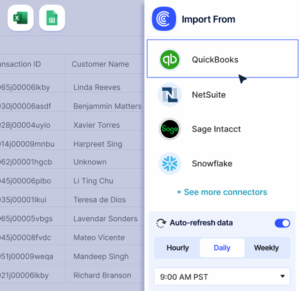 Sync Live Finance Data into Your Spreadsheet