

Direct Material Price Variance = (Actual Price – Standard Price) × Actual Quantity
Raw material costs can make or break your margins. One price shift from a supplier, and your budget is off track. Direct material price variance helps you spot these cost changes fast, so you can act before they hurt profits. This free calculator shows you exactly what you paid versus what you planned to pay—and what that gap means for your bottom line.
You’ll learn how to calculate the variance, read the results, and track material costs over time.
We’ve also built a free Excel and Google Sheets template you can download right now.
Direct Material Price Variance Formula Explained
Direct Material Price Variance = (Actual Price – Standard Price) × Actual Quantity
This formula tells you if you paid more or less than planned for materials. Let’s break down each part.
Actual Price is what you really paid per unit. This includes the invoice price, shipping costs, taxes, and any fees tied to getting the material. If you bought steel at $52 per ton including freight, that’s your actual price.
Standard Price is what you budgeted to pay. Most companies set this based on past orders, supplier quotes, or market data. If you planned to spend $50 per ton for steel, that’s your standard price.
Actual Quantity is how much material you bought in the period you’re measuring. Note: this is what you purchased, not what you used in production. If you bought 200 tons of steel, that’s your actual quantity.
Why we measure this: When actual price exceeds standard price, you’re over budget on materials. When it’s below, you saved money. But not all savings are good—sometimes a lower price means lower quality that causes problems later.
What Is Direct Material Price Variance?
Direct material price variance tracks the cost difference between what you planned to pay for raw materials and what you actually paid. It answers one question: did purchasing decisions help or hurt your material budget?
This metric isolates price from other factors. If you used more material than planned, that’s a usage variance. This variance only cares about the price per unit.
Finance teams use it to spot supplier price changes, catch cost creep, and hold purchasing accountable for negotiating good deals.
Who uses this metric?
CFOs and controllers track it monthly to see if material costs are trending up or down, and adjust forecasts before quarterly close.
Cost accountants calculate it as part of standard costing systems to feed variance reports to management.
Purchasing managers own the number since their supplier negotiations directly drive the variance.
Plant controllers at manufacturing sites measure it weekly to flag cost spikes before they blow up batch costs.
Financial analysts building models use it to stress-test margins when raw material markets swing.
How to Calculate Direct Material Price Variance: Step-by-Step
Let’s walk through a real example. A furniture maker buys oak lumber for tables.
- Gather your figures
You need three numbers: actual price paid, standard price budgeted, and actual quantity bought. Pull these from purchase orders and your accounting system for the period.
- Identify actual price per unit
Check your supplier invoice. Say you bought oak at $58 per board foot. That’s your actual price.
- Find your standard price per unit
Look at your budget or cost standards. You planned to pay $55 per board foot based on last quarter’s quotes. That’s your standard.
- Record actual quantity purchased
Your purchase order shows 800 board feet bought this month. That’s your actual quantity.
- Calculate the price difference
Subtract standard from actual: $58 – $55 = $3 per board foot. You paid $3 more than planned for each board foot.
- Multiply by quantity
Take that $3 difference and multiply by 800 board feet: $3 × 800 = $2,400. This is your variance.
- Interpret the result
A positive $2,400 variance means you spent $2,400 more than budgeted on oak. This is unfavorable—it hurts margins. You’d report this as “$2,400 unfavorable” or “$2,400 U.” If the number were negative, you’d call it favorable.
How to Interpret Your Direct Material Price Variance Number
| Variance Range | Interpretation | Recommended Actions |
| -5% or better (favorable) | Exceptional cost savings – You paid significantly less than standard price | • Verify quality meets specs<br>• Document supplier terms for future buys<br>• Check if lower price was one-time or sustainable |
| -2% to 0% (slightly favorable) | Good performance – Minor savings achieved | • Continue current purchasing practices<br>• Monitor for quality consistency<br>• Consider locking in rates if market rising |
| 0% to +2% (slightly unfavorable) | Acceptable range – Small cost overrun | • Review recent price changes<br>• Check if within normal market volatility<br>• Update standards if market shifted |
| +2% to +5% (unfavorable) | Material concern – Costs running high | • Investigate supplier price increases<br>• Renegotiate contracts or find alternatives<br>• Adjust budgets and pricing if sustained |
| +5% or worse (highly unfavorable) | Critical issue – Major budget impact | • Immediate supplier discussion required<br>• Explore emergency sourcing options<br>• Escalate to CFO for pricing strategy review |
Most companies aim for variances between -2% and +2% of standard cost. Larger swings need investigation. A $10,000 unfavorable variance might seem bad, but if it’s only 1% of your $1 million material budget, it’s likely normal market noise. Context matters.
Watch trends over time. One month of +3% variance could be a blip. Three straight months means a pattern you need to fix.
Direct Material Price Variance Benchmarks by Industry
Material price variance varies by industry based on commodity exposure and supplier dynamics.
| Industry | Typical Variance Range | Notes |
| Food Manufacturing | ±3% to ±8% | Agricultural inputs swing with weather and harvest cycles |
| Automotive Parts | ±2% to ±5% | Steel and aluminum prices tied to commodity markets |
| Pharmaceuticals | ±1% to ±4% | Active ingredients from few suppliers. Contracts limit variance |
| Electronics | ±4% to ±10% | Semiconductors see volatile pricing. Shortages cause spikes |
| Furniture & Wood | ±3% to ±7% | Lumber prices fluctuate with housing market demand |
| Chemicals & Plastics | ±5% to ±12% | Petroleum-derived inputs track oil prices closely |
| Textiles & Apparel | ±2% to ±6% | Cotton and synthetics vary by global supply patterns |
Companies with few suppliers (like pharma) see smaller variance because contracts lock prices. Industries with commodity inputs (food, chemicals) face larger swings from daily market moves. Purchasing power also matters—large buyers negotiate tighter pricing than small shops.
Seasonal patterns drive variance too. Food manufacturers see unfavorable variance when produce is scarce. Electronics firms faced +15% variances during the 2021-2022 chip shortage as they paid premiums for scarce parts.
Benchmark Citations
HighRadius Cost Accounting Analysis
B.Com Institute Manufacturing Variance Studies
Automating Direct Material Price Variance Tracking with Coefficient
Stop pulling CSV exports from your ERP every month.
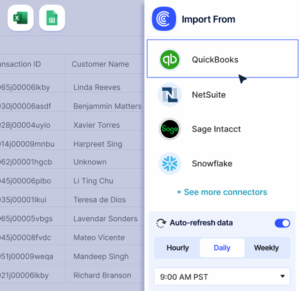
Coefficient connects QuickBooks, NetSuite, SAP, or Oracle directly to your Excel or Google Sheets, pulling actual costs and quantities automatically. Your variance calculations update themselves with live data.
Set it up once. Watch your material variance table refresh on a schedule you choose—daily, weekly, or right before month-end close. No more copy-paste errors or stale numbers. If a supplier price jumps, you see it in your dashboard the same day.
Get started with Coefficient and connect your first data source in minutes. Your finance team saves hours every week, and you catch cost issues before they hit your P&L.
How to Improve Your Direct Material Price Variance
Negotiate volume contracts
Lock in fixed prices for 6-12 months by committing to minimum volumes. Approach your top suppliers with annual projections and ask for discounts. Even 2-3% off per unit adds up fast across thousands of units.
Build multiple supplier relationships
Source from at least two qualified vendors for critical materials. When one raises prices, shift volume to the other. Competition keeps pricing fair. Document backup suppliers before you need them.
Time purchases strategically
Buy when prices favor you. Steel often drops in Q1, wheat after harvest. Use historical data to spot patterns. Build storage so you can stock up during low-price windows.
Improve demand forecasting
Order materials farther ahead to avoid rush premiums. Better forecasts also support volume contracts. Run monthly demand reviews with sales, ops, and finance.
Update standard costs quarterly
Old standards make every purchase look bad. Review standards every quarter using current quotes, commodity indices, and recent history. Realistic standards make variance useful.
Direct Material Price Variance vs. Material Quantity Variance vs. Total Material Variance
These three metrics work together to explain your total material cost performance.
Direct Material Price Variance
Isolates price per unit. Formula: (Actual Price – Standard Price) × Actual Quantity.
Example: You paid $12 per kg but budgeted $10, on 500 kg bought = $1,000 unfavorable.
Material Quantity Variance
Tracks production efficiency. Formula: (Actual Quantity Used – Standard Quantity Allowed) × Standard Price.
Example: You used 520 kg to make 100 units, standard is 500 kg, at $10 = $200 unfavorable.
Total Material Variance
Combines both. Formula: (Actual Price × Actual Quantity Used) – (Standard Price × Standard Quantity Allowed). It shows the full budget impact.
In the examples above, total = $1,200 unfavorable.
When to use each
Price variance is purchasing’s job—did they get good deals? Quantity variance is operations’ job—did they avoid waste? Total variance hits your P&L.
Pro tip for fractional CFOs: Show all three to clients. It stops finger-pointing and gives clear action. If price is unfavorable but quantity is favorable, maybe the pricier material cut waste—net win.
Control your costs
Material price variance gives you early warning when supplier costs shift. Track it weekly. Compare it to your standards. Use it to hold purchasing accountable and protect margins.Get started with Coefficient and automate your variance tracking today.
 Sync Live Finance Data into Your Spreadsheet