

Straight-Line Depreciation = (Asset Cost – Salvage Value) / Useful Life
Asset value drops over time. This depreciation calculator helps you track that decline and spread costs across useful life.
Learn how to calculate depreciation, interpret results, and automate tracking in Excel or Google Sheets. Download our free template to start tracking asset value today.
Depreciation Formula Explained
Straight-Line Depreciation = (Asset Cost – Salvage Value) / Useful Life
This formula shows how much value an asset loses each year. Asset cost is what you paid upfront plus setup fees. Salvage value is what the asset will be worth when you’re done using it. Useful life is how many years you expect to use it.
- Why salvage value matters: Assets rarely become worthless. A truck might still sell for scrap. A machine might have parts worth something. Subtract this end value from the purchase price. Only the difference gets spread across the years.
- Why straight-line is common: It’s simple math. Divide once, use the same number every year. Most assets wear out fairly evenly over time. Office furniture, computers, and equipment all work well with this method. The IRS also accepts it for most asset types, making tax prep easier.
Not all assets depreciate the same way. Some lose more value up front, like vehicles. Others depend on how much you use them, like factory equipment. But straight-line works for most businesses and most assets.
What Is Depreciation?
Depreciation tracks how assets lose value as they age. It spreads large purchases across multiple years instead of hitting your books all at once. This matches expenses to the revenue those assets help generate.
Think of it this way: Buy a $50,000 truck. Don’t expense $50,000 in year one. Spread that cost over five years at $10,000 per year. Your books show a steady expense that matches how you actually use the truck.
Who uses this metric?
- CFOs and Controllers track asset value for financial reporting and tax planning. Need accurate numbers for board meetings and investor presentations.
- Fractional CFOs manage depreciation schedules across multiple client companies. Must understand different methods for different industries.
- Tax Accountants calculate deductions to reduce taxable income. Choose methods that comply with IRS rules while maximizing benefits.
- Financial Analysts build forecasts that include future depreciation expenses. Project cash needs and replacement timing.
- Small Business Owners track major purchases like vehicles, equipment, and buildings. Plan for replacements before assets fail.
How to Calculate Depreciation: Step-by-Step
Let’s walk through a real example. Your company buys manufacturing equipment for $100,000. You expect it to last 10 years. At the end, you can sell it for scrap at $10,000.
- Record the purchase price
Equipment cost: $100,000
- Estimate salvage value
Research shows similar equipment sells for $10,000 as scrap.
- Calculate depreciable base
$100,000 – $10,000 = $90,000
- Determine useful life
Industry standards say 10 years. IRS guidelines agree.
- Apply the formula
$90,000 ÷ 10 years = $9,000 per year
- Record annual depreciation
Each year for 10 years, expense $9,000.
- Track book value
After 5 years: $100,000 – ($9,000 × 5) = $55,000. After 10 years: $10,000 (salvage value).
Your books now show the equipment at its true value, not what you paid years ago.
How to Interpret Your Depreciation Number
| Asset Age | Book Value Range | What This Means | Recommended Actions |
| Years 1-3 | 70-100% of cost | Asset still new with high value. Low maintenance costs expected. | • Track actual vs expected depreciation<br>• Document condition and usage<br>• Plan for future replacements |
| Years 4-7 | 30-70% of cost | Asset in productive middle years. Normal wear and maintenance. | • Increase maintenance budget<br>• Start researching replacement options<br>• Set aside funds for eventual replacement |
| Years 8-10 | 10-30% of cost | Asset approaching end of useful life. Higher repair costs likely. | • Accelerate replacement planning<br>• Compare repair costs to new purchase<br>• Lock in replacement budget |
| Beyond Useful Life | At or below salvage | Asset fully depreciated. Repairs may exceed value. | • Replace immediately if critical<br>• Expense all repairs, don’t capitalize<br>• Consider trade-in or disposal |
Depreciation Benchmarks by Industry
Different industries depreciate assets at different rates based on how they use equipment and how long it typically lasts.
| Industry | Typical Period | Notes |
| Manufacturing | 5-15 years | Heavy machinery lasts longer but needs regular maintenance. |
| Retail | 3-7 years | Store fixtures and POS systems. Technology drives shorter periods. |
| SaaS/Software | 3-5 years | Servers and data centers. Rapid tech change means faster obsolescence. |
| Construction | 5-20 years | Vehicles 5-7 years, heavy equipment 10-20 years. |
| Transportation | 3-8 years | Delivery vehicles 3-5 years, semi-trucks 5-8 years. |
| Healthcare | 5-10 years | Medical equipment varies. Imaging lasts 10+ years, computers 3-5. |
| Professional Services | 3-7 years | Office furniture 7 years, computers 3-5 years. |
| Hospitality | 5-10 years | Kitchen equipment and furniture. Guest items need faster replacement. |
Manufacturing companies use straight-line depreciation because wear happens steadily. Construction firms often use units-of-production for heavy equipment since usage varies significantly. SaaS companies face rapid tech changes and often use shorter useful lives.
Benchmark Citations
Corporate Finance Institute – Depreciation Methods
Infraon Asset Management Guide
TrustRadius Depreciation Methods Guide
Automating Depreciation Tracking with Coefficient
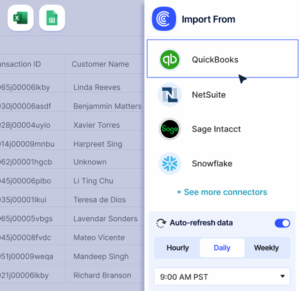
Stop manually updating spreadsheets every month. Coefficient connects your accounting system directly to Excel or Google Sheets. Asset data flows automatically. Depreciation calculates itself.
Link NetSuite, QuickBooks, or Sage Intacct to your depreciation schedules. When you add a new asset in your accounting system, it appears in your spreadsheet. Set your formulas once. They update every time data refreshes.
Get started with Coefficient and automate your depreciation tracking.
How to Improve Your Depreciation Tracking
Choose the right depreciation method
Match your method to how assets actually lose value. Vehicles lose more value up front – use declining balance. Equipment that runs constantly – consider units of production. Office furniture wears evenly – stick with straight-line.
Document salvage value estimates
Don’t guess. Research what similar assets sell for at end of life. Check auction sites, talk to equipment dealers, review your own disposal history. Update estimates when market conditions change.
Review useful life assumptions annually
Assets might last longer or shorter than expected. A well-maintained truck could run 8 years instead of 5. Technology might become obsolete in 3 years instead of 5. Adjust when needed and document why.
Track actual vs expected depreciation
Compare your calculations to market values. If your books show $50,000 but similar equipment sells for $30,000, your assumptions are off. Fix them before year-end.
Automate depreciation schedules
Use software or connected spreadsheets. Manual calculations lead to errors. One wrong cell formula can throw off your entire balance sheet. Automate once, verify twice, then let it run.
Depreciation Methods Compared
Straight-Line Depreciation
Same expense every year. Easy to calculate and explain. Works best for assets that wear evenly over time like office furniture, buildings, and standard equipment. The IRS accepts it for most assets. Downside: doesn’t match reality for assets that lose value faster up front.
Declining Balance Depreciation
Higher expenses in early years, lower later. Matches how vehicles and technology actually lose value. You get bigger tax deductions when the asset is new. Good for items that become obsolete quickly. More complex math than straight-line.
Units of Production Depreciation
Based on actual use, not time. Perfect for manufacturing equipment and vehicles. A machine that runs 2,000 hours depreciates more than one that runs 500 hours. Requires careful tracking of usage. Best reflects true wear and tear.
Pro tip for fractional CFOs: Different clients may need different methods for the same type of asset. A delivery company uses its trucks hard – consider accelerated methods. A sales team uses cars lightly – straight-line works fine. Match the method to actual business use, not just asset type.
Make depreciation simple
Depreciation tracking doesn’t need to be complex. Calculate it right. Match your method to how assets actually lose value. Update your assumptions when reality changes. Automate the process so errors don’t compound.
Your balance sheet accuracy depends on getting this right. Bad depreciation numbers create bad financial reports. Good tracking helps you plan replacements, budget maintenance, and make smart capital decisions.Get started with Coefficient and turn depreciation tracking into a system that runs itself.
 Sync Live Finance Data into Your Spreadsheet