



Debt-to-Asset Ratio Formula Explained
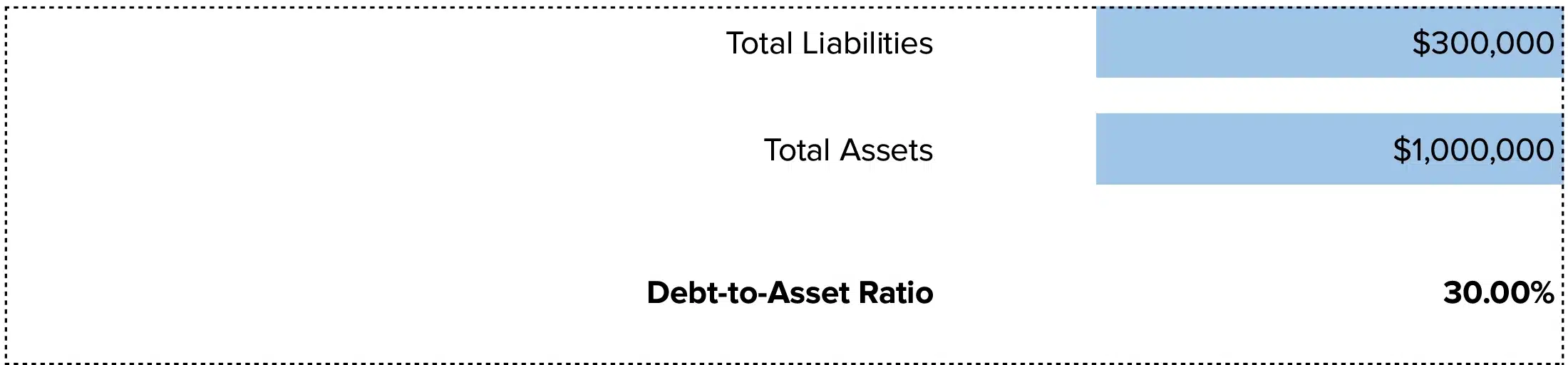
Debt-to-Asset Ratio = Total Debt ÷ Total Assets
Let’s break down each part:
Total Debt: All money your business owes. This includes short-term obligations like accounts payable, credit lines, and the current portion of long-term debt. It also includes long-term liabilities such as term loans, bonds payable, and mortgages. These debts create legal obligations your business must meet regardless of cash flow conditions.
Total Assets: Everything your company owns with value. This encompasses cash, accounts receivable, inventory, equipment, real estate, vehicles, and intangible assets like patents or trademarks. Asset values should reflect current market conditions rather than historical purchase prices.
The ratio shows what portion of your assets are funded by debt rather than equity. When you calculate 0.50, this means 50 cents of every dollar in assets came from borrowed money. The other 50 cents came from owner equity or retained earnings.
What Is Debt-to-Asset Ratio?
Debt-to-asset ratio measures how much of your company’s resources are financed by creditors versus shareholders. This metric answers a simple question: If you liquidated all assets tomorrow, could you pay off all debts?
This ratio differs from debt-to-equity ratio by including all assets, not just equity. It gives lenders and investors a clear picture of leverage and solvency risk.
Who uses this metric?
CFOs and Controllers monitor this ratio monthly to track capital structure and make informed decisions about taking on new debt or paying down existing obligations.
Commercial Lenders review debt-to-asset ratios as part of credit analysis, often setting maximum thresholds in loan covenants to protect their positions.
Private Equity Investors analyze this metric during due diligence to assess financial risk and determine if a company can support acquisition debt.
Credit Analysts use the ratio to evaluate creditworthiness and recommend appropriate interest rates based on leverage levels.
Board Members track the ratio to ensure management maintains healthy capital structures that support long-term growth.
How to Calculate Debt-to-Asset Ratio: Step-by-Step
Let’s walk through a real calculation using sample numbers from a mid-market company.
- Gather your balance sheet
Pull your most recent balance sheet showing all liabilities and assets as of the same date. Month-end or quarter-end statements work best.
- Calculate total debt
Add up all your liabilities. For our example:
- Short-term debt: $150,000
- Accounts payable: $85,000
- Current portion of long-term debt: $45,000
- Long-term debt: $520,000
Total Debt = $800,000
- Calculate total assets
Sum all assets from your balance sheet:
- Cash: $125,000
- Accounts receivable: $275,000
- Inventory: $180,000
- Equipment: $420,000
- Real estate: $800,000
Total Assets = $1,800,000
- Apply the formula
Divide total debt by total assets:
$800,000 ÷ $1,800,000 = 0.44
- Convert to percentage
Multiply by 100 to express as a percentage:
0.44 × 100 = 44%
- Interpret your result
This company’s debt-to-asset ratio of 44% means creditors have financed 44% of assets. Shareholders financed the remaining 56% through equity contributions or retained profits.
- Compare to benchmarks
Check your industry’s typical range. For this mid-market manufacturing company, 44% falls within the healthy range of 30-50% common for the sector.
How to Interpret Your Debt-to-Asset Ratio Number
Understanding your ratio requires industry context and risk tolerance.
| Ratio Range | Interpretation | Recommended Actions |
| Below 0.30 | Conservative structure – Low financial risk but potentially underutilized debt capacity | • Consider strategic growth investments<br>• Evaluate opportunities for leverage<br>• May be leaving returns on table |
| 0.30 – 0.50 | Balanced approach – Healthy mix of debt and equity financing | • Maintain current practices<br>• Monitor trends quarterly<br>• Stay alert to market changes |
| 0.50 – 0.70 | Moderate leverage – Elevated risk requiring careful management | • Review debt service coverage<br>• Postpone new borrowing<br>• Build cash reserves |
| Above 0.70 | High leverage – Significant financial risk and limited flexibility | • Prioritize debt reduction<br>• Improve cash flow<br>• Avoid new debt obligations |
Debt-to-Asset Ratio Benchmarks by Industry
Understanding your ratio requires context. What’s healthy for one industry may signal trouble in another.
| Industry | Typical Range | Notes |
| Software/SaaS | 0.15 – 0.35 | Light asset base, high margins enable low leverage |
| Retail | 0.45 – 0.65 | Inventory requirements drive higher debt needs |
| Manufacturing | 0.35 – 0.55 | Equipment investments require moderate leverage |
| Real Estate | 0.60 – 0.80 | Property financing drives higher acceptable ratios |
| Healthcare Services | 0.40 – 0.60 | Equipment and facility needs create moderate debt |
| Professional Services | 0.20 – 0.40 | Minimal physical assets enable lower leverage |
| Hospitality | 0.55 – 0.75 | Property and equipment needs drive higher ratios |
| Utilities | 0.60 – 0.80 | Infrastructure investments justify higher leverage |
These benchmarks come from analysis of thousands of companies in each sector, updated through 2024-2025.
Benchmark Citations
NYU Stern Debt Fundamentals Study
Corporate Finance Institute Debt Analysis
Automating Debt-to-Asset Ratio Tracking with Coefficient
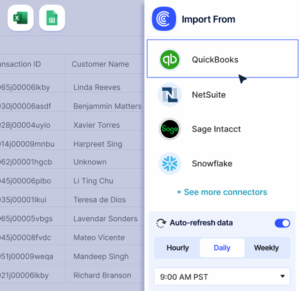
Stop pulling CSV exports from NetSuite or QuickBooks every month just to calculate your leverage metrics.
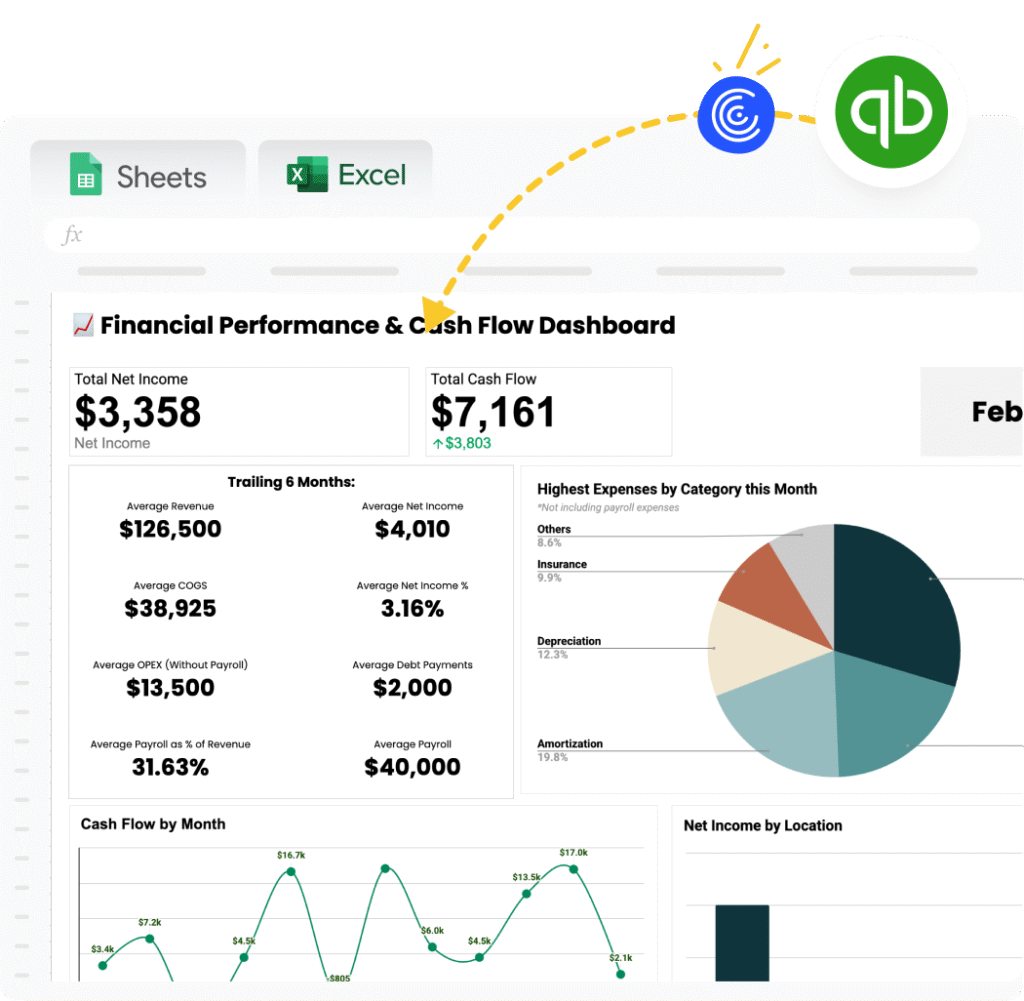
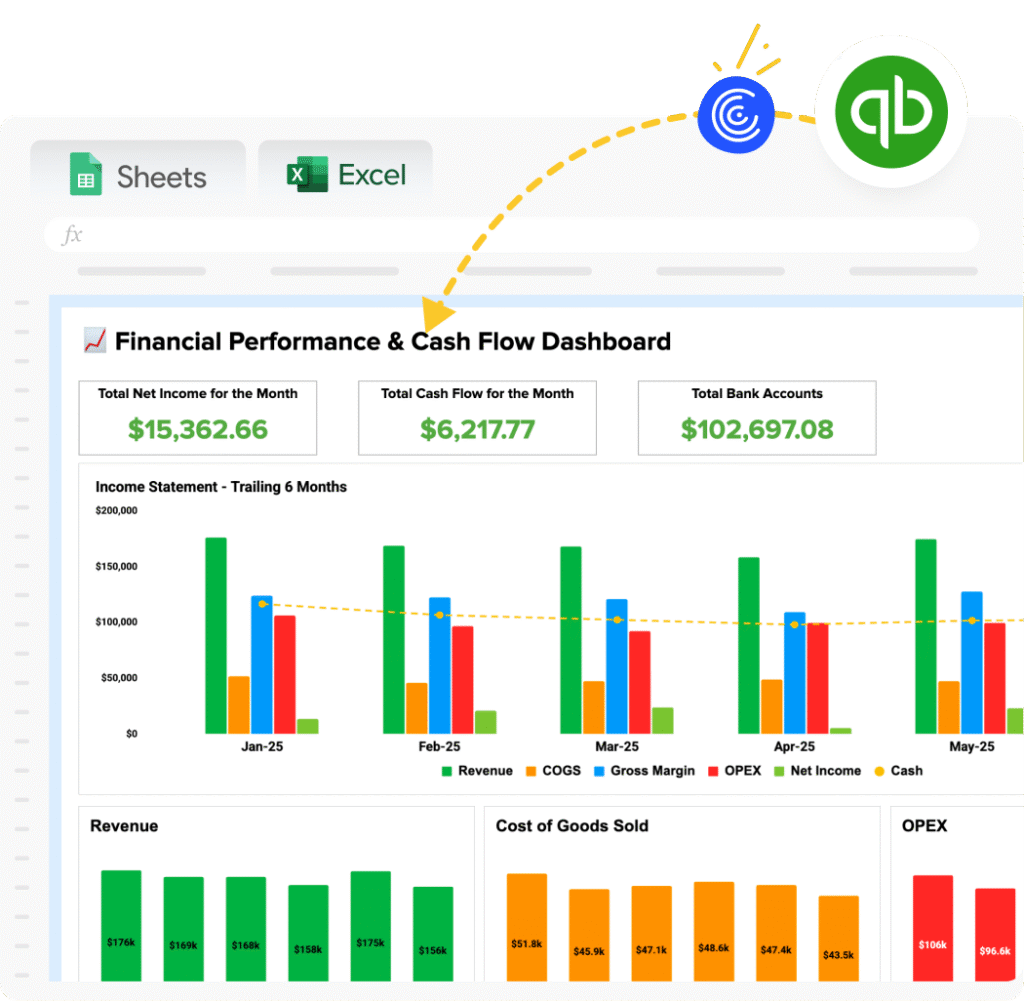
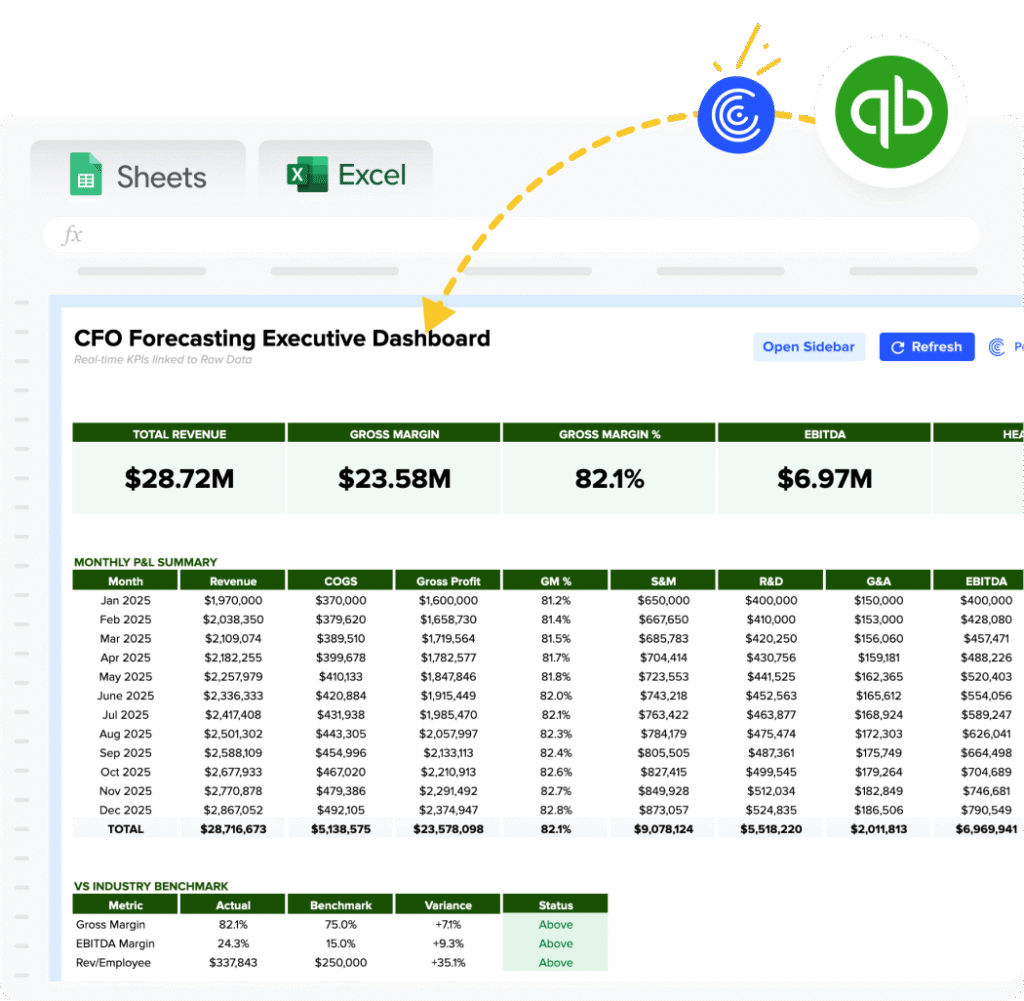
Coefficient connects your ERP directly to Excel or Google Sheets, pulling real-time balance sheet data automatically. Your debt-to-asset ratio updates itself from live accounting data.
This matters for fractional CFOs managing multiple clients or finance teams tracking metrics across entities. Set up once, and your ratios refresh on your schedule—daily, weekly, or monthly. Try Coefficient and eliminate manual data entry.
How to Improve Your Debt-to-Asset Ratio
Reducing your ratio requires lowering debt or growing assets efficiently.
Accelerate debt paydown
Focus extra payments on high-interest debt first. A company paying down $100,000 in debt while maintaining $1.8M in assets will improve its ratio from 44% to 39%—a meaningful improvement that lenders notice.
Build retained earnings
Keep more profits in the business instead of distributing them. Retained earnings increase equity without adding debt, directly improving your ratio.
Increase asset efficiency
Sell underperforming assets and reinvest proceeds into debt reduction. That unused equipment sitting on your books? Convert it to cash and pay down your line of credit.
Delay major purchases
Time large asset acquisitions carefully. If you’re at 65% debt-to-assets, wait until you’ve paid down debt before buying that new building.
Refinance strategically
Convert short-term debt to long-term obligations when possible. While this won’t change your ratio immediately, it improves cash flow and gives you breathing room to reduce total debt over time.
Debt-to-Asset Ratio vs. Debt-to-Equity Ratio vs. Debt Service Coverage Ratio
Finance teams track multiple leverage metrics. Each reveals different risk dimensions.
Debt-to-Asset Ratio
Shows portion of assets financed by debt. Use for solvency analysis and credit applications. Formula: Total Debt ÷ Total Assets.
Debt-to-Equity Ratio
Reveals leverage relative to owner investment. Use for investor due diligence and capital structure decisions. Formula: Total Debt ÷ Shareholders’ Equity.
Debt Service Coverage Ratio
Indicates ability to cover debt payments from operations. Use for loan covenant compliance and cash flow risk assessment. Formula: EBITDA ÷ Debt Payments.
When to use each
Debt-to-asset ratio shows your balance sheet leverage. Debt-to-equity ratio reveals how much creditors have funded versus shareholders. Debt service coverage ratio indicates whether cash flow can support debt payments.
Pro tip for fractional CFOs: Present all three ratios together with context. For example: “Your debt-to-asset ratio of 55% is acceptable for retail, but your debt service coverage of 1.2x is tight. We should focus on improving cash flow before taking on new debt.”
Know your leverage
Understanding your debt-to-asset ratio helps you make smarter financing decisions. Track it monthly alongside other capital structure metrics for a complete financial health picture.
Get started with Coefficient to automate your leverage tracking and focus on strategic decisions instead of manual calculations.
 Sync Live Finance Data into Your Spreadsheet