

DSCR = Net Operating Income / Total Debt Service
Calculate your debt service coverage ratio fast with our free tool. Get the formula, see real examples, and download our free Excel and Google Sheets template built for CFOs and finance teams.
Most lenders want a DSCR of 1.25 or more before they approve a loan.
Debt Service Coverage Ratio Formula Explained
DSCR = Net Operating Income / Total Debt Service
This simple formula tells lenders one thing: can your cash flow cover your debt?
Net Operating Income (NOI): This is your revenue minus operating expenses. Include rent, fees, and other income. Then subtract costs like property tax, insurance, repairs, and staff wages. Don’t include loan payments, taxes on income, or big one-time capital projects.
Total Debt Service: This is every cent you owe on debt each year. Add up your principal payments and interest charges. If you lease equipment or have other fixed payment obligations, those count too.
Why subtract operating expenses but not debt? Because lenders want to see your core business performance before debt eats into it. They need to know if the property or business makes enough money on its own to pay what you owe.
What Is Debt Service Coverage Ratio?
DSCR measures your ability to pay debt with the income you generate. It’s a quick health check for any asset or business that carries loans.
Lenders use it to decide if you’ll make your payments on time. If your DSCR sits above 1.0, you’re making more than you owe. If it’s below 1.0, you’re short each month.
Real estate investors watch DSCR closely. So do small business owners with term loans. It’s one of the first metrics a bank checks.
Who uses this metric?
CFOs and Controllers track DSCR to make sure debt obligations won’t choke cash flow during slow months.
Fractional CFOs monitor it across client portfolios to spot red flags before they become crises.
Commercial Lenders set minimum DSCR thresholds (usually 1.20 to 1.25) as loan covenants.
Real Estate Investors calculate DSCR before they buy a property to ensure rental income can cover the mortgage.
Financial Analysts use DSCR in credit models and stress tests for debt capacity planning.
How to Calculate Debt Service Coverage Ratio: Step-by-Step
Let’s walk through a real calculation using a rental property.
- Gather your financial data
You need your most recent income statement or rent roll. Pull annual numbers for income and expenses, plus your loan payment schedule.
- Calculate Net Operating Income
Start with total revenue. For our example: $450,000 in annual rent. Now subtract operating expenses: $50,000 property tax, $25,000 insurance, $40,000 maintenance, $35,000 property management fees. Total expenses: $150,000.
NOI = $450,000 – $150,000 = $300,000
- Find your total debt service
Look at your loan statements. Add up all principal and interest payments for the year. In our case: $18,000 monthly payment x 12 months = $216,000 annual debt service.
- Apply the formula
Divide NOI by debt service:
DSCR = $300,000 / $216,000 = 1.39
- Interpret the result
A DSCR of 1.39 means you generate $1.39 for every $1.00 of debt payments. That’s a 39% cushion above your obligations.
Most lenders smile at this number. It shows you can handle your debt even if income drops a bit or expenses spike.
How to Interpret Your DSCR Number
Your DSCR tells a clear story about financial health. Here’s what the numbers mean and what you should do at each level.
| Ratio Range | Interpretation | Recommended Actions |
| Below 1.0 | Critical – You’re losing money each month and can’t cover debt payments from income alone. | • Negotiate with lenders immediately<br>• Cut non-essential costs<br>• Consider selling assets or refinancing<br>• Build emergency cash reserves |
| 1.0 – 1.19 | Tight – You break even or have minimal buffer. One bad month could cause a missed payment. | • Monitor cash flow weekly<br>• Reduce operating expenses where possible<br>• Negotiate longer payment terms<br>• Avoid taking on new debt |
| 1.20 – 1.49 | Acceptable – You meet lender minimums but don’t have much room for error. | • Maintain current financial discipline<br>• Build 3-6 months of payment reserves<br>• Look for ways to increase revenue<br>• Review loan terms annually |
| 1.50 – 2.00 | Strong – You have healthy cash flow and can handle unexpected costs or revenue dips. | • Consider strategic growth investments<br>• Maintain but don’t over-focus on ratio<br>• Use excess cash flow wisely<br>• Good position for refinancing |
| Above 2.00 | Excellent – Very strong position. May indicate you’re underleveraged. | • Evaluate if you could deploy cash better<br>• Consider expansion opportunities<br>• Check if you’re missing growth chances<br>• Keep some cushion for downturns |
DSCR Benchmarks by Industry
Different industries have different DSCR norms. What’s strong in retail might be weak in industrial real estate.
| Industry | Typical DSCR Range | Notes |
| Multifamily Residential | 1.20 – 1.30 | Stable income from multiple tenants reduces risk. Lower turnover than other property types. |
| Office Buildings | 1.30 – 1.40 | Tenant concentration and lease rollover risk require higher cushion. Market conditions matter. |
| Retail Properties | 1.30 – 1.50 | Revenue tied to consumer spending. Higher vacancy risk pushes lenders to demand more coverage. |
| Industrial/Warehouse | 1.25 – 1.40 | Long-term leases and stable tenants allow for moderate ratios. E-commerce demand helps. |
| Hotel/Hospitality | 1.40 – 1.50+ | Daily revenue swings and no long-term leases make these riskiest. Lenders want big cushions. |
| Healthcare Facilities | 1.30 – 1.40 | Stable demand but regulatory changes add risk. Insurance reimbursement rates affect NOI. |
| Manufacturing | 1.20 – 1.35 | Capital-intensive with equipment debt. Revenue can be cyclical based on orders. |
| Self-Storage | 1.25 – 1.35 | Low operating costs and high margins, but competition and location drive success. |
These ranges come from commercial lending data across major U.S. markets. Your specific deal might vary based on location, tenant quality, and market conditions.
Why do these ranges differ? It comes down to risk. Hotels have no guaranteed income next month. An apartment building has signed leases. Lenders adjust their standards based on how predictable your cash flow is.
Benchmark Citations
Investopedia – DSCR Definition and Formula
JPMorgan Chase Commercial Real Estate Insights
QuickBooks Guide to DSCR Calculation
Automating DSCR Tracking with Coefficient
Stop exporting CSVs from NetSuite or Sage Intacct every month just to update your DSCR calculation.
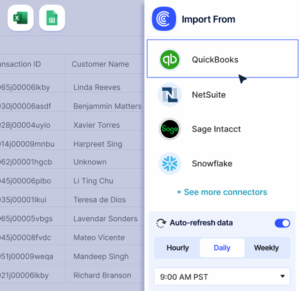
Coefficient connects your accounting system straight to Google Sheets or Excel. Your income, expenses, and debt service numbers flow in automatically. The DSCR formula updates itself with live data.
Set it up once. Your financial ratios refresh on a schedule you choose – daily, weekly, or monthly. No more manual data entry. No more copy-paste errors. No more wondering if you’re looking at last month’s numbers.
Perfect for fractional CFOs managing multiple clients. Build one template, duplicate it for each portfolio company, and monitor every DSCR in real time.
Get started with Coefficient and grab your free DSCR template.
How to Improve Your DSCR
A weak DSCR doesn’t have to stay that way. Here are five moves that actually work.
Increase revenue without adding costs
Raise rents to market rate if you’re below average for your area. Add revenue streams like parking fees, storage, or laundry. Fill vacancies faster with better marketing or lease incentives. Every extra dollar of income boosts NOI and lifts your ratio.
Cut operating expenses
Renegotiate service contracts with vendors. Switch to energy-efficient systems to lower utility bills. Bring some work in-house if contractors cost too much. Review every line item – most properties waste 5-10% on things that don’t add value.
Refinance to lower debt service
If rates have dropped since you took your loan, refinance. Even a 0.5% rate cut on a $2 million loan saves you $10,000 a year. Longer loan terms also reduce annual payments, though you pay more interest over time.
Pay down principal faster
Extra principal payments lower your debt service for next year. If you have excess cash and can’t increase income, this works. Just make sure prepayment penalties don’t eat up your savings.
Sell underperforming assets
Sometimes a property just won’t hit the DSCR you need. Selling it frees up cash and removes a drag on your overall portfolio metrics. Lenders care about your global DSCR across all properties.
DSCR vs. Interest Coverage Ratio vs. Debt-to-Income Ratio
People mix these up all the time. They measure different things.
Debt Service Coverage Ratio (DSCR)
Looks at total debt payments – both principal and interest – compared to operating income. It’s the most complete view of whether you can handle your obligations.
Interest Coverage Ratio
Only checks if you can pay interest, ignoring principal. Formula is EBIT / Interest Expense. Useful for big companies with bonds, less helpful for real estate investors who must pay principal too.
Debt-to-Income Ratio (DTI)
Compares all your debt payments to your gross personal income. Consumer banks use this for mortgages and credit cards. Not the same as DSCR because it includes personal income, not just property income.
When to use each
Use DSCR when you’re evaluating an asset’s ability to carry its own debt. Use DTI when a lender is checking if you personally can afford the payments. They answer different questions.
Pro tip for fractional CFOs: Show clients all three metrics. A business might have a solid DSCR but the owner’s high personal DTI could block financing. Understanding the full picture helps you advise better.
Know your numbers
DSCR gives you and your lenders confidence in your ability to service debt. Track it monthly. Compare it to industry benchmarks. Use it to make better financing decisions.Get started with Coefficient and automate your DSCR tracking today.
 Sync Live Finance Data into Your Spreadsheet