

Budget Variance Formula Explained
Budget Variance = Actual Amount – Budgeted Amount
Or express as a percentage:
Budget Variance % = [(Actual – Budget) / Budget] × 100
Break down each part:
Actual Amount: The real money you spent or earned in a period. Pull this from your accounting system at month-end. Include all transactions that hit your books.
Budgeted Amount: The forecast you set at year start. This came from last year’s data, market trends, and growth plans. Lock this number before the period starts.
Variance: The gap between what happened and what you planned. Positive means you beat budget (good for revenue, bad for costs). Negative means you missed budget (bad for revenue, good for costs).
We subtract budget from actual—not the other way around—to keep the math simple. A $10,000 revenue beat shows as +$10,000. A $5,000 cost overrun shows as +$5,000.
Why percentage matters: A $50,000 variance sounds big until you see it’s 2% of a $2.5M budget. Small percentages on large budgets need less attention than large percentages on small budgets.
What Is Budget vs Actual Comparison?
Budget vs actual comparison measures how well you stuck to your financial plan. You put actual results next to forecasts to find gaps. These gaps tell you if operations ran smoothly or if something broke.
Month-end close brings the comparison to life. Finance pulls actuals from the ERP system. They line up numbers against the budget by department, project, or cost center. Variances pop out immediately.
Most teams run this monthly. Some do it weekly for key metrics. Annual reviews show big-picture trends but miss short-term issues.
Who uses this metric?
CFOs track company-wide performance and explain variances to the board. They adjust forecasts based on what the data reveals.
Controllers dig into department budgets to catch overspending early. They work with managers to fix problems mid-year.
FP&A Analysts build variance reports that highlight trends. They forecast future performance using actual vs budget patterns.
Department Managers monitor their team’s spending against approved budgets. They justify variances and request adjustments when needed.
Fractional CFOs manage variance analysis across multiple client portfolios. They benchmark performance and spot patterns that drive change.
How to Calculate Budget vs Actual: Step-by-Step
Let’s walk through a real example with numbers from a mid-market software company.
- Pull your budget for the period
Your annual budget breaks down by month. For Q2, you planned:
- Revenue: $850,000
- Operating Expenses: $520,000
- Marketing: $85,000
- Salaries: $310,000
- Gather actual results from accounting
Month-end close finished. Your books show:
- Revenue: $782,000
- Operating Expenses: $547,000
- Marketing: $92,000
- Salaries: $308,000
- Calculate dollar variances
Subtract budget from actual for each line:
- Revenue: $782,000 – $850,000 = -$68,000 (unfavorable)
- Operating Expenses: $547,000 – $520,000 = $27,000 (unfavorable)
- Marketing: $92,000 – $85,000 = $7,000 (unfavorable)
- Salaries: $308,000 – $310,000 = -$2,000 (favorable)
- Calculate percentage variances
Divide each variance by budget and multiply by 100:
- Revenue: (-$68,000 / $850,000) × 100 = -8.0%
- Operating Expenses: ($27,000 / $520,000) × 100 = 5.2%
- Marketing: ($7,000 / $85,000) × 100 = 8.2%
- Salaries: (-$2,000 / $310,000) × 100 = -0.6%
- Identify material variances
Set a threshold—say 5% or $25,000. Revenue variance at -8% and -$68,000 crosses both limits. Marketing at 8.2% also demands attention.
- Investigate root causes
Revenue miss: Two large deals pushed to next quarter. One client delayed their project start.
Marketing overspend: Unplanned conference attendance and extra digital ad spend.
- Document findings and adjust forecast
Revenue timing issue means Q3 should beat budget. Marketing overage was one-time. Reforecast shows catch-up by year-end.
How to Interpret Your Budget Variance Numbers
Raw numbers mean nothing without context. A -5% revenue variance might be fine in January but terrible in December. Understanding what each range signals helps you respond correctly.
| Variance Range | Interpretation | Recommended Actions |
| -2% to +2% | On Track – Performance matches forecast within normal fluctuations. Minor timing differences or rounding. | • Monitor monthly trends<br>• Document any patterns<br>• Maintain current controls |
| -5% to -2% or +2% to +5% | Watch Zone – Small deviation that needs attention. Could signal emerging issues or opportunities. | • Review transaction details<br>• Check for timing shifts<br>• Update rolling forecasts<br>• Flag for next review |
| -10% to -5% or +5% to +10% | Action Required – Significant gap between plan and reality. Operational changes or market factors at play. | • Conduct root cause analysis<br>• Adjust spending if needed<br>• Revise forecast assumptions<br>• Report to management |
| Below -10% or Above +10% | Critical – Major deviation demands immediate investigation. Budget assumptions broke down or execution failed. | • Emergency review meeting<br>• Implement corrective plan<br>• Reforecast full year<br>• Consider budget revision |
Revenue variances flip the script. Negative is bad, positive is good. A -8% revenue variance means you’re missing targets. Time to boost sales efforts or adjust expectations.
Expense variances work opposite. Positive means overspending, negative means savings. That +5% marketing variance signals poor cost control or scope creep.
Timing matters more than you think. A -20% variance in January might reverse by February if invoices hit late. Look at year-to-date trends, not single months.
Industry context changes everything. Retail sees wild swings during holiday seasons. SaaS companies face quarterly close patterns. Manufacturing deals with raw material price shocks.
Budget Variance Benchmarks by Industry
Performance standards vary wildly across sectors. What’s acceptable in one industry would trigger alarms in another.
| Industry | Typical Acceptable Variance Range | Notes |
| SaaS / Software | ±3% to ±5% | Predictable recurring revenue model makes tight control possible. Marketing spend can swing wider (±10%) during growth phases. |
| Professional Services | ±5% to ±8% | Project-based work creates natural volatility. Revenue recognition timing and utilization rates drive variances. |
| Manufacturing | ±7% to ±12% | Raw material prices and supply chain disruptions create wider bands. Volume variances amplify with production changes. |
| Retail | ±10% to ±15% | Seasonal patterns and consumer behavior shifts make forecasting hard. Inventory timing affects expense recognition. |
| Healthcare | ±5% to ±10% | Reimbursement timing and patient volume fluctuations impact revenue. Staffing costs remain relatively stable. |
| Construction | ±8% to ±15% | Project delays, weather, and change orders create high variability. Material cost inflation adds uncertainty. |
| Financial Services | ±3% to ±6% | Regulatory requirements and audit scrutiny demand tight controls. Interest rate changes can create revenue swings. |
| Hospitality | ±10% to ±20% | Highly seasonal with external factors (weather, events) driving results. Variable labor costs respond to occupancy. |
Why benchmarks differ
Business model stability determines variance tolerance. Subscription revenue (SaaS) is predictable. Project-based revenue (consulting) swings more.
Capital intensity matters. Manufacturing burns cash on inventory and equipment. Service businesses have lower fixed costs and tighter ranges.
Economic sensitivity varies. Luxury retail feels recessions first. Healthcare demand stays steady. Financial services track market cycles.
Seasonal patterns create expected variances. Retail December beats budget by 30%, then January falls 20% short. Average them to see the real trend.
Benchmark Citations
Numeric Variance Analysis Guide 2025
Vena Solutions Profit Margin Industry Benchmarks
Beebole Budget Variance Best Practices
Automating Budget Variance Tracking with Coefficient
Stop spending hours each month pulling data from NetSuite into Excel. You export CSVs, copy-paste numbers, fix broken formulas, then do it again next month.
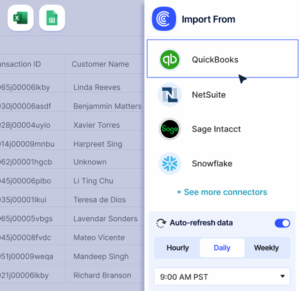
Coefficient connects your ERP directly to Google Sheets or Excel. Budget vs actual calculations update themselves with live data. Set it to refresh daily, weekly, or monthly—your choice.
The benefit hits fast: 15-30 minutes saved per report. No more copy-paste errors. Department managers see current variances without waiting for finance.
Real-time monitoring means problems surface early. A cost overrun that would hide until month-end now shows up on day 15. You can act before it grows.
Get started with Coefficient and automate your variance tracking.
How to Improve Your Budget Variance
High variances signal opportunity. Here’s how to tighten the gap between budget and actual.
Improve your forecasting process
Base budgets on rolling 12-month averages, not last year’s static numbers. Markets change. Customer behavior shifts. Your budget should reflect current reality.
Pull in department managers during budget building. They know operational details finance misses. Their input makes targets realistic and builds buy-in.
Implement monthly rolling forecasts
Lock the annual budget but update your forecast every month. Use actuals from closed months plus revised estimates for open periods.
This approach catches trends early. When Q1 runs hot, you can adjust Q2-Q4 expectations before you’re behind the curve.
Tighten approval controls for large expenses
Require CFO sign-off on purchases over $10,000. This simple rule catches surprise spending before it hits the books.
Add contract review for new vendors. Marketing wants a $50,000 software tool? Finance checks if it fits the budget first.
Run variance analysis more frequently
Monthly reviews catch problems after 30 days of drift. Weekly flash reports on key metrics (revenue, headcount, marketing) spot issues in real-time.
Daily dashboard checks take two minutes. Revenue pacing, cash balance, and top expense categories give you constant awareness.
Build accountability into the process
Assign variance ownership by department. Marketing owns their budget. Sales owns theirs. Each manager explains gaps over ±5% in monthly reviews.
Link bonuses to budget performance. Managers who consistently hit targets get rewarded. Those who miss get coached.
Budget Variance vs Forecast Variance vs Actual vs Prior Year
Finance teams track multiple comparisons. Each tells a different story about performance.
Budget Variance
Budget Variance compares actuals to your original annual plan. This measures how well you executed the strategy you set 12 months ago. Boards and investors focus here.
Example: You budgeted $1M revenue. Actual hit $950,000. Budget variance is -$50,000 or -5%.
Forecast Variance
Forecast Variance compares actuals to your most recent forecast update. This shows if you’re hitting revised expectations. Operational teams watch this closely.
Example: Budget was $1M but you reforecast to $925,000 in Q2. Actual $950,000 beats forecast by $25,000.
Actual vs Prior Year
Actual vs Prior Year tracks year-over-year growth independent of any plan. This reveals true business trajectory without forecast bias.
Example: Last year’s Q2 was $850,000. This year $950,000 is +11.8% growth regardless of budget.
When to use each comparison
Use budget variance for board reporting and annual performance reviews. Investors care about hitting the plan you committed to.
Use forecast variance for operational management and short-term decisions. Finance needs to know if current trends match updated expectations.
Use actual vs prior year for growth analysis and market positioning. When budgets miss the mark, YoY shows if you’re still growing.
Pro tip for fractional CFOs: Present all three in your monthly package. Budget variance for accountability. Forecast variance for operations. YoY for context. This combo answers every stakeholder’s question.
Track what matters
Budget variance shows where reality diverged from your plan. Calculate it monthly. Investigate material gaps. Adjust your forecast based on what you learn.
Small variances compound into big problems if you ignore them. A 3% miss in January becomes 15% by June if nothing changes.
Get started with Coefficient and automate budget variance tracking so problems surface before they grow.
 Sync Live Finance Data into Your Spreadsheet