



Monthly Bookkeeping Cost = Base Fee + (Transaction Volume × Per-Transaction Rate) + Additional Service Fees
Bookkeeping costs eat into your budget fast. Most small businesses spend between $300 and $2,000 per month on bookkeeping services, but pricing varies based on transaction volume, complexity, and service scope.
This calculator helps you estimate costs and track bookkeeping expenses. Download our free Excel and Google Sheets template to calculate and monitor your bookkeeping costs.
Bookkeeping Cost Formula Explained
Monthly Bookkeeping Cost = Base Fee + (Transaction Volume × Per-Transaction Rate) + Additional Service Fees
Let’s break down each component:
Base Fee: The fixed monthly charge for standard bookkeeping services. This covers transaction recording, bank reconciliations, and monthly financial statements. Most services charge between $200-$600 depending on business size.
Transaction Volume: The total number of financial transactions processed monthly. This includes sales, purchases, payments, receipts, and transfers. High-volume businesses (100+ transactions) pay more because each transaction requires categorization and recording.
Per-Transaction Rate: The additional cost for each transaction beyond the base package. Some providers charge $0.50-$2.00 per transaction after a threshold. This variable pricing reflects the actual work required.
Additional Service Fees: Extra charges for specialized services like payroll processing ($40-$150/month), sales tax filing ($50-$200/quarter), or inventory tracking ($75-$250/month). These fees stack on top of the base cost.
We exclude one-time setup fees and catch-up bookkeeping from the monthly formula. Setup fees ($500-$2,000) are paid once. Catch-up work gets billed separately at $50-$150 per hour.
What Is Bookkeeping Cost?
Bookkeeping cost represents the total expense of maintaining accurate financial records. This includes recording transactions, reconciling accounts, generating reports, and ensuring tax compliance.
Unlike accounting, which interprets financial data and provides strategy, bookkeeping handles daily data entry and record maintenance. The cost reflects the time, expertise, and tools required to keep your books clean.
Most businesses outsource bookkeeping to save time. In-house bookkeepers cost $40,000-$55,000 annually plus benefits, while outsourced services run $3,600-$24,000 per year. Cost depends on business complexity and transaction volume.
Who uses this metric?
CFOs and Controllers budget for finance expenses and evaluate outsourcing versus in-house options.
Small Business Owners compare service quotes and track monthly operating expenses.
Finance Managers analyze cost-per-transaction ratios and negotiate contracts.
Fractional CFOs benchmark client costs against industry standards to identify savings.
Accounting Firm Partners price packages and evaluate profitability by client.
How to Calculate Bookkeeping Cost: Step-by-Step
Let’s walk through calculating monthly bookkeeping costs:
- Identify your monthly transaction volume
Count all transactions: sales, purchases, payments, receipts, and transfers. Our example e-commerce business processes 250 transactions monthly.
- Determine your base service package
Most services offer tiered packages. Our business needs monthly reconciliations, statements, and accounts payable support. The base package costs $500 monthly and includes up to 150 transactions.
- Calculate excess transactions
Subtract included transactions from your total:
250 transactions – 150 included = 100 excess transactions
- Apply the per-transaction rate
The service charges $1.50 per additional transaction:
100 excess × $1.50 = $150
- Add additional service fees
Our business needs payroll processing for 8 employees. The service charges $80 monthly for this add-on.
- Calculate total monthly cost
Add all components:
$500 (base) + $150 (excess) + $80 (payroll) = $730 per month
- Interpret the result
At $730 monthly, this business pays $8,760 annually. That’s 2.9 transactions per dollar, which falls within typical range for e-commerce with moderate complexity. The cost is reasonable given transaction volume and payroll needs.
How to Interpret Your Bookkeeping Cost Number
| Cost Range (Monthly) | Interpretation | Recommended Actions |
| Below $200 | Very Low – Likely DIY or basic software only. High risk of errors and incomplete records. | • Evaluate if all transactions are recorded<br>• Check compliance with tax requirements<br>• Consider if growth is constrained by poor visibility |
| $200 – $500 | Budget-Friendly – Appropriate for very small businesses with simple finances. | • Verify monthly reconciliations happen<br>• Ensure statements are accurate<br>• Add services as volume grows |
| $500 – $1,200 | Standard Range – Suitable for most small to mid-size businesses. | • Review transaction volume quarterly<br>• Benchmark against industry standards<br>• Negotiate rates if volume decreases |
| $1,200 – $2,500 | Premium Service – Typical for high volume or complex operations. | • Evaluate ROI on additional services<br>• Consider partial in-house team<br>• Request detailed cost breakdown |
| Above $2,500 | High-End – Either very large operations or overpaying for services. | • Compare quotes from 3+ providers<br>• Analyze cost per transaction<br>• Consider in-house bookkeeper |
Bookkeeping Cost Benchmarks by Industry
Bookkeeping costs vary across industries due to transaction complexity, regulatory requirements, and volume patterns.
| Industry | Typical Monthly Range | Notes |
| Professional Services | $300 – $700 | Low volume, mostly receivables and payables. Simple chart of accounts. |
| E-commerce / Retail | $600 – $1,400 | High volume, inventory tracking, multi-state sales tax, payment processors. |
| Restaurants | $500 – $1,300 | Daily cash reconciliation, inventory, tip reporting, multiple payment methods. |
| Construction | $650 – $1,500 | Job costing, work-in-progress, retainage, equipment depreciation. |
| Healthcare | $500 – $1,200 | Insurance billing, patient payments, HIPAA compliance, multiple revenue streams. |
| Real Estate | $400 – $1,000 | Property-level tracking, rent collection, security deposits, maintenance. |
| Manufacturing | $700 – $1,600 | Raw materials, work-in-progress, finished goods, cost allocation. |
| SaaS / Software | $400 – $900 | Subscription revenue recognition, deferred revenue, minimal inventory. |
Professional services pay the least due to straightforward financials. Construction and manufacturing pay more for job costing and inventory complexity. E-commerce faces high costs from volume and multi-state sales tax.
Location impacts costs too. Services in New York, San Francisco, and Boston charge 20-30% more than smaller markets. Remote services offer the best value.
Benchmark Citations
NerdWallet Bookkeeping Pricing Study 2025
RemoteBooksOnline Cost by State Analysis
Clutch Bookkeeping Pricing Guide 2025
Automating Bookkeeping Cost Tracking with Coefficient
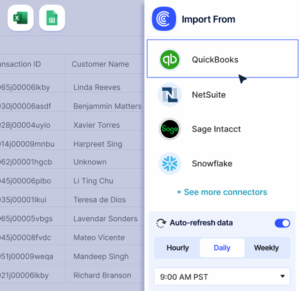
Stop exporting bookkeeping invoices to CSV files monthly. Coefficient connects your accounting system directly to Excel or Google Sheets, pulling invoice data and expense categorizations automatically. Your cost analysis updates itself with live data.
Build dashboards tracking month-over-month trends, calculate cost-per-transaction ratios, and compare spending against budgets. Schedule automatic refreshes so reports stay current without manual work. Perfect for fractional CFOs tracking costs across client portfolios.
Get started with Coefficient and automate your bookkeeping cost tracking.
How to Improve Your Bookkeeping Cost Efficiency
Reduce transaction volume through automation
Implement automated payment systems for recurring expenses. Many businesses cut costs by 15-20% by reducing manual transactions. Set up automatic bill pay for rent, utilities, and subscriptions to eliminate dozens of monthly entries.
Negotiate service terms based on volume
Track your actual monthly transaction volume for three months, then negotiate a package matching your needs. If volume dropped from 200 to 150 transactions, request a tier adjustment. This saves $100-$200 monthly.
Standardize processes and chart of accounts
Clean categorization reduces bookkeeper hours. Create vendor rules that automatically categorize recurring expenses. Simple organization cuts review time by 25-30%, directly reducing costs.
Bundle services for volume discounts
Adding payroll or sales tax filing to your bookkeeping contract costs less than buying separately. Providers discount bundled services by 10-20%. A business paying $500 for bookkeeping and $150 for payroll separately might get both for $550 bundled.
Move to modern cloud accounting software
Legacy systems require more manual intervention. Cloud platforms like QuickBooks Online or Xero automate bank feeds and reconciliations. Switching can reduce monthly costs by $150-$300.
Bookkeeping Cost vs. Accounting Cost vs. CFO Services Cost
Businesses often confuse bookkeeping, accounting, and CFO services. Understanding the distinctions helps you buy the right services without overpaying.
Bookkeeping Cost
Bookkeeping Cost focuses on transaction recording. Services include categorizing expenses, reconciling accounts, and generating statements. Pricing ranges from $300-$2,000 monthly. You’re paying for accurate records and compliance readiness. Best for businesses needing clean books for taxes.
Accounting Cost
Accounting Cost includes bookkeeping plus analysis and tax planning. Accountants interpret data and provide recommendations. Services cost $500-$3,000 monthly or $2,000-$10,000 annually for tax prep. You’re paying for expertise and strategic insight. Best for businesses optimizing financial performance.
CFO Services Cost
CFO Services Cost provides executive financial strategy, forecasting, and fundraising support. Fractional CFOs charge $3,000-$15,000 monthly. Full-time CFO salaries range from $150,000-$400,000 annually. You’re paying for strategic leadership. Best for scaling businesses with complex financial decisions.
Pro tip for fractional CFOs: Clarify what’s included in client bookkeeping packages. Many businesses overpay by having CPAs do data entry at $200/hour when bookkeepers could handle it for $50/hour.
Control your bookkeeping costs
Bookkeeping costs don’t need to spiral. Calculate what you actually need. Match services to transaction volume. Automate where possible. Negotiate based on real usage patterns.
Track your cost-per-transaction monthly. When it climbs above industry benchmarks, audit your service package and cut what you don’t use.Get started with Coefficient and turn bookkeeping cost tracking into a system that runs itself.
 Sync Live Finance Data into Your Spreadsheet