

Average Variable Cost = Total Variable Costs ÷ Quantity of Output
Your costs change with each unit you make or sell. But how much does each unit really cost? This free average variable cost calculator cuts through the noise. You’ll learn how to calculate, interpret, and track your variable costs per unit.
We’ve also included a free Excel and Google Sheets template you can download and use today.
Average Variable Cost Formula Explained
Average Variable Cost = Total Variable Costs ÷ Quantity of Output
Let’s break down each component:
Total Variable Costs: All costs that change with production volume. This includes raw materials needed for each unit, direct labor tied to production output, sales commissions based on units sold, packaging and shipping costs, and production utilities that scale with volume. These costs rise when you make more and fall when you make less.
Quantity of Output: The total number of units produced or sold in a period. Count finished goods that left your production line, not work in progress. Use the same time frame as your cost data—if costs are monthly, output should be monthly too.
Why we divide these: This gives you the cost per unit. A company spending $50,000 on variable costs to make 5,000 units has an average variable cost of $10 per unit. That $10 is your baseline—sell below it and you lose money on every sale.
What Is Average Variable Cost?
Average variable cost measures what each unit costs to produce. It’s your variable spending divided by your output. This tells you the minimum price needed to cover direct production costs.
Also called variable cost per unit or unit variable cost, this metric changes as production scales. Make more units and your per-unit cost might drop due to bulk material discounts or better labor efficiency. Make fewer units and costs per unit often rise because fixed overhead gets spread across less output.
Who uses this metric?
CFOs and Controllers use it for pricing strategy and margin analysis across product lines.
Cost Accountants track it to identify production inefficiencies and cost overruns.
Operations Managers monitor it to optimize production schedules and supplier contracts.
Fractional CFOs compare it across clients to spot outliers and improvement areas.
Product Managers analyze it when deciding which products to promote or discontinue.
How to Calculate Average Variable Cost: Step-by-Step
Let’s walk through a real calculation for a mid-sized manufacturer:
- Pick your time period
Choose a consistent period—month, quarter, or year. We’ll use one month for this example.
- List all variable costs
For March, our manufacturer had:
- Raw materials: $85,000
- Direct labor: $42,000
- Sales commissions: $8,500
- Packaging: $12,000
- Shipping: $6,500
- Add up total variable costs
$85,000 + $42,000 + $8,500 + $12,000 + $6,500 = $154,000 in total variable costs
- Count units produced
In March, the plant produced 7,000 finished units.
- Apply the formula
Average Variable Cost = $154,000 ÷ 7,000 = $22.00 per unit
- Verify the number makes sense
At $22 per unit, check this against your selling price. If you sell for $45 per unit, you have $23 in contribution margin before fixed costs. That’s healthy.
- Interpret the result
Your floor price is $22. Sell below that and you lose money on each sale. Price above $22 and each unit contributes toward fixed costs and profit. Watch this number monthly—rising average variable cost signals trouble with suppliers, labor, or waste.
How to Interpret Your Average Variable Cost Number
Context matters when evaluating your average variable cost. Express it as a percentage of your selling price to understand margin pressure.
| AVC as % of Price | Interpretation | Recommended Actions |
| Below 40% | Strong unit economics – High contribution margin provides cushion for fixed costs and profit. | • Maintain quality standards<br>• Consider strategic price increases<br>• Invest in growth and capacity<br>• Build cash reserves |
| 40% – 55% | Healthy range – Good balance between costs and pricing power. | • Monitor trends quarterly<br>• Look for small efficiency gains<br>• Maintain supplier relationships<br>• Track competitor pricing |
| 55% – 70% | Moderate pressure – Limited room for fixed costs and profit. Rising variable costs or pricing pressure. | • Renegotiate supplier contracts<br>• Find material substitutes<br>• Improve labor productivity<br>• Review pricing strategy |
| 70% – 85% | Warning zone – Minimal contribution margin. Vulnerable to cost shocks or market changes. | • Audit all variable costs immediately<br>• Reduce waste and scrap rates<br>• Consider price increases<br>• Evaluate product viability |
| Above 85% | Crisis level – Little to no margin. Each sale barely covers variable costs, leaving almost nothing for fixed costs. | • Implement emergency cost cuts<br>• Raise prices or exit product line<br>• Find cheaper suppliers urgently<br>• Review entire business model |
Average Variable Cost Benchmarks by Industry
Variable costs vary widely by business model. Capital-heavy industries spend less on variable costs as a percent of revenue because fixed costs dominate. Service businesses spend more on variable costs since labor scales with output.
| Industry | AVC as % of Revenue | Notes |
| SaaS / Software | 15% – 30% | Hosting, support, and payment processing scale with customers but overall low variable costs |
| Manufacturing | 40% – 60% | Raw materials and direct labor are primary variable costs; bulk purchasing lowers per-unit costs |
| Retail | 55% – 70% | Cost of goods sold is main variable cost; margins depend on product category and volume |
| Restaurants | 50% – 65% | Food costs 28-35% plus labor 25-35%; total variable costs dominate the cost structure |
| Healthcare Services | 35% – 50% | Medical supplies and staff costs vary with patient volume; regulatory costs are often fixed |
| Construction | 45% – 65% | Materials and subcontractor labor are highly variable; project-based cost structures |
| Professional Services | 60% – 75% | Labor is the dominant variable cost; low material costs but high staff expenses |
| Hospitality | 40% – 55% | Room costs are mostly fixed but F&B and housekeeping scale with occupancy |
Manufacturing companies spend roughly 42% of revenue on materials and 15% on labor, totaling about 57% for key variable costs. Restaurant food costs run 28-35% of revenue with labor at 25-35%, putting total variable costs at 53-70%. SaaS companies showed average variable costs around 12.5% of revenue in recent benchmarks, though AI costs are pushing this higher.
Benchmark Citations
Wall Street Prep – Average Variable Cost
APQC – Manufacturing Cost Benchmarks
CBRE – Hospitality Operating Costs 2024
Automating Average Variable Cost Tracking with Coefficient
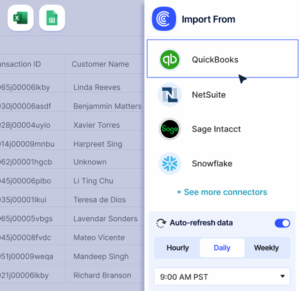
Stop pulling CSV files from your ERP every month. Coefficient connects QuickBooks, NetSuite, Sage Intacct, or Xero directly to your spreadsheets. Your cost data flows automatically into your average variable cost calculations.
Set it up once and your formulas update themselves. Schedule daily, weekly, or monthly refreshes. Build dashboards that track per-unit costs across product lines without touching a CSV file. Perfect for fractional CFOs managing multiple clients from one platform.
Get started with Coefficient to automate your cost tracking.
How to Improve Your Average Variable Cost
Reducing your average variable cost directly improves margins. Here’s how to do it:
Negotiate bulk purchase agreements
Lock in volume discounts with your top three suppliers. A 5% material cost reduction drops a $20 average variable cost to $19 when materials are 50% of variable costs. Commit to quarterly or annual volumes in exchange for better pricing.
Reduce material waste and scrap rates
Track your scrap percentage monthly. If you’re wasting 8% of raw materials, cutting that to 5% saves real money. Install better quality controls, train staff on waste reduction, and measure waste by shift or line to find problems.
Optimize labor productivity
Measure output per labor hour. If one shift produces 80 units per hour and another produces 65, find out why. Better training, equipment maintenance, or workflow changes can boost the slower shift without adding headcount.
Switch to lower-cost suppliers for non-critical inputs
Audit every purchased component. Secondary materials like packaging, fasteners, or basic supplies often have cheaper alternatives that don’t affect quality. Test alternatives on small batches first.
Automate repetitive production tasks
Labor costs drop when machines handle repetitive work. A $50,000 investment in automation that cuts labor costs by $15,000 annually pays back in 3.3 years while locking in lower variable costs permanently.
Average Variable Cost vs. Total Variable Cost vs. Marginal Cost
People confuse these three metrics constantly. Each measures something different.
Average Variable Cost
Divides total variable costs by units produced. It’s your typical per-unit variable cost. Use this for pricing decisions and margin analysis. Example: $100,000 in variable costs ÷ 5,000 units = $20 average variable cost.
Total Variable Cost
The sum of all costs that change with output. It’s the numerator in the average variable cost formula. Use this for budgeting and cash flow planning. Example: Raw materials $60,000 + Direct labor $30,000 + Commissions $10,000 = $100,000 total variable costs.
Marginal Cost
The cost to produce one additional unit. It includes both variable and fixed costs at the margin. Use this for production volume decisions. Example: Making unit 5,001 might cost $19 if you get efficiency gains, or $23 if you’re hitting capacity constraints.
When to use each
Most clients misuse these terms. When a client says “our marginal cost is $15,” they usually mean average variable cost. Marginal cost requires more complex analysis since it changes at different production levels. For most pricing and profitability discussions, average variable cost is the right metric.
Pro tip for fractional CFOs: Most clients misuse these terms. When a client says “our marginal cost is $15,” they usually mean average variable cost. Marginal cost requires more complex analysis since it changes at different production levels. For most pricing and profitability discussions, average variable cost is the right metric.
Control Your Costs
Average variable cost below 55% of selling price signals healthy unit economics. Above 70% demands immediate action on costs or pricing.
Track this metric monthly by product line. Aggregate numbers hide problems when one product shows 85% variable costs while others stay at 45%. Find the outliers and fix them.Get started with Coefficient to automate your cost tracking and spot margin erosion before it becomes a crisis.
 Sync Live Finance Data into Your Spreadsheet