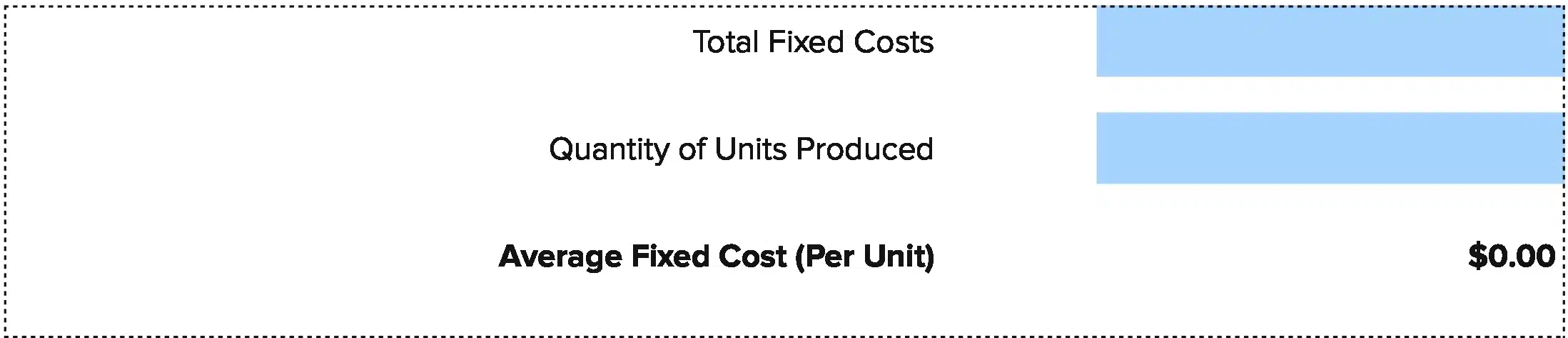




Average Fixed Cost (AFC) = Total Fixed Costs ÷ Units Produced
This free average fixed cost calculator cuts the math and saves time. You’ll learn how to calculate, interpret, and track cost per unit as your business scales. We’ve included a free Excel and Google Sheets template you can download and use today.
Master this metric and improve your margins.
Average Fixed Cost Formula Explained
Average Fixed Cost (AFC) = Total Fixed Costs ÷ Units Produced
Here’s what each part means:
Total Fixed Costs: Costs that stay the same no matter how much you make. Rent, property tax, insurance, base salaries, depreciation, and software fees all count as fixed costs.
Units Produced: Total units made or services done in a set time. Count products, service hours, or finished projects.
Why it matters: More production spreads fixed costs wider. Cost per unit drops. A plant with $50,000 rent pays less per unit at 10,000 units than at 1,000 units.
Alternative formula: AFC = Average Total Cost – Average Variable Cost. Use this when you know your other cost metrics.
What Is Average Fixed Cost?
Average fixed cost shows how much fixed expense hits each unit. It’s your overhead burden per unit.
You pay $10,000 rent to make 100 widgets or 1,000 widgets. At 100 units, rent is $100 per widget. At 1,000 units, rent drops to $10 per widget. AFC tracks this.
Who uses this metric?
CFOs and Controllers use AFC to evaluate pricing strategies and determine break-even points for new products or services.
Cost Accountants track AFC to analyze manufacturing efficiency and allocate overhead costs across product lines.
Operations Managers monitor AFC to make decisions about scaling production and capacity utilization.
Fractional CFOs use AFC across multiple clients to identify scaling opportunities and pricing inefficiencies.
Business Owners rely on AFC to understand how fixed costs impact profit margins at different production volumes.
How to Calculate Average Fixed Cost: Step-by-Step
Let’s walk through calculating AFC with a real example from a small manufacturing business:
- Pick your time period
Use one month. All costs and output must match the same month.
- List fixed costs
Pull from your ledger:
- Rent: $8,000
- Depreciation: $2,500
- Insurance: $800
- Salaries: $12,000
- Software: $700
- Add them up
$8,000 + $2,500 + $800 + $12,000 + $700 = $24,000 total
- Count units made
Check your records. This month: 2,000 units
- Do the math
$24,000 ÷ 2,000 = $12.00 per unit
- Compare months
Last month: 1,500 units with same $24,000 fixed costs.
$24,000 ÷ 1,500 = $16.00 per unit
- Read the result
AFC fell from $16.00 to $12.00 when output rose by 500 units. This $4.00 drop per unit boosts margins. At $50 sale price, profit per unit jumped from $34 to $38.
How to Interpret Your Average Fixed Cost Number
Your AFC tells you how efficiently you’re spreading overhead across production.
| AFC Range | Interpretation | Recommended Actions |
| Above $50 per unit | High burden – Volume too low. Risk of losses. | • Cut fixed costs where possible<br>• Boost production volume<br>• Review pricing to cover overhead<br>• Consider outsourcing |
| $20 – $50 per unit | Moderate – Room to improve through scale. | • Find ways to lift output<br>• Check which fixed costs add value<br>• Track AFC monthly<br>• Compare to industry peers |
| $10 – $20 per unit | Healthy – Good balance. Solid position. | • Keep current levels<br>• Watch for seasonal swings<br>• Plan growth carefully<br>• Invest savings in growth |
| $5 – $10 per unit | Strong – Great economies of scale. | • Keep volume steady<br>• Watch quality at high volume<br>• Price to win market share<br>• Add product lines |
| Below $5 per unit | Optimal – Near full capacity. Maximum efficiency. | • Keep quality high<br>• Plan for constraints ahead<br>• May need more facilities<br>• Strong profit position |
Note: These are guides only. Heavy industries have higher AFC than service firms. Compare to your own industry peers.
Average Fixed Cost Benchmarks by Industry
Your AFC needs context. Here’s how fixed costs break down by industry as percent of revenue.
| Industry | Fixed Cost % | AFC Range | Notes |
| Manufacturing | 25-35% | $8-$25 per unit | Heavy facility and equipment costs. AFC drops fast with volume. |
| SaaS / Software | 15-25% | $2-$8 per user | Low facility costs but high dev salaries. Most costs in R&D. |
| Retail | 20-30% | Varies | Store rent and staff wages are biggest fixed costs. |
| Healthcare | 35-45% | $50-$150 per visit | High facility and equipment costs. Labor 40-45% of revenue. |
| Hospitality | 30-40% | $25-$60 per night | Property, staff, utilities mostly fixed. Occupancy drives AFC. |
| Construction | 15-25% | Varies by job | Equipment and office costs. Many costs scale with projects. |
| Restaurants | 25-30% | $3-$12 per meal | Rent and kitchen staff fixed. Food costs 28-32% of revenue. |
| Professional Services | 10-20% | $5-$15 per hour | Lowest ratio. Office and admin staff are main fixed costs. |
Why benchmarks vary: Capital intensity drives differences. Manufacturing and healthcare need costly facilities and equipment. These create high fixed costs that get covered no matter the output. Service firms need less infrastructure, so they carry lighter fixed costs.
Labor structure matters. Firms with salaried staff (healthcare, SaaS) carry higher fixed costs than those using hourly workers. A restaurant sends servers home on a slow night. A hospital keeps fixed nursing staff no matter what.
Business model shapes AFC. Subscription models (SaaS, gyms) predict volume better and plan fixed costs well. Project firms (construction, consulting) face swings in demand but keep fixed costs low to stay agile.
Benchmark Citations
Projection Hub: Manufacturing Industry Financial Statistics
Wall Street Prep: Average Fixed Cost Formula
NetSuite: Payroll Percentage by Industry
Automating Average Fixed Cost Tracking with Coefficient
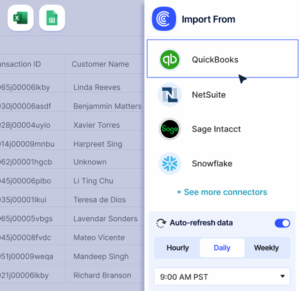
Stop pulling CSV files each month. Coefficient links NetSuite, Sage Intacct, QuickBooks, or Xero to your sheets. Fixed costs and output import on their own.
Set your AFC formula once. Coefficient keeps data fresh. Your numbers update themselves. No manual work. No paste errors.
Save 20-30 minutes monthly. Track AFC with live dashboards. Compare across products and time. Great for fractional CFOs with many clients.
Get started with Coefficient to automate your cost tracking.
How to Improve Your Average Fixed Cost
Lower AFC boosts profit margins. Here are five ways:
Boost production without adding capacity
Best option if you have spare capacity. Make more units to spread fixed costs wider. Each unit drops AFC. A plant at 60% capacity can add 40% volume without new facility costs. AFC falls fast.
Cut facility costs
Rent hits AFC hard at low volumes. Talk to your landlord 6-12 months before lease ends. Downsize if you use less than 70% of your space. Remote work cuts office rent 30-50% for service firms.
Turn fixed costs into variable costs
Lease equipment instead of buying. Use hourly staff for part-time roles. Hire contract workers for tasks outside your core work. Each swap adds flex and cuts AFC risk when sales slow.
Spread fixed costs across more products
Launch new products using current space and gear. This spreads fixed costs over more sales. A bakery adding lunch items uses the same kitchen and staff. Each new line cuts AFC for all products.
Cut or automate fixed costs
Check fixed costs each quarter. Cancel unused software, old insurance, or weak services. Automate work that needs salaried staff now. Each dollar saved goes to profit and cuts AFC for good.
Average Fixed Cost vs. Average Variable Cost vs. Average Total Cost
Know how these three metrics work together.
Average Fixed Cost (AFC)
Total fixed costs divided by units made. Falls as you make more units. You spread the same fixed costs wider. Example: $10,000 rent ÷ 1,000 units = $10.00 per unit AFC. Best for understanding overhead burden and break-even analysis.
Average Variable Cost (AVC)
Total variable costs divided by units made. Stays flat or rises slightly at high volumes. Variable costs move with output. Example: $5.00 materials + $3.00 labor = $8.00 per unit AVC. Best for marginal cost decisions and pricing incremental units.
Average Total Cost (ATC)
Total costs divided by units made. Or AFC + AVC. Combines both cost types. Example: $10.00 AFC + $8.00 AVC = $18.00 per unit ATC. Best for full cost pricing and profitability analysis.
When to use each
AFC decreases with increased production (economies of scale). AVC stays flat or increases slightly. ATC decreases then may increase (U-shaped curve).
Pro tip for fractional CFOs: Present all three metrics together when analyzing client profitability. Show the client that while AVC might be $12 per unit (covering materials and labor), the ATC of $24 per unit reveals they need higher pricing or volume to cover the $12 AFC. This full picture often surprises clients who focus only on direct costs and ignore the fixed cost burden.
Scale smarter
Track AFC monthly. Compare across time periods. Use the data to make better decisions about pricing, capacity, and growth.Get started with Coefficient to automate your cost tracking and stop the manual spreadsheet work.
 Sync Live Finance Data into Your Spreadsheet