Free Cash Flow Forecasting Tool
Input your starting balance and expected inflows/outflows. We'll chart your projected cash position in under a minute.
The amount of cash on hand today.
Average incoming cash (sales, payments, etc.).
Average outgoing cash (expenses, payroll, etc.).
How far ahead to project.
Monthly change in inflows/outflows.
Cash Flow Results

Forecast is empty.
Click Build my forecast to generate your visualization.
Summary Stats
Cash at end of period
$---
Lowest balance
$---
When (if) balance < 0
NIL
Average monthly net change
$---


Trusted by Finance Leaders
See how companies are saving time and making better decisions with Coefficient
Cyrq Energy
Sam Sholeff, Director of Finance
"We were able to recreate reports on our NetSuite data in days with Coefficient. This took us months to build with other database query tools. Our spreadsheets are now faster, more accurate, and easier to update."
Impact
$50K+
Saved annually
Key Achievement
Months of work
Rebuilt in days
Thornton Capital
Mike Lynch, CFO
"Coefficient helped us cut month-end close for our clients from 10 to 3 days. What used to take weeks of manual work now happens in a few clicks. It's the single greatest return on investment I've made this year."
Impact
10 to 3 days
Month-end close
Monthly Savings
20+ hrs
Per month
Why Finance Teams Choose Coefficient
Connect your data, build better reports, and make smarter decisions faster
Automate Financial Reporting
Automate reporting workflows by connecting spreadsheets to live data from NetSuite, powering everything from month-end close to FP&A models.
Enable Self-Service Analytics
Empower your finance and operations teams with self-service reporting without relying on IT or expensive BI tools.
Unify Data Across Systems
Connect and blend sales, financial, and operational data directly in spreadsheets for faster strategic decisions.

How to Automate Your Month End Close Process
Allison James, CFO, CPA, and AI Enthusiast, will walk you through her finance automation process that transformed her team from report-builders into strategic advisors.
- Identify the key metrics that matter for your business
- Build accurate financial models without complex spreadsheets
- Make data-driven decisions with confidence
- Real-world examples from successful startups
Free Cash Flow Forecasting Tool | Project Your Business Cash Flow
Cash flow kills more businesses than profitability. You can show profits while running out of cash to pay bills. Without accurate cash flow forecasting, companies face unexpected shortfalls that threaten operations. Manual forecasting in spreadsheets takes hours and quickly becomes outdated.
This free cash flow forecasting tool helps small business owners and finance teams project future cash flow instantly. Learn the forecasting process, essential components, and how to automate cash flow management with real-time data.
Step-by-step cash flow forecasting process
Building accurate cash flow projections requires systematic data collection and analysis. Follow this forecasting process to predict cash positions and avoid cash shortages.
1. Start with your current cash balance.
Pull your actual cash balance from bank accounts and cash equivalents. This becomes your baseline for cash flow projections.
2. List all expected inflows by timing.
Document receivable collections, customer payments, loan proceeds, and investment income. Include payment terms and historical collection patterns for forecasting accuracy.
3. Map out all planned outflows.
Detail payroll dates, vendor payments, rent, loan payments, and tax obligations. Include both fixed and variable costs with specific payment dates.
4. Apply collection and payment patterns.
Use historical data to adjust timing. If customers typically pay in 45 days, shift revenue accordingly. This improves cash flow forecasting accuracy significantly.
5. Create multiple scenarios.
Build best-case, worst-case, and most likely cash flow models. Vary collection rates and expense timing to understand potential shortfalls.
6. Calculate running cash balance.
Subtract outflows from inflows for each period. Add to previous balance. This shows when cash positions turn negative.
7. Identify and plan for shortfalls.
Mark periods where cash balance goes negative. Plan financing, payment delays, or collection acceleration to cover gaps.
8. Update forecasts with actual data.
Replace projections with real results weekly. This rolling forecast approach improves accuracy over time.
Components of a cash flow forecast
Effective cash flow forecasting requires tracking specific financial data categories. Each component directly impacts liquidity and business decisions.
Operating cash inflows
Include customer payments, cash sales, and service revenue. Track payment terms, collection rates, and seasonal patterns. For accurate cash flow data, monitor accounts receivable aging and customer payment history. Small business owners should note which customers pay early, on-time, or late consistently.
Operating cash outflows
Cover payroll, rent, utilities, inventory purchases, and operating expenses. Fixed costs like rent are predictable. Variable costs need historical data for accurate projections. Include tax payments, insurance premiums, and other periodic expenses that impact cash flow management.
Financing activities
Include loan proceeds, loan payments, investor funding, and dividend distributions. These significantly impact cash positions but occur less frequently. Track principal and interest separately for better financial planning.
Investment activities
Cover equipment purchases, software subscriptions, and capital improvements. These outflows often represent large, irregular amounts that require advance cash flow planning to avoid shortages.
Timing adjustments
Transform accrual-based projections into cash-based forecasts. Revenue becomes cash when collected, not when earned. Expenses impact cash when paid, not when incurred. This timing difference is critical for accurate cash flow statements versus income statements.
How to set up an automated cash flow tracker in spreadsheets?
Manual cash flow forecasting in Excel becomes obsolete quickly. Coefficient transforms spreadsheets into real-time cash flow management dashboards by connecting directly to QuickBooks, Xero, and ERP systems.
Pull bank accounts, receivables, and payables automatically. Our cash flow forecasting tool updates projections as transactions post. No more data entry or manual updates. The dashboard shows current cash positions, upcoming inflows and outflows, and projected shortfalls instantly.
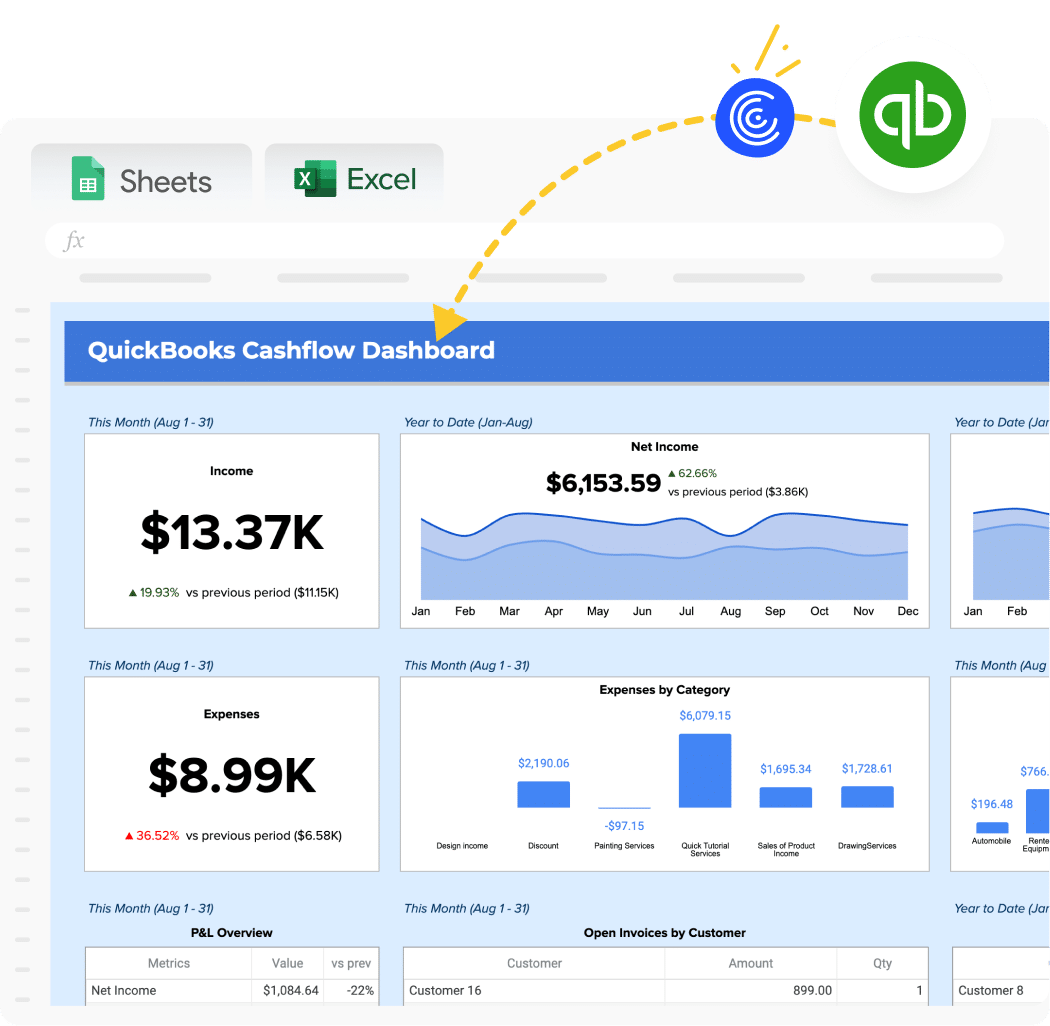
Access the automated cash flow template →
This forecasting solution uses machine learning to improve accuracy based on your historical data. Real-time data feeds ensure informed decisions. CFOs and finance teams monitor liquidity without manual spreadsheet updates.
Cash flow forecasting for different business models
Cash flow patterns vary dramatically across business models. Understanding your specific cycle improves forecasting accuracy and financial health.
SaaS / Subscription business
SaaS businesses enjoy predictable monthly recurring revenue but face upfront customer acquisition costs. Cash flow forecasting focuses on MRR, churn, and CAC payback periods. Annual prepayments create positive cash flow but complicate revenue recognition. Model expansion revenue and contraction separately. Track collection timing since failed payments impact cash immediately. Use cohort analysis for accurate long-term projections.
Professional services
Service firms experience uneven cash flow based on project milestones and client payment terms. Forecast using project pipeline, utilization rates, and historical collection patterns. Large projects create lumpy inflows. Model retainer clients separately from project work. Include work-in-progress that converts to receivables. Plan for seasonal slowdowns and client concentration risk.
Product / E-commerce
E-commerce cash flow depends on inventory turns, payment processing timing, and seasonal demand. Include manufacturing lead times and supplier payment terms. Model returns and refunds explicitly. Factor marketplace payout schedules. Holiday seasons create major cash needs months before revenue arrives. Track unit economics carefully as growth often consumes cash.
Manufacturing
Manufacturers face long cash conversion cycles. Raw material purchases, production time, and customer payment terms create significant working capital needs. Forecast using production schedules, supplier terms, and customer contracts. Include equipment financing and maintenance costs. Model different capacity utilization scenarios. Track inventory levels closely as excess inventory destroys cash flow.
Frequently asked questions
What's the difference between cash flow and profit?
Profit shows revenue minus expenses on an accrual basis. Cash flow tracks actual money movement in and out of bank accounts. Profitable companies can fail from poor cash flow management. You might show profit while awaiting customer payments, but still lack cash for payroll. Cash flow forecasting prevents these dangerous mismatches between profitability and liquidity.
How far ahead should I forecast cash flow?
Most businesses forecast 13 weeks for short-term cash flow management. This covers immediate obligations while remaining accurate. Annual projections help with financial planning but lose precision. Weekly forecasts for the next quarter provide optimal balance. Update weekly, extending the forecast to maintain a rolling 13-week view. High-growth companies may need daily cash positions for the next 30 days.
What's a good cash runway for a startup?
Startups should maintain 6-12 months of cash runway minimum. This provides buffer for pivots, slower sales, or funding delays. Calculate runway by dividing cash balance by monthly burn rate. Include committed funding but not hoped-for revenue. Conservative cash flow planning assumes revenue arrives late and expenses hit early. Better to have excess runway than face emergency fundraising.
How do I forecast cash flow with irregular income?
Use probability-weighted scenarios for irregular income. Assign percentages to potential deals or projects based on historical close rates. Create multiple cash flow models: guaranteed income only, probable income (>75% likely), and possible income (<50% likely). This approach prevents optimistic forecasting. Update probabilities weekly as deals progress. Always plan expenses against guaranteed income only.
What's the difference between direct and indirect cash flow forecasting?
Direct forecasting lists actual expected cash receipts and payments. You project each invoice collection and bill payment specifically. This method works for short-term forecasting with detailed visibility. Indirect forecasting starts with net income and adjusts for non-cash items. This approach suits longer-term projections where specific transaction timing is unknown. Most businesses combine both methods for comprehensive cash flow projections.
How often should I update my cash flow forecast?
Update cash flow forecasts weekly at minimum. Daily updates during cash crunches or high-growth periods. Replace projected data with actuals as transactions occur. Extend forecast period to maintain consistent forward visibility. Automated cash flow forecasting software enables real-time updates without manual work. Regular updates improve forecasting accuracy and enable quick decision-making when cash positions change.
Can I automate cash flow forecasting in Excel or Google Sheets?
Yes, modern tools connect Excel and Google Sheets to QuickBooks, Xero, and ERP systems for automated forecasting. Pull real-time data from bank accounts, receivables, and payables automatically. Templates with built-in formulas calculate projections instantly. APIs eliminate manual data entry. This automation transforms static spreadsheets into dynamic cash flow forecasting tools with live dashboards and metrics.
What systems should I connect for automated cash flow tracking?
Connect your accounting software (QuickBooks Online, Xero, NetSuite) for transaction data. Link bank accounts for current balances and cleared transactions. Integrate CRM systems for sales pipeline and receivable projections. Connect payment processors for real-time cash positions. ERP systems provide inventory and production data. Payroll systems ensure accurate outflow timing. These integrations create comprehensive cash flow data for informed decisions.
Transform cash flow management with automation
Manual cash flow forecasting fails modern businesses. Spreadsheets become outdated immediately. Data entry wastes hours. Critical cash shortages surprise finance teams too late for corrective action.
Real-time cash flow management changes everything. Automated systems pull financial data continuously from QuickBooks, bank accounts, and ERPs. Machine learning improves projections based on your patterns. Dashboards show current liquidity, upcoming shortfalls, and scenario impacts instantly.
The right cash flow forecasting software pays for itself by preventing one cash crisis. Optimize working capital. Negotiate better payment terms with data. Make business decisions confidently knowing your cash positions. Small business owners sleep better with accurate cash flow projections.
Ready to automate your cash flow forecasting? Get started with Coefficient to connect your financial systems to spreadsheets and build real-time cash flow dashboards that update automatically.
Transform your spreadsheet into a live workspace
Join thousands of finance teams using Coefficient to eliminate manual work and focus on strategic analysis. Start building for free today.
Start building for free