



Interest Coverage Ratio = EBIT ÷ Interest Expense
Most finance teams waste hours each month manually pulling data from their accounting system just to check if they can cover interest payments. This free interest coverage ratio calculator cuts that work to seconds. You’ll learn how to calculate your ratio, interpret what the number means for your business, and track trends over time.
Let’s start with the basics.
Download the free Excel and Google Sheets template to automate the entire process.
Interest Coverage Ratio Formula Explained
Interest Coverage Ratio = EBIT ÷ Interest Expense
Each part tells you something about your ability to pay debt:
EBIT (Earnings Before Interest and Taxes) shows your operating profit before you pay interest or taxes. This is the cash your core business generates. It includes revenue minus operating costs like salaries, rent, and materials. EBIT excludes non-operating items because you want to see if your day-to-day operations can support debt payments.
Interest Expense is the total cost of servicing your debt. This includes interest on loans, bonds, lines of credit, and the current portion of long-term debt. You find this on your income statement. It does not include principal payments—just the interest portion.
The ratio tells you how many times you can cover your interest with operating earnings. A ratio of 5.0 means you earn five dollars of EBIT for every dollar of interest you owe. Higher is better, but too high might mean you’re not using debt efficiently to grow.
What Is Interest Coverage Ratio?
The interest coverage ratio measures your company’s ability to pay interest on outstanding debt using earnings from operations. Lenders and investors use this number to assess credit risk. If your ratio drops below 2.0, lenders start to worry. Below 1.0 means you can’t cover interest from operations and need to dip into cash reserves or borrow more.
This metric matters because it reveals financial stress before cash flow problems become visible. A declining trend over several quarters signals trouble even if you’re still profitable.
Who uses this metric?
CFOs and Controllers track this monthly to ensure debt covenants stay within limits and monitor leverage risk.
Fractional CFOs use it to assess client financial health quickly and prioritize companies needing urgent attention.
Credit Analysts at banks calculate this before approving loans and setting interest rates based on risk.
Private Equity Firms evaluate this ratio in due diligence to understand how much additional debt a target company can handle.
Bond Investors monitor this to gauge default risk and decide whether to buy, hold, or sell corporate debt.
How to Calculate Interest Coverage Ratio: Step-by-Step
Here’s how to calculate your interest coverage ratio with real numbers:
- Pull your most recent income statement
You need your income statement for the last 12 months or most recent quarter. Make sure you have figures for operating income and interest expense from the same period.
- Find your EBIT
Locate “Operating Income” or “EBIT” on your income statement. For our example: $850,000 EBIT for the last 12 months. If your income statement doesn’t show EBIT directly, calculate it: Revenue – Cost of Goods Sold – Operating Expenses = EBIT.
- Locate interest expense
Find the “Interest Expense” line item below operating income. In our example: $170,000 in annual interest expense. This should include all interest on debt but not principal payments.
- Divide EBIT by interest expense
$850,000 ÷ $170,000 = 5.0 interest coverage ratio
- Interpret your result
A ratio of 5.0 means you can cover interest payments five times over with operating earnings. This is a healthy position that gives you room to handle revenue drops or rising interest rates. Most lenders want to see at least 2.5 to 3.0 for new credit.
How to Interpret Your Interest Coverage Ratio Number
Your ratio tells a story about financial stability.
| Ratio Range | Interpretation | Recommended Actions |
| Below 1.0 | Critical distress – Cannot cover interest from operations. Imminent default risk. | • Negotiate with lenders immediately for forbearance<br>• Cut all non-essential costs<br>• Consider restructuring or refinancing debt |
| 1.0 – 1.5 | High risk – Barely covering interest. Vulnerable to any revenue decline. | • Halt new borrowing<br>• Accelerate collections and improve margins<br>• Review debt terms for covenant violations |
| 1.5 – 2.5 | Moderate risk – Adequate coverage but little margin for error. Most lenders want higher. | • Focus on improving EBIT through cost control<br>• Monitor quarterly and watch for trends<br>• Avoid taking on additional debt |
| 2.5 – 5.0 | Healthy – Good cushion for interest payments. Room to handle business fluctuations. | • Maintain current financial discipline<br>• Can consider strategic debt for growth<br>• Good position for negotiating better rates |
| Above 5.0 | Strong – Very comfortable coverage. May signal under-leveraging. | • Consider if excess cash should be deployed<br>• May have room for strategic acquisitions<br>• Evaluate if conservative approach limits growth |
Interest Coverage Ratio Benchmarks by Industry
What counts as healthy coverage varies widely by industry. Capital-intensive businesses with stable cash flows can operate safely at lower ratios. Tech companies with volatile earnings need higher coverage.
| Industry | Typical Range | Notes |
| Technology / SaaS | 6.0 – 15.0 | High margins and recurring revenue support strong coverage. Low fixed assets mean less need for debt. |
| Retail | 2.5 – 4.0 | Thin margins and seasonal cash flow require tight management. Coverage below 3.0 raises concerns. |
| Manufacturing | 3.0 – 5.0 | Heavy equipment investments mean more debt. Cyclical demand makes consistent coverage critical. |
| Healthcare Services | 4.0 – 7.0 | Stable demand and reimbursement cycles support higher ratios. Regulatory risk requires buffer. |
| Real Estate | 1.5 – 2.5 | Leveraged business model with predictable rental income. Lenders accept lower coverage due to asset backing. |
| Transportation | 2.5 – 4.5 | Fuel costs and equipment financing drive debt levels. Economic sensitivity demands adequate cushion. |
| Utilities | 2.0 – 3.5 | Regulated rates and stable demand allow lower ratios. Heavy infrastructure debt is standard. |
| Energy | 3.0 – 6.0 | Commodity price volatility requires strong coverage. Project financing creates lumpy interest expense. |
These ranges come from market data across thousands of companies. Your specific situation depends on business model, customer concentration, and debt structure. A company with fixed-rate debt has more predictable interest expense than one with variable rates.
Benchmark Citations
CSI Market Industry Financial Strength Analysis
Investopedia Interest Coverage Ratio Guide
Financial Modeling Prep Industry Ratios Database
Automating Interest Coverage Ratio Tracking with Coefficient
Finance teams waste hours each month exporting data from NetSuite or QuickBooks, pasting it into Excel, and recalculating ratios manually.
Coefficient connects your accounting system directly to your spreadsheet and updates your interest coverage ratio automatically.
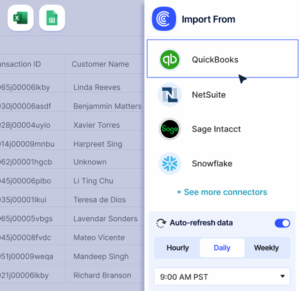
Pull EBIT and interest expense from your income statement with one click. Schedule daily, weekly, or monthly refreshes so your ratios stay current. Build dashboards that show trends over time without touching a CSV file.
Set up takes five minutes. Connect NetSuite, Sage Intacct, QuickBooks, or your data warehouse. Map your accounts once.
Get started with Coefficient and start tracking automatically.
How to Improve Your Interest Coverage Ratio
A low ratio doesn’t mean doom. You can fix it by growing EBIT faster than interest expense or reducing debt strategically.
Increase operating profit
Raise prices where customers will accept it. Cut costs that don’t generate revenue. Renegotiate supplier contracts. A 10% increase in EBIT directly improves your ratio by 10% if interest stays flat. Focus on high-margin products and cut low-margin offerings that consume resources.
Refinance high-interest debt
Replace expensive loans with lower-rate alternatives. If your ratio is above 2.5, banks will compete for your business. Refinancing from 8% to 5% interest can drop your annual interest expense by 35% on the same principal. Look at SBA loans, equipment financing with longer terms, or sale-leaseback arrangements.
Convert short-term debt to long-term
Extend loan maturities to reduce current interest burden. This doesn’t lower total interest paid but spreads it over more years, improving your annual ratio. A five-year term instead of two years cuts annual interest expense significantly if you can get similar rates.
Pay down principal faster
Use excess cash to reduce debt balances. Every dollar of principal you pay off saves you interest expense going forward. If you’re paying 7% interest, paying off $100,000 saves $7,000 annually in interest. That flows straight to your coverage ratio.
Avoid variable-rate debt
Lock in fixed rates when possible. Variable rates climb when central banks raise rates, crushing your coverage ratio without warning. If you must use variable rates, stress test your ratio at 2-3% higher interest to see if you can handle rate hikes.
Interest Coverage Ratio vs. Debt Service Coverage Ratio vs. Times Interest Earned
These three metrics all measure debt-paying ability but differ in what they include.
Interest Coverage Ratio
Formula: EBIT ÷ Interest Expense
Measures ability to pay interest only. Quick assessment of debt risk.
Debt Service Coverage Ratio
Formula: Net Operating Income ÷ Total Debt Service
Measures ability to pay principal and interest. Best for real estate and project financing.
Times Interest Earned
Formula: EBIT ÷ Interest Expense
Same as interest coverage ratio. Identical metric, different name.
When to use each
Interest coverage and times interest earned are the same thing—just different names for EBIT divided by interest. Debt service coverage includes principal payments in the denominator, making it more conservative. If you’re paying off debt aggressively, your debt service coverage will be much lower than interest coverage.
Pro tip for fractional CFOs: Present both ratios to clients. Interest coverage shows their current health. Debt service coverage reveals if they can actually afford their payment schedule. A company with 4.0 interest coverage but 0.9 debt service coverage is headed for trouble.
Protect your debt capacity
Interest coverage ratio shows if your operations can handle your debt load. Track it monthly. Compare it to industry benchmarks. Use it to make smarter financing decisions.Get started with Coefficient and automate your coverage ratio tracking today.
 Sync Live Finance Data into Your Spreadsheet