

EBITDA Margin = (EBITDA / Revenue) × 100
Let’s break down each part:
EBITDA: Earnings Before Interest, Taxes, Depreciation, and Amortization. This shows your core operating profit before non-operating expenses and non-cash charges. You calculate it by taking net income and adding back interest, taxes, depreciation, and amortization.
Revenue: Total sales or net revenue for the period. This is your top-line number from the income statement, representing all money from customers before any deductions.
Why multiply by 100? This converts the ratio to a percentage, making it easier to compare across companies and track over time. A margin of 0.25 becomes 25%, which is clearer to read and discuss.
Why use EBITDA instead of net income? EBITDA strips out financing decisions like debt interest, tax strategies, and accounting choices like depreciation methods. This lets you compare operating performance across companies with different capital structures or in different tax jurisdictions.
What Is EBITDA Margin?
EBITDA margin measures how much profit you generate from each dollar of revenue before you account for capital structure, taxes, and non-cash charges. It answers the question: “What percent of our sales turns into core operating profit?”
This metric helps you see pure operational efficiency. A company with $10 million in revenue and $2 million in EBITDA has a 20% margin. That means for every dollar of sales, 20 cents flows to core operating profit.
Who uses this metric?
CFOs and Controllers tracking operational efficiency and comparing performance against prior periods.
Fractional CFOs benchmarking client companies against industry standards and identifying margin improvement opportunities.
Private Equity Investors evaluating acquisition targets and assessing operational leverage potential.
Lenders and Credit Analysts determining debt capacity and assessing ability to service debt payments.
Business Owners measuring the health of their core operations separate from tax and financing decisions.
How to Calculate EBITDA Margin: Step-by-Step
Let’s work through a real example using a mid-market software company.
- Gather your income statement
You need your most recent income statement with revenue, operating expenses, and net income. All figures should be from the same period.
- Identify total revenue
From your income statement, find total revenue or net sales. For our example: $5,000,000 in annual revenue.
- Calculate EBITDA using the top-down method
Start with operating income from your income statement: $1,200,000
Add back depreciation expense: $150,000
Add back amortization expense: $100,000
Total EBITDA: $1,200,000 + $150,000 + $100,000 = $1,450,000
- Alternative method – bottom-up from net income
If you prefer to start from net income, use this approach:
Net income: $800,000
Add back interest expense: $80,000
Add back tax expense: $270,000
Add back depreciation: $150,000
Add back amortization: $100,000
Total EBITDA: $800,000 + $80,000 + $270,000 + $150,000 + $100,000 = $1,400,000
Note: Small differences between methods can occur due to rounding or one-time items.
- Apply the EBITDA margin formula
Divide EBITDA by revenue, then multiply by 100:
($1,450,000 / $5,000,000) × 100 = 29%
- Interpret your result
A 29% EBITDA margin means that for every $100 in revenue, this company generates $29 in core operating profit. For a software company, this is solid but not exceptional. It suggests good cost control and operational efficiency with room to improve.
How to Interpret Your EBITDA Margin Number
Context matters when evaluating your margin performance.
| Ratio Range | Interpretation | Recommended Actions |
| Below 0% | Negative EBITDA – Your core operations lose money before accounting for financing costs. This is a critical warning sign. | • Cut operating costs immediately<br>• Review pricing strategy<br>• Assess product-market fit<br>• Consider raising capital or restructuring |
| 0% – 10% | Low margin – Your operations generate minimal profit. Small disruptions threaten viability. | • Analyze cost structure by category<br>• Benchmark against competitors<br>• Focus on gross margin improvement<br>• Review overhead and admin costs |
| 10% – 20% | Moderate margin – Acceptable for many industries, but leaves little cushion for growth investments or downturns. | • Track margin trends monthly<br>• Identify efficiency opportunities<br>• Compare to industry benchmarks<br>• Consider strategic pricing changes |
| 20% – 30% | Healthy margin – Strong operational performance with flexibility for growth investment and economic uncertainty. | • Maintain operational discipline<br>• Invest in growth initiatives<br>• Build cash reserves<br>• Consider expansion opportunities |
| Above 30% | Excellent margin – Top-tier performance indicating pricing power, operational excellence, or both. Rare outside high-margin industries. | • Sustain competitive advantages<br>• Watch for margin compression signs<br>• Balance reinvestment with profitability<br>• Consider strategic acquisitions |
EBITDA Margin Benchmarks by Industry
Understanding your margin in the context of your industry is critical. What looks weak in software may be strong in retail.
| Industry | Typical Range | Notes |
| Software (SaaS) | 25% – 40% | High margins due to low variable costs and recurring revenue. Top performers hit 40%+. |
| Healthcare Services | 15% – 25% | Moderate margins with high compliance costs and insurance reimbursement pressures. |
| Manufacturing | 10% – 15% | Lower margins due to high depreciation on equipment and inventory costs. |
| Retail | 5% – 15% | Thin margins from intense competition and inventory management challenges. |
| Professional Services | 15% – 25% | Variable based on utilization rates and pricing model. |
| Pharmaceuticals | 25% – 35% | High margins from R&D-driven moats and patent protection. |
| Oil & Gas | 30% – 50% | Highly variable based on commodity prices. Strong margins when prices are favorable. |
| Construction | 5% – 12% | Low margins with high competition and project-based volatility. |
Why margins vary so much: Capital intensity matters. Industries that require heavy equipment and machinery like manufacturing face high depreciation charges, which lower EBITDA margins compared to asset-light businesses like software.
Business model differences drive variation. Subscription businesses with predictable recurring revenue typically command higher margins than transaction-based or project-based models.
Competitive dynamics influence pricing power. Industries with few barriers to entry like retail or construction face intense price competition that compresses margins, while industries with patents or network effects maintain pricing power.
Benchmark Citations
Accounting Insights EBITDA Analysis
Automating EBITDA Margin Tracking with Coefficient
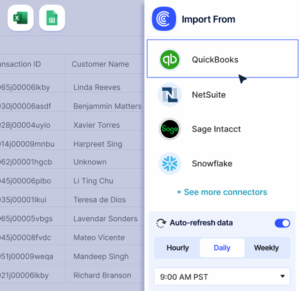
Stop exporting monthly financial statements from NetSuite or QuickBooks into Excel. Coefficient connects your accounting system directly to your spreadsheets, automatically pulling revenue and EBITDA components. Your margin calculations update themselves from live data.
Save 2-3 hours per month on financial reporting. No more manual exports or copy-paste errors. Get real-time visibility into margin trends. Set up automatic refreshes daily, weekly, or monthly.
Perfect for fractional CFOs managing multiple clients. Build one dashboard template, connect each client’s system, and track all margins in one place. Build executive dashboards that update automatically. Share live margin trends with your board or investors without rebuilding reports each month.
Get started with Coefficient to automate your EBITDA tracking.
How to Improve Your EBITDA Margin
A weak margin signals opportunity. Here are five proven strategies to boost profitability.
Increase prices strategically
Review your pricing for the first time in months or years. Test 5-10% price increases on new customers or renewals. Most companies lose fewer customers than they fear, and the revenue gain more than offsets any churn. Focus price increases on your most valuable customers or products where you deliver clear differentiation.
Cut low-value operating expenses
Audit your expense categories for waste. Cancel unused software subscriptions, renegotiate vendor contracts, and eliminate redundant roles or processes. Target 10-15% reduction in OpEx without touching revenue-generating activities. Every dollar saved in expenses flows directly to EBITDA.
Improve gross margins first
Focus on cost of goods sold or cost of services delivered. Negotiate better terms with suppliers, reduce material waste, or shift to lower-cost inputs without sacrificing quality. Gross margin improvements scale with revenue, creating compound benefits over time.
Increase asset utilization
If you have equipment or facilities sitting idle, find ways to increase usage rates. Manufacturing plants running at 60% capacity should target 80-90%. Service businesses should optimize consultant or employee utilization rates. Better asset use spreads fixed costs over more revenue.
Shift your revenue mix
Prioritize higher-margin products or services. If your software business offers both professional services at 30% margin and SaaS subscriptions at 70% margin, shift sales focus to subscriptions. Track margin by product line and allocate resources accordingly.
EBITDA Margin vs. Operating Margin vs. Net Margin
These three profitability metrics often get confused. Here’s how they differ and when to use each.
EBITDA Margin
(EBITDA / Revenue) × 100. This measures core operating profit before depreciation and amortization. Use it to compare operational efficiency across companies with different capital structures or asset bases. Best for evaluating businesses in capital-intensive industries where depreciation varies widely.
Operating Margin
(Operating Income / Revenue) × 100. This measures profit from operations after depreciation and amortization but before interest and taxes. Use it for a more complete view of operational profitability that includes the cost of capital assets. Better than EBITDA margin for comparing mature companies in the same industry.
Net Margin
(Net Income / Revenue) × 100. This measures bottom-line profitability after all expenses including interest and taxes. Use it to assess total company profitability and return to shareholders. Most relevant for comparing companies with similar capital structures and tax situations.
When to use each
Each margin tells a different story about profitability. Use all three together for complete analysis.
Pro tip for fractional CFOs: Present all three margins to clients in context. A company with 25% EBITDA margin, 18% operating margin, and 10% net margin tells a story. The 7-point gap between EBITDA and operating margin reveals high depreciation expense, while the 8-point gap between operating and net margin shows significant interest or tax burden. This guides where to focus improvement efforts.
Control your margins
Track EBITDA margin monthly. Compare to industry benchmarks. Use the data to guide operational improvements and strategic decisions.
Get started with Coefficient to automate your margin tracking and stop wasting time on manual reports.
 Sync Live Finance Data into Your Spreadsheet