

Debt-to-Capital Ratio Formula Explained
Debt-to-Capital Ratio = Total Debt ÷ (Total Debt + Total Equity)
Let’s break down each part:
Total Debt: The sum of all money your company owes. This includes short-term loans due within a year, long-term debt like bonds or mortgages, and lease obligations. You find these numbers on your balance sheet under liabilities.
Total Equity: The value that shareholders own in your company. It equals total assets minus total liabilities. You can pull this straight from the shareholders’ equity section of your balance sheet. It includes common stock, preferred stock, and retained earnings.
Why use total capital? This shows your complete financial picture. It measures how much of your entire funding comes from debt versus equity. The ratio helps you see if you’re too reliant on borrowed money or if you have room to take on more debt for growth.
What Is Debt-to-Capital Ratio?
A debt-to-capital ratio shows what portion of your company’s funding comes from debt. It answers a simple question: how much of your business runs on borrowed money versus money from shareholders?
Most companies use a mix of debt and equity to grow. Debt can be cheaper than equity because interest is tax deductible. But too much debt can put you at risk if cash flow drops.
Who uses this metric?
CFOs and Controllers tracking capital structure and making financing decisions.
Fractional CFOs comparing financial health across multiple client companies.
Lenders and Credit Analysts evaluating loan applications and setting credit terms.
Investment Bankers assessing companies for M&A deals and capital raises.
Board Members reviewing management’s financing strategy and risk profile.
How to Calculate Debt-to-Capital Ratio: Step-by-Step
Let’s walk through a real example using a mid-market manufacturing company.
- Pull your most recent balance sheet
You need your company’s balance sheet from the end of your latest quarter. Make sure all numbers come from the same date.
- Find your total debt
Add up all your company’s debt obligations. For our example company:
- Short-term debt: $2.5 million
- Long-term debt: $12.5 million
- Total Debt = $2.5M + $12.5M = $15 million
- Locate shareholders’ equity
Look at the equity section of your balance sheet. In our example: $35 million
- Calculate total capital
Add debt and equity together: $15 million + $35 million = $50 million in total capital
This represents all the money funding your company’s operations.
- Apply the debt-to-capital ratio formula
Divide total debt by total capital: $15 million ÷ $50 million = 0.30
- Convert to a percentage
Multiply by 100: 0.30 × 100 = 30%
- Interpret your result
A ratio of 30% means debt funds 30% of this company’s operations. The remaining 70% comes from equity. This falls in a healthy range for most manufacturing firms. It shows the company uses some debt for its tax benefits but isn’t overleveraged.
How to Interpret Your Debt-to-Capital Ratio Number
Context determines whether your ratio signals strength or risk.
| Ratio Range | Interpretation | Recommended Actions |
| Below 20% | Conservative – Very low debt use. You may be missing tax benefits or growth opportunities. | • Evaluate if you could use more debt for expansion<br>• Consider if your cost of capital is too high<br>• Look for growth investments that could benefit from leverage |
| 20% – 40% | Healthy – Moderate debt levels with strong financial flexibility. Good balance for most businesses. | • Maintain current discipline<br>• Monitor cash flow trends quarterly<br>• Keep debt costs competitive through refinancing |
| 40% – 60% | Elevated – Higher leverage requiring careful management. Watch cash flow closely. | • Strengthen cash flow monitoring<br>• Build cash reserves for downturns<br>• Consider pausing non-essential debt-funded projects<br>• Review debt maturities to avoid bunching |
| Above 60% | High Risk – Heavy debt load limiting flexibility. One downturn could cause serious problems. | • Prioritize debt reduction immediately<br>• Halt all debt-funded expansion<br>• Explore asset sales to pay down debt<br>• Engage with lenders proactively if covenants tighten |
Debt-to-Capital Ratio Benchmarks by Industry
Your optimal ratio depends heavily on your industry. Capital-intensive businesses typically carry more debt than asset-light ones.
| Industry | Typical Range | Notes |
| Software/SaaS | 10% – 25% | Low debt due to minimal physical assets and unpredictable cash flows in growth phase |
| Manufacturing | 25% – 45% | Moderate leverage supported by tangible assets and steady cash generation |
| Healthcare Services | 30% – 50% | Varies by payer mix; hospital systems can support higher debt than physician practices |
| Retail | 35% – 55% | Inventory and real estate provide collateral; seasonal patterns affect optimal levels |
| Real Estate | 45% – 65% | Property values support high debt; income streams from leases provide coverage |
| Utilities | 50% – 70% | Regulated, stable cash flows allow highest sustainable debt levels |
| Financial Services | 60% – 80% | Different definition of debt; customer deposits don’t count as debt for this ratio |
| Energy (Oil & Gas) | 30% – 50% | Commodity price volatility and capital intensity drive moderate debt levels |
Industry benchmarks show clear patterns. Capital-intensive sectors like utilities and real estate run higher debt loads because their assets provide strong collateral and their cash flows are predictable. Software companies carry less debt because their main assets are people and code, not equipment or property.
Benchmark Citations
NYU Stern Debt Fundamentals by Sector (US)
Eqvista Debt-to-Equity Ratio Study 2025
Phoenix Strategy Group Cost of Capital Industry Benchmarks
Automating Debt-to-Capital Ratio Tracking with Coefficient
Stop pulling CSV files from your ERP every month.
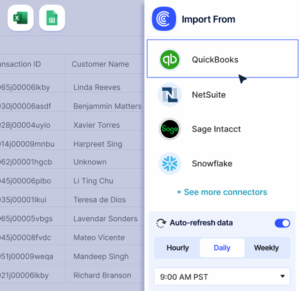
Coefficient connects NetSuite, Sage Intacct, or QuickBooks directly to Excel or Google Sheets. Your debt and equity numbers update automatically. The ratio calculates itself.
Finance teams save 15-30 minutes per report. No data entry means fewer errors. Real-time connections mean you always see current numbers, not last month’s exports.
Perfect for fractional CFOs managing multiple clients. Set up once per client, then monitor all your portfolios from one dashboard. Schedule automatic refreshes daily, weekly, or monthly. Your choice. Start automating your financial reporting today.
How to Improve Your Debt-to-Capital Ratio
Lowering your ratio requires reducing debt or increasing equity.
Accelerate cash collection
Tighten your accounts receivable process. Send invoices the day work completes. Follow up on overdue accounts within three days, not three weeks. Offer 2% discounts for payment within 10 days. Reducing your collection period from 45 to 30 days can free up significant cash to pay down debt.
Optimize working capital
Reduce inventory levels through better forecasting and just-in-time ordering. Negotiate longer payment terms with suppliers to keep cash in your business. Each $100,000 reduction in working capital can cut your debt load directly.
Sell non-core assets
Look at underutilized equipment, real estate, or business units that don’t fit your strategy. A one-time asset sale can make a major dent in your debt load. One manufacturer we worked with sold an idle warehouse for $2 million and used it to retire high-interest debt.
Convert debt to equity
If you’re a private company, consider bringing in equity investors to replace some debt. This works especially well if you’re growing fast and lenders are getting nervous about your leverage. Swap $5 million of debt for $5 million of equity and your ratio improves immediately.
Improve operating margins
Every dollar of profit you keep becomes retained earnings, strengthening equity. Focus on your highest-margin products. Cut low-value costs. A 2% improvement in operating margin on $50 million revenue creates $1 million of additional equity per year.
Debt-to-Capital Ratio vs. Debt-to-Equity Ratio vs. Leverage Ratio
These three ratios measure financial leverage differently. Here’s when to use each one.
Debt-to-Capital Ratio
Shows debt as a percent of total funding (debt + equity). Best for evaluating your overall capital structure. Most conservative view. Example: 40% means debt is 40% of your total capital.
Debt-to-Equity Ratio
Compares debt directly to equity, expressed as a ratio. Example: 0.67 means you have $0.67 of debt for every $1 of equity. Higher numbers indicate more leverage. Better for comparing leverage intensity between companies.
Leverage Ratio
Usually means debt-to-assets or debt-to-EBITDA. Shows if your earnings can cover debt. Lenders prefer this because it links debt to cash-generating ability.
When to use each
Pro tip for fractional CFOs: Show clients all three ratios. A company might look fine with a 40% debt-to-capital ratio (seems low), but that translates to a debt-to-equity ratio of 0.67 (moderate) and could mean debt is 3.5 times EBITDA (high for some industries). Context matters. Each ratio tells part of the story.
Find your balance
The goal isn’t to eliminate debt—it’s to find the right amount for your business strategy and industry. Use this calculator alongside other metrics like interest coverage ratio and current ratio for a complete picture.
Get started with Coefficient to automate your debt-to-capital tracking and make better financing decisions.
 Sync Live Finance Data into Your Spreadsheet