




Companies invest in AI tools, hire data scientists, and run pilots that produce poor results. The model is rarely the problem. The data feeding it is.
Here is exactly how data silos break AI, and what to do about it at three different levels of technical maturity.
What AI Actually Needs From Data
AI and machine learning models have three requirements that data silos directly undermine.
Volume. Models need enough examples to learn patterns. A silo limits the training set to what one department or system has captured.
Diversity. Models trained on narrow data generalize poorly. A customer churn model trained only on CRM data cannot factor in support tickets, billing records, or product usage sitting in other systems.
Consistency. If ‘customer’ means something different in Salesforce than in the data warehouse, the model receives contradictory signals and produces unreliable outputs.
Five Ways Data Silos Break AI Initiatives
Incomplete Training Data
An AI model trained on one department’s CRM data cannot see support tickets, billing records, product usage logs, or web behavior data sitting in other systems. It learns patterns from a partial view of reality and makes predictions based on what it can see, which is not the same as what is true.
For a churn prediction model, this might mean missing the most predictive signal entirely: a customer filed 12 support tickets in the last 30 days. That data lived in Zendesk. The model never saw it.
Conflicting Metric Definitions
When ‘Active Customer’ means one thing in Salesforce, something slightly different in the data warehouse, and something else in the finance system, AI agents and models receive contradictory inputs. The model cannot reconcile definitions it was never told about.
This is a governance problem, not a data quality problem. The fix is defining the metric once, at the source, so every downstream system including AI queries the same definition.
Stale Training Data
AI models fed yesterday’s export make yesterday’s decisions. When source data updates and the model’s training data does not, predictions degrade silently. There is no error. The model continues to run. The outputs just become progressively less accurate.
In production environments where models run daily or weekly, a two-week lag between source data and model inputs can be enough to make recommendations systematically wrong.
Governance Failures Lock Out the Best Data
IT locks down sensitive data for legitimate security and compliance reasons. The result: AI tools can only access the data that is least controlled, which is usually the least complete and least governed. The most predictive data, including detailed customer records, transaction history, and support data, is precisely what AI cannot reach.
Poor Input Causes AI Hallucinations
Generative AI fed siloed, biased, or inconsistent data produces incorrect and sometimes misleading outputs. This is a data problem, not a model architecture problem. Research shows 85% of IT leaders say data silos are hindering their digital transformation and AI efforts.
The risk compounds with generative AI. A language model generating a sales forecast from siloed data can be confidently wrong in ways that a statistical model would surface as a low-confidence prediction.
The Snowflake Semantic Views Example
Snowflake’s Semantic Views let data teams define what ‘Revenue,’ ‘Churn,’ and ‘Active Customer’ mean once, inside the warehouse. Every tool, team, and AI model that queries those definitions sees the same governed answer.
The problem: if non-technical business users cannot access those definitions, they bypass the warehouse. They export a CSV, build a personal spreadsheet, and define ‘Revenue’ in their own formula. The AI model now has two definitions to reconcile.
Coefficient surfaces Snowflake Semantic Views directly inside Google Sheets and Excel through a visual Metrics and Dimensions picker. Finance and ops teams browse available governed metrics, select what they need, and Coefficient generates the correct query. The data team’s definitions stay governed. Business user access becomes self-serve. The last-mile silo closes.
| Important:Coefficient surfaces what the data team defines in Snowflake Semantic Views. It does not maintain the Context Layer. That responsibility stays with the data engineering team. |
How to Fix Data Silos Fast Enough to Unblock AI
No Engineering Required (Weeks to Live)
Coefficient connects 150+ systems into Google Sheets and Excel with scheduled auto-refresh. This does not replace a data warehouse, but it gives business users a unified operational view in a tool they already use, fast enough to unblock reporting and lighter AI use cases.
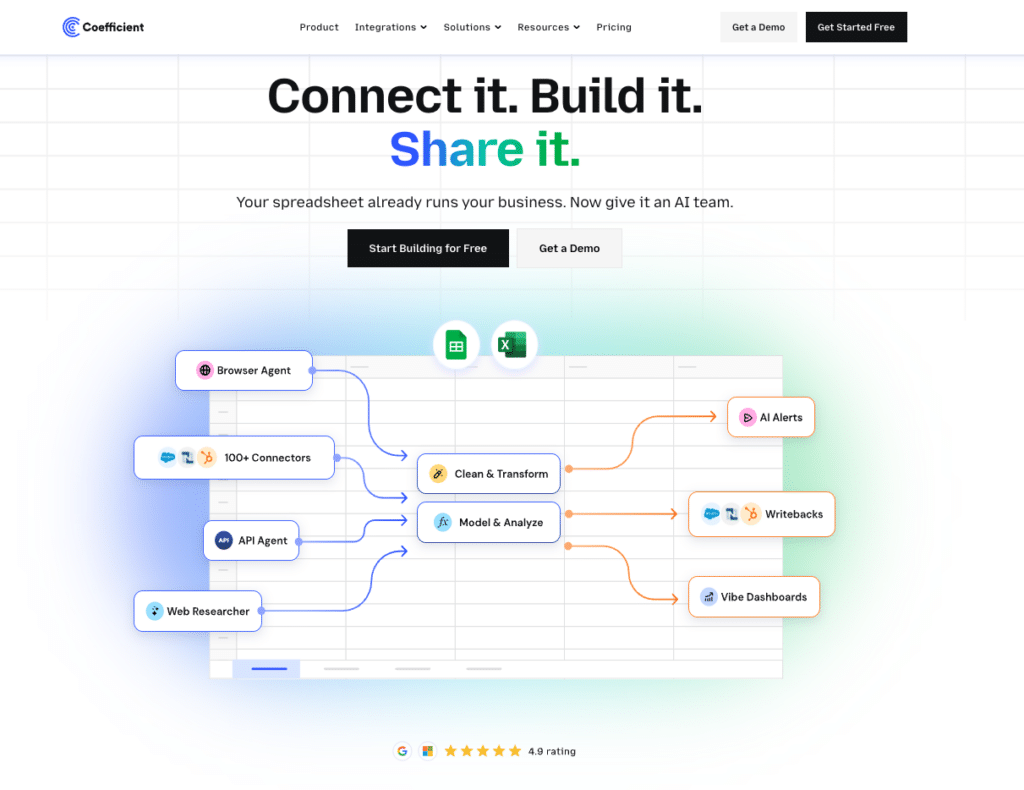
Two-way sync is available for Salesforce, HubSpot, NetSuite, QuickBooks, Snowflake, MySQL, MS SQL Server, PostgreSQL, BigQuery, and Redshift.
Centralize Into a Warehouse (Months)
Consolidate all data sources into a central warehouse (Snowflake, BigQuery, or Redshift). Build ETL pipelines to ingest from each source. Apply data quality rules and metric definitions at the warehouse level. The right solution for organizations with 20+ data sources and serious AI ambitions.
Coefficient works alongside this approach, connecting the warehouse to business users in Sheets and Excel so governed data reaches the people who need it without SQL tickets.
Enterprise Data Mesh and Governance (Years)
Full domain-oriented data ownership, a semantic layer, a data catalog, and enterprise-wide governance. Right for large enterprises with hundreds of data sources. Not the right first step for most organizations reading this article.
Is Your Organization AI-Ready?
- Can you pull a single report combining customer data from your CRM, billing system, and support tool without manual steps?
- Does every team use the same definition for your top three business metrics?
- Is your AI model’s training data refreshed automatically, or does someone export it manually on a schedule?
- Are there spreadsheets in your organization being used as unofficial data hubs?
- Can non-technical teams access the data they need without filing an IT ticket?
No to any of these: data silos are limiting your AI outcomes, not the quality of your models.
Frequently Asked Questions
Why do data silos cause AI to fail?
AI models need volume, diversity, and consistency. Data silos break all three: they limit training data to one department’s view, produce conflicting metric definitions, and keep the most governed data inaccessible to AI tools.
How can I fix data silos without rebuilding my data infrastructure?
For most teams, the fastest path is connecting existing tools to a shared spreadsheet layer using a no-code connector like Coefficient. Connect Salesforce, HubSpot, QuickBooks, and Snowflake to a Google Sheet or Excel file with live auto-refresh. No data engineering required.
What is the relationship between Snowflake Semantic Views and AI?
Snowflake Semantic Views let data teams define governed metrics once. Every tool and AI model that queries those definitions sees the same answer, eliminating the inconsistent inputs that cause AI hallucinations. Coefficient surfaces Semantic Views in Sheets and Excel so business users can query governed metrics without SQL.
Bottom Line
If your AI investments are underperforming, check the data before blaming the model. Start by closing the silos easiest to close: the CRM export that still runs manually, the finance report pulling from three disconnected systems, the Snowflake metrics that business users cannot access without a ticket.
Coefficient is free to start. Connect your first data source in minutes.