




Most data silo content covers how to fix silos after they exist. This guide covers the decisions that prevent them from forming in the first place. This includes the one problem most infrastructure projects miss.
The last-mile silo forms after the data warehouse is built and governed, when business users cannot access the governed data without filing a ticket and build their own rogue spreadsheets instead. Preventing enterprise data silos requires solving both the infrastructure problem and the access problem.
Five Structural Causes of Enterprise Data Silos
- Tool sprawl without integration planning. Every department adopts the best tool for its job. Marketing chooses HubSpot. Finance chooses NetSuite. Engineering chooses Jira. Nobody at the procurement stage maps how data will flow between systems. Silos form by default.
- Organizational structures that mirror data structures. In large companies with separate P&Ls and independent IT budgets, data isolation is a natural byproduct of organizational isolation. Teams that do not share goals do not share data.
- Legacy systems that predate cloud integration. On-premises ERPs and mainframe systems from 15 to 20 years ago were not designed to connect to modern cloud infrastructure. Extracting the data requires custom engineering that competes with everything else for resources.
- Security decisions without self-service alternatives. IT restricts access to sensitive data for legitimate reasons. When the restriction creates a silo because nobody built a governed self-service path, the data is locked away and teams route around it.
- The last-mile gap. A data warehouse is built. Metrics are governed. The data team is proud of the architecture. Finance asks for a report and discovers they need to file a ticket because they cannot write SQL. So they export a CSV and build their own spreadsheet. The governance chain breaks at the last mile.
Steps to Take to Avoid Enterprise Data Silos
Centralize Before You Silo
The core architectural principle: every new data source connects to a central warehouse before business users consume it directly. Snowflake, BigQuery, and Redshift are the standard choices.
The mistake most organizations make is allowing teams to build direct tool-to-tool connections that bypass the warehouse. Marketing connects HubSpot directly to a reporting sheet. Finance pulls from NetSuite directly into Excel. Each connection is logical in isolation. Together they create a web of integrations that are impossible to govern.
Snowflake’s Semantic Views are the governance mechanism for this layer. Data teams define what ‘Revenue,’ ‘Churn,’ and ‘Customer’ mean once inside the warehouse. Every downstream tool and AI model queries the same governed definitions. The metrics cannot drift.
Build Self-Service Access Before Teams Build Their Own
Silos do not re-form because the warehouse architecture is wrong. They re-form because business users cannot access the governed data and build their own version instead.
The fix: make the governed path easier than the rogue path. If getting data from the warehouse requires a ticket to the data team, teams will export CSVs. If it takes five minutes through a visual interface in a tool they already use, they will use the governed path.
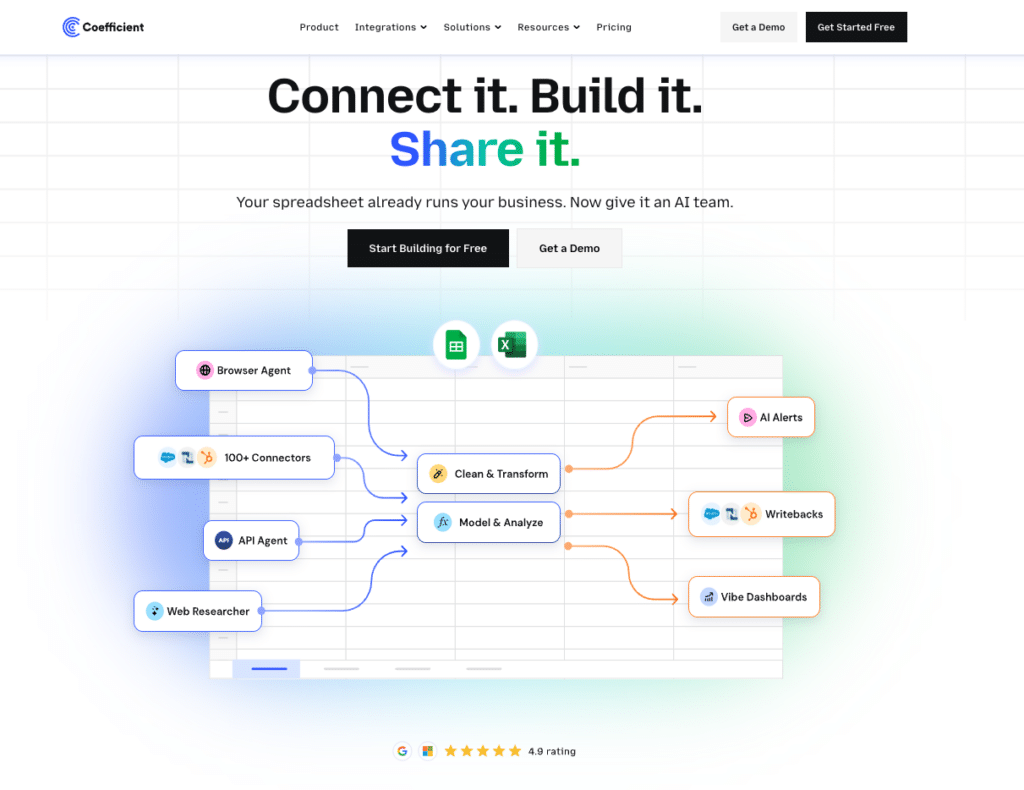
For spreadsheet-based teams in finance, RevOps, and operations, Coefficient surfaces Snowflake Semantic Views directly in Google Sheets and Excel through a visual Metrics and Dimensions picker. Available to all Coefficient users. Business users browse governed metrics, select what they need, and Coefficient generates the query. No SQL, no ticket, no rogue export.
Govern Tools at Procurement
Most enterprise data silos start with a SaaS tool that IT did not know was being bought. The marketing team needed a new attribution tool. Someone put it on a corporate card. It was live before IT could assess the data implications.
Make integration review part of every software procurement decision. Before any new tool is adopted, the data team answers: how does data flow into this tool, how does data flow out, can it connect to the central warehouse, and who owns the data if the vendor contract ends.
This is a process change, not a technology investment. It requires executive support to enforce because it slows down tool adoption. The business case: every tool adopted without integration review is a potential silo that costs months to fix later.
Define Metrics Before Teams Define Their Own
Metric inconsistency is the most visible symptom of data silos. When sales reports one revenue figure and finance reports another, the root cause is usually that both teams are applying their own definition to their own data extract.
Establish canonical definitions for your top 10 business metrics before different teams create their own. Document them in a semantic layer: Snowflake Semantic Views, dbt metrics, or a data catalog. The important property: the definition lives in one place and every tool that references the metric queries that definition.
This requires cross-functional agreement before it is technical work. Finance, sales, marketing, and the data team need to align on what the metric means. That conversation is harder than the technical implementation.
Audit Spreadsheet Usage Quarterly
Spreadsheets are the early warning system for new silos. When a team starts maintaining a spreadsheet as their primary data source, it is almost always because the governed data infrastructure does not serve their needs.
A quarterly audit: identify every spreadsheet being manually updated from a data export. For each, ask: can a live connection replace this manual update? In most cases, the answer is yes.
Coefficient can automate most manual spreadsheet-to-system connections in under an hour. 150+ source connectors, available in both Google Sheets and Excel.
What Not to Do with Enterprise Data Silos
Do not build a warehouse without building self-service access.
A warehouse that business users cannot access without tickets is itself a silo. The same teams that maintained rogue spreadsheets before will continue to maintain them.
Do not require SQL for all data access.
Non-technical users route around requirements they cannot meet. If every query requires SQL, every non-technical user becomes a potential silo creator.
Do not mistake data restriction for data governance.
Real governance is about controlled access with audit trails, not about preventing access entirely.
Bottom Line
Preventing enterprise data silos requires two parallel investments: centralized infrastructure with a warehouse and semantic layer, and governed access that is easier than the rogue alternative. The second investment is where most enterprises fall short.