
Table of Contents

- 1. Top 7 Financial Consolidation Tools in 2025 | Complete Comparison Guide
- 2. Top 7 Financial Forecasting Tools in 2025 [w/ Feature Comparison]
- 3. Best 6 AI Tools for CFOs in 2026 [w/ Feature Comparison Table]
-
4. Finance controller checklist: Weekly and monthly tasks
- What does a finance controller do?
- Why do you need a finance controller checklist? For structure.
- Weekly finance controller checklist
- Monthly finance controller checklist
- Quarterly finance controller checklist
- Annual finance controller checklist
- Critical control and compliance checklist
- Finance controller checklist for team management
- Technology and systems checklist
- Build your finance controller checklist
- Frequently asked questions
- 5. New accounting client checklist: Streamline your onboarding process
- 6. Top 8 Strategic Workforce Planning Tools in 2025 [w/ Feature Comparison]



Finance controllers face mounting pressure. Manual processes consume hours each day. Month-end close takes 6-10 days on average for mid-market companies. Controllers spend 20+ hours per week on manual data work instead of strategic analysis.
The role has evolved far beyond basic bookkeeping. Modern controllers must balance daily accounting operations with strategic planning, compliance, and team management. Structured checklists help manage this complexity and ensure nothing falls through the cracks.
This guide provides a complete finance controller checklist covering weekly, monthly, quarterly, and annual tasks. You’ll learn how to organize controller responsibilities, speed up the financial close, and free time for strategic work.
What does a finance controller do?
A finance controller oversees day-to-day accounting and financial operations. They manage the nuts and bolts of financial reporting, ensuring accurate and timely records. The role sits between the accounting team and senior finance leadership.
Controller vs. CFO
Controllers focus on historical data and financial reporting. CFOs use controller data for strategic planning and external stakeholder relations. Controllers handle month-end close. CFOs focus on mergers, acquisitions, and investor relations. Controllers ensure compliance. CFOs drive business strategy.
Controller vs. accounting manager
Controllers have broader strategic responsibility. Accounting managers focus on specific functions like accounts payable, receivable, or payroll. Controllers report to the CFO or VP Finance. Accounting managers report to controllers. Controllers design systems and processes. Accounting managers execute them.
Key controller responsibilities
- Oversee financial close process and statement preparation
- Manage internal controls and risk mitigation
- Coordinate external and internal audits
- Lead budget preparation and variance analysis
- Manage and develop finance teams
- Implement technology for finance operations
The role requires technical accounting expertise and leadership skills. Controllers must understand GAAP, manage teams effectively, and communicate financial insights to non-finance stakeholders.
Why do you need a finance controller checklist? For structure.
Reduces human error and improves accuracy
Manual processes create opportunities for mistakes. Inconsistent procedures lead to missed steps and discrepancies. A standardized finance controller checklist ensures every task gets completed correctly. Controllers using checklists report 40-50% reduction in reconciliation errors.
Speeds up the financial close process
Month-end close averages 6-10 days for mid-market companies. Checklists identify bottlenecks and dependencies between tasks. Teams work more efficiently when responsibilities are clear. Thornton Capital reduced close time from 10 days to 3 days using structured processes and automation.
Ensures regulatory compliance and audit readiness
Controllers must maintain complete documentation for audits. Checklists create consistent audit trails and ensure proper segregation of duties. Every step gets documented with proper approvals. This preparation saves time during external audits and reduces compliance risk.
Enables better team management and accountability
Clear checklists define roles and responsibilities. Team members understand what’s expected and when. Controllers can identify skill gaps and training needs. The structure prevents confusion about task ownership and reduces last-minute scrambles.
Weekly finance controller checklist
Financial statement review
Controllers need real-time visibility into financial performance throughout the month. Weekly reviews of preliminary financial statements help identify trends and potential issues early. This includes reviewing revenue recognition, expense accruals, and cash position.
Early detection prevents surprises during month-end close. Many controllers implement soft close processes, reconciling key accounts mid-month rather than waiting until month-end. This distributes the workload and catches problems when they’re easier to fix.
Team meetings and 1-on-1s
Effective communication prevents bottlenecks during the close process. Weekly team meetings align everyone on priorities and deadlines. One-on-one meetings address individual challenges and provide coaching opportunities.
Use these sessions to identify capacity constraints and remove obstacles that slow down work. Building strong relationships across departments ensures timely data delivery for financial reporting.
Accounts receivable and collections review
Cash flow management requires consistent attention to receivables. Controllers should review aging reports weekly to identify overdue invoices. This includes monitoring days sales outstanding and collection trends.
Proactive collections prevent cash flow problems. Weekly review allows time to address payment issues before they become critical.
Payroll review and approval
Payroll represents a significant expense requiring careful oversight. Controllers must verify accuracy of hours, rates, and deductions before processing. This includes reviewing bonus payments, commissions, and benefits deductions.
Weekly payroll review catches errors before they impact employees or financial statements. Ensure proper allocation of payroll costs to departments and projects.
Budget vs. actual analysis
Weekly variance analysis keeps spending on track. Controllers should identify significant variances and investigate root causes promptly. This enables course corrections before month-end.
Department managers need timely feedback on their budget performance. Weekly review creates accountability and prevents budget overruns.
Process improvement initiatives
Controllers should dedicate time each week to operational efficiency. This includes evaluating workflows and identifying automation opportunities. Look for redundant tasks that can be eliminated.
Process improvement reduces the burden during month-end close. It frees capacity for strategic work that adds more value.
Compliance and control reviews
Internal controls require ongoing monitoring. Controllers should review exception reports, access logs, and system controls weekly. This includes verifying segregation of duties and approval hierarchies.
Early detection of control weaknesses prevents larger issues. Weekly monitoring demonstrates commitment to compliance and maintains audit readiness.
Monthly finance controller checklist
Month-end close process
The month-end close is the controller’s most critical monthly responsibility. It involves reconciling all accounts, posting journal entries, and finalizing financial statements. The process typically takes 3-10 days depending on company complexity and automation level.
Thornton Capital transformed their close process by implementing automation. Before Coefficient, CFO Mike Lynch spent up to 10 days each month downloading reports and re-uploading data into Excel models. He constantly fixed broken formulas.

After implementing Coefficient to automate QuickBooks data syncs, they cut month-end close from 10 days to 3 days. This saved 20+ hours monthly and produced consistent, accurate financials across 16 ledgers. “Coefficient is the single greatest return on investment I’ve made this year,” Lynch said.
Key close activities include:
- Reconciling bank and credit card accounts
- Reviewing accounts payable and receivable
- Verifying inventory and fixed assets
- Aligning payroll expenses
Financial statement preparation
Controllers prepare three primary financial statements: balance sheet, income statement, and cash flow statement. These documents must accurately reflect the company’s financial position and comply with GAAP or IFRS standards.
Statement preparation requires careful review of all account balances and supporting documentation. Ensure proper classification and disclosure of significant transactions. The statements become the foundation for management reporting and board presentations.
Variance analysis and commentary
Understanding why actual results differ from budget is critical for management decisions. Controllers should analyze material variances across revenue, expenses, and key metrics. This analysis should explain the “why” behind the numbers, not just report them.
Coefficient helps automate variance analysis by connecting live data from business systems directly to spreadsheets. This eliminates manual data gathering and enables faster insights.
Management reporting package
Executive teams need clear, actionable financial information. The management package typically includes:
- Financial statements
- Key performance indicators
- Variance analysis
- Trend charts
Controllers should tailor reports to their audience, highlighting what matters most to decision-makers.
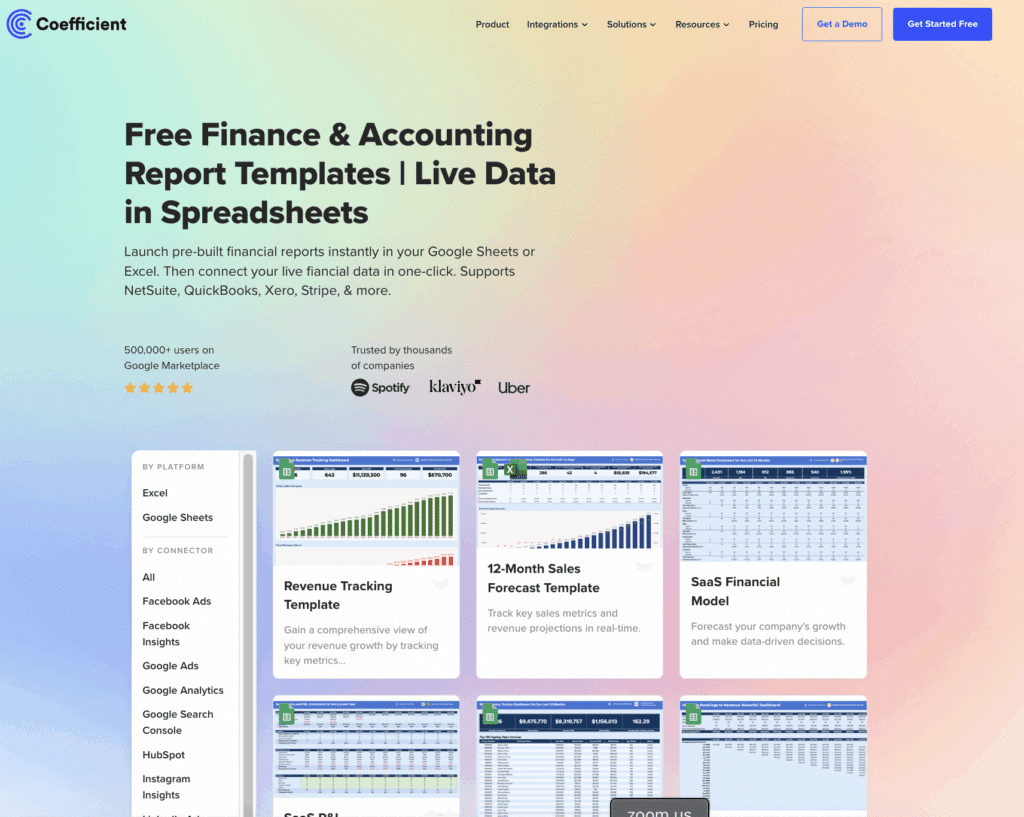
Automated reporting tools can pull data from multiple sources like QuickBooks, NetSuite, and Snowflake into pre-built dashboard templates. The Finance and Accounting Dashboard Gallery offers templates for P&L reports, balance sheets, cash flow, and KPI dashboards that update automatically with live data.
Board report preparation
Board reports require a higher level of summary and strategic context. Controllers must distill complex financial data into clear insights about company performance, risks, and opportunities.
These reports often include strategic metrics beyond standard financials—customer acquisition costs, lifetime value, and unit economics tell the story behind the numbers.
Forecast updates
Rolling forecasts help companies adapt to changing conditions. Controllers should update financial forecasts monthly based on actual results and revised assumptions. This includes adjusting revenue projections based on pipeline changes and updating expense forecasts for new hires or projects.
The Coefficient Cashflow Forecast template connects QuickBooks, Stripe, and HubSpot data to create real-time forecasts. The template automatically:
- Tracks cash inflows from one-time deals and subscriptions
- Monitors cash outflows by category
- Calculates net cashflow
- Updates deal pipeline values and accounts receivable aging as source data changes
This automation ensures forecasts stay current without manual updates each week.

Team performance reviews
Monthly check-ins with accounting team members maintain productivity and morale. Controllers should review workload distribution and provide feedback on deliverables. Address any challenges that team members face.
These reviews identify training needs and development opportunities. Strong one-on-ones build trust and improve team effectiveness.
Department budget reviews
Controllers provide department heads with financial reports showing their performance against budget. This creates accountability and enables managers to make informed decisions.
Review spending patterns, identify areas of concern, and discuss upcoming needs that may require budget adjustments.
Quarterly finance controller checklist
Detailed quarterly forecasts
Quarterly forecasting provides a longer planning horizon than monthly updates. Controllers should reassess annual projections based on year-to-date performance and market conditions. Include scenario modeling for different business outcomes.
Board presentations and materials
Quarterly board meetings require comprehensive financial packages. This includes financial results, comparison to budget and forecast, significant transactions, and risk assessments. Controllers should prepare clear visualizations that tell the financial story.
Tax planning and quarterly filings
Quarterly tax compliance includes estimated tax payments and various filings. Controllers calculate income tax provisions based on year-to-date income and expected full-year results. Sales tax returns must be filed in all jurisdictions where the company has nexus.
External audit preparation
Controllers should begin audit preparation well before year-end. This includes updating documentation, testing internal controls, and addressing any known issues. Quarterly check-ins with auditors prevent surprises during the annual audit.
Compliance and regulatory filings
Publicly-traded companies must file quarterly reports with the SEC. Controllers coordinate Form 10-Q preparation, including unaudited financial statements and management discussion and analysis. Private companies may have lender or investor reporting requirements.
Annual finance controller checklist
Year-end close process
The year-end close is the most comprehensive and critical close of the year. It requires additional procedures beyond monthly close, including physical inventory counts, depreciation calculations, and deferred tax accounting.
Controllers must ensure all accruals are properly recorded. Cut-off procedures prevent transactions from being recorded in the wrong period. Automation significantly reduces this burden.
Watch this video for expert tips on streamlining your year-end close.
Annual audit coordination
Controllers coordinate with external auditors throughout the audit process. This includes:
- Providing requested schedules and supporting documentation
- Responding to auditor questions
- Resolving identified issues
- Managing the audit timeline to meet filing deadlines
Prepare the PBC (Prepared by Client) list early to avoid delays and additional audit fees.
Annual budget preparation
Controllers lead the budgeting process, including:
- Establishing the budget calendar and process
- Collecting input from department heads
- Consolidating and reviewing submissions
- Modeling scenarios and assumptions
- Presenting recommendations to leadership
The budget becomes the benchmark for measuring performance throughout the coming year.
Strategic planning support
Controllers provide financial analysis supporting strategic initiatives. This includes modeling different growth scenarios, assessing capital requirements, evaluating M&A opportunities, and analyzing return on investment for major initiatives.
Annual performance reviews
Year-end reviews assess team member performance against goals. Controllers should document achievements, identify development areas, and set objectives for the coming year. Fair and transparent performance management supports retention of top talent.
Policy and procedure updates
Controllers should annually evaluate finance policies and procedures for improvement opportunities. Update documentation to reflect process changes. Ensure policies align with current business needs and regulatory requirements.
Critical control and compliance checklist
Internal controls monitoring
Controllers maintain oversight of key financial controls. This includes reviewing exception reports, verifying approval hierarchies, and testing control effectiveness. Document control performance for audit purposes.
Regular monitoring demonstrates commitment to compliance and identifies weaknesses before they cause problems.
SOX compliance (if applicable)
Companies subject to Sarbanes-Oxley must document and test internal controls over financial reporting. Controllers coordinate this process, including identifying key controls, performing walkthroughs, testing effectiveness, and remediating deficiencies.
Policy enforcement
Controllers enforce financial policies across the organization. This includes expense policies, procurement procedures, and approval authorities. Consistent enforcement maintains control effectiveness and prevents exceptions from becoming standard practice.
Balance policy compliance with business needs. Training employees on policies reduces unintentional violations.
Segregation of duties reviews
Proper segregation of duties prevents fraud and error. Controllers regularly review access rights to ensure no individual has incompatible responsibilities. For example, the person recording checks should not also reconcile the bank account.
Small companies may struggle with full segregation but should implement compensating controls.
Finance controller checklist for team management
Staff development and training
Controllers must invest in team development to maintain effectiveness. This includes technical accounting training, software skills, and leadership development. As technology transforms finance operations, controllers should enhance skills of existing staff through certifications and specialized training.
Cross-training team members ensures continuity when someone is unavailable.
Hiring and onboarding
Growing companies require expanded finance capacity. Controllers design hiring processes that assess both technical competence and cultural fit. Structured onboarding helps new hires contribute quickly while learning company-specific procedures.
Document standard processes and create training materials that support consistent onboarding.
Performance management
Controllers set clear expectations and provide regular feedback. Performance management includes goal setting, progress reviews, and year-end evaluations. Recognize achievements and address performance issues promptly.
Development plans help team members grow their careers while meeting organizational needs.
Succession planning
Controllers should identify and develop potential successors for key roles. This includes their own position and critical team members. Succession planning ensures business continuity during transitions.
Create development plans that prepare high-potential employees for advancement.
Technology and systems checklist
System access reviews
Controllers maintain oversight of financial system access. Regular reviews ensure terminated employees lose access promptly and active users have appropriate permissions. Review privileged access quarterly and standard access annually.
Access reviews prevent unauthorized transactions and support audit requirements.
Automation opportunities
Controllers should continuously seek automation opportunities. Manual processes waste time and increase error risk.
Solv’s FP&A team faced this challenge before implementing Coefficient. FP&A Analyst Christian Budnik was “doing multiple data pulls a day” from Salesforce, Looker, and QuickBooks. He called it “a huge time sink” that disrupted analysis flow.

After implementing Coefficient to automate data imports, Solv’s seven-person FP&A team saved 364 hours per year—over 15 days of recovered productivity. “Coefficient automated everything,” Christian noted. “Instead of manually exporting or importing into Google Sheets every day, I can just sit back and watch the data update automatically.”
Software evaluation and implementation
Controllers lead technology selection for finance systems. This includes accounting software, reporting tools, and data automation platforms. Evaluation should consider functionality, integration capabilities, security, and total cost of ownership.
Manage implementation projects to ensure proper configuration, testing, and training.
Data security and backup
Controllers ensure financial data remains secure and recoverable. This includes implementing strong passwords, multi-factor authentication, and encryption. Regular backups protect against data loss from system failures or cyber attacks.
Test backup restoration periodically to verify recovery procedures.
Build your finance controller checklist
Structured checklists bring order to the controller role. Start with weekly and monthly tasks that drive immediate value. Add quarterly and annual items as your process matures.
Focus on automation opportunities that free your team from manual work. Controllers who eliminate repetitive tasks create capacity for strategic analysis. Modern tools make automation accessible without technical expertise.
Use this framework as a starting point. Adjust based on your company size, industry, and reporting requirements. Get started with Coefficient to automate your financial reporting and month-end close process.
Frequently asked questions
What are the main responsibilities of a finance controller?
Finance controllers oversee day-to-day accounting operations, financial reporting, and internal controls. Key responsibilities include:
- Managing the month-end close process
- Preparing financial statements
- Coordinating audits
- Leading budget preparation
- Managing finance teams
- Implementing technology for finance operations
The role requires both technical accounting expertise and leadership skills.
What should a controller do daily?
Controllers should review cash position and key metrics daily. Monitor unusual transactions or variances that require attention. Respond to urgent questions from management or department heads.
Check progress on month-end close activities and remove obstacles for the team. Daily controller work focuses on oversight rather than transaction processing.
How do you organize finance controller tasks?
Organize controller tasks by frequency: daily, weekly, monthly, quarterly, and annual. Group related activities together, like all close tasks or all compliance activities.
- Use checklists for recurring processes to ensure consistency
- Assign clear ownership for each task with specific deadlines
- Build in buffer time for unexpected issues
- Automate routine tasks to free capacity for strategic work
How do you prioritize controller responsibilities?
Prioritize based on deadline criticality and business impact. Month-end close and compliance filings have hard deadlines that take precedence.
Balance urgent operational needs with important strategic initiatives. Automate low-value repetitive tasks to create capacity for high-impact work. Regular communication with the CFO ensures alignment on strategic priorities versus operational demands.