How to prevent unauthorized users from sending contact data to primary user’s Google Sheets

This represents a critical contact data protection vulnerability in HubSpot’s native Google Sheets integration, where any user with workflow creation rights can potentially send data to any connected sheet.

Here’s how to implement comprehensive security measures that prevent unauthorized data exports while maintaining the functionality your team needs.

Implement user-controlled connections with individual authentication using Coefficient

Coefficientprovides comprehensive security measures to prevent unauthorized data exports through user-controlled connections and connection-level authentication. Each user maintains their own connections to their designated Google Sheets, eliminating the possibility of unauthorized users accessing others’ sheets.

HubSpotWithand Coefficient, connections are tied to individual user authentication, meaning users can only export to sheets they have direct access to through their own Google account credentials.

How to make it work

Step 1. Set up user-controlled connections.

Each user creates their own Coefficient connection to their designated Google Sheets through their personal Google account. This eliminates shared integration dependencies that create security vulnerabilities.

Step 2. Implement connection-level authentication.

Coefficient connections are tied to individual user authentication, ensuring users can only export to sheets they have direct access to through their own Google account credentials, not shared marketplace app access.

Step 3. Replace workflow exports with scheduled exports.

Use Coefficient’s scheduled exports that operate under individual user permissions rather than shared marketplace app access. These exports run with the security context of the user who created them.

Step 4. Configure conditional export logic.

Implement conditional exports that include user verification checks, ensuring data only flows to authorized destinations based on the user initiating the export and their specific permissions.

Step 5. Enable audit and monitoring.

Track all data export activities through Coefficient’s connection management system in “Connected Sources,” providing visibility into who is accessing which sheets and when.

Step 6. Use API-based security.

Coefficient’s API-based approach provides more secure authentication compared to broad marketplace app permissions, offering better integration security settings that protect individual user data.

Secure your contact data at the user level

ImplementThis approach ensures that contact data protection is maintained at the individual user level, preventing the security vulnerabilities inherent in HubSpot’s shared marketplace app integration model.secure user-controlled connections today.

How to resolve permission errors when pulling data into Google Sheets for reports

Permission errors occur due to insufficient OAuth scopes, expired credentials, or incomplete API permissions that native Google Sheets connections often request incorrectly. These integrations work initially but fail when accessing specific fields or objects.

Here’s how to eliminate permission debugging and establish data connections with proper authorization that persists long-term without maintenance.

Eliminate permission errors using Coefficient

CoefficientHubSpothandles permission management comprehensively through its managed connection system. When connecting to, the platform automatically requests all necessary permissions including e-commerce permissions and Super Admin access requirements upfront.

How to make it work

Step 1. Establish connections through Coefficient’s “Connected Sources” menu.

Instead of direct API calls that often request insufficient permissions, use Coefficient’s authentication system that handles the complete OAuth flow with appropriate permission scopes for your specific use case.

Step 2. Benefit from comprehensive permission requests.

The platform automatically requests all necessary permissions during initial setup, eliminating the trial-and-error process of discovering missing permissions after your integration fails.

Step 3. Use clear permission error messaging for quick resolution.

When permission issues arise, Coefficient shows specific error messages explaining exactly which permissions are missing instead of vague “access denied” errors that leave you guessing.

Step 4. Maintain permission validity automatically.

Let the platform refresh credentials before expiration and handle permission renewal behind the scenes. This eliminates ongoing permission maintenance that causes native integration failures.

Stop fighting permission errors

Connect your dataEnd the frustration of access denied messages and complex permission troubleshooting that breaks your reporting workflows.with Coefficient for permissions that work correctly from the start.

How to restrict which Google Sheets appear in workflow builder dropdown after marketplace app installation

HubSpot’s native Google Sheets integration exposes all sheets in your connected account to any user with workflow creation permissions, with no built-in filtering options.

Here’s how to implement granular sheet access controls that solve this security limitation while maintaining your workflow functionality.

Control sheet visibility with connection-level permissions using Coefficient

CoefficientThe fundamental issue with HubSpot’s marketplace app integration is its all-or-nothing approach.provides a superior alternative by offering granular connection-level controls that let you specify exactly which sheets each user can access.

HubSpot’sInstead of relying onbroad marketplace integration, you can create specific sheet connections that only expose designated sheets or cell ranges to authorized users.

How to make it work

Step 1. Create specific sheet connections in Coefficient.

Navigate to the “Connected Sources” menu in Coefficient and establish connections to only the Google Sheets that should be available for workflow integration. Each connection can target specific sheets or even specific cell ranges within those sheets.

Step 2. Set up user-specific data connections.

Configure different team members with their own Coefficient connections to only the sheets they should access. This eliminates the security risk of unauthorized sheet visibility that comes with organization-wide marketplace apps.

Step 3. Replace workflow exports with scheduled exports.

Use Coefficient’s scheduled exports feature instead of HubSpot workflows to push data to sheets. This provides better access control and doesn’t require exposing all sheets to workflow builders.

Step 4. Manage connections through the admin dashboard.

Through Coefficient’s “Connected Sources” menu, administrators can manage, rename, and delete specific sheet connections, providing oversight that HubSpot’s marketplace integration lacks.

Secure your workflow integrations today

Get startedThis approach addresses the core security concern while maintaining the functionality you need for contact data exports and workflow automation.with Coefficient to implement proper integration security settings.

How to segment imported HubSpot contact lists by batch size for email campaigns

HubSpot’snative list management lacks built-in batch size controls for email campaign segmentation, making it difficult to manage large lists or create sequential email sends with controlled timing.

Here’s how to automatically segment large contact lists into precise batch sizes with sequential scheduling that optimizes email deliverability and campaign management.

Create controlled batch segments with sequential timing using Coefficient

Coefficientprovides sophisticated batch segmentation through automated list creation and formula-based contact assignment. You can use Excel formulas to assign batch numbers based on desired sizes, then create multiple scheduled exports for sequential campaign sends.

HubSpotThe biggest advantage is dynamic batch sizing. You can reference Excel cells containing batch size parameters, allowing easy adjustment without reconfiguring workflows.cannot automatically create sequential email send segments or provide dynamic batch sizing capabilities.

How to make it work

Step 1. Create batch assignment formulas in Excel.

Use formulas like =CEILING(ROW()/500,1) to assign every 500 contacts to sequential batches. This creates numbered batches (1, 2, 3, etc.) that maintain equal distribution across your contact list.

Step 2. Set up multiple Contact List Sync exports with batch filters.

Create separate import configurations in Coefficient, each filtering for specific batch numbers. Configure one export for Batch_Number=1, another for Batch_Number=2, and continue for all your desired segments.

Step 3. Schedule sequential list creation at campaign intervals.

Use Coefficient’s scheduling to create batch lists at intervals that align with your email send timing. Set daily schedules to automatically generate new batch lists for sequential campaigns.

Step 4. Implement random distribution for A/B testing.

Use RANDBETWEEN formulas like =RANDBETWEEN(1,4) to randomly assign contacts to batches while maintaining target sizes. This ensures A/B test segments are properly randomized.

Step 5. Set up campaign readiness notifications.

Configure Coefficient’s email alerts to notify your team when new batch lists are created and ready for email sends. Include variables in alerts to specify batch numbers and contact counts.

Optimize deliverability with smart batch management

Start usingControlled batch segmentation helps manage large email volumes while supporting deliverability best practices and campaign timing requirements.automated batch segmentation for better email campaign management.

How to split large HubSpot contact lists into smaller segments for email campaigns

HubSpot’snative list management can’t easily split large contact lists into equal segments for sequential email sends, and there’s no built-in batch size management for campaigns over 1,000 contacts.

Here’s how to automatically segment large contact lists into manageable batches with precise size control and sequential timing.

Create automated batch segments for sequential campaigns using Coefficient

Coefficienthandles automated list segmentation through advanced filtering and conditional export capabilities. You can use Excel formulas to assign batch numbers to contacts, then create multiple HubSpot static lists with different filter criteria.

HubSpotThe key advantage is dynamic batch sizing. You can adjust segment sizes by changing filter values in Excel cells without recreating the entire workflow.can’t automatically split lists into equal-sized segments or provide batch processing for large email sends.

How to make it work

Step 1. Add batch assignment formulas to your contact data.

Use Excel formulas like =MOD(ROW(),500)+1 to assign every 500 contacts to sequential batches. This creates numbered batches (1, 2, 3, etc.) that you can filter on later.

Step 2. Set up multiple Contact List Sync exports with batch filters.

Create separate import configurations in Coefficient, each filtering on different batch numbers. For example, one export filters where Batch_Number=1, another where Batch_Number=2, and so on.

Step 3. Schedule sequential list creation.

Use Coefficient’s scheduling feature to create batch lists at timed intervals. Set daily schedules to automatically generate new batch lists for sequential email campaigns.

Step 4. Implement proportional distribution for A/B testing.

Use RANDBETWEEN formulas to randomly assign contacts to batches while maintaining equal distribution. This ensures your A/B test segments are properly balanced.

Step 5. Set up email alerts for campaign readiness.

Configure Coefficient’s email alerts to notify your marketing team when new batch lists are created and ready for email sends. This automates campaign preparation workflow.

Optimize email deliverability with controlled batch sizes

Get startedAutomated batch segmentation helps you manage large email volumes while maintaining deliverability best practices.with automated list segmentation for your email campaigns.

How to sync Google Sheets form responses to HubSpot contacts for conditional email workflows

HubSpotCoefficientYou can sync Google Sheets form responses directly tocontacts and trigger conditional email workflows automatically using.

This guide shows you how to set up real-time form data synchronization and create automated email sequences based on your Google Sheets responses.

Bridge the gap between Google Forms and HubSpot automation using Coefficient

HubSpot’s native form tools only work with forms created inside HubSpot. But many teams prefer Google Forms for data collection and want to keep their existing Google Sheets workflow while gaining HubSpot’s email automation power.

Coefficient solves this by creating a direct bridge between your Google Sheets form responses and HubSpot contact properties. Once your form data syncs to HubSpot, workflows can trigger automatically based on the imported information.

How to make it work

Step 1. Connect your Google Sheets form responses to Coefficient.

Open your Google Sheets document with form responses. Install Coefficient from the Google Workspace Marketplace, then click the Coefficient sidebar. Go to “Connected Sources” and select Google Sheets to establish the connection.

Step 2. Set up scheduled exports to HubSpot.

In Coefficient’s sidebar, choose “Export to HubSpot” and select your form response sheet. Configure the scheduled export to push new responses hourly or in real-time. Choose “Append New Data” to ensure new form responses are added without overwriting existing contacts.

Step 3. Map form fields to HubSpot contact properties.

Coefficient automatically maps common fields like name, email, and phone. For custom form questions, create corresponding HubSpot properties (dropdown for status, checkboxes for multi-select answers, date properties for timestamps). Map each Google Sheets column to its matching HubSpot property.

Step 4. Create conditional HubSpot workflows.

In HubSpot, build workflows that enroll contacts based on the synced form data. Set enrollment criteria using the imported properties – for example, enroll contacts where “Application Status” equals “Submitted” or “Interest Level” is “High Priority.”

Step 5. Enable bi-directional tracking.

Set up Coefficient imports to pull HubSpot email engagement data back to your Google Sheets. This creates complete visibility – you can see form responses, email opens, clicks, and sequence completion all in one spreadsheet.

Start automating your form response workflows

Try CoefficientThis setup keeps your familiar Google Forms process while adding HubSpot’s sophisticated email automation. Your team gets the best of both platforms without changing existing workflows.to connect your forms and start automating today.

How to sync HubSpot contact updates bidirectionally with Google Sheets without workflow limitations

HubSpot workflows create significant limitations for bidirectional sync: they only trigger on initial property assignments, lack real-time capabilities, and provide no reliable way to push spreadsheet changes back to HubSpot.

You need complete bidirectional synchronization that eliminates workflow dependencies. Here’s how to get reliable two-way data flow between HubSpot and Google Sheets.

Get complete bidirectional sync using Coefficient

Coefficient provides a complete bidirectional synchronization between HubSpot and Google Sheets or Excel by establishing direct API connections that bypass HubSpot’s trigger-based system entirely. This enables reliable inbound sync fromto Sheets and outbound sync from Sheets back to HubSpot.

The system captures every property modification through scheduled imports while pushing spreadsheet changes back to HubSpot through automated exports, creating seamless two-way data flow.

Coefficient is a certified HubSpot App Partner on HubSpot’s app marketplace. Here’s a full walkthrough of how it works.

How to make it work

Step 1. Set up comprehensive HubSpot contact import with all required properties.

Connect to HubSpot and select contact properties, custom fields, and association data from related deals, companies, and tickets. Use dynamic filtering to create flexible import criteria that adjust automatically.

hubspot contact updates in google sheets

Step 2. Configure scheduled refresh for inbound sync.

Set up automated imports every hour to capture all contact property changes from HubSpot. This detects every modification, not just “unknown to known” transitions that limit workflows.

schedule refreshes for hubspot contacts in google sheets

Step 3. Create export configuration for outbound sync to HubSpot.

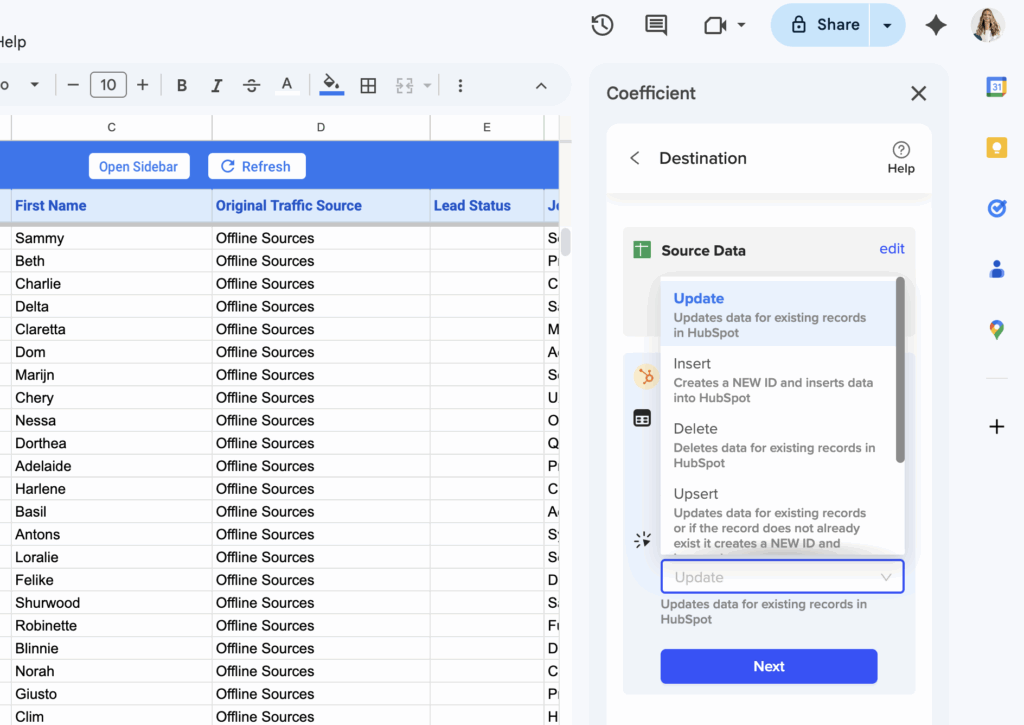
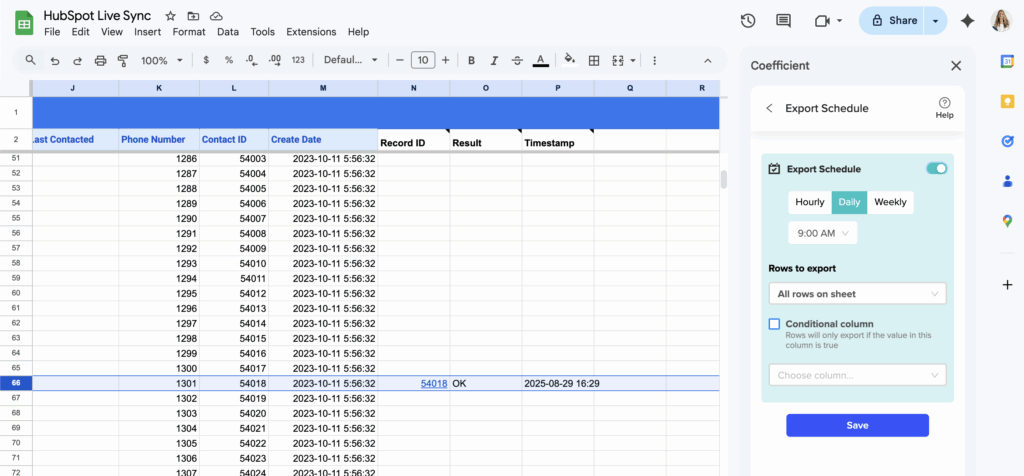
Set up scheduled exports to push spreadsheet changes back to HubSpot using UPDATE, INSERT, UPSERT, or DELETE actions. Use conditional exports to only sync rows that meet specific criteria, like Status = “Updated”.

export configuration for hubspot to google sheets

Step 4. Schedule bidirectional sync timing for optimal data flow.

Configure inbound sync every hour and outbound sync daily to maintain current data flow. Adjust timing based on your business needs and data change frequency.

schedule hubspot contact data refreshes to and from google sheets

Step 5. Enable contact list management for advanced HubSpot operations.

Add or remove contacts from HubSpot lists directly from spreadsheet data. Manage contact list memberships and object associations without workflow dependencies.

Step 6. Set up monitoring alerts for bidirectional sync health.

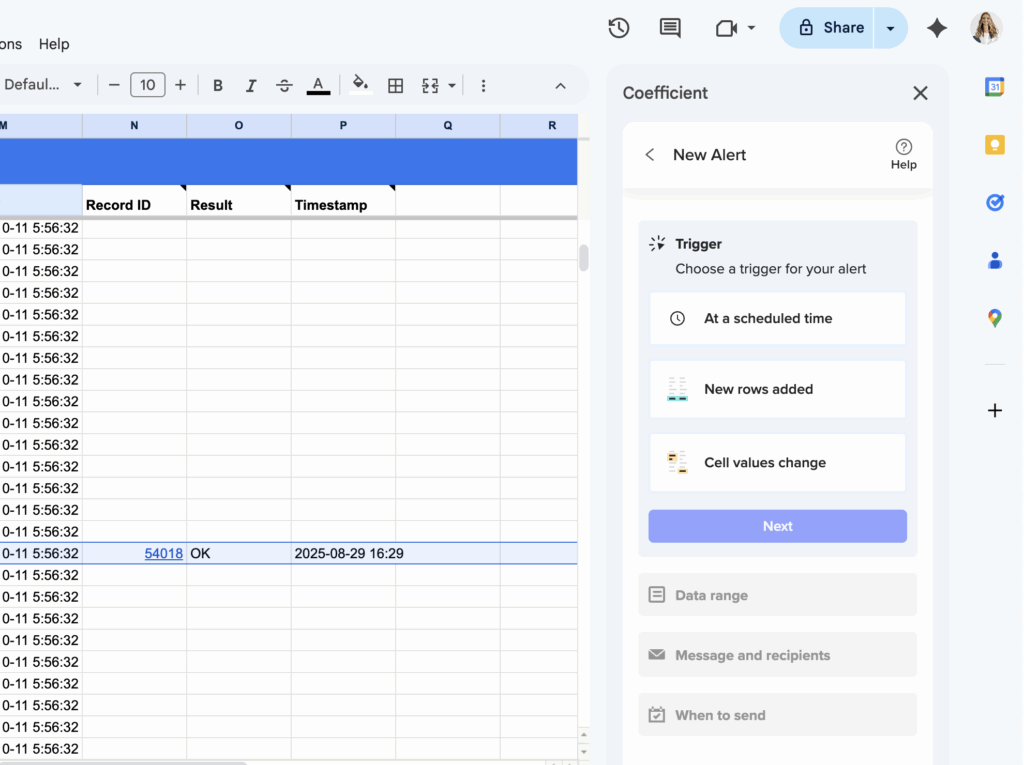
Configure Slack and email alerts for both import and export activities. Monitor connection status and get error logging with specific details for troubleshooting sync issues.

trigger slack email alerts on hubspot contact data in google sheets

Start reliable two-way sync

Coefficient for HubSpot eliminates all workflow trigger limitations while providing automated bidirectional synchronization with complete transparency. You’ll get reliable data flow in both directions with comprehensive monitoring and error reporting.with bidirectional sync today.

Get Started with Coefficient for HubSpot

How to sync specific HubSpot contact fields to Google Sheets columns with live updates

Syncing specific HubSpot contact fields to designated Google Sheets columns with live updates requires precise field mapping and reliable refresh mechanisms that HubSpot’s native integration cannot consistently deliver.

You need superior field-specific synchronization with near real-time updates. Here’s how to get precise control over which fields sync to which columns with automated live updates.

Get precise field sync with live updates using Coefficient

CoefficientHubSpotprovides superior field-specific synchronization through advanced import and mapping capabilities. It offers granular field control for custom selection of exactly whichcontact properties to import, automatic column mapping with clear labeling, and data type preservation for proper formatting.

The system enables near real-time field synchronization through scheduled refresh systems, complete field monitoring, and automated field management that maintains data integrity as fields update.

How to make it work

Step 1. Select specific contact properties during import setup.

Connect to HubSpot through Coefficient sidebar and choose exactly which contact properties to import. Access both standard HubSpot fields and custom properties, plus association fields from related companies, deals, and tickets.

Step 2. Configure automatic column mapping with clear field identification.

Let Coefficient automatically map HubSpot property names to Google Sheets column headers for easy identification. The system preserves proper formatting for dates, numbers, and boolean values while maintaining clear column organization.

Step 3. Set up hourly refreshes for near real-time field synchronization.

Configure scheduled imports to run every hour for live field updates and enable manual refresh buttons for immediate synchronization when critical changes occur. Each refresh captures current state of all selected fields.

Step 4. Enable dynamic field filtering for targeted synchronization.

Use spreadsheet cell references to dynamically filter which contacts to sync and create multiple imports for different contact segments with different field requirements. Apply up to 25 filters across 5 groups for precise control.

Step 5. Configure automated field management and monitoring.

Use formula auto-fill to extend calculations automatically when new contacts are added and set up data validation to maintain integrity as fields update from HubSpot. Enable historical tracking with snapshots to preserve field value history.

Step 6. Set up field change alerts for live monitoring.

Configure Slack or email notifications for field value changes, new contacts added, or specific property modifications. Use variables in alerts for personalized field change notifications.

Start syncing specific fields with live updates

Get startedThis approach ensures specific HubSpot contact fields remain synchronized with designated spreadsheet columns through reliable, automated live updates. You’ll get precise field control with near real-time synchronization and comprehensive monitoring.with live field sync today.

How to track original HubSpot record IDs during Excel deduplication process

Losing track of original HubSpot record IDs during deduplication creates audit nightmares and prevents rollback if something goes wrong. Manual ID tracking with formulas is error-prone and breaks easily during complex merge processes.

Here’s how to maintain complete ID tracking automatically with hyperlinked references and full audit trails throughout your deduplication workflow.

Automatic ID preservation with hyperlinked audit trails using Coefficient

CoefficientHubSpotmaintainsObject IDs automatically throughout the deduplication process, providing hyperlinked references and complete audit trails without manual tracking formulas.

How to make it work

Step 1. Import records with automatic ID preservation.

All imported HubSpot records include their original Record ID in a dedicated column with direct hyperlinks to the HubSpot records. These IDs remain intact and clickable throughout your entire deduplication process, providing instant verification access.

Step 2. Create comprehensive ID tracking columns.

Set up tracking columns for Original IDs (automatically imported), Duplicate Group (useto group related records), Master Record (flag which ID becomes primary), and Action Taken (track UPDATE, DELETE, or MERGE actions per ID).

Step 3. Build duplicate ID consolidation mapping.

Create formulas to concatenate all duplicate IDs in each group:where column C contains your duplicate group numbers. This creates merged ID strings showing all original records in each consolidation.

Step 4. Implement cross-reference validation.

Validate all Object IDs against current HubSpot data during the deduplication process. Coefficient’s live connection alerts you if referenced IDs become invalid, preventing broken references in your tracking system.

Step 5. Execute updates with preserved ID references.

Use UPDATE actions with original Object IDs to modify master records, DELETE actions with tracked duplicate IDs for removal, and maintain association updates with proper ID relationships across all objects.

Step 6. Create rollback capability with ID mapping.

The preserved Object ID tracking enables complete process reversal if needed. All original record identifiers remain intact and traceable, allowing you to undo consolidations and restore individual records exactly as they were.

Never lose track of your data changes

Start your free trialAutomatic ID preservation with hyperlinked references provides bulletproof audit trails and rollback capability for enterprise-grade deduplication processes. Ready to implement professional ID tracking?and maintain complete data lineage automatically.

How to trigger HubSpot workflows on every property value change not just unknown to known

HubSpot workflows only trigger when properties change from empty to having a value. If a contact’s job title changes from “Manager” to “Director,” no workflow fires.

This limitation creates blind spots in your automation. Here’s how to capture every property change, including subsequent value modifications.

Monitor all property changes using Coefficient

CoefficientHubSpotHubSpot’s workflow system has a fundamental flaw: it only detects the first time a property gets a value.bypasses this limitation entirely by connecting directly to yourdata and monitoring changes through scheduled imports.

Instead of waiting for triggers that may never fire, Coefficient pulls fresh data on your schedule and compares it against previous states. This catches every modification, whether it’s the first assignment or the hundredth change.

How to make it work

Step 1. Connect your HubSpot account through Coefficient’s sidebar.

HubSpotInstall Coefficient in your spreadsheet application and authenticate yourconnection. This creates a direct API link that doesn’t depend on workflow triggers.

Step 2. Import contact data with the properties you want to monitor.

Select specific contact fields during import setup. Include all properties where you need to track changes, not just initial value assignments.

Step 3. Schedule automatic refreshes for continuous monitoring.

Set up hourly imports to capture changes throughout the day. Each refresh pulls current property states and effectively detects any modifications since the last check.

Step 4. Configure alerts for property change notifications.

Use Coefficient’s alert system to notify you via Slack or email when specific properties change. Set up alerts for new rows added or cell value changes to catch modifications in real-time.

Step 5. Create historical snapshots for change tracking.

Schedule daily or weekly snapshots to preserve property value history. This creates an audit trail showing exactly when and how properties changed over time.

Start monitoring every property change

Get startedThis approach eliminates the “unknown to known” limitation that restricts HubSpot workflows. You’ll capture every property modification automatically without missing critical changes.with comprehensive property monitoring today.