You’re shopping for a data connector to automate business reporting. Coefficient and Coupler look remarkably similar at first glance. Both promise to eliminate manual data exports. Both support popular platforms like Salesforce, HubSpot, and Google Ads. Both have strong user ratings and passionate customer bases.
These tools serve fundamentally different workflows. Choosing the wrong one means missing critical capabilities or paying for features you’ll never use.
Do you need to route data to multiple destinations like BI dashboards and warehouses? Or do you do your analysis, reporting, and even data updates directly in spreadsheets? Your answer determines which tool makes sense.
This comparison breaks down exactly how Coefficient and Coupler differ across integrations, features, pricing, and user experience. You’ll learn where each tool excels and where it falls short. By the end, you’ll know which one fits your workflow.
- Coefficient vs Coupler: Core differences
- Coefficient vs Coupler: Integration capabilities
- Coefficient vs Coupler: Key features
- Coefficient vs Coupler: User experience
- Coefficient vs Coupler: Pricing comparison
- Coefficient vs Coupler: Customer support
- Coefficient vs Coupler: Security and compliance
- The verdict: Choosing your data connector
- Transform your data workflow today
Coefficient vs Coupler: Core differences
Understanding how these companies position themselves reveals what problems they’re trying to solve.
What is Coupler?

Coupler has built its reputation on flexibility and breadth. With over 1 million users worldwide and a 95% customer satisfaction rating, the platform connects 300+ data sources to multiple destination types. You can:
- Send Salesforce data to Google Sheets for quick analysis
- Route marketing metrics to Looker for visualization
- Push transaction data to Snowflake for warehousing
All from the same tool. Coupler’s 100+ dashboard templates give you pre-built reports for common use cases, while AI Insights (powered by Claude) analyzes your data and surfaces trends automatically.
For teams that need data in multiple places and want ready-made reporting frameworks, Coupler’s multi-destination approach makes sense. The $24/month starting price makes it accessible for small teams testing automation for the first time.
What is Coefficient?

Coefficient focuses on making spreadsheets as powerful as dedicated BI tools. Serving 50,000+ companies and 500,000+ users, Coefficient has earned an overall G2 rating of 4.7 out of 5 stars, plus Best Relationship and Fastest Implementation awards.
The platform treats Google Sheets and Excel as first-class analytics environments rather than export destinations:
- Live data connections mean your spreadsheet updates automatically without scheduling refreshes
- Two-way sync lets you edit data in your spreadsheet and push changes back to source systems
- AI Sheets Assistant builds dashboards, writes formulas, and creates visualizations using natural language
For spreadsheet power users—especially in finance, RevOps, and operations teams—Coefficient’s depth in this specific environment delivers capabilities that generalist platforms can’t match.

Or consider Brian Chalif, Head of BizOps at Mutiny. His team integrated Salesforce and QuickBooks data for executive reporting. “I never worry about reports being up-to-date and accurate anymore,” he explains. “At this point, after setting it up, Coefficient does most of the heavy lifting.” Senior leadership—including the CEO, CFO, CRO, and CTO—now have a real-time view of business performance that combines financial actuals with forward-looking pipeline data.
The fundamental divide
The core difference comes down to destination strategy. Coupler says, “We’ll get your data anywhere you need it.” Coefficient says, “We’ll make your spreadsheets powerful enough that you don’t need other tools.”
Both approaches work:
- Coupler wins when your workflow involves multiple platforms and you need broad connectivity
- Coefficient wins when spreadsheets are your primary workspace and you need sophisticated functionality within that environment
This distinction matters. If you’re a marketing analyst who builds reports in Looker and uses Sheets only for quick spot checks, Coupler’s multi-destination flexibility is essential—Coefficient can’t send data to Looker at all.
But if you’re a finance manager who builds budgets, forecasts, and models in Excel and needs to update QuickBooks directly from your spreadsheet, Coefficient’s two-way sync changes everything. Coupler doesn’t offer this capability.
Coefficient vs Coupler: Integration capabilities
Both platforms connect to the business systems you’re already using, but their integration strategies reveal different philosophies.
Coupler: Volume and variety
Coupler leads on sheer volume with 300+ source integrations:
- Major platforms: Salesforce, HubSpot, Google Ads, Facebook Ads, QuickBooks, Stripe, Shopify, Xero
- Project management: Jira, Asana, Monday.com
- Customer support: Zendesk, Intercom, Freshdesk
For teams with diverse tech stacks or niche tools, this breadth is valuable. If you need to pull data from a lesser-known platform, Coupler is more likely to have a pre-built connector.
Coefficient: Focused coverage

Coefficient supports 100+ integrations, focusing on widely used business systems:
- CRMs: Salesforce, HubSpot, Pipedrive
- Marketing platforms: Google Ads, Facebook Ads, LinkedIn Ads
- Financial systems: QuickBooks, Xero, Stripe, NetSuite
The integration list covers what most teams need for cross-functional reporting, but you won’t find as many specialized or niche connectors.
The destination difference
Source overlap is actually high for major business systems. Both tools connect to Salesforce, HubSpot, Google Ads, QuickBooks, Stripe, and most platforms driving core business metrics.
The real difference is destinations:
| Platform | Coupler Destinations | Coefficient Destinations |
| Spreadsheets | Google Sheets, Excel | Google Sheets, Excel |
| BI Tools | Looker, Power BI, Tableau, Data Studio | None |
| Warehouses | Snowflake, BigQuery, Redshift | None |
| Databases | PostgreSQL, MySQL | None |
This multi-destination capability defines Coupler. If you need your data in a BI tool or warehouse, Coefficient isn’t an option—you’d need to export from Sheets to your BI platform, defeating automation’s purpose.
Finance-specific considerations
Both tools handle the sources finance teams care about: QuickBooks, Xero, NetSuite, Stripe, and other financial platforms. But Coefficient’s two-way sync with QuickBooks Online adds a capability that matters for finance workflows. You can:
- Build budget models in Excel
- Push approved numbers directly back to QuickBooks
- Eliminate manual entry and transcription errors
Coefficient vs Coupler: Key features
The feature comparison reveals fundamentally different approaches to how data should flow through your organization.
Live data vs scheduled refreshes
This differentiator changes how teams work with data.
Coefficient supports live data connections that update your spreadsheet in real-time as source data changes. When a sales rep closes a deal in Salesforce, your Google Sheets dashboard reflects that new opportunity within seconds. For teams making decisions based on current information:
- Finance teams reviewing today’s revenue don’t wait for overnight batch jobs
- RevOps managers see pipeline changes as they happen
- Customer success teams monitor account health with current data
Coupler works on scheduled refreshes with a minimum interval of 15 minutes. You set up data flows to run every 15 minutes, hourly, daily, or on custom schedules. This approach works for many use cases:
- Daily sales reports
- Weekly marketing analysis
- Monthly financial reviews
But when you need current information for real-time decision-making, the 15-minute minimum becomes a limitation.
Two-way sync capabilities
| Platform | Two-Way Sync Support | Supported Systems |
| Coefficient | Yes | Salesforce, HubSpot, QuickBooks Online, Snowflake, MySQL, PostgreSQL |
| Coupler | No | None |
Coefficient’s two-way sync lets you update source systems directly from your spreadsheet. Consider these scenarios:
RevOps workflow: A manager pulls 500 Salesforce opportunities into Sheets, applies bulk cleanup logic, and pushes the cleaned data back to Salesforce in one operation. That’s 500 manual edits avoided.
Finance workflow: A director builds quarterly budgets in Excel by pulling current QuickBooks data, adjusting line items, and pushing approved budget numbers back to QuickBooks. No re-keying numbers, no transcription errors.
Marketing operations: A specialist updates HubSpot contact properties for 1,000 contacts based on spreadsheet analysis—segmentation logic that’s easier to build in Sheets formulas than in HubSpot workflows.

Coupler doesn’t offer two-way sync. Data flows from sources to destinations, but never back. For many reporting workflows, this is fine. But when you need to update source systems based on spreadsheet analysis, this limitation is fundamental.
AI capabilities comparison
Both tools offer AI features serving different functions, but with different levels of sophistication.
Coefficient’s AI Sheets Assistant acts as a comprehensive spreadsheet analyst. You can ask:
- “Build a P&L dashboard from QuickBooks with variance analysis”
- “Create a sales pipeline report with conversion metrics”
- “Generate a chart showing monthly revenue trends”
The AI doesn’t just help with formulas—it builds complete dashboards, generates pivot tables, creates visualizations, and explains insights. For finance teams specifically, the AI understands accounting terminology and can create standard financial reports automatically.
Coupler’s AI Insights analyzes your data and surfaces trends. Powered by Claude, it focuses on data interpretation rather than spreadsheet manipulation. AI Insights might tell you: “Your ad spend increased 23% but conversions only grew 8%—your cost per acquisition is trending up.”
These AI features solve different problems:
- Coefficient’s AI transforms how you build reports and analyze data within spreadsheets
- Coupler’s AI helps you understand what your data tells you
Dashboard templates and pre-built reports
Both platforms offer extensive template libraries, but with different focuses.
Coefficient provides pre-built templates for finance, sales, marketing, and operations dashboards. These templates work directly in your spreadsheet environment and include:
- QuickBooks P&L dashboards
- Salesforce pipeline reports
- Marketing attribution models
- Financial forecasting templates
Coupler offers 100+ dashboard templates spanning various reporting scenarios:
- Sales dashboards
- Marketing attribution reports
- Financial summaries
The key difference: Coefficient’s templates leverage the AI Sheets Assistant for customization, while Coupler’s templates are more static starting points. Both accelerate time-to-value, but Coefficient’s approach offers more flexibility within the spreadsheet environment.
Spreadsheet-native features
Coefficient’s spreadsheet focus delivers unique capabilities:
- Auto-refresh pivot tables update automatically when underlying data changes
- Column auto-mapping remembers field mappings and reapplies structure on each refresh
- Formula preservation maintains custom calculations as data updates
These features make Coefficient feel native to spreadsheets rather than bolted on.
Coupler exports data to spreadsheets but doesn’t offer these integrated features. Data lands in your Sheet, and you work with standard spreadsheet functionality. For straightforward reporting, this works. For complex spreadsheets with custom logic and layouts, Coefficient’s native integration reduces friction.
Coefficient vs Coupler: User experience
Both platforms prioritize user-friendly setup, but their interfaces reflect different approaches to data connectivity.
Interface design philosophy
Coefficient’s interface lives directly inside Google Sheets and Excel as a sidebar panel. You:
- Open your spreadsheet
- Launch the Coefficient add-on
- Select your data source
- Choose what data to import
- Map it to your spreadsheet

Live Coefficient QuickBooks Dashboard
All without leaving the spreadsheet environment. This native integration means fewer context switches. Coefficient won G2’s Fastest Implementation award, and users frequently cite the straightforward setup process. For spreadsheet-first users, this tight integration feels intuitive.
Coupler operates through a web-based interface where you configure data pipelines. You:
- Log into Coupler’s platform
- Set up source connections
- Configure destination settings
- Schedule refresh intervals
This approach gives you more configuration options for complex multi-destination workflows. But it also means more steps and complexity to manage. For teams comfortable with data pipeline concepts, this makes sense. For users who want data in their spreadsheet, it’s additional overhead.
Learning curve comparison
| Aspect | Coefficient | Coupler |
| Interface Location | Inside spreadsheets | Separate web platform |
| Configuration Steps | Choose source → Import | Source → Transform → Destination → Schedule |
| Complexity | Simpler (fewer choices) | More options to configure |
| Time to First Import | 15-20 minutes | 15-20 minutes basic, longer for multi-destination |
Coefficient’s simpler interface gets most users productive quickly. You’re choosing data sources and importing to spreadsheets—a workflow that feels natural.
Coupler’s broader capabilities mean more configuration options: which destinations, what transformation rules, which dashboard templates. That flexibility comes with complexity.
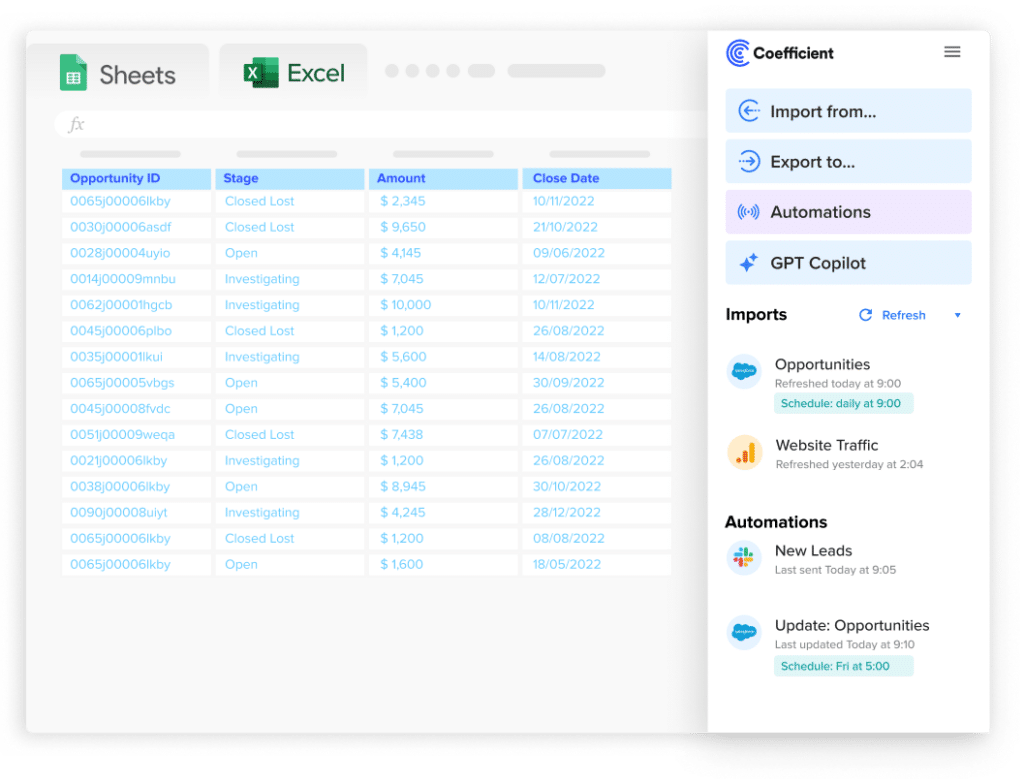
Stop exporting data manually. Sync data from your business systems into Google Sheets or Excel with Coefficient and set it on a refresh schedule.
Get Started
Centralized vs distributed management
One advantage of Coupler’s separate interface is centralized data pipeline management. If you’re managing dozens of data flows to multiple destinations, having a dedicated dashboard to monitor status, logs, and configurations helps.
Coefficient’s spreadsheet-centric approach means each spreadsheet manages its own data connections. Simpler for individual reports but potentially scattered for enterprise-scale deployments.
Coefficient vs Coupler: Pricing comparison
Pricing reveals significantly different value propositions.
Pricing structures
| Plan Level | Coupler | Coefficient |
| Starter | $24/month | $49/month |
| Mid-Tier | $99-149/month | $99-149/month |
| Enterprise | Custom | Custom |
| Entry Features | Unlimited sources, scheduled refreshes | Unlimited sources, scheduled refreshes |
| Advanced Features | More frequent refreshes, transformations | Live data, two-way sync, AI Sheets Assistant, spreadsheet features |
Coupler’s $24/month entry point makes it one of the most affordable enterprise data connectors. For small teams testing automation, this low price removes barriers.

Coefficient starts at $49/month—double Coupler’s entry price. But this includes access to the AI Sheets Assistant and other spreadsheet-native features even at the starter level.

Value calculation scenarios
Scenario 1: Basic reporting team Small marketing team needs Google Ads and Salesforce data in Sheets, refreshed daily.
- Coupler at $24/month saves $300/year
- Coefficient at $49/month includes AI assistance and templates
- Winner: Depends on whether AI productivity gains justify the extra $25/month
Scenario 2: Finance team with update requirements Finance team needs QuickBooks data in Excel for budget modeling, then pushes approved budgets back.
- Coefficient’s two-way sync at $99-149/month enables this workflow
- Coupler can’t solve this at any price
- Winner: Coefficient (unique capability)
Scenario 3: Multi-destination analytics Data team needs Salesforce data in Sheets, Looker, and Snowflake.
- Only Coupler supports multiple destinations
- Winner: Coupler (only viable option)
Scenario 4: Real-time dashboard Sales operations builds real-time leaderboard tracking deals closed today.
- Coefficient’s live data enables real-time updates
- Coupler’s 15-minute minimum creates lag
- Winner: Coefficient (live data advantage)
Total cost considerations
The value comparison depends on your specific requirements:
- Coupler offers better value for teams needing multi-destination routing or working with extremely tight budgets
- Coefficient offers better value when you factor in AI productivity gains, live data capabilities, and two-way sync
Consider indirect costs:
- Coefficient’s AI Sheets Assistant can save hours building reports
- Coefficient’s Fastest Implementation award suggests quicker setup
- Coupler’s lower entry price reduces initial investment risk
For finance professionals, Coefficient’s AI capabilities alone might justify the higher price. The AI can build financial reports in minutes that would take hours manually—potentially paying for itself in time savings.
Coefficient vs Coupler: Customer support
Both platforms have built strong reputations for customer support with slightly different approaches.
Support quality metrics
| Metric | Coefficient | Coupler |
| G2 Rating | 4.7-4.8/5 | 4.8-4.9/5 |
| Notable Awards | Best Relationship 2025 | 95% satisfaction rating |
| Support Channels | Chat, email, Slack community | Chat, email |
| Documentation | Integration guides, best practices | Setup guides, 100+ templates |
Coefficient won G2’s Best Relationship Award for 2025, recognizing exceptional customer support. Users consistently praise:
- Quick response times
- Helpful support agents
- Willingness to help with complex setup
Plus, Coefficient offers an active Slack community for users to get inspiration from!
Coupler’s 95% customer satisfaction rating and strong reviews mention:
- Helpful support teams
- Thorough documentation
- Responsive problem resolution
Support philosophy differences
Coefficient emphasizes technical depth, with support teams helping with complex spreadsheet integrations and formula troubleshooting. Their active Slack community enables peer-to-peer support for advanced techniques.
Coupler focuses on self-service resources, with 100+ dashboard templates reducing the need for support interactions. Templates serve as both functionality and learning tools.
Both platforms maintain comprehensive documentation and aim for same-day responses to standard requests, with faster response for higher-tier customers.
Coefficient vs Coupler: Security and compliance
For teams handling sensitive business data, security capabilities matter.
Security comparison
| Feature | Coefficient | Coupler |
| SOC 2 Type II | Yes | Not documented |
| GDPR Compliance | Yes | Expected (verify directly) |
| Encryption | TLS + at rest | Standard practices |
| SSO Support | Yes | Yes |
| Audit Logging | Enterprise tier | Enterprise tier |
Coefficient maintains SOC 2 Type II certification and documented GDPR compliance, important for teams with strict security requirements.
Coupler implements expected security measures for business data platforms. Their 1M+ users and enterprise customer base suggest adequate security infrastructure, though specific certifications should be verified directly for regulated industries.
Both platforms act as data conduits rather than storing business data long-term, reducing security exposure. Both support OAuth authentication and role-based access controls.
For highly regulated industries, Coefficient’s documented compliance may reduce procurement friction. For most organizations, both platforms meet typical security requirements.
The verdict: Choosing your data connector
After comparing every dimension, Coefficient and Coupler are both capable platforms optimized for fundamentally different workflows.
Choose Coefficient if:
You work primarily in spreadsheets and want Google Sheets or Excel as your analytics hub. Building financial models, sales dashboards, or operational reports? Coefficient’s spreadsheet-native approach and AI assistance deliver unique value.
You need live data or two-way sync. Real-time dashboards require Coefficient’s live connections. Updating QuickBooks, Salesforce, or HubSpot from spreadsheets requires Coefficient’s two-way sync. Coupler can’t match these capabilities.
You want AI-powered spreadsheet assistance. Coefficient’s AI Sheets Assistant dramatically accelerates report building, formula writing, and dashboard creation. This productivity multiplier often justifies the higher price.
You’re in finance, RevOps, or operations. These roles rely heavily on spreadsheet analysis. Coefficient treats spreadsheets as powerful analytics platforms, not just data destinations.
You value implementation speed and simplicity. Coefficient’s Fastest Implementation award and spreadsheet-native interface mean quicker time-to-value.
Choose Coupler if:
You need multi-destination routing. If data must flow to Looker, Power BI, Snowflake, or other BI tools and warehouses, Coupler’s architecture is essential. Coefficient only sends to spreadsheets.
You’re working with 300+ different data sources. Coupler’s extensive connector library covers more niche and specialized platforms than Coefficient’s 100+ mainstream integrations.
Budget is the primary constraint. At $24/month, Coupler offers the lowest entry point for basic automation. If you don’t need AI, live data, or two-way sync, the savings add up.
You prefer centralized pipeline management. Coupler’s dedicated web interface provides a single place to manage all data flows, which helps when coordinating complex multi-destination setups.
When the choice is obvious
- Finance team updating QuickBooks from Excel: Coefficient (two-way sync required)
- Marketing team routing data to Looker and Snowflake: Coupler (multi-destination required)
- RevOps building real-time Salesforce dashboards: Coefficient (live data required)
- Data team with 10+ destination platforms: Coupler (multi-destination architecture)
- Small team wanting AI help with spreadsheet reports: Coefficient (AI Sheets Assistant)
- Agency managing 50+ client data sources: Coupler (broader connector coverage)
Transform your data workflow today
Choose the tool that matches where you actually work with data. The right data connector fits your workflow, not someone else’s feature checklist.If you’re a spreadsheet-centric team who wants AI assistance, live data, two-way sync, or deep spreadsheet integration, get started with Coefficient and see how it transforms your workflow.