How to automatically export HubSpot contact records to Excel when deal stage changes

HubSpot workflows can’t create Excel files when deal stages change, but there’s a better approach that gives you live, automatically updating spreadsheets with your contact data.

Instead of trying to trigger one-time exports, you can set up a system that maintains real-time contact records and updates automatically in Excel whenever deal stages change.

Get live contact data that updates with deal stage changes using Coefficient

Rather than wrestling with workflow limitations, Coefficient’s 2-way sync between HubSpot and Excel connects your data directly to Excel with live sync capabilities. This means your contact records update automatically when deal stages change, without needing complex workflow triggers.

The key advantage is that you get a continuously updated spreadsheet instead of static exports. Your data stays current, and you can apply Excel’s full analytical power to your contact records and deal associations.

How to make it work

Feel free to read through the steps below or watch this quick tutorial on how to pull and sync HubSpot contact data to Excel. The video shows a walkthrough in Google Sheets, but you’ll experience the same setup process in Excel.

Now for our readers.

Step 1. Connect HubSpot to Excel and import contact records with deal associations.

Open Excel and install Coefficient from the add-ins menu. Connect to HubSpot and create an import for contacts. Select “Row Expanded” display to show multiple deals per contact, giving you complete visibility into deal stage relationships.
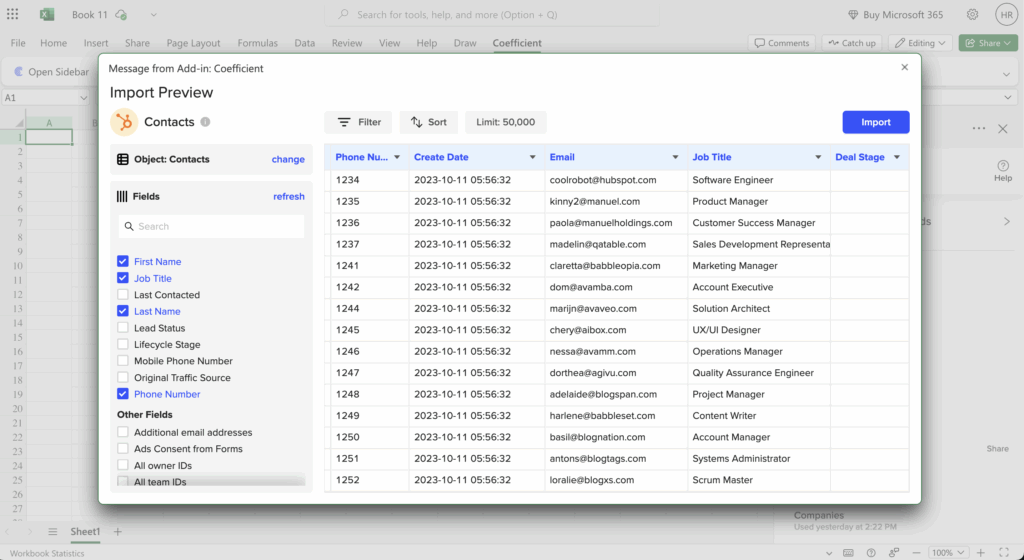
automatically export hubspot contacts excel deal stage

Step 2. Apply dynamic filters for specific deal stages.

Use Coefficient’s filtering system to focus on contacts associated with deals in specific stages. You can set up to 25 filters with AND/OR logic, and even reference spreadsheet cells for flexible criteria that you can change without rebuilding the import.
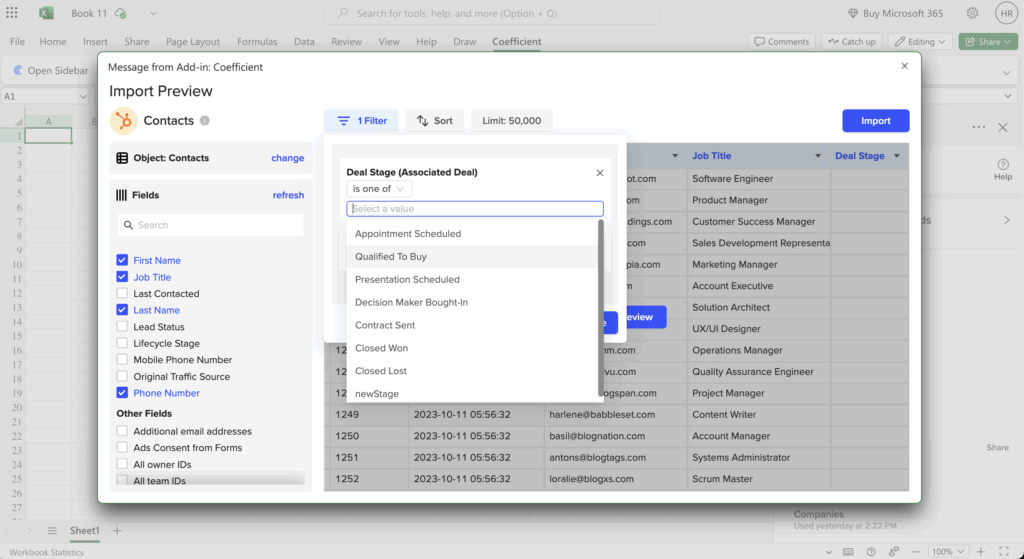
apply dynamic filters to hubspot deal stages

Step 3. Schedule automatic refreshes to capture deal stage changes.

Set up hourly, daily, or weekly refreshes so your spreadsheet updates automatically when deal stages change in HubSpot. This eliminates the need for workflow triggers while ensuring your data stays current.

Schedule automatic excel refreshes to capture hubspot deal stage changes

Step 4. Set up alerts for stakeholders when new records appear.

Configure Slack or email notifications to alert your team when new contact records meet your deal stage criteria. This gives you the notification benefits of workflows without the complexity.

trigger alerts on mysql data to slack or email

Start syncing your contact data automatically

This approach gives you more reliable contact data exports than workflow-based solutions, with the added benefit of live updates and Excel’s analytical capabilities.to set up your automated contact exports today. Try Coefficient’s HubSpot connector for Excel today.

How to bulk export report folder permissions for all user profiles in Salesforce

Salesforce doesn’t provide a consolidated view for bulk report folder permissions export, forcing admins to manually navigate through Setup > Sharing Settings for each folder individually.

Here’s how to automate the entire process using custom SOQL queries that extract permission data directly into your spreadsheet.

Extract all report folder permissions automatically using Coefficient

Coefficientsolves this by leveraging custom SOQL queries to target permission objects like FolderShare, Report, and UserRole. This creates comprehensive permission matrices without the manual clicking through hundreds of user profiles.

How to make it work

Step 1. Connect to Salesforce and set up your permission query.

SalesforceIn Coefficient, choose “Custom SOQL Query” and connect to yourorg. Use this query to get folder-level permissions:

Step 2. Add user and profile details with a second query.

Create another import to get user information:. This lets you cross-reference permission assignments with actual user details and profile assignments.

Step 3. Build your permission matrix using spreadsheet formulas.

Use VLOOKUP formulas (auto-filled by Coefficient) to match UserOrGroupId from the permissions data with actual user names and profiles. Apply conditional formatting to visualize different access levels like Read, Edit, and Manage.

Step 4. Schedule automated refreshes for ongoing monitoring.

Set up hourly, daily, or weekly refresh schedules to maintain current permission data. Add Slack or email alerts to notify you when permission changes occur across your report folders.

Get centralized permission auditing that updates automatically

Start buildingThis approach eliminates manual permission checking and provides a schedulable audit solution that maintains current data automatically.your automated permission matrix today.

How to bypass CloudAnswers authentication issues for automated report sending

CloudAnswers authentication issues are blocking your automated report distribution, causing missed deadlines and frustrated partners who depend on consistent data delivery.

Here’s how to completely bypass CloudAnswers authentication bottlenecks by establishing an independent connection pathway that avoids the problems affecting CloudAnswers entirely.

Establish independent authentication pathway using Coefficient

CoefficientSalesforcecompletely bypasses CloudAnswers authentication issues by establishing an entirely separate connection pathway tothat avoids the authentication bottlenecks affecting CloudAnswers. This approach provides immediate relief while delivering equivalent or superior automated reporting capabilities.

While CloudAnswers struggles with profile-based authentication in MFA environments, Coefficient uses OAuth2 API authentication that operates independently of user profile permissions, eliminating the root cause of CloudAnswers’ failures.

How to make it work

Step 1. Set up alternative authentication method.

SalesforceConnect Coefficient tousing OAuth2 API authentication that operates independently of the user session dependencies causing CloudAnswers authentication timeouts and permission conflicts. This provides stable connections with automatic reauthorization to prevent authentication timeouts.

Step 2. Migrate your CloudAnswers reports.

Inventory all reports currently automated through CloudAnswers, then use Coefficient’s “From Existing Report” feature to recreate CloudAnswers functionality. Import any standard or custom object data that your automated workflows require.

Step 3. Configure equivalent scheduling and distribution.

Set up daily automation matching current CloudAnswers timing using Coefficient’s built-in scheduling engine. Configure automated email alerts to send reports directly to partners without relying on CloudAnswers’ problematic distribution system, with multiple trigger options including scheduled times, new data, or value changes.

Step 4. Test and transition safely.

Verify email alerts reach intended recipients and test partner distribution workflows. Run both systems briefly in parallel to ensure continuity before CloudAnswers decommission, maintaining business operations during the transition period.

Eliminate authentication problems permanently

Bypass these authentication issuesThis approach provides immediate relief from CloudAnswers authentication problems while delivering superior automated reporting capabilities that maintain organizational security requirements.and establish reliable automated reporting that works consistently.

How to bypass Salesforce cross filter limitations when filtering opportunities by product presence and name

CoefficientSalesforceprovides the most effective method to bypasscross filter limitations when filtering opportunities by both product presence and specific product names.

This approach completely sidesteps Salesforce’s restrictive cross filter logic while maintaining real-time data accuracy.

Eliminate all cross filter restrictions with direct API access

SalesforceThis bypass method transforms complex opportunity analysis from impossible into straightforward and comprehensive. You get unlimited complexity in product filtering logic while maintaining single unified report views with real-time data analysis.

How to make it work

Step 1. Execute direct object queries that bypass reporting limitations.

Use Coefficient’s custom SOQL capability to write queries Salesforce reporting cannot handle:.

Step 2. Apply advanced filtering during import.

Import opportunities with complex filter logic that Salesforce reports cannot apply. Use Coefficient’s AND/OR filter combinations:. Apply multiple product criteria simultaneously that cross filters fundamentally cannot process.

Step 3. Implement spreadsheet-based logic for unlimited complexity.

Import all opportunity and product data separately then use advanced spreadsheet functions:. This handles any level of complexity in product filtering logic.

Step 4. Set up advanced bypass techniques.

Implement dynamic filtering using cell references for flexible criteria changes and multiple import consolidation for complex product relationship analysis. Set up real-time data refresh to maintain bypass solution accuracy and conditional exports back to Salesforce for enhanced reporting.

Step 5. Apply implementation best practices.

Schedule automatic refreshes to ensure current data and use dynamic filters for changing product criteria. Implement data validation to maintain report integrity and create backup filters for different business scenarios.

Get unlimited filtering flexibility that cross filters can’t deliver

ImplementThis bypass method provides the filtering flexibility that cross filters fundamentally cannot deliver. You’ll have unlimited complexity in product filtering logic with real-time data analysis and advanced analytics across product presence and naming scenarios.your bypass solution and eliminate all cross filter restrictions today.

How to audit Salesforce dashboard permissions when using folder-based security model

Folder-based security models in Salesforce create complex permission inheritance that’s difficult to audit through native interfaces, as dashboard access depends on folder permissions, user assignments, and organizational hierarchy.

Here’s how to get comprehensive dashboard permission auditing through automated folder security analysis.

Audit folder-based dashboard security using Coefficient

Coefficientprovides comprehensive dashboard folder permission auditing through automated folder security analysis. You get dashboard-folder relationship mapping and user access analysis through folder permission inheritance.

How to make it work

Step 1. Import comprehensive dashboard folder permissions.

SalesforceConnect toand get folder security data:

Step 2. Map dashboard-folder relationships.

Import dashboard locations:. This shows which dashboards inherit permissions from which folders.

Step 3. Analyze user access through folder permission inheritance.

Cross-reference folder permissions with user assignments to calculate effective dashboard access. Identify permission gaps or excessive access rights through folder security settings.

Step 4. Set up automated folder security auditing.

Schedule imports to maintain current folder permission data. Use spreadsheet filtering for specific folders or security levels, with conditional formatting highlighting security violations or inconsistencies.

Step 5. Create compliance reporting through permission matrices.

Build user-dashboard access matrices based on folder permissions. Analyze security levels (Private, Public Read Only, Public Read/Write) and track historical permissions through Coefficient snapshots.

Get comprehensive folder-based security auditing

Salesforce’sStart auditingThis includes dynamic filtering by folder access type, Slack/email alerts for folder permission changes, and export capabilities for compliance documentation that’s impossible throughnative folder navigation.your folder-based dashboard security today.

How to automate daily partner report distribution without CloudAnswers Report Sender

CloudAnswers Report Sender is unreliable for partner communications, but you need consistent daily report distribution to maintain business relationships and operational efficiency.

Here’s how to build comprehensive partner report automation that eliminates dependency on CloudAnswers while providing superior distribution capabilities.

Build enterprise-level partner automation using Coefficient

Coefficientoffers comprehensive partner report automation through Google Sheets integration that creates a robust distribution system. This approach provides enterprise-level automation capabilities while remaining cost-effective and immune to CloudAnswers authentication issues.

The solution leverages automated data import, sophisticated scheduling, and professional distribution features to ensure partners receive consistent, timely reports without manual intervention.

How to make it work

Step 1. Set up automated data import.

SalesforceUse Coefficient to pull anyreport data through automated refresh scheduling. Access ALL standard objects (Account, Contact, Lead, Opportunity, Campaign Member, etc.) to recreate any partner report requirements that CloudAnswers was handling.

Step 2. Configure flexible scheduling options.

Set up daily refresh at specific times based on your timezone preferences. Choose from hourly intervals (1, 2, 4, 8 hours), daily, or weekly scheduling to match partner expectations and business requirements.

Step 3. Enable sophisticated distribution automation.

SalesforceConfigure Coefficient’s Email and Slack Alerts feature fordata in Google Sheets. Set up trigger options including scheduled alerts at specific times, notifications when new rows are added, or alerts when cell values change to keep partners informed of relevant updates.

Step 4. Customize partner communications.

Create custom messaging with formatted content, charts, and screenshots in partner communications. Use variables for intelligent recipient selection based on data content, and configure separate messages or consolidated updates for different partner groups.

Step 5. Implement advanced partner features.

Create timestamped snapshots of reports for partner record-keeping, provide partners direct access to always-current Google Sheets dashboards, and use the append new data functionality to maintain historical context partners need.

Deliver professional partner automation without the headaches

Build your partner automation systemThis comprehensive approach provides enterprise-level automation capabilities while maintaining cost-effectiveness and reliability that CloudAnswers can’t match.to ensure consistent, professional report distribution.

How to automatically export deals to multiple Excel files by team or territory

You can automatically export deals to multiple Excel files by team or territory using dynamic filtering that references team lookup tables, eliminating the need to manually create separate reports for each group.

This approach lets you manage multiple filtered exports from a single interface while automatically creating new team datasets when you add new territories or sales reps.

Create team-specific automated exports using Coefficient

CoefficientHubSpot’senables multi-file automation that addresseslimitation of single-output scheduled reports, which cannot automatically generate separate files for different teams or territories.

Unlike HubSpot’s native reporting that requires manual creation of separate reports for each team, Coefficient allows you to manage multiple filtered imports from a single interface. The dynamic filtering capability means adding new teams only requires updating your reference table, automatically creating new filtered datasets without rebuilding import configurations.

How to make it work

Step 1. Set up multiple deal imports filtered by team owner or territory.

Create separate deal imports in Coefficient, each filtered by team owner or territory custom properties. You can set up one import per team or use dynamic filtering to reference a master team list that automatically creates the right filters.

Step 2. Use dynamic filtering with team/territory lookup tables.

Create a reference table in your spreadsheet that lists all teams and territories. Point your import filters to reference this table, so adding new teams automatically creates new filtered datasets without reconfiguring each import manually.

Step 3. Create separate sheets or workbooks for each team.

Organize your team exports into separate sheets within the same workbook or create entirely separate workbooks for each team. This gives each team access to their specific data while maintaining centralized management of all imports.

Step 4. Schedule synchronized weekly refreshes across all team imports.

Set up coordinated refresh schedules so all team imports update at the same time. This ensures consistency across team reports and prevents confusion about data timing differences between territories.

Step 5. Set up team-specific email alerts for each import completion.

Configure separate email alerts for each team import, so team leaders get notified when their specific data refreshes. You can customize alert recipients and messaging for each territory or sales group.

Streamline your team reporting process

Start automatingAutomated multi-team deal exports eliminate the administrative overhead of maintaining dozens of individual team reports while ensuring each group gets their relevant data on schedule.your team-specific deal exports with dynamic filtering that scales as your organization grows.

Free alternatives to CloudAnswers Report Sender that support multi-factor authentication

CloudAnswers Report Sender fails with MFA compatibility, but you need automated report distribution without the licensing costs of enterprise solutions.

Here’s a free alternative that was built with modern authentication protocols in mind and provides enterprise-grade capabilities without budget constraints.

Get robust report automation for free using Coefficient

Coefficientstands out as a premier free alternative with full multi-factor authentication support. While CloudAnswers struggles with MFA compatibility, Coefficient’s connection process includes built-in MFA support with reauthorization capability, eliminating the profile permission errors that break CloudAnswers functionality.

SalesforceThe free tier provides robust functionality includingreport imports, automated scheduling, and alert capabilities that address your immediate cost constraints while delivering professional results.

How to make it work

Step 1. Set up your MFA-compatible connection.

SalesforceConnect your MFA-enabledorg through Coefficient’s OAuth authentication system. This operates independently of the SSO configuration that causes CloudAnswers to fail, providing stable authentication without profile conflicts.

Step 2. Import from all your Salesforce reports.

Access ALL Salesforce reports and standard objects (Account, Contact, Lead, Opportunity, Campaign, etc.) plus custom objects – broader access than CloudAnswers’ limited report selection. Use the “From Existing Report” feature to quickly recreate your current CloudAnswers workflows.

Step 3. Configure enhanced scheduling options.

Set up hourly (1, 2, 4, 8), daily, and weekly scheduling options with timezone-based execution. This provides more flexibility than CloudAnswers’ basic daily scheduling while maintaining the automation your team depends on.

Step 4. Enable advanced alert features.

Configure email and Slack notifications with customizable formatting, chart inclusions, and variable support for dynamic recipient routing based on data changes. These professional features typically require paid solutions but are included in Coefficient’s free tier.

Eliminate authentication bottlenecks without breaking the budget

Start using CoefficientThis solution provides enterprise-grade report automation capabilities in a free package that works reliably with your MFA requirements.to replace CloudAnswers with a more capable and cost-effective solution.

Free report scheduling tools that work with Salesforce MFA and SSO setup

Most free report scheduling tools fail in enterprise environments with MFA and SSO requirements, leaving you choosing between security compliance and automated reporting functionality.

Here’s a free solution specifically designed to work seamlessly with enterprise security configurations that challenge other tools, providing professional capabilities without compromising your security protocols.

Get enterprise-compatible free scheduling using Coefficient

CoefficientSalesforcestands out as the premier free report scheduling tool specifically designed to work seamlessly withMFA and SSO configurations that challenge other solutions. Unlike tools that struggle with multi-factor authentication, Coefficient was built with MFA requirements in mind.

The OAuth2 API authentication operates independently of your SSO configuration, eliminating the conflicts that cause other free tools to fail in enterprise security environments while maintaining all security protocols.

How to make it work

Step 1. Connect with enterprise security compatibility.

SalesforceEstablish connection to your MFA and SSO-enabledorg using Coefficient’s native MFA support with automatic reauthorization and token refresh capabilities. This prevents the authentication failures that break other free tools in secure environments.

Step 2. Access comprehensive data without restrictions.

Import from ALL Salesforce reports, standard objects (Account, Contact, Lead, Opportunity, Campaign Member, Task, Event, User, Opportunity Snapshot), and custom objects without the row limitations or restricted connectivity found in other free alternatives.

Step 3. Configure advanced scheduling options.

Set up hourly scheduling (1, 2, 4, 8 hour intervals), daily scheduling with timezone control, or weekly scheduling with multiple day selection. Include manual refresh capabilities for ad-hoc requirements that exceed typical free tool limitations.

Step 4. Enable professional distribution features.

Configure email alerts with customizable formatting including chart and screenshot inclusions. Set up dynamic routing using variable-based recipient selection, and configure multiple triggers including schedule-based, new data, or value change triggers for comprehensive automation.

Achieve enterprise-grade automation without compromising security

Implement enterprise-compatible schedulingThis combination makes Coefficient the optimal choice for organizations requiring reliable, free report scheduling in secure Salesforce environments where other tools fail.that works with your security requirements rather than against them.

Free tools for scheduling Salesforce reports to external partners daily

External partner report distribution requires professional automation capabilities, but enterprise solutions exceed your budget constraints and many free tools lack the features you need.

Here’s a comprehensive free solution that provides enterprise-grade partner reporting without cost barriers or feature limitations.

Get professional partner reporting for free using Coefficient

Coefficientranks among the top free tools for external partner report scheduling, offering enterprise-grade capabilities without cost barriers. The free tier provides comprehensive data access and professional distribution features that most paid alternatives can’t match.

SalesforceUnlike other free tools that restrict data volume or object access, Coefficient’s free tier includes unlimited access to ALLreports, standard objects (Account, Contact, Lead, Opportunity, Campaign, Task, Event, User), and custom objects.

How to make it work

Step 1. Set up comprehensive data access.

SalesforceImport from ALLreports and objects without the restrictions found in other free tools. Use the “From Existing Report” feature for quick setup or “From Objects & Fields” to build custom partner reports with specific data requirements.

Step 2. Configure advanced scheduling options.

Set up daily scheduling with timezone control, hourly intervals (1, 2, 4, 8 hours) for time-sensitive partner data, or weekly scheduling for summary reports. Include manual refresh capabilities for ad-hoc partner requests when needed.

Step 3. Enable professional distribution features.

Configure automated email alerts with customizable formatting and chart inclusions. Set up dynamic recipient routing using variables to send different reports to appropriate partner contacts, and customize message formatting with professional presentation options.

Step 4. Implement partner-specific capabilities.

Create shared dashboard access so partners can view always-current Google Sheets with real-time data. Use the snapshots feature to preserve timestamped copies for partner record-keeping, while maintaining Salesforce security boundaries through shared sheet access only.

Deliver enterprise-grade partner reporting without budget constraints

Start building your partner reporting systemThis combination of robust functionality and zero cost makes Coefficient ideal for organizations needing professional partner reporting without budget limitations.with enterprise capabilities at no cost.