Open-source data integration sounds great in theory. But when your team is wrestling with Docker containers, managing infrastructure, and debugging complex pipelines, the dream quickly turns into a nightmare.
You need data flowing, not another full-time job maintaining your ELT platform.
The good news? You have options that actually work for real teams with real deadlines.
What is Airbyte?
Airbyte is an open-source ELT (Extract, Load, Transform) platform that helps teams sync data from various sources into data warehouses and lakes. Built around a connector-first approach, it offers:
- 600+ connectors
- Community-driven development
- Modular, container-based architecture
- Custom connector development through their Connector Development Kit (CDK)
Each connector runs in its own Docker container. This design allows for horizontal scaling and custom development.
While Airbyte’s open-source model provides flexibility and cost savings, it comes with significant operational overhead that many teams underestimate.
Why look for Airbyte alternatives?
Despite its extensive connector library, Airbyte presents several challenges that drive teams to seek alternatives:
Technical complexity and setup overhead
Setting up Airbyte requires Docker or Kubernetes expertise. Your team needs to:
- Provision infrastructure
- Manage container orchestration
- Handle scaling worker pods
For many organizations, this represents a substantial hidden cost.
Maintenance and operational burden
Self-hosted Airbyte instances demand ongoing maintenance. You’re responsible for:
- System updates and security patches
- Monitoring pipeline health and performance
- Troubleshooting connector failures
- Managing resource allocation and costs
Limited transformation capabilities
Airbyte focuses heavily on the “EL” in ELT. Transformations require external tools like dbt, adding complexity and integration overhead to your data stack.
Debugging and error handling
Users frequently report:
- Inconsistent error messages
- Limited debugging capabilities
- Time-consuming root cause identification when pipelines fail
Resource and scaling challenges
The open-source UI lacks direct resource configuration options. Scaling requires:
- Manual YAML edits
- External orchestration tools
- Complex performance and cost optimization
Top 7 Airbyte alternatives
1. Fivetran – The enterprise-grade managed solution

Fivetran positions itself as the “hands-off” alternative to Airbyte’s self-managed complexity. This fully managed ELT platform automates data replication with minimal configuration, targeting enterprises that prioritize reliability over control.
Key features:
- 700+ pre-built connectors with automated maintenance
- 15-minute to 1-minute sync intervals depending on plan
- Native dbt Core integration for transformations
- Enterprise security with customer-managed keys
- Automated schema drift handling
Pricing:
Usage-based model starting at $500 per million monthly active rows (MAR). Annual contracts offer up to 22% discounts.
Best for:
Enterprise data teams seeking a fully managed solution with predictable SLAs and extensive connector coverage.
The trade-off:
Higher costs at scale and reduced customization compared to open-source alternatives.
2. Stitch Data – Simple, transparent pricing
Stitch Data (now part of Talend) offers a cloud-native ELT solution that emphasizes simplicity and transparent pricing. It’s designed for mid-market companies that want managed infrastructure without enterprise complexity.
Key features:
- 140+ connectors with straightforward setup
- Row-based pricing that’s easy to predict
- Advanced security features including VPC peering
- Site-to-site VPN and AWS PrivateLink support
- Historical log retention up to 60 days
Pricing:
Starts at $100/month for 5 million rows. Plans scale to 1 billion rows with predictable tier-based pricing.
Best for:
Growing companies that need transparent costs and simple data pipelines without extensive customization requirements.
The trade-off:
Limited real-time capabilities and fewer advanced transformation options compared to other platforms.
3. Coefficient – Zero-setup spreadsheet integration

Coefficient takes a radically different approach to data integration. Instead of building another complex ELT platform, it brings live data directly into spreadsheets where business users already work.
Key features:
- 70+ business system connectors with one-click setup
- Two-way data sync between spreadsheets and source systems
- AI Sheets Assistant for instant analysis and chart generation
- Real-time alerts through Slack and email
- No infrastructure management – everything runs in the cloud
Why choose Coefficient over Airbyte:
Immediate usability:
- While Airbyte requires Docker setup and technical configuration
- Coefficient works instantly from your Google Sheets or Excel
- No containers, no infrastructure, no learning curve
Business user focus:
- Airbyte targets data engineers
- Coefficient empowers analysts, marketers, and finance teams
- Work with live data without waiting for IT support
Zero maintenance:
- Forget about managing servers
- No updating connectors or debugging pipelines
- Coefficient handles all infrastructure
- Focus on insights, not maintenance
Spreadsheet-native approach:
- Instead of moving data to another tool
- Coefficient enhances the spreadsheet environment
- Live data connections with AI-powered analysis
Pricing:
- Free plan: Available for testing
- Paid plans: Start at $49/month with volume discounts for larger teams
Best for:
Business teams that want immediate access to live data without technical overhead, infrastructure management, or lengthy setup processes.
The trade-off:
Limited to spreadsheet workflows and not suited for large-scale enterprise data warehouse integration.
4. AWS Glue – Serverless and cloud-native
AWS Glue offers a serverless data integration experience for organizations already invested in the AWS ecosystem. It eliminates infrastructure management through fully managed Spark-based ETL jobs.
Key features:
- Serverless Spark-based ETL with automatic scaling
- Integrated data catalog and schema discovery
- Pay-per-use pricing model ($0.44 per DPU-Hour)
- Built-in ML transforms and streaming capabilities
- Deep integration with AWS services
Best for:
AWS-centric organizations seeking serverless data integration with automatic scaling and integrated metadata management.
The trade-off:
AWS vendor lock-in and potential cost unpredictability for complex transformations.
5. Matillion – Cloud data warehouse optimization

Matillion specializes in pushdown ELT for cloud data warehouses, offering a low-code interface optimized for platforms like Snowflake, BigQuery, and Redshift.
Key features:
- Low-code pipeline development with drag-and-drop interface
- Cloud warehouse-optimized transformations
- Built-in orchestration and scheduling capabilities
- Git integration for version control
- AI assistant (“Maia”) for pipeline optimization
Pricing:
Credit-based system starting at $2.50 per credit. Enterprise tiers available through sales.
Best for:
Data engineering teams focused on cloud data warehouse environments that want visual pipeline development.
The trade-off:
Cloud-only focus limits on-premises deployments, and credit pricing can become complex at scale.
6. Talend (Qlik Talend Cloud) – Enterprise data fabric

Talend Data Fabric provides a comprehensive platform that goes beyond basic ELT to include data quality, governance, and cataloging in a unified solution.
Key features:
- Unified data integration, quality, and governance platform
- Support for both ETL and ELT patterns
- Multi-cloud and hybrid deployment options
- Advanced data lineage and impact analysis
- Self-service data preparation capabilities
Pricing:
Capacity-based subscription model available through sales consultation.
Best for:
Large enterprises requiring comprehensive data management with built-in governance and quality controls.
The trade-off:
Higher complexity and steeper learning curve compared to focused ELT tools.
7. Hevo Data – Rapid deployment focus

Hevo Data positions itself as the “quick setup” alternative, emphasizing fast time-to-value with automated schema mapping and real-time change data capture.
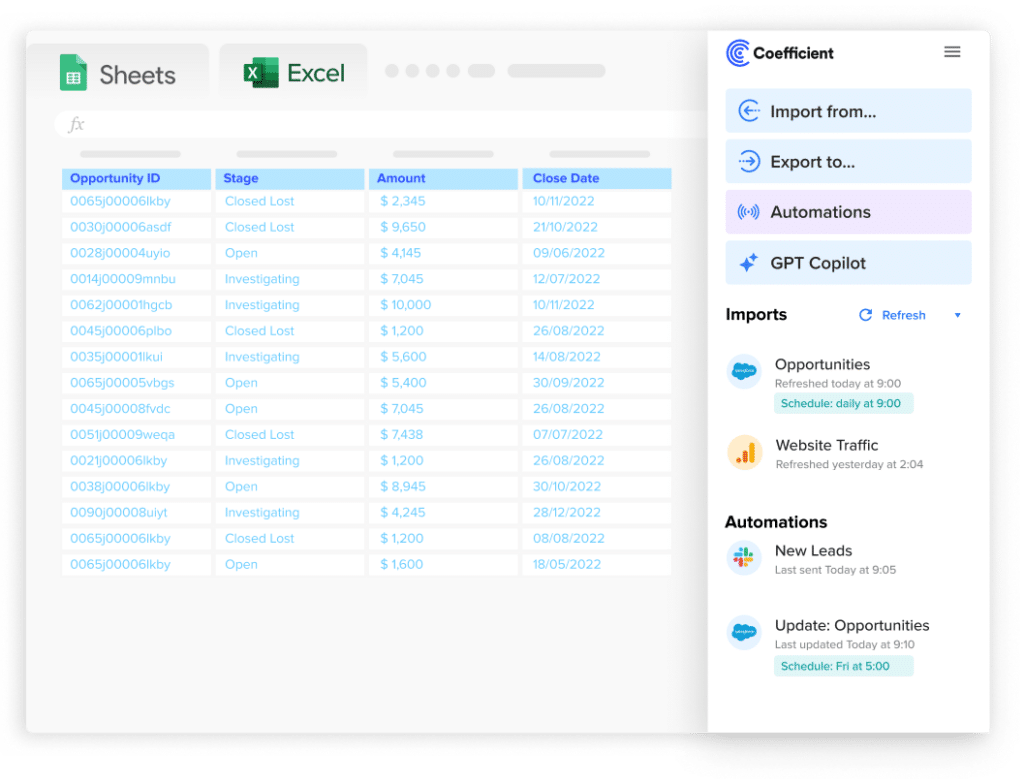
Stop exporting data manually. Sync data from your business systems into Google Sheets or Excel with Coefficient and set it on a refresh schedule.
Get Started
Key features:
- 150+ pre-built connectors with automated setup
- Real-time CDC for immediate data availability
- No-code transformations with drag-and-drop interface
- Built-in monitoring and alerting capabilities
- White-glove onboarding and support
Pricing:
Starts at $239/month for 5 million events, with custom enterprise pricing available.
Best for:
Mid-market teams that need rapid deployment with minimal technical investment.
The trade-off:
Less customization flexibility compared to open-source solutions and potential vendor dependency.
How to choose the right alternative
Selecting the best Airbyte alternative depends on several key factors:
Technical expertise and resources
High technical capacity:
- Consider Fivetran or Matillion if you have skilled data engineers
- Want to reduce operational overhead
Limited technical resources:
- Choose Coefficient or Hevo Data for immediate value
- No infrastructure management required
AWS-centric environment:
- AWS Glue provides native integration and serverless scaling
Use case requirements
Business user empowerment:
- Coefficient excels when analysts need direct data access
- Eliminates technical bottlenecks
Enterprise governance:
- Talend offers comprehensive data management beyond basic integration
Cloud warehouse focus:
- Matillion optimizes specifically for cloud data warehouse workflows
Budget and pricing preferences
Predictable costs:
- Stitch Data and Hevo offer transparent, tier-based pricing models
Pay-as-you-scale:
- Fivetran and AWS Glue provide usage-based pricing
- Grows with your data volume
Cost optimization:
- Coefficient offers competitive pricing for spreadsheet-native workflows
Integration complexity
Simple data flows:
- Coefficient and Stitch handle straightforward integration needs effectively
Complex transformations:
- Matillion and Talend provide advanced transformation capabilities
Real-time requirements:
- Hevo and Fivetran excel at low-latency data synchronization
Finding the right fit for your team
The best Airbyte alternative isn’t necessarily the most feature-rich platform. It’s the one that matches your team’s actual workflow and technical capacity.
Consider these scenarios:
If you’re spending more time managing infrastructure than analyzing data:
- Consider managed solutions like Fivetran or Stitch
If your team lives in spreadsheets and needs immediate access to live data:
- Coefficient eliminates the complexity entirely
For AWS-native environments:
- Glue provides seamless integration
For comprehensive enterprise needs:
- Talend offers the full data fabric approach
The key insight: Modern data teams need solutions that reduce friction, not add it. Choose the platform that gets you to insights faster, not the one with the longest feature list.
Skip the complexity, embrace simplicity
Complex infrastructure shouldn’t stand between your team and critical insights. While some organizations need enterprise-grade data warehouses and complex transformation pipelines, many teams simply want live data in their existing workflows.
The right solution empowers your team to focus on what matters most—turning data into actionable insights that drive business growth.
Ready to eliminate data integration headaches? Start your free Coefficient trial and connect your first data source in under 60 seconds.