Raw MySQL data sitting in tables helps no one. You need reports that make sense, update themselves, and reach the right people at the right time.
Most teams hit the same walls: manual exports that break, dashboards that go stale, and BI tools that require a PhD to operate. MySQL reporting tools fix this. They connect to your database, pull live data, and turn it into dashboards and reports your team can actually use.
This guide covers eight tools that handle MySQL reporting well. Each serves a different use case. Some cost nothing. Others run into six figures. The right choice depends on your team’s skills, budget, and how much you hate CSV exports.
Quick decision guide
Need the short version? Here’s who should use what:
| If you need… | Choose this |
|---|---|
| MySQL data in spreadsheets, no code | Coefficient |
| Free, open-source dashboards | Metabase |
| Microsoft ecosystem integration | Power BI |
| Advanced visual analytics | Tableau |
| Governed semantic layer | Looker |
| MySQL + NoSQL + APIs in one tool | Knowi |
| All-in-one enterprise platform | Domo |
| Pixel-perfect embedded reports | Jaspersoft |
| Budget | Options |
|---|---|
| Under $1K/year | Coefficient, Metabase (self-hosted) |
| $1K-10K/year | Metabase Cloud, Power BI |
| $10K-50K/year | Tableau, Knowi |
| $50K+/year | Looker, Domo, enterprise tiers |
1. Coefficient

Best for: Business teams who want live MySQL data in Google Sheets or Excel without building a full BI stack.
Coefficient is a spreadsheet-native connector that syncs MySQL directly into Google Sheets and Excel. It targets operations, revenue, and finance teams who already live in spreadsheets and don’t want another dashboard platform to manage.
The tool focuses on self-serve reporting. Once connected, you define parameterized queries, schedule refreshes, and build spreadsheet-based dashboards on top of live MySQL data. The interface stays inside your spreadsheet—no switching between applications.
Coefficient also supports writeback. Teams can push cleaned or modeled data from Sheets back into MySQL. This enables lightweight operational workflows like updating status fields or pushing bulk changes without leaving the spreadsheet.
Key features
- Live MySQL sync with scheduled refreshes and parameterized imports—no code required
- Two-way sync that lets you write edited records from Sheets/Excel back into MySQL
- Multi-source reporting by blending MySQL with CRMs, marketing tools, and warehouses in one spreadsheet
- Governance features including shared connections, templates, and permissions for team collaboration
MySQL integration details
- Connection method: Native MySQL connector in the add-on sidebar. Enter host, port, database, and credentials.
- Setup complexity: Minutes for admin setup. Business users run queries from Sheets immediately after.
Pricing
Coefficient offers a free trial, then paid plans for Google Sheets and Excel with per-user SaaS pricing. Exact rates require a sales conversation, but it sits at the affordable end compared to enterprise BI.
Get started with Coefficient for free →
Pros
- Extremely low friction for spreadsheet-centric teams
- Live scheduled sync and writeback eliminate CSV exports
- Supports 60+ non-MySQL sources for blended reporting
- Friendly learning curve for anyone who knows spreadsheets
Cons
- Not a full enterprise BI platform for complex semantic modeling
- Heavy dashboards can hit spreadsheet performance limits
- Pricing requires talking to sales
Verdict: Coefficient works when “BI” really means “better spreadsheets” and you want MySQL reporting where business users already work.
2. Metabase

Best for: Product and analytics teams that want a low-cost, open-source BI tool with solid MySQL support and easy self-serve dashboards.
Metabase connects directly to MySQL and other databases, offering both a visual query builder and SQL editor. Non-technical users can explore data using the GUI while analysts write SQL for complex questions. Everything saves as dashboards or automated “pulses.”
The open-source core runs on your own infrastructure at zero license cost. Paid cloud and self-hosted tiers add governance, embedding, SSO, and priority support. MySQL is a first-class data source, so setup is quick and query performance scales with your underlying schema.
The trade-off is support depth. Open-source means community forums. Commercial tools offer phone calls with engineers.
Key features
- Visual query builder plus SQL editor with drill-through and interactive dashboards
- Alerts and pulses that email or Slack MySQL metrics when thresholds trigger
- Embeddable dashboards and multi-tenant capabilities on higher tiers
- Open-source core with active community and flexible deployment
MySQL integration details
- Connection method: Native MySQL connector. Add MySQL as a database from the admin panel with host, port, DB, and credentials.
- Setup complexity: Under 5 minutes to connect. Metabase auto-profiles tables and fields to enable GUI querying without modeling.
Pricing
- Free: Open-source self-hosted, unlimited users
- Starter: ~$85/month for 5 users, +$5/month per additional user (cloud)
- Pro: ~$500/month including 10 users, +$10/month per additional user
- Enterprise: Custom pricing, starting ~$15,000/year
Pros
- Fast, low-cost path to MySQL dashboards—especially with free tier
- Simple UX for non-technical users, full SQL for analysts
- Flexible deployment: cloud or self-hosted, open-source codebase
- Pricing undercuts enterprise BI significantly
Cons
- Enterprise features (governance, white-label embedding) gated behind paid plans
- Fewer advanced modeling and semantic layer capabilities than Looker or Tableau
- Self-hosted scaling requires ops work
Verdict: Metabase is ideal when you want robust MySQL reporting quickly and affordably, with room to grow into enterprise features.
3. Power BI

Best for: Microsoft-centric organizations that want inexpensive, MySQL-backed dashboards deeply integrated with Office 365 and Fabric.
Power BI is Microsoft’s flagship BI platform. It brings strong data modeling, DAX calculations, and tight integration with Excel, Teams, and Azure services. MySQL connects via built-in connectors or ODBC, letting analysts build semantic models and interactive reports on operational databases.
Power BI remains one of the most cost-effective options for internal audiences at scale. It shines when paired with other Microsoft services and when teams invest in proper DAX and star schema modeling.
The catch: DAX has a learning curve. And direct-querying MySQL at scale needs optimization—often pushing teams toward data warehousing.
Key features
- Rich data modeling with relationships, measures, and DAX for complex business logic
- Tight Microsoft integration with Excel, Teams, SharePoint, and Azure
- Large visualization library plus custom visuals and embedding capabilities
- Row-level security and governance with deployment pipelines for enterprise rollouts
MySQL integration details
- Connection method: Native MySQL connector and ODBC options from Power BI Desktop. Specify server, database, credentials, then publish models to Power BI service.
- Setup complexity: Moderate. Basic connection is straightforward. Performant models need schema design, incremental refresh, and gateway configuration for on-prem MySQL.
Pricing
- Power BI Pro: $14/user/month
- Power BI Premium Per User (PPU): $24/user/month
- Premium capacity: Starting at $4,995/month for P1 SKUs (transitioning to Microsoft Fabric SKUs)
Pros
- Extremely competitive per-user pricing vs. Tableau, Looker, Domo
- Strong fit for organizations on Microsoft 365 and Azure
- Mature governance, security, and deployment features
- Large ecosystem: documentation, community, third-party visuals
Cons
- Steep DAX learning curve for complex use cases
- Mixed experience outside Microsoft environments
- Direct MySQL querying at scale needs optimization or warehousing
Verdict: Power BI is the default for MySQL reporting in Microsoft shops—strong capabilities, aggressive pricing, if you’re willing to learn DAX.
4. Tableau

Best for: Data teams who need polished, interactive visual analytics on MySQL with rich exploratory capabilities and enterprise deployment.
Tableau is a visual analytics platform known for drag-and-drop dashboarding, expressive visualizations, and powerful exploratory workflows. MySQL connects via native connector, letting analysts build extracts for performance and publish dashboards to Tableau Server or Cloud.
Recent releases added better connectivity for AWS-hosted MySQL via PrivateLink. Tableau fits when data storytelling and interactive exploration matter as much as canned reports, and when teams want governed environments for published data sources.
The cost is higher than Power BI or Metabase. But so is the visual polish.
Key features
- Drag-and-drop dashboarding with a large library of visualizations and interactions
- Native MySQL connector plus extracts for faster performance at scale
- Tableau Server/Cloud for centralized governance, permissions, and shared data sources
- Strong embedded analytics and advanced calculation support
MySQL integration details
- Connection method: Native MySQL connector in Tableau Desktop/Cloud. Requires MySQL ODBC driver. Connect with host, port, DB, credentials.
- Setup complexity: Low for basic connections. More involved for extracts, refresh schedules, and secure connectivity (AWS PrivateLink for AWS-hosted MySQL).
Pricing
Tableau Cloud (Standard):
- Creator: $75/user/month (billed annually)
- Explorer: $42/user/month (billed annually)
- Viewer: $15/user/month (billed annually)
Tableau Enterprise:
- Creator: $115/user/month
- Explorer: $70/user/month
- Viewer: $35/user/month
Every deployment requires at least one Creator license.
Pros
- Excellent interactive visualization and data storytelling
- Mature governance and server/cloud deployment for enterprises
- Native MySQL connector with extract support for large datasets
- Strong training ecosystem and community
Cons
- Licensing costs significantly higher than Power BI for comparable user counts
- Complex for small teams needing lightweight reporting
- Performance often requires modeling and extract strategy
Verdict: Tableau fits when visual richness and exploration on MySQL matter more than rock-bottom pricing, and when enterprise deployment is justified.
5. Looker (Looker & Looker Studio)

Best for: Organizations that want a governed semantic layer on MySQL (Looker) or free, lightweight dashboards with direct MySQL connectors (Looker Studio).
Looker uses LookML to define a reusable semantic model across MySQL and other databases. This centralizes metrics and permissions, letting teams build governed explores and dashboards without duplicating logic.
Looker Studio (formerly Data Studio) is a free, lighter-weight visualization front end with a Cloud SQL for MySQL connector. Good for teams already in Google Cloud who need simple dashboards without LookML investment.
The enterprise Looker product requires significant upfront work. LookML isn’t trivial to learn. But it pays off when “single source of truth” for metrics matters.
Key features
- Looker: Central semantic layer (LookML) with governed explores, row-level security, and powerful modeling
- Looker Studio: Free dashboards with Cloud SQL for MySQL and third-party connectors
- Strong Google Cloud integration with BigQuery, Cloud SQL, Workspace
- Embedding and APIs for product analytics and customer-facing reports
MySQL integration details
- Looker: Native JDBC connectors for MySQL. Configure connection in admin UI, model in LookML.
- Looker Studio: Cloud SQL for MySQL native connector, plus community connectors. Supports MySQL 5.6, 5.7, 8.0. Query limit: 150,000 rows.
- Setup complexity:
- Looker: High. Connecting MySQL is easy. Building robust LookML requires specialized skills.
- Looker Studio: Low. Authenticate to Cloud SQL for MySQL and start building charts within row limits.
Pricing
- Looker: Starting ~$36,000–60,000/year for small deployments. Average enterprise cost ~$150,000/year. Large deployments can exceed $300,000+/year. Additional costs for LookML development, BigQuery compute, and implementation typically add 40–60% to licensing.
- Looker Studio: Free. Third-party connectors run $20–350/month depending on vendor. Looker Studio Pro is $9/user/month.
Pros
- Strong semantic layer and governance for “single source of truth” metrics
- Deep Google Cloud alignment
- Looker Studio offers zero-license-cost entry for MySQL dashboards
- Flexible embedding and APIs for product analytics
Cons
- Looker licensing and TCO among highest in BI market
- LookML introduces steep learning curve and ongoing maintenance
- Looker Studio has query row limits and less customization
- MySQL isn’t the primary “sweet spot” vs. BigQuery
Verdict: Choose Looker when you need robust semantic governance and can invest in LookML and Google Cloud. Use Looker Studio for simple, free MySQL dashboards on Cloud SQL.
6. Knowi

Best for: Teams needing a single platform to query MySQL alongside NoSQL, REST APIs, and unstructured data in real time without heavy ETL.
Knowi is a polyglot analytics platform that connects to MySQL, NoSQL systems (MongoDB, Elasticsearch, InfluxDB), and APIs. It builds dashboards on those sources without requiring data centralization in a warehouse first.
The differentiator: cross-database joins. Blend MySQL with MongoDB or REST endpoints in a single query. This matters when your data lives across multiple systems and ETL is a bottleneck.
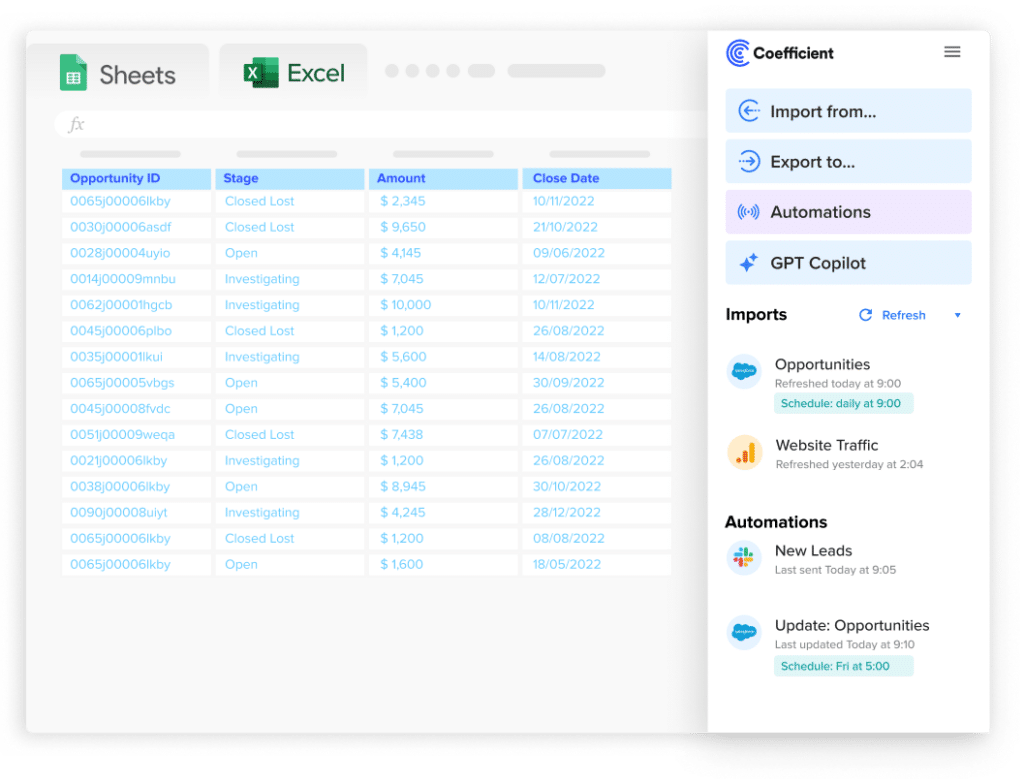
Stop exporting data manually. Sync data from your business systems into Google Sheets or Excel with Coefficient and set it on a refresh schedule.
Get Started
Deployment options include cloud, on-premises, and hybrid—appealing for data-sensitive industries or ISVs embedding analytics.
Key features
- Connectors for 30+ SQL and NoSQL sources including MySQL, MongoDB, Elasticsearch, and REST APIs
- Real-time, no-ETL architecture that queries data where it lives
- Cross-database joins allowing MySQL + NoSQL + REST in a single query
- Embedded analytics and AI features for machine learning and advanced use cases
MySQL integration details
- Connection method: Native MySQL data source. Configure host, port, credentials. Create queries using SQL or drag-and-drop builder.
- Setup complexity: Low-to-moderate. MySQL connection is straightforward. Advanced cross-source joins and embedding require more design.
Pricing
Knowi offers Basic, Teams, and Enterprise plans. Starting price around $15,000/year for advanced deployments, though many customers negotiate tailored packages. No surprise billing—subscription-based.
Pros
- Excellent for environments where MySQL coexists with NoSQL and APIs
- No-ETL approach reduces warehouse dependency
- Flexible deployment: cloud, on-prem, hybrid
- Predictable subscription pricing without usage-based surprises
Cons
- Pricing less transparent than mass-market tools
- Learning curve for advanced cross-source joins
- Overkill if you only need standard MySQL dashboards
Verdict: Knowi is compelling when MySQL is one of several data stores and you want to avoid heavy ETL—unifying SQL, NoSQL, and APIs in one analytics layer.
7. Domo

Best for: Mid-market and enterprise organizations that want an all-in-one BI platform with MySQL connectors, data pipelines, and wide business user distribution.
Domo is an end-to-end cloud BI platform combining data integration, storage, transformation, and visualization. It offers connectors for MySQL alongside 1,000+ other sources, plus built-in ETL (Magic ETL), governance, and collaboration tools.
For MySQL reporting, Domo can connect directly to your database or ingest data via Workbench or ODBC drivers. This enables large-scale KPI distribution to hundreds of business users—but at a premium price.
The consumption-based pricing model adds complexity. Budget estimates require careful credit calculation.
Key features
- Hundreds of data connectors including MySQL, with scheduling and data pipelines
- Built-in ETL (Magic ETL) and governance inside the same platform as dashboards
- Strong sharing and collaboration with mobile access for business users
- Embedded analytics and consumption-based options for external audiences
MySQL integration details
- Connection method: Native MySQL connectors plus ODBC and Workbench tools. Connect MySQL directly or via drivers.
- Setup complexity: Moderate. Connector configuration is straightforward. Building robust dataflows, schedules, and governance layers requires implementation work.
Pricing
Domo uses consumption-based pricing (credits). Estimates:
- Standard tier: ~$50,000–75,000/year for small teams
- Enterprise tier: ~$100,000–200,000+/year
- Business Critical: $200,000–500,000+ for large deployments
- Base user fee: ~$750/year per user, plus consumption credits
Pros
- True end-to-end stack: connectors, storage, transformation, dashboards
- Scales for large organizations sharing MySQL-derived KPIs widely
- Rich connector catalog reduces need for separate ETL
- Strong embedded and mobile capabilities
Cons
- Among the most expensive BI options—often pricier than Tableau or Looker
- Base tiers have connector, storage, and user limits leading to overages
- Implementation and change management require vendor or partner support
Verdict: Domo is best when you want a single platform for MySQL and broader analytics at enterprise scale, with budget for premium deployment.
8. Jaspersoft (TIBCO Jaspersoft)

Best for: Engineering-heavy teams and ISVs that need embeddable, pixel-perfect MySQL reports and dashboards inside their own applications.
Jaspersoft is a developer-oriented BI suite focused on pixel-perfect reporting, embeddable dashboards, and flexible Java/web integration. MySQL is a core relational source, making it common in SaaS products and internal platforms requiring controlled report layouts and export formats (PDF, XLS, etc.).
The platform includes Jaspersoft Studio for report design, a server component for scheduling and access control, and cloud marketplace images for AWS and Azure. Multi-tenancy and data virtualization make it suitable for complex, multi-customer MySQL environments.
This isn’t a self-serve dashboard tool. It’s an embeddable reporting engine.
Key features
- Pixel-perfect report designer for highly formatted outputs with charts, images, and crosstabs
- Ad hoc report designer for business users plus interactive dashboards
- Multi-tenancy and embedding for SaaS and OEM use cases
- Data virtualization and ETL for integrating multiple sources beyond MySQL
MySQL integration details
- Connection method: JDBC-based connectors from Jaspersoft Studio/Server to MySQL. Configure data adapters with MySQL connection parameters.
- Setup complexity: Moderate-to-high. Basic connectivity is straightforward. Robust report templates, parameters, and embedded experiences require developer involvement.
Pricing
Jaspersoft offers cloud editions via AWS and Azure marketplaces with hourly or annual subscriptions, plus direct annual subscriptions through sales. OEM pricing often runs per customer or per CPU core for embedded deployments. Public pricing details are limited—expect to negotiate.
Pros
- Excellent for pixel-perfect MySQL reporting where layout fidelity matters
- Strong embeddability, multi-tenancy, and Java compatibility for OEM
- Handles large datasets with optimized MySQL schemas
- Flexible deployment: cloud or on-prem with fine-grained control
Cons
- Less approachable for non-technical users than Metabase or Power BI
- Implementation requires engineering resources and report design expertise
- Pricing is opaque, especially for OEM models
Verdict: Jaspersoft is a strong choice when you need industrial-grade, embeddable MySQL reports with strict layout requirements and have developers to maintain the platform.
MySQL reporting tools: which is right for you?
The right tool depends on three factors: where your team already works, how much you want to spend, and what you’re building.
If your team lives in spreadsheets: Start with Coefficient. Live MySQL data flows into Google Sheets or Excel. No new tools to learn. Two-way sync handles writeback. It’s the fastest path from MySQL to usable reports without changing how your team operates.
If budget is tight: Metabase’s open-source tier costs nothing for self-hosted deployments. Power BI Pro at $14/user/month is competitive for Microsoft shops.
If visual polish matters: Tableau’s drag-and-drop interface produces impressive exploratory dashboards. Worth the premium for data storytelling.
If you need governed metrics: Looker’s semantic layer (LookML) centralizes business logic. High TCO, but “single source of truth” matters in complex orgs.
If data lives everywhere: Knowi’s cross-source joins connect MySQL with NoSQL and APIs without ETL. Domo’s connector catalog covers 1,000+ sources in one platform.
If you’re building embedded reports: Jaspersoft’s pixel-perfect output and multi-tenancy fit SaaS and OEM scenarios.
Get started with Coefficient for free →
Pull live MySQL data into your spreadsheet in minutes. No code. No exports. Just better reports.