
Table of Contents

- 1. Best 7 FP&A Software Tools in 2026 [w/ Feature Comparison Table]
- 2. Best 7 Financial Planning Tools in 2026 [w/ Feature Comparison Table]
- 3. Top 8 Demand Planning Tools in 2025 [w/ Feature Comparison]
- 4. 6 Best Financial Reporting Tools in 2026: Compared for Finance Teams
- 5. BI Tools for Finance Teams in 2026: A Buyer’s Guide That Doesn’t Waste Your Time



Demand swings fast. Customer behavior shifts. Supply chains break. Manual spreadsheets can’t keep up.
Demand planning tools use AI and real-time data to forecast what’s coming. They help teams stock the right products, avoid shortages, and stop overspending on inventory.
Here’s a breakdown of 8 demand planning platforms—what they do, what they cost, and what users actually say about them.
Feature comparison table
Tool | Target Market | AI/ML Forecasting | Scenario Modeling | S&OP/IBP Integration | Starting Price | Pricing Transparency |
|---|---|---|---|---|---|---|
Anaplan | Enterprise | Yes | Advanced | Full | ~$20,000/year | Quote-based |
Kinaxis | Enterprise | Yes | Real-time | Full | Custom | Quote-based |
Blue Yonder | Enterprise/Retail | Yes (Cognitive) | Advanced | Full | Custom | Quote-based |
Logility | Mid-market to Enterprise | Yes | Yes | Full | Custom | Quote-based |
RELEX Solutions | Retail/Grocery | Yes | Yes | Yes | ~€3,000/year | Quote-based |
Netstock | SMB to Mid-market | Yes | Limited | Partial | Custom | Quote-based |
Streamline (GMDH) | SMB/eCommerce | Yes | Yes | Yes | Custom | Quote-based |
Inventory Planner | eCommerce | Yes | Limited | No | Tiered SaaS | Varies by platform |
#1 Anaplan
Anaplan is a cloud-native planning platform that connects demand, supply, finance, and workforce planning in one model-driven environment. Its demand planning apps combine AI/ML forecasting with real-time scenario modeling. Commercial, supply chain, and finance teams can align on a single plan.
Highlights
AI-powered demand forecasting and demand sensing with configurable planning apps
Connected planning across demand, supply, finance, and workforce on one in-memory platform
Strong scenario modeling and what-if analysis for consumer and retail brands
Pros
Flexible, model-driven platform. Business users can configure complex demand and S&OP models without heavy custom coding. This speeds up iteration and change management.
Strong collaboration and governance. Shared models, role-based access, and workflow controls help align sales, supply chain, and finance on a single demand plan.
Enterprise-grade performance at scale. Anaplan’s in-memory engine supports large SKU and location hierarchies with near real-time recalculation for global planning teams.
Cons
Premium pricing and TCO. Research and user feedback indicate Anaplan typically starts around $20,000 per year. Smaller companies often find it expensive.
Steep learning curve for modeling. Getting the most out of the platform requires Anaplan modeling skills and a structured implementation approach. This can slow early deployments.
Not purpose-built just for demand planning. As a broad planning platform, it may require more configuration versus out-of-the-box demand-planning suites.
Pricing
As of December 2025, public benchmarks suggest Anaplan pricing often starts around $20,000 per year. Final pricing is quote-based and varies by use case, user count, and model complexity.
What do users say about Anaplan?
Positive review: A TrustRadius reviewer notes that Anaplan delivers strong enterprise planning capabilities. The reviewer emphasizes that while “Anaplan’s pricing is on the higher end,” it can still be justified when used to transform critical planning processes. (Source)
Critical review: The same analysis references reviewers who question ROI for smaller organizations. High subscription and implementation costs can make it harder for mid-market buyers to justify Anaplan compared with lighter tools. (Source)
Support
Anaplan offers enterprise support tiers that typically include an online help center, community, ticketing, and success programs. Optional premium support and access to certified partners are available. Many customers work with Anaplan’s partner ecosystem and customer success teams for design, implementation, and ongoing optimization.
#2 Kinaxis (RapidResponse)

Kinaxis RapidResponse is a real-time supply chain planning platform used by large enterprises. It handles demand planning, S&OP/IBP, supply, capacity, and inventory planning. Its demand planning application fuses historical data, functional forecasts, and external signals into a single, continuously synchronized plan.
Highlights
Real-time demand planning and supply chain visibility with in-memory analytics
Integrated S&OP/IBP, demand, supply, inventory, and capacity planning on one platform
Powerful scenario modeling to test demand, supply, and capacity trade-offs in minutes
Pros
True end-to-end, concurrent planning. RapidResponse lets teams see demand, supply, and capacity impacts instantly. This improves agility in volatile environments.
Strong fit for complex global operations. Large enterprises with multi-site manufacturing and long lead times benefit from real-time visibility and what-if capabilities.
Excel-like interface for planners. Users often highlight that the UI feels familiar. This makes adoption easier for analysts used to spreadsheets.
Cons
Enterprise-focused pricing and scope. RapidResponse is typically sold into large enterprises. This makes it less accessible from a cost and complexity standpoint for smaller organizations.
Complexity of configuration. Tapping into the full power of concurrent planning can require significant data integration and process redesign.
Occasional usability and stability issues. Users note areas for improvement in supplier collaboration features. Unexpected errors can appear during intensive use.
Pricing
As of December 2025, Kinaxis does not publish list pricing. RapidResponse is sold via customized enterprise contracts based on modules, data volume, and number of users.
What do users say about Kinaxis RapidResponse?
Positive review: A Software Advice reviewer comments that Kinaxis RapidResponse is an “excellent planning tool.” It’s easy to use thanks to an Excel-like interface and effective for constraint-based and demand planning. (Source)
Critical review: The same review highlights that supplier collaboration features need improvement. The tool can sometimes throw unexpected errors, impacting confidence during critical planning runs. (Source)
Support
Kinaxis provides enterprise-grade support that typically includes 24/7 assistance for critical issues, an online knowledge base, training, and customer success resources. Customers can also leverage consulting and partner services for implementation, integration, and continuous process improvements.
#3 Blue Yonder

Blue Yonder (formerly JDA) offers AI-powered demand planning and omni-channel retail planning solutions. These include Cognitive Demand Planning and Demand Planning applications. The tools use patented algorithms and machine learning to forecast a wide range of demand patterns—from slow-moving items to highly seasonal and lumpy demand.
Highlights
Patented forecasting algorithms and machine learning models for complex demand patterns
Cognitive Demand Planning that automates routine tasks and provides real-time simulations of demand drivers
Strong capabilities in promotion planning, new item management, and unified commerce
Pros
High forecast accuracy improvements. Blue Yonder reports forecast accuracy gains of up to about 12% using its cognitive demand-planning approach.
Efficiency and cost benefits. Automation and real-time simulations can improve planner efficiency by around 75% and reduce costs by up to 50% in published benchmarks.
Mature retail and consumer-goods focus. The platform is widely used in retail, CPG, and distribution. It has deep functionality for promotions and assortment-driven planning.
Cons
Limited self-service pricing transparency. Pricing is quote-based. This makes it harder for buyers to benchmark budgets without engaging sales.
Performance at very large scale. Users managing tens of millions of demand forecast units (DFUs) report that some advanced features may be constrained. Certain apps can feel slow.
Implementation complexity. As a comprehensive suite, Blue Yonder often requires substantial implementation and change management, particularly in large retailers.
Pricing
As of December 2025, Blue Yonder Demand Planning and related modules are sold via custom enterprise contracts. No public per-user or tiered pricing is listed. Costs depend on scope, modules, and customer size.
What do users say about Blue Yonder?
Positive review: A Capterra user notes that Blue Yonder provides powerful forecasting with configurable parameters and algorithms (such as the Lewandowski method). These can be tuned to produce accurate forecasts across product hierarchies. (Source)
Critical review: The same review indicates that for product portfolios above 20 million DFUs, some features are not available. Demand360 can respond slowly, impacting user experience for very large data sets. (Source)
Support
Blue Yonder provides enterprise support that typically includes a customer portal, knowledge base, and ticketing. Optional premium support tiers are available. Many customers also work with Blue Yonder’s professional services and partner network for implementation, optimization, and ongoing managed services.
#4 Logility
Logility is a supply chain planning platform that offers demand forecasting, inventory and supply optimization, merchandise lifecycle management, and S&OP capabilities. Its demand-planning modules focus on modeling, forecasting, and scenario analysis across product lifecycles, channels, and regions.
Highlights
Integrated demand planning, inventory optimization, and replenishment in a single suite
Advanced forecasting, trade-promotion planning, and lifecycle planning capabilities
Cloud-based platform with analytics and what-if scenario planning
Pros
Rich planning and modeling feature set. Users and analysts highlight strong forecasting, planning, and modeling tools that help businesses anticipate demand and manage inventories.
Flexible data handling and analytics. Reviewers appreciate how easy it is to manipulate and manage data within Logility. Running different planning scenarios is straightforward.
Good customer support. Feedback often mentions prompt, effective support that helps mitigate challenges during and after implementation.
Cons
Challenging initial implementation. Multiple reviews describe the initial setup as complex and cumbersome. It requires significant time and resources.
Steep learning curve. Users report that the software can be difficult to customize. There is a noticeable learning curve for new planners.
Legacy roots. While modernized with AI and cloud features, some analysts suggest buyers should validate how much advantage the “AI-first” messaging delivers over established methods.
Pricing
As of December 2025, Logility does not list standard pricing publicly. Costs are typically custom and depend on deployment scope, modules, and company size. Buyers should expect quote-based enterprise pricing and multi-year contracts.
What do users say about Logility?
Positive review: An Info-Tech user review titled “Great Features and Efficiently Capable” highlights that Logility Demand is easy to set up and customize. It helps businesses predict future demand to stay prepared for demand fluctuations. (Source)
Critical review: A SelectHub research summary notes that while Logility offers strong planning and modeling capabilities, the initial configuration is challenging. There’s a steep learning curve and difficulty customizing the software. (Source)
Support
Logility provides customer support that includes helpdesk access, documentation, and training resources. Reviewers generally rate support as prompt and effective. Implementation and optimization are often delivered via Logility’s professional services and partner ecosystem.
#5 RELEX Solutions
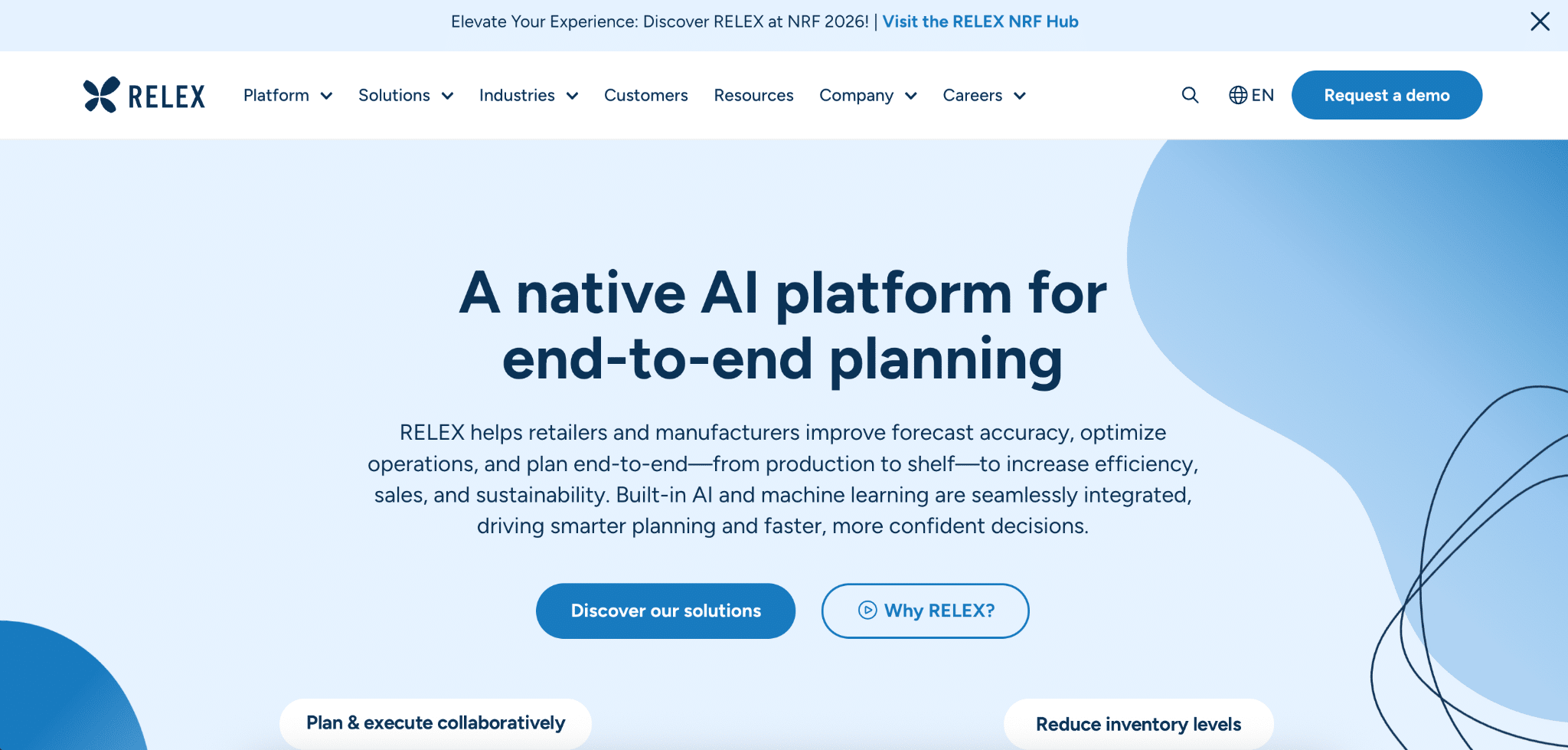
RELEX Solutions offers a unified retail and supply chain planning platform. It covers demand forecasting, replenishment, inventory, space, and workforce planning for retailers, wholesalers, and consumer brands. Its demand-planning engine uses AI/ML and real-time data to generate highly granular forecasts and automate large portions of day-to-day planning.
Highlights
AI/ML-driven demand forecasting and demand sensing for retail and wholesale networks
Unified platform spanning demand, inventory, merchandising, and store operations
High level of automation for replenishment and exception-based planning
Pros
Strong fit for retail and grocery. RELEX is designed for retailers and consumer brands. It addresses spoilage, promotions, and complex store networks.
High automation and planner productivity. Automated forecasts and order suggestions reduce manual workload. Planners can focus on high-value exceptions.
Good analytical depth. Users note multi-year demand analysis and flexible report building across channels and assortments.
Cons
Calendar and configuration constraints. Some users report limitations in adjusting the calendar structure to match internal fiscal calendars. This can complicate analysis alignment.
Enterprise entry point. With starting prices in the thousands of euros per year, RELEX is oriented toward mid-sized and large organizations rather than very small retailers.
Implementation complexity for multi-country rollouts. As a broad, unified suite, global deployments can require substantial integration and change management.
Pricing
As of December 2025, Capterra notes that RELEX pricing starts around €3,000 per year. Full deployments for retailers typically cost more as modules and scale increase. RELEX uses quote-based pricing, so buyers should treat published figures as entry points.
What do users say about RELEX?
Positive review: A Capterra reviewer states that RELEX “makes demand planning easier.” They describe it as easy to use and effective at supporting work across multiple channels with automated replenishment that boosted planning productivity. (Source)
Critical review: Another review on the same page mentions that RELEX does not allow changing the calendar structure to match the company’s fiscal calendar. This leads to misalignment between RELEX analysis and external reporting. (Source)
Support
RELEX provides support through product support teams, documentation, and implementation services tailored to retail and wholesale customers. Reviews generally indicate responsive assistance and ongoing collaboration to refine forecasts and planning processes after go-live.
#6 Netstock
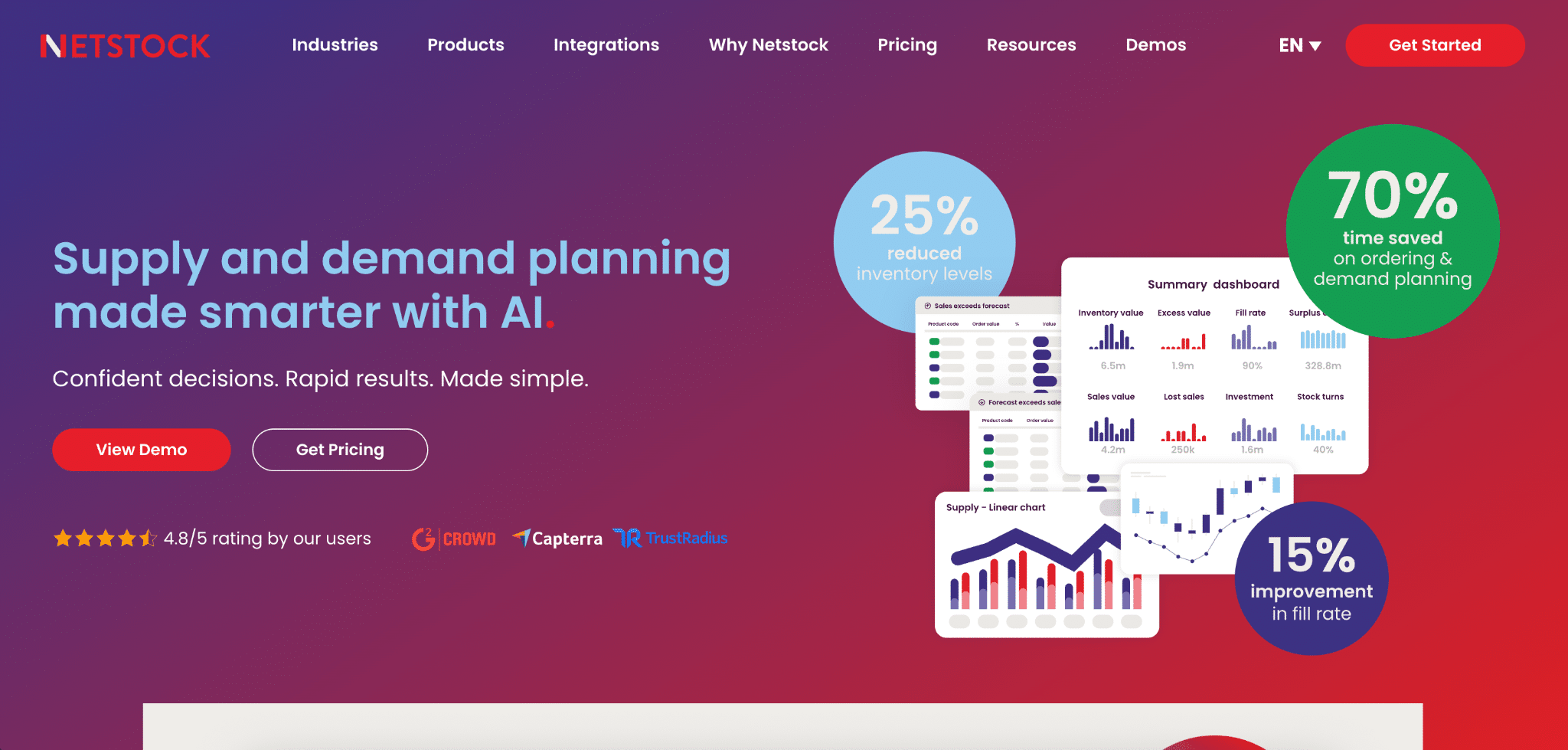
Netstock is a cloud-based supply and demand planning platform designed to optimize inventory levels. It serves small and mid-sized businesses as well as larger organizations. The platform focuses on accurate demand forecasting, inventory optimization, ordering, and supplier performance tracking with dashboards that integrate to popular ERPs.
Highlights
AI-supported demand forecasting and inventory optimization tailored to SMB and mid-market needs
ERP integration to pull data and push purchase orders, speeding up planning workflows
Intuitive dashboards that visualize stock risk, demand, and supplier performance
Pros
Fast time to value. Netstock emphasizes being fully operational in 90 days or less. Many customers see ROI within weeks.
Strong inventory outcomes. Reviews highlight reduced overstock and stockouts. Users report improved stock profiles across locations and better alignment of inventory with demand.
ERP-friendly integration. Users value seamless integration with existing ERP systems. This simplifies deployment and data synchronization.
Cons
Limited pricing transparency. While positioned for SMBs, detailed pricing is available only on request. This requires direct engagement with sales.
May lack some deep enterprise features. Compared with heavyweight suites, Netstock focuses on pragmatic inventory and demand planning rather than an all-encompassing SCP platform.
Change management still required. Even with a simpler tool, organizations must invest in process alignment and data quality to unlock full value.
Pricing
As of December 2025, Software Advice lists Netstock pricing as “available upon request.” Pricing depends on company size, modules, and data volume. Netstock positions itself as delivering rapid ROI, often paying for itself within the first weeks, but does not publish fixed list prices.
What do users say about Netstock?
Positive review: A Software Advice reviewer notes that Netstock has enabled accurate inventory management across multiple locations. It reduced overstock and mitigated stockouts while integrating seamlessly with the ERP system. (Source)
Critical review: In broader user feedback, some reviewers indicate that while Netstock is powerful, there is still a learning curve around configuration and interpreting certain analytics. This is especially true for teams new to formal demand planning. (Source)
Support
Netstock provides support through online resources, onboarding assistance, and ongoing customer success. Many reviews highlight responsive and helpful teams. The company publishes customer stories and testimonials that reference close collaboration during adoption and optimization.
#7 Streamline (GMDH Streamline)
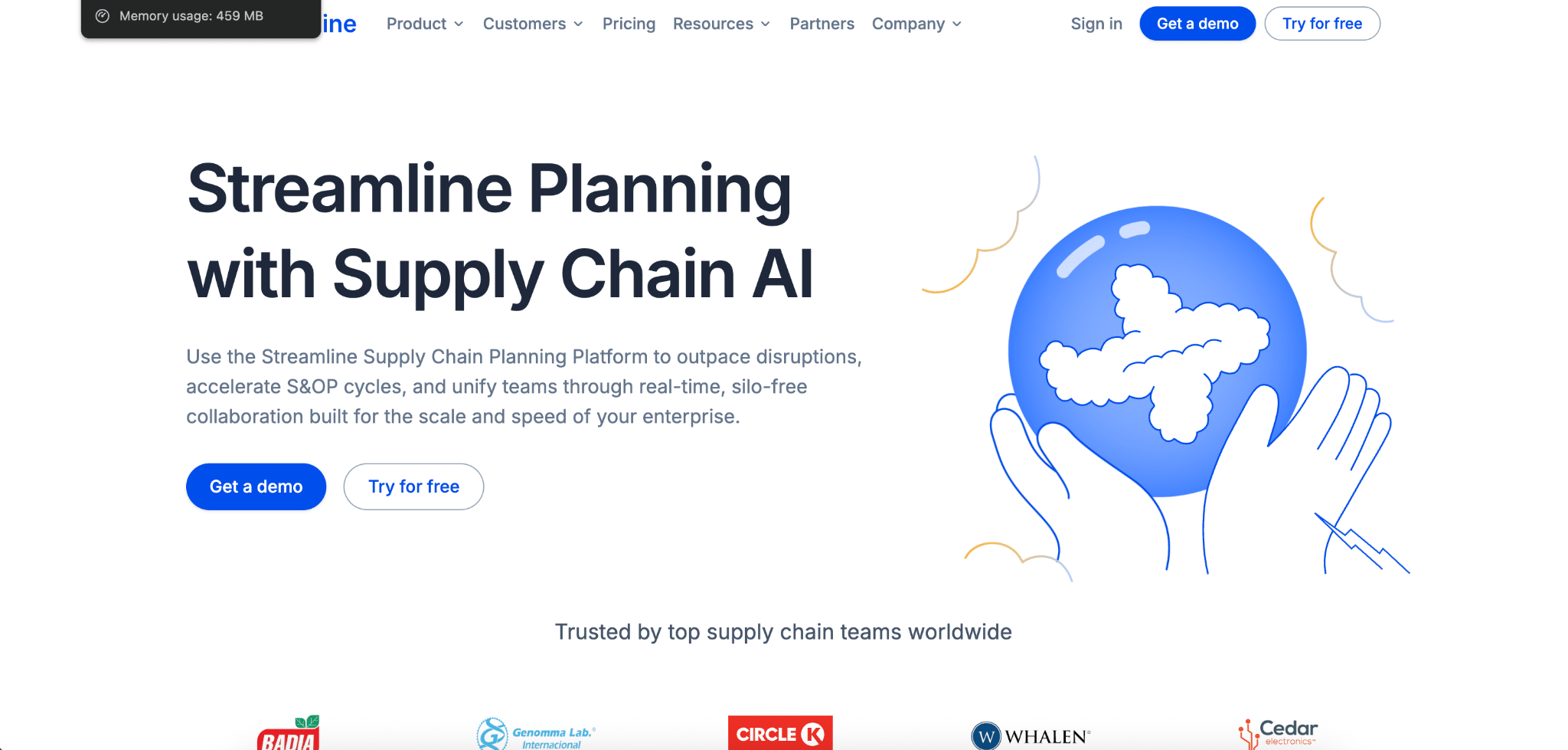
GMDH Streamline is an AI-driven demand, supply, and inventory planning platform. It’s geared toward retail, wholesale, distribution, and manufacturing businesses, including many eCommerce sellers. The platform automates statistical forecasting, safety stock calculations, and ordering while integrating with ERPs and spreadsheets.
Highlights
AI-powered demand forecasting that incorporates seasonality, events, and calendar effects
Integrated demand, inventory, and supply planning (including MRP/DRP and multi-echelon planning)
Fast implementation with connectors to databases and Excel/CSV files
Pros
Broad functionality in one tool. Streamline combines demand forecasting, inventory analysis, and planning features typically found in larger, more expensive suites.
Easy integration and fast deployment. Users highlight quick connections to ERP systems or Excel with relatively short implementation timelines.
Strong usability for planners. Reviews frequently mention a friendly, intuitive interface and visual dashboards that make it easier to plan orders and monitor KPIs.
Cons
Limited public pricing detail. Most pricing information is quote-based. This makes it hard to compare directly with alternatives.
Best fit for certain segments. The product is especially tuned for retail and eCommerce use cases. Highly complex, multi-enterprise environments may require more configuration or complementary tools.
Occasional functional gaps. A minority of reviewers note that while functionality is broad, there are areas where advanced features or deeper customization would help specific use cases.
Pricing
As of December 2025, Capterra lists multiple plans for GMDH Streamline but does not provide firm public pricing. Costs are generally available on request. Buyers should assume quote-based pricing that scales with users, data volume, and deployment scope.
What do users say about Streamline?
Positive review: A Software Advice reviewer writes that Streamline integrates demand, supply, and inventory planning in a single, complete solution. They highlight easy and fast ERP/Excel connections, an intuitive interface, and very fast algorithms that reduce purchase-department workload. (Source)
Critical review: On Capterra, some reviewers mention that while Streamline is a strong fit for their business, there are areas where advanced functionality could be expanded. Highly specialized workflows may still require manual work or external tools. (Source)
Support
Streamline offers support through online documentation, email and ticket-based help, and professional services. Users praise fast, professional support responses. Reviews also reference hands-on guidance during implementation and configuration, especially for integrating with ERP systems.
#8 Inventory Planner
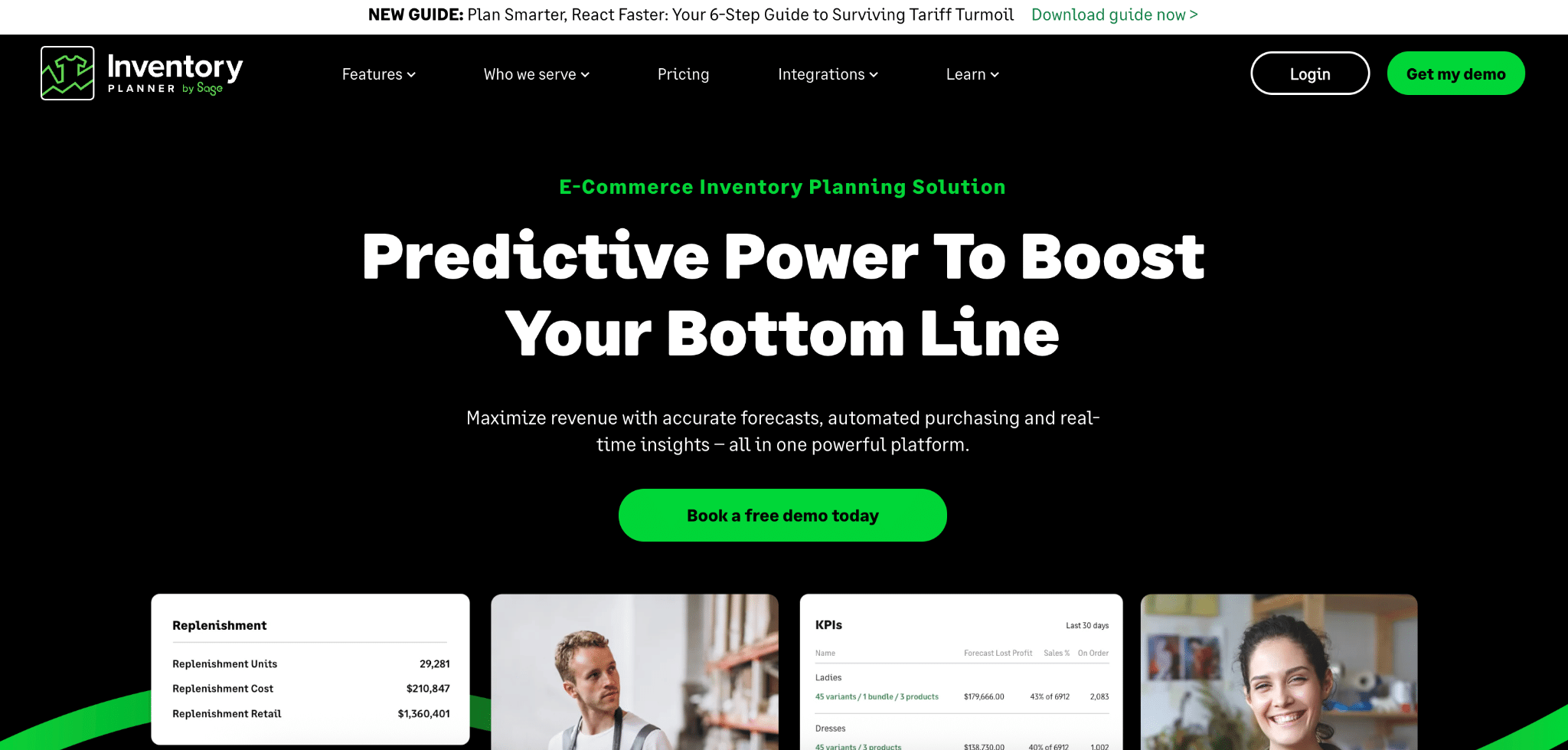
Inventory Planner is an inventory forecasting and demand-planning solution popular with eCommerce and omni-channel merchants. It integrates with platforms like Shopify, Amazon, and other marketplaces. The tool focuses on accurate demand forecasting, replenishment planning, and merchandise analytics to help merchants avoid stockouts and overstock.
Highlights
Demand forecasting tuned to eCommerce and retail data, including channels, seasons, and product lifecycles
Purchase planning, replenishment recommendations, and assortment visibility across warehouses and sales channels
Robust API and integrations with major commerce platforms and ERPs
Pros
Easy to get started. Reviewers highlight that Inventory Planner is straightforward to implement. Growing brands see quick time to value.
Strong API and workflow automation. The API enables automation of purchasing workflows and integration into broader operations.
Insightful reporting and drill-downs. Users appreciate summary-level views with the ability to drill into SKU-level detail in one place.
Cons
Occasional bugs and availability issues. Some users note that rapid company growth has led to occasional bugs or availability problems.
Limitations in invoice and extra-charge handling. Reviews mention that reconciling invoices against POs can be tricky. There’s limited support for complex invoice scenarios.
Primarily eCommerce-focused. While powerful for online merchants, manufacturers or complex multi-tier supply chains may find some planning needs out of scope.
Pricing
As of December 2025, public sources note that Inventory Planner uses subscription pricing that scales with usage. Specific dollar amounts are not consistently published and may vary by platform and region. Buyers should expect tiered SaaS pricing tied to order volume, connected stores, or revenue.
What do users say about Inventory Planner?
Positive review: A Capterra reviewer writes that Inventory Planner is easy to get started with. It offers an excellent API for automating workflows and provides both summary and detailed drill-downs, all backed by a “first rate support team.” (Source)
Critical review: The same review points out that rapid growth of the company has led to occasional bugs or issues affecting availability. Reconciling invoices against POs can be difficult because of limited fields for extra charges and multi-invoice scenarios. (Source)
Support
Inventory Planner provides support via documentation, in-app help, and a responsive support team frequently praised in user reviews. Users highlight helpful guidance during onboarding and ongoing support when fine-tuning reports and automation workflows.
Get started with better demand data
These tools help you forecast demand and plan inventory. But forecasts are only as good as the data feeding them.
Coefficient connects your spreadsheets to 70+ business systems—including ERPs, CRMs, and data warehouses. Pull live data into Google Sheets or Excel. Set up automated refreshes. Build dashboards that stay current.
If you’re running demand analysis in spreadsheets, get started with Coefficient and connect your data sources in minutes.