Every finance team using QuickBooks faces the same challenge: getting accounting data into spreadsheets for analysis. Manual exports waste hours. Reports become outdated instantly. Reconciliation errors creep in.
Both Coefficient and QBO Spreadsheet Sync promise to solve this problem by automating QuickBooks reporting in Excel. They both provide two-way sync capabilities. They both eliminate manual data exports.
Here’s the fundamental difference: QBO Spreadsheet Sync connects QuickBooks Online Advanced to Excel exclusively. Coefficient matches that QuickBooks functionality while extending to 70+ other business systems across finance, sales, marketing, and operations—in both Excel and Google Sheets.
- Coefficient vs QBO Spreadsheet Sync: Core differences
- Coefficient vs QBO Spreadsheet Sync: Integration capabilities
- Coefficient vs QBO Spreadsheet Sync: Features and functionality
- Coefficient vs QBO Spreadsheet Sync: Pricing comparison
- Coefficient vs QBO Spreadsheet Sync: User experience
- Coefficient vs QBO Spreadsheet Sync: Which should you choose?
- The reality for finance teams
- Stop wrangling data, start analyzing it
Coefficient vs QBO Spreadsheet Sync: Core differences
The core question centers on scope. Both tools serve finance teams working with QuickBooks data. They solve different problems based on different philosophies about modern finance workflows.
What is QBO Spreadsheet Sync?

Intuit built QBO Spreadsheet Sync with one mission: connect QuickBooks Online Advanced to Microsoft Excel. They’ve chosen to do one thing—sync QuickBooks data with Excel spreadsheets.
QBO Spreadsheet Sync works within Excel through a native ribbon integration, providing access to:
- All QuickBooks reports (P&L, Balance Sheet, General Ledger, Cash Flow)
- 31+ objects including invoices, bills, journal entries, and customers
- Two-way sync enabling data analysis and bulk edits back to QuickBooks
QBO Spreadsheet Sync comes free with QuickBooks Online Advanced ($275/month). It provides pre-built templates and enables multi-company reporting for consolidating data from multiple QuickBooks companies.
The strategic limitation: QBO Spreadsheet Sync connects ONLY to QuickBooks. You cannot connect Salesforce for pipeline forecasting. You cannot pull Google Ads data for marketing ROI analysis. You cannot access Snowflake for data warehouse reporting. The moment your finance team needs data from systems beyond QuickBooks, you’re back to manual exports.
QBO Spreadsheet Sync also works exclusively in Excel (Office 365 only). Teams using Google Sheets have no options with this tool.
What is Coefficient?

Coefficient addresses a different reality: finance teams need data from across the business. Modern CFOs combine P&L data with sales forecasts. They calculate customer acquisition costs using accounting systems and marketing platforms. They build board presentations showing financial performance alongside operational drivers.
The platform works inside Google Sheets and Excel, connecting 70+ business systems with live data. Financial integrations include:
- QuickBooks, NetSuite, Xero
- Sage Intacct, Stripe, Chargebee
- Salesforce for pipeline analysis
Coefficient provides two-way sync with CRM and database systems—Salesforce, HubSpot, Snowflake, MySQL, PostgreSQL, and SQL Server. This enables operational workflows beyond financial reporting:
- Update Salesforce opportunity stages based on pipeline analysis
- Push bulk changes to HubSpot contacts
- Modify database records directly from your spreadsheet
The platform works identically in both Google Sheets and Microsoft Excel. Teams can collaborate across platforms without limitation.
Serving 50,000+ companies and 500,000+ users, Coefficient has earned an overall G2 rating of 4.7 out of 5 stars, plus Best Relationship and Fastest Implementation awards.
Take Christian Budnik at Solv as an example.
His FP&A team needed to combine QuickBooks financial data with Salesforce pipeline metrics and Looker analytics. Using Coefficient, they connected all three systems to Google Sheets with automatic refreshes, creating unified dashboards that gave leadership real-time visibility across finance, sales, and operations.

Coefficient vs QBO Spreadsheet Sync: Integration capabilities
This architectural difference determines what analysis you can perform.
Integration comparison table
| Integration Type | QBO Spreadsheet Sync | Coefficient |
| QuickBooks Data | ✅ All reports and 31+ objects | ✅ All reports and objects |
| Other Accounting Systems | ❌ None | ✅ NetSuite, Xero, Sage Intacct |
| CRM Platforms | ❌ None | ✅ Salesforce, HubSpot, Pipedrive |
| Marketing Tools | ❌ None | ✅ Google Ads, Facebook Ads, LinkedIn |
| Data Warehouses | ❌ None | ✅ Snowflake, BigQuery, Redshift |
| Operations | ❌ None | ✅ Jira, Asana, Zendesk |
| Total Systems | 1 (QuickBooks only) | 70+ cross-functional |
QBO Spreadsheet Sync: QuickBooks depth, nothing else
QBO Spreadsheet Sync connects to one data source: QuickBooks Online Advanced. The integration quality reflects that specialization. You get comprehensive access to all QuickBooks reports and objects with native performance.
The data quality benefits from Intuit controlling both the source system and the connector. No third-party integration layer introduces latency or compatibility issues.
What’s absent: everything beyond QuickBooks. When your CFO asks for revenue forecasts combining QuickBooks actuals with Salesforce pipeline data—impossible without manual exports. When calculating customer acquisition cost requiring QuickBooks expenses and Google Ads spend—back to CSV downloads.
Nick Giovacchini at Large Scale found Coefficient valuable because he needed more than QuickBooks: “I’m using Coefficient to create a 13-week cash flow report linked to my QuickBooks Online account. It works great!” His broader analytics required data beyond QuickBooks, which QBO Spreadsheet Sync cannot provide.
Coefficient: QuickBooks plus comprehensive business data

Coefficient connects 70+ systems organized by business function:
- Finance first: QuickBooks, NetSuite, Xero, Sage Intacct, Stripe, Chargebee, Square, Shopify
- Sales and CRM: Salesforce (two-way sync), HubSpot (two-way sync), Pipedrive, Zoho CRM
- Marketing: Google Ads, Facebook Ads, LinkedIn Ads, Google Analytics, Mailchimp
- Databases: Snowflake, BigQuery, MySQL, PostgreSQL, SQL Server (with two-way sync)
- Operations: Jira, Asana, ClickUp, Zendesk, Intercom
For QuickBooks specifically, Coefficient provides comprehensive data access matching QBO Spreadsheet Sync—all reports, all objects, OAuth authentication, automatic refresh.
Real scenarios demonstrate the advantage:
- Revenue forecasting: Pull Q3 actuals from QuickBooks, combine with Q4 pipeline from Salesforce, layer in win rates and marketing leads from HubSpot. QBO Spreadsheet Sync provides only QuickBooks data.
- Marketing ROI: Calculate customer acquisition cost combining QuickBooks payroll, Google Ads spend, Facebook campaign performance, and HubSpot conversions. QBO Spreadsheet Sync accesses no marketing platforms.
- Executive dashboards: Build board presentations showing P&L trends (QuickBooks), sales velocity (Salesforce), marketing performance (Google Ads), and customer churn (Stripe). All in one sheet with hourly refresh. QBO Spreadsheet Sync provides only P&L data.
Christian Budnik at Solv quantifies the transformation: “Before Coefficient, I was doing multiple data pulls a day from various systems. By automating connections between Salesforce, Looker, and QuickBooks, we saved 364 hours per year—that’s over 9 weeks of manual work eliminated.”
Coefficient vs QBO Spreadsheet Sync: Features and functionality
Both tools offer automatic refresh and bulk editing, but their feature sets reflect different philosophies.
Feature comparison table
| Feature | QBO Spreadsheet Sync | Coefficient |
| Data Refresh | On file open or scheduled | Hourly auto-refresh (Pro) |
| Two-Way Sync | ✅ QuickBooks transactions | ✅ CRM and databases |
| Platform Support | Excel only (Office 365) | Excel AND Google Sheets |
| AI Capabilities | ❌ None | ✅ AI Sheets Assistant |
| Alerts | ❌ None | ✅ Slack and email alerts |
| Templates | QuickBooks-focused | Cross-functional |
| Multi-Company | QuickBooks companies only | Any connected system |
Data refresh and automation
QBO Spreadsheet Sync refreshes QuickBooks data when you open workbooks or on scheduled intervals. For monthly reports or weekly analyses, this ensures current QuickBooks data without manual intervention.
Coefficient offers hourly auto-refresh on the Pro plan. Your spreadsheets update automatically every 60 minutes from ALL connected systems—QuickBooks, Salesforce, Google Ads, and more. Combined with Slack and email alerts, Coefficient notifies teams when values change or meet conditions. Set an alert for “cash balance below $50,000” and receive notifications within an hour.
Two-way sync capabilities
QBO Spreadsheet Sync excels at bulk editing QuickBooks transactions:
- Pull hundreds of journal entries into Excel
- Make bulk modifications to accounts or amounts
- Push changes back to QuickBooks in one operation
You can create new QuickBooks records directly from Excel—invoices, bills, purchase orders—and sync them to QuickBooks.
Coefficient provides two-way sync with Salesforce, HubSpot, Snowflake, MySQL, PostgreSQL, and SQL Server. These operational capabilities extend beyond financial reporting:
- Update Salesforce opportunities based on pipeline analysis
- Modify HubSpot contact records in bulk
- Change database tables directly from spreadsheets
For QuickBooks, Coefficient operates read-only, prioritizing reliable financial data for analysis rather than pushing changes to accounting records.

AI and intelligence
QBO Spreadsheet Sync includes no AI assistance. You work with standard Excel functionality plus QuickBooks connectivity.
Coefficient’s AI Sheets Assistant provides conversational intelligence across all connected data sources:
- Build revenue dashboards combining QuickBooks and Salesforce automatically
- Analyze which marketing channels have highest customer acquisition cost
- Generate SQL queries without technical expertise
The AI understands business context, generates formulas, creates visualizations, and provides insights QBO Spreadsheet Sync cannot offer.
Coefficient vs QBO Spreadsheet Sync: Pricing comparison
Understanding true costs requires examining both advertised prices and total value.
Pricing breakdown table
| Pricing Element | QBO Spreadsheet Sync | Coefficient |
| Base Cost | $0 (with QBO Advanced) | $49-99/user/month |
| QBO Advanced Required | Yes ($275/month) | No (works with any QBO plan) |
| If Not Using QBO Advanced | Must upgrade for $275/month | Works with existing plan |
| Included Systems | QuickBooks only | All 70+ integrations |
| Platform Support | Excel only | Excel AND Google Sheets |
| Free Option | No | Yes (3 data sources) |
QBO Spreadsheet Sync pricing structure

QBO Spreadsheet Sync is FREE with QuickBooks Online Advanced. No additional charges, no per-user fees. However, QuickBooks Online Advanced costs $275/month (currently discounted to $137.50/month for first 3 months).
The value equation depends on your existing subscription:
Already using QBO Advanced: Spreadsheet Sync costs $0 additional. Excellent value for QuickBooks-only automation.
Not using QBO Advanced: You pay $275/month primarily for Spreadsheet Sync access. That’s expensive for a single-system connector.
Spreadsheet Sync cannot be purchased standalone. You must subscribe to QuickBooks Online Advanced.
Coefficient pricing structure

Coefficient publishes transparent per-user pricing:
Free: 3 data sources, manual refresh, 5,000 row limit
Starter ($49/month): 5 accounts per source, daily auto-refresh, SQL builders
Pro ($99/user/month): Hourly refresh, unlimited rows, AI Assistant, two-way sync, Slack alerts
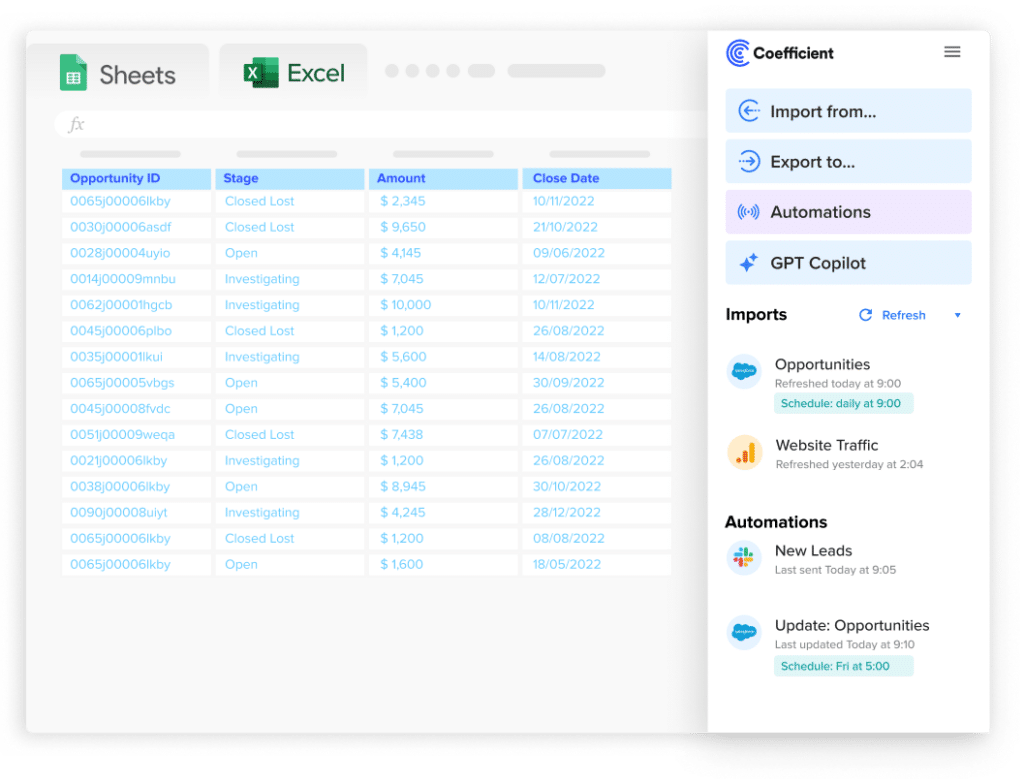
Stop exporting data manually. Sync data from your business systems into Google Sheets or Excel with Coefficient and set it on a refresh schedule.
Get Started
Enterprise: Custom pricing with unlimited refreshes and admin controls
Coefficient’s pricing includes ALL 70+ integrations. Connect QuickBooks, Salesforce, Google Ads, and Snowflake for the same price. No upcharges for premium connectors.
Cost comparison scenarios
Existing QBO Advanced users: Spreadsheet Sync = $0 additional
Teams needing QuickBooks + other systems: QuickBooks Plus ($90/month) + Coefficient Pro ($99/user) = $189/month for QuickBooks + 70 integrations. This costs $86/month LESS than QBO Advanced while gaining cross-functional capabilities.
Coefficient vs QBO Spreadsheet Sync: User experience
Both platforms prioritize simplicity with different integration approaches.
Setup and workflow
QBO Spreadsheet Sync installs as a native Excel add-in through the ribbon. For QBO Advanced users, setup takes under 5 minutes. Authenticate once and start working. The experience feels like native Excel functionality.
Coefficient operates as a sidebar in Google Sheets and Excel. Install the add-on, connect data sources using OAuth (30-60 seconds per source), start importing. The interface stays minimal—a data connection layer, not a comprehensive application.

Live Coefficient QuickBooks Dashboard
Both platforms deliver fast time-to-value. The difference is scope: QBO Spreadsheet Sync connects QuickBooks instantly. Coefficient connects QuickBooks and 70+ other systems with equal simplicity.
Support and security
QBO Spreadsheet Sync support comes through Intuit’s QuickBooks channels with comprehensive documentation for QuickBooks-specific questions.
Coefficient maintains a 9.9/10 support quality rating on G2 with chat support, extensive documentation, and video tutorials.
Plus, Coefficient offers an active Slack community for users to get inspiration from!
Both platforms meet enterprise security standards with OAuth authentication, encrypted transmission, and GDPR compliance. Coefficient adds SOC 2 Type II certification.
Coefficient vs QBO Spreadsheet Sync: Which should you choose?
Choose QBO Spreadsheet Sync if:
You already pay for QuickBooks Online Advanced. Spreadsheet Sync comes free with your existing subscription.
You only need QuickBooks data. If you never need sales forecasts, marketing analytics, or operational metrics, QBO Spreadsheet Sync’s focused scope works.
You work exclusively in Excel. Teams using only Microsoft Excel benefit from native integration.
Your primary need is bulk QuickBooks editing. For journal entry modifications and transaction management, QBO Spreadsheet Sync’s accounting features help.
Choose Coefficient if:
You need QuickBooks plus other systems. Combining QuickBooks with Salesforce, Google Ads, or Snowflake requires Coefficient.
You use Google Sheets or both platforms. Coefficient works identically in Excel and Google Sheets. QBO Spreadsheet Sync is Excel-only.
You don’t have QuickBooks Online Advanced. Paying $275/month just for Spreadsheet Sync is expensive. Coefficient works with any QuickBooks plan at $49-99/month.
You use other accounting systems. QBO Spreadsheet Sync only works with QuickBooks. Coefficient connects NetSuite, Xero, and Sage Intacct.
You need hourly refresh and AI assistance. Coefficient provides real-time monitoring and AI-powered analysis that QBO Spreadsheet Sync lacks.
The reality for finance teams
Modern financial analysis extends beyond QuickBooks data. Finance teams need:
- Last quarter’s P&L from QuickBooks AND next quarter’s pipeline from Salesforce for accurate revenue forecasting
- Payroll costs from QuickBooks AND advertising spend from Google Ads for customer acquisition calculations
- Financial performance from QuickBooks AND operational metrics to understand business drivers
Teams working with only QuickBooks data find themselves constantly exporting CSVs, manually reconciling, and introducing errors. Christian Budnik described this before Coefficient: “multiple data pulls a day” creating “a huge time sink.”
With 500,000+ users across 50,000+ companies, Coefficient proves that finance teams value platforms starting with excellent financial integration but extending comprehensively beyond.
Stop wrangling data, start analyzing it
If you use QuickBooks Online Advanced and need only QuickBooks data, QBO Spreadsheet Sync provides solid value at zero additional cost.
For finance teams whose questions extend beyond QuickBooks—combining P&L trends with sales pipelines, calculating customer acquisition costs across systems, building comprehensive board presentations—Coefficient delivers QuickBooks excellence plus 70+ additional systems providing strategic context.
Connect QuickBooks for financial analysis. Add Salesforce for pipeline forecasting. Layer in Google Ads for marketing ROI. Pull Snowflake for data warehouse analytics. All updating automatically in Excel or Google Sheets with hourly refresh.
Get started with Coefficient today. Free to try, transparent pricing from $49/month, and 70+ integrations that grow with your needs. No sales calls required. No platform lock-in. No limitations when your finance questions extend beyond a single accounting system.