Big data meets familiar spreadsheets. That’s RowZero’s promise—handle billions of rows with the comfort of Excel.
But what if your team doesn’t need billion-row datasets? What if you want live business data without the learning curve? Or maybe you need collaboration features that work seamlessly across your organization.
RowZero excels at massive data analysis, but many teams discover they need different tools for different challenges. Here are 10 powerful alternatives that might fit your workflow better.
In this guide, you’ll find options ranging from free collaborative platforms to specialized business intelligence tools, each with unique strengths for specific use cases.
What is RowZero?
RowZero is a cloud-based spreadsheet platform designed for big data analytics. Think Excel, but capable of handling datasets 1000 times larger.
Core features include:
- Billion-row capacity far exceeding traditional spreadsheet limits
- SQL integration for writing and sharing queries within spreadsheet interface
- Cloud architecture providing fast processing and enterprise-grade stability
- Direct database connectivity with live connections to data warehouses
- Advanced analytics including pivot tables, graphing, and conditional formatting
- Enterprise security with data governance and collaboration controls
Target audience and pricing:
- Target users: Data analysts, business intelligence teams, and enterprises
- Use cases: Secure environments for large-scale data analysis
- Pricing: $8-20 per user monthly depending on features and data capacity
Why look for RowZero alternatives?
Several factors drive teams to explore other spreadsheet solutions:
Overkill for typical business needs
- Most teams don’t analyze billion-row datasets
- Specialized features unnecessary for standard business reporting
- Advanced capabilities may exceed actual requirements
Learning curve challenges slow adoption
- SQL integration complexity requires significant training
- Governance features overwhelming for business users
- Advanced analytics need technical expertise
Cost considerations at scale
- Individual pricing reasonable but multiplies for larger teams
- Simpler tools might provide better value
- Budget constraints favor less expensive alternatives
Limited integrations compared to established platforms
- Newer market entrant has fewer third-party connectors
- Community resources less extensive than mature alternatives
- Third-party ecosystem still developing
Cloud dependency requirements
- Constant internet connectivity required for functionality
- Offline capability not available for teams needing it
- Connectivity restrictions in some work environments
Feature gaps in visualization
- Advanced BI visualizations lag behind specialized platforms
- Predictive analytics capabilities limited
- Business intelligence features less comprehensive
Top 10 RowZero alternatives
1. Google Sheets – “The collaborative standard”

Best for: Small to medium teams prioritizing collaboration and cost-effectiveness over advanced analytics
Google Sheets delivers collaborative spreadsheet functionality with cloud accessibility and an extensive add-on ecosystem.
Key strengths:
- Free tier available making it accessible to individuals and small teams
- Real-time collaboration with live editing, comments, and automatic version history
- Cloud-native design works seamlessly across devices and operating systems
- Extensive add-on marketplace expanding functionality through third-party integrations
- Google Workspace integration connecting naturally with Gmail, Drive, and other Google tools
Pricing:
- Personal accounts: Free
- Business plans: $6-18 per user monthly
- Enterprise features: Advanced security and compliance
Best fit: Teams wanting proven collaboration without advanced analytics complexity.
How it compares to RowZero: Much more accessible and collaborative, but limited to 10 million cells and struggles with large datasets. Perfect for typical business workflows without big data requirements.
2. Microsoft Excel – “The professional standard”

Best for: Professional analysts, financial teams, and users requiring advanced calculations and large dataset processing
Excel remains the gold standard for professional spreadsheet analysis with advanced calculation capabilities and extensive business adoption.
Key strengths:
- Advanced analytical features including sophisticated formulas, pivot tables, and statistical functions
- Large dataset handling supporting over 1 million rows with better performance than cloud alternatives
- Power Query integration enabling data transformation and connectivity to various sources
- AI-powered Copilot providing automated insights and assistance with complex tasks
- Offline capability ensuring full functionality without internet connectivity
Pricing:
- Personal use: $6.99 monthly through Office 365
- Business plans: Up to $22 per user monthly
- Enterprise features: Advanced security and compliance
Best fit: Teams wanting advanced features without learning new platforms.
How it compares to RowZero: More familiar interface with proven reliability, but lacks RowZero’s massive scale and cloud-native collaboration. Ideal for teams wanting advanced features without learning new platforms.
3. Coefficient – “The live data enhancer”

Best for: Marketing, sales, and operations teams needing live business data in familiar spreadsheet interfaces
Coefficient transforms ordinary spreadsheets into live data dashboards by connecting Google Sheets and Excel directly to business systems.
Key strengths:
- Live data connections to 70+ platforms (Salesforce, HubSpot, SQL databases, analytics tools)
- AI Sheets assistant automatically builds dashboards, writes SQL queries, analyzes data using business context
- No migration required enhances existing Google Sheets and Excel workflows
- Two-way data sync enables editing source data directly from spreadsheets for select connectors
- Automated workflows with scheduled refresh, alerts, and report distribution
- Pre-built templates accelerating setup for common business use cases
Unique value proposition: Coefficient eliminates the choice between familiar tools and powerful data capabilities. Teams get enterprise-grade live data integration while working in spreadsheets they already know and love.
Best fit: Teams wanting real-time operational insights without learning specialized tools.
How it compares to RowZero: Less focused on massive datasets but excels at live business data integration. Perfect for teams wanting real-time operational insights without learning specialized big data tools or migrating workflows.
4. Equals – “The modern data spreadsheet”

Best for: Data analysts and technical business users comfortable with SQL but wanting spreadsheet familiarity
Equals modernizes spreadsheet analysis for data professionals with advanced SQL integration and automation capabilities.
Key strengths:
- 500,000 row capacity providing significant scale for business analysis
- 30+ native connectors linking directly to SQL databases, SaaS platforms, and analytics tools
- Visual SQL Builder with AI assistance making complex queries more accessible
- Advanced automation including AI-powered task completion and workflow optimization
- Modern dashboard creation with contemporary chart themes and interactive elements
Pricing:
- Workspace-based pricing scales with team size and usage requirements
- Professional features for data-focused teams
Best fit: Teams needing more than basic spreadsheets but less than billion-row capacity.
How it compares to RowZero: More accessible than RowZero’s enterprise focus while maintaining advanced analytical capabilities. Good middle ground for teams needing more than basic spreadsheets but less than billion-row capacity.
5. Rows – “The modern business spreadsheet”

Best for: Business teams wanting modern spreadsheet collaboration with basic automation features
Rows delivers modern spreadsheet functionality with automation and integration features designed for contemporary business workflows.
Key strengths:
- Cloud-based collaboration with real-time editing and sharing capabilities
- Integration ecosystem connecting to various business systems and data sources
- Modern interface designed for current business needs and workflows
- Automation capabilities streamlining repetitive tasks and data processes
Pricing:
- Competitive workspace pricing aligns with other modern spreadsheet alternatives
- Modern business features included
Best fit: Teams prioritizing ease of use over advanced analytics.
How it compares to RowZero: Simpler and more accessible for general business use, but without RowZero’s big data capabilities. Suitable for teams prioritizing ease of use over advanced analytics.
6. Airtable – “The database-spreadsheet hybrid”

Best for: Teams needing structured data management with workflow automation and multiple data perspectives
Airtable blends database structure with spreadsheet familiarity, creating powerful workflow management and data organization capabilities.
Key strengths:
- Flexible database design with linked tables, custom field types, and relational data management
- Multiple view options including Grid, Calendar, Kanban, Gallery, and Form views
- Powerful automation with triggers, actions, and workflow orchestration
- Extensive integrations through robust API and third-party connector ecosystem
- Collaborative features including comments, permissions, and secure sharing
Pricing:
- Free tier: Basic functionality available
- Paid plans: $10-20 per user monthly for advanced features
- Enterprise options: Custom pricing for large organizations
Best fit: Teams wanting database power with spreadsheet accessibility.
How it compares to RowZero: More flexible for workflow management and structured data, but cannot handle RowZero’s massive dataset scale. Ideal for teams wanting database power with spreadsheet accessibility.
7. Smartsheet – “The project management platform”

Best for: Project managers and teams requiring advanced project tracking with spreadsheet-style data management
Smartsheet combines spreadsheet interfaces with project management capabilities, delivering advanced collaboration and reporting tools.
Key strengths:
- Project management integration with Gantt charts, resource allocation, and timeline tracking
- Advanced reporting dashboards providing comprehensive project and business insights
- Workflow automation streamlining approval processes and task management
- Enterprise integrations connecting to major business systems and platforms
- Collaboration tools including proofing, approval workflows, and real-time editing
Pricing:
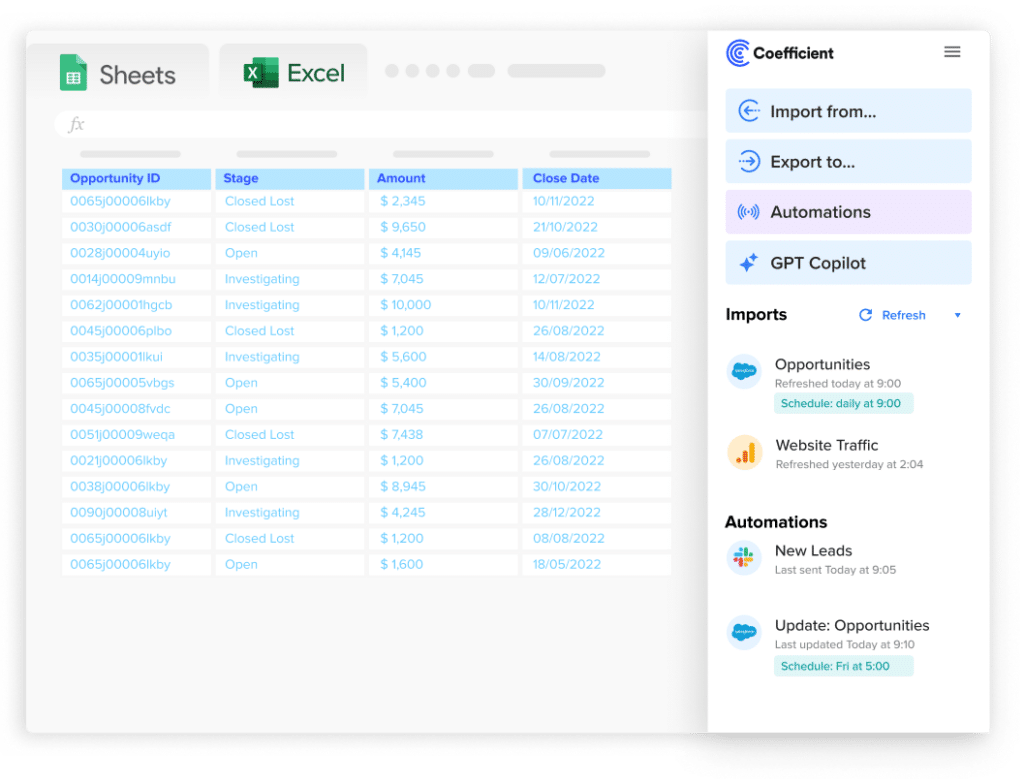
Stop exporting data manually. Sync data from your business systems into Google Sheets or Excel with Coefficient and set it on a refresh schedule.
Get Started
- Individual plans: $7-25 per user monthly
- Enterprise plans: Custom pricing available
- Project management focus with business features
Best fit: Teams managing complex projects with data-driven reporting needs.
How it compares to RowZero: More specialized for project management workflows, offering superior collaboration but less big data analytical capability. Perfect for teams managing complex projects with data-driven reporting needs.
8. Notion – “The all-in-one workspace”

Best for: Teams wanting flexible workspaces for knowledge management combined with light database functionality
Notion creates all-in-one workspaces combining documents, databases, tasks, and knowledge management in a highly customizable platform.
Key strengths:
- Unified workspace eliminating the need for multiple separate tools
- Flexible database functionality with relational capabilities and various view types
- Block-based customization enabling highly personalized page layouts and workflows
- Collaborative editing across all content types with real-time updates
- Template ecosystem providing starting points for diverse use cases
Pricing:
- Free tier: Individual use with basic features
- Business plans: $8-15 per user monthly
- Enterprise features: Advanced security and administration
Best fit: Teams wanting to consolidate multiple tools into one flexible platform.
How it compares to RowZero: More versatile for general team collaboration and knowledge sharing, but with limited analytical capabilities. Great for teams wanting to consolidate multiple tools into one flexible platform.
9. Observable – “The code-driven analytics platform”
Best for: Data scientists, developers, and analysts comfortable with code-based data exploration and visualization
Observable delivers code-driven data visualization and analysis through JavaScript notebooks with interactive capabilities.
Key strengths:
- Reactive programming model where cells update automatically as dependencies change
- Unlimited customization through JavaScript and modern web standards
- Interactive dashboards with highly dynamic and responsive visualizations
- Developer-friendly workflows including Git integration and open-source options
- Collaborative features supporting sharing, commenting, and version control
Pricing:
- Free options available for individual use
- Team/enterprise tiers for organizational needs
- Flexible pricing based on usage and features
Best fit: Technical teams wanting unlimited flexibility in data presentation.
How it compares to RowZero: More powerful for custom visualizations and interactive analysis, but requires programming knowledge. Ideal for technical teams wanting unlimited flexibility in data presentation.
10. Retool – “The custom application builder”

Best for: Technical teams building custom internal tools and business applications with database integration
Retool enables building custom internal applications with direct database connectivity and advanced workflow capabilities.
Key strengths:
- Custom application development through drag-and-drop interface with code support
- Direct database connections to SQL, NoSQL, APIs, and third-party business systems
- Advanced workflow automation with complex logic and business rule implementation
- Mobile application support creating native iOS and Android apps
- Enterprise security features including role-based access, SSO, and audit logging
Pricing:
- Free tier: Basic functionality for individuals
- Team plans: $12 per user monthly
- Enterprise features: Custom pricing for large deployments
Best fit: Teams wanting to build exactly the tools they need rather than adapting to existing platforms.
How it compares to RowZero: Different paradigm focusing on custom application development rather than spreadsheet analysis. Perfect for teams wanting to build exactly the tools they need rather than adapting to existing platforms.
How to choose the right alternative
Data volume requirements should guide initial decisions
Assessment questions:
- Dataset size: Do you regularly work with over 100,000 rows?
- RowZero’s billion-row capacity: Unnecessary for most business use cases
- Alternative options: Google Sheets or Excel might serve you better for typical datasets
Technical comfort levels determine platform fit
Skill assessment:
- Coefficient: Works within familiar spreadsheets requiring zero learning curve
- Observable: Demands programming skills for full utilization
- Team abilities: Assess technical capabilities honestly before choosing
Collaboration needs vary significantly
Workflow considerations:
- Google Sheets: Excels at real-time collaboration
- Excel: Works better for individual analysis
- Team dynamics: Consider how your team actually works together
Integration requirements affect long-term success
Platform specializations:
- Coefficient: Specializes in business system connections
- Retool: Handles custom database integration
- Airtable: Offers workflow automation
- Matching needs: Align integration requirements with platform strengths
Budget considerations impact sustainability
Cost analysis:
- Free options: Google Sheets works for basic needs
- Enterprise platforms: RowZero requires significant investment
- Total cost calculation: Include training and setup time
- Long-term value: Consider ongoing costs and benefits
Key evaluation questions:
- What’s the largest dataset we typically analyze?
- How important is real-time collaboration?
- Do we need live connections to business systems?
- What’s our team’s technical skill level?
- How much are we willing to invest in training?
Decision framework:
- Assess data volume needs: Most teams don’t need billion-row capacity
- Evaluate technical requirements: SQL, APIs, custom development needs
- Consider collaboration patterns: Real-time editing, sharing, permissions
- Review integration needs: Business systems, databases, third-party tools
- Calculate total costs: Including training, setup, and ongoing expenses
Choose the right tool for your workflow
Choosing the right spreadsheet platform transforms how your team works with data. Whether you need RowZero’s massive scale, Google Sheets’ collaboration, or Coefficient’s live business data integration, better tools accelerate insights and decision-making.
The best alternative isn’t always the most powerful—it’s the one your team will actually use effectively. Consider your real requirements, not theoretical capabilities. Most teams benefit more from live business data connections than billion-row capacity.
Each platform serves different priorities. Collaborative teams gravitate toward Google Sheets. Technical users appreciate Observable’s flexibility. Business teams need live data integration that Coefficient provides.
Stop wrestling with tools that don’t match your workflow. Get started with Coefficient and experience live business data in the spreadsheets your team already loves using.