Wrike organises work around folders, projects and tasks. Import and export capabilities centre on these objects. Attachments, comments and time logs have separate handling.
This guide covers CSV import, task export, the Wrike API and Coefficient for recurring exports to Google Sheets or Excel.
| What data can you import and export from Wrike? |
| Wrike supports CSV and Excel import of tasks, including task name, description, status, assignee, due date and custom fields. Export covers tasks and projects as CSV, Excel or PDF. The Wrike API provides full access to folders, tasks, users, timelog entries and attachments. Coefficient connects Wrike to Google Sheets or Excel for live, auto-refreshing project data exports. |
How to import data into Wrike
Method 1: CSV or Excel import
Use this to bring tasks in bulk from a spreadsheet or another project management tool.
- In Wrike, open the folder or project where you want to import tasks.
- Click + New Task or look for the import option in the folder menu.
- Upload your CSV or Excel file. Wrike reads column headers and maps to task fields.
- Review field mappings: Task Name, Status, Assignee, Due Date, Description and custom fields.
- Click Import. Wrike creates tasks from each row.
Format requirements:
- File types: CSV or XLSX.
- Required field: Task Name. All other fields are optional.
- Status values: must match Wrike’s workflow status names exactly or they default to Active.
- Assignees: use the email address of the Wrike user to ensure correct mapping.
- Custom fields: must be pre-created in the folder/project before import.
- Cannot import: comments, attachments and timelog entries cannot be imported via file. Use the API for those.
Method 2: Wrike API
The Wrike API supports programmatic creation of tasks, folders, projects and subtasks. Use it for automated migrations from other project tools, bulk task creation from external data sources or continuous sync workflows.
How to export data from Wrike
Method 1: Task and project export (CSV/Excel)
- Open the folder or project you want to export in Wrike.
- Click … (more options) at the top and select Export.
- Choose CSV, Excel or PDF format.
- Wrike exports all visible tasks with their fields. The download begins immediately.
What the export includes:
- Included: task name, description, status, assignee, due date, created date, custom fields, tags.
- Not included by default: comments, attachments, timelog details. These require the API.
PDF export: includes a visual layout of the project or folder. Not suitable for data re-import.
Method 2: Coefficient for live, scheduled exports

Wrike’s native export is a manual download. For project managers who need fresh task status or workload data in a spreadsheet for weekly reviews or executive reporting, Coefficient removes the manual step.
Coefficient connects Wrike to Google Sheets or Excel and keeps project data live.
- Import tasks, projects and folder data with field-level selection and status or assignee filters.
- Set auto-refresh so project dashboards are always current.
- Turn live Wrike data into a shareable web dashboard. Coefficient AI dashboards build it in plain English.
How to connect Wrike to a spreadsheet with Coefficient:
- Install Coefficient from the Google Workspace Marketplace or Microsoft AppSource.
- Open Coefficient from the Extensions menu in Google Sheets, or the add-in menu in Excel.
- Click Import From and select Wrike. When prompted, enter your Wrike API key to complete the connection.
- Select your data (tasks, projects, folders), choose fields and apply filters.
- Set a Scheduled Run to refresh data automatically.
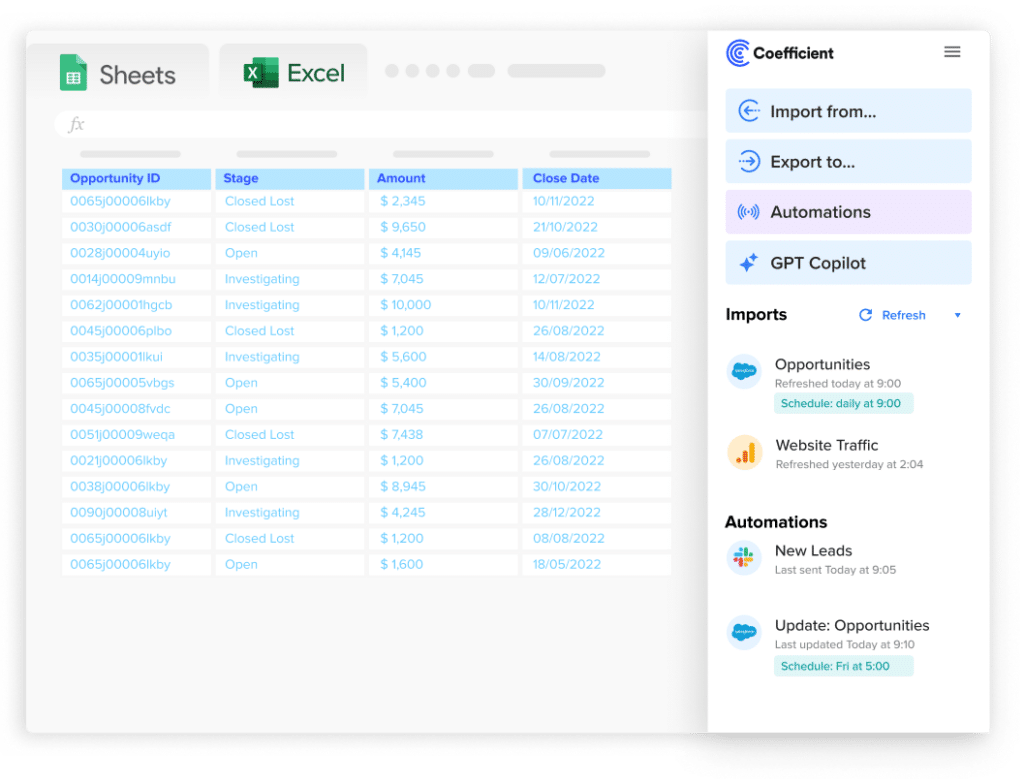
Stop exporting data manually. Sync data from your business systems into Google Sheets or Excel with Coefficient and set it on a refresh schedule.
Get Started
Method 3: Wrike API for programmatic export
The Wrike API supports export of tasks, projects, timelog entries, attachments and user data in JSON format. Use it for automated reporting pipelines or feeding Wrike data into a data warehouse.
Import and export method comparison
| Method | Direction | Data covered | Format | Best for |
|---|---|---|---|---|
| CSV/Excel import | Import | Tasks, custom fields | CSV, XLSX | Bulk task import, migration from spreadsheets |
| Wrike API (import) | Import | Tasks, folders, projects, timelogs | JSON | Automated migrations, continuous sync |
| Task/project export (CSV) | Export | Tasks and project fields | CSV, XLSX, PDF | One-time project or folder export |
| Coefficient | Export from Wrike | Tasks, projects, folders | Live sync to Sheets or Excel | Recurring exports, live project reporting |
| Wrike API (export) | Export | All data including timelogs and attachments | JSON | Automated pipelines, data warehouse ingestion |
FAQs
Can you import tasks from Excel into Wrike?
Yes. Wrike accepts XLSX files via the import option in any folder or project view. Map column headers to task fields during the import flow.
Can you export Wrike data to Google Sheets automatically?
Yes, with Coefficient. Connect Wrike, select your data and set a refresh schedule. Task and project data updates in Google Sheets or Excel automatically.
What data types can be imported into Wrike?
Tasks with name, description, status, assignee, due date, tags and custom fields can be imported via CSV or Excel. Comments, attachments and timelog entries require the Wrike API.
What are the Wrike export limitations?
Native export covers task and project fields only. Comments, file attachments and detailed timelog data are not included in CSV or Excel exports. Access these via the Wrike API.
If you need Wrike project data refreshed automatically in a spreadsheet, try Coefficient free and connect Wrike in a few clicks.