

Domo does not publish pricing. What you see on their website is a 30-day free trial and a Contact Sales button. Pricing is negotiated directly and varies by team size, data volume and contract structure. Based on verified transaction data from Vendr, G2 and TrustRadius, this guide breaks down what organisations actually pay, how the credit model works, where costs hide and what alternatives cost in direct comparison.
What Is Domo?
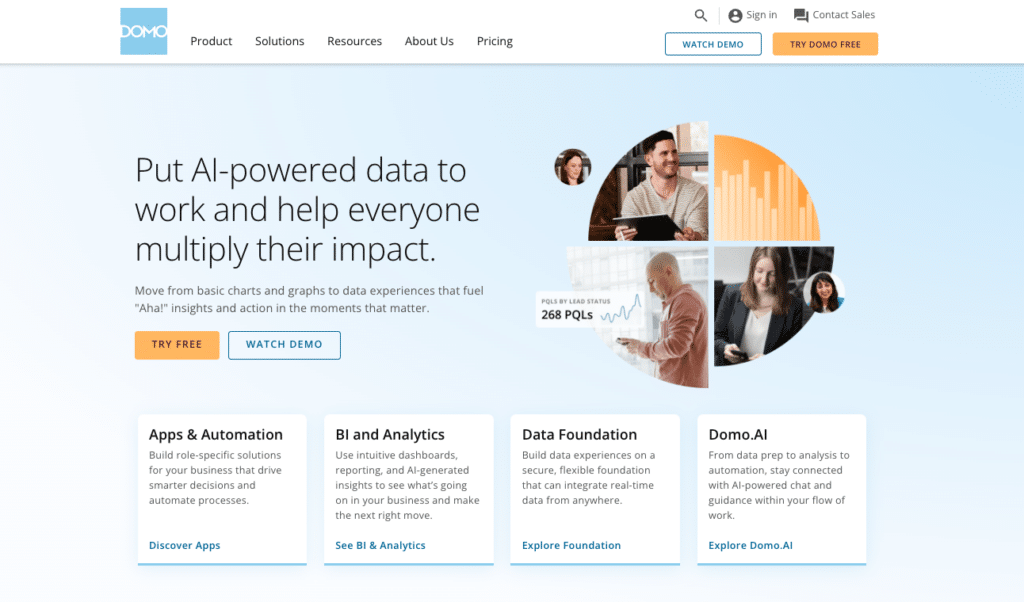
Domo is a cloud-based business intelligence platform that combines data integration, ETL, dashboards, embedded analytics and mobile reporting in a single product. It targets mid-market to enterprise organisations that need to centralise data from many sources and surface insights to both technical and non-technical users.
Target users: data teams, business analysts, RevOps and finance leaders in organisations with annual BI budgets of $100K or more.
Core limitations to be aware of before evaluating:
- No published pricing. Every contract is negotiated, which makes budget planning difficult without a sales conversation.
- Consumption-based credit model introduced in mid-2023. Costs are harder to forecast than flat per-user pricing and can escalate without warning.
- Minimum viable deployment starts at around $30,000/year, which puts Domo out of reach for smaller teams.
- Implementation complexity. Most organisations require professional services to get full value, adding $20,000 to $100,000 on top of the license fee.
Domo Pricing Overview
Domo uses a hybrid model combining per-user license fees with consumption credits. Every action in the platform, including data ingestion, ETL transformations, dashboard refreshes and AI queries, draws from a pre-purchased credit pool. Vendr’s dataset of 84 Domo deals shows an average annual contract value of approximately $134,000.
| Deployment Size | Typical Annual Cost | Per-User Equivalent | Notes |
|---|---|---|---|
| Small (10 to 25 users) | $30,000 to $75,000 | $1,200 to $3,000/user/year | Minimum viable deployment; Standard tier |
| Mid-market (50 to 100 users) | $100,000 to $150,000 | $1,000 to $2,000/user/year | Enterprise tier typical; credits included |
| Enterprise (200+ users) | $200,000 to $500,000+ | $750 to $1,500/user/year | Volume discounts; Business Critical tier |
| Very large (500+ users) | $500,000 to $1M+ | Custom | Multi-year contracts; dedicated support |
The minimum viable Domo deployment costs approximately $30,000/year. Teams below that threshold typically find Domo out of reach on budget alone.
Domo Pricing Plans: What You Get
Standard
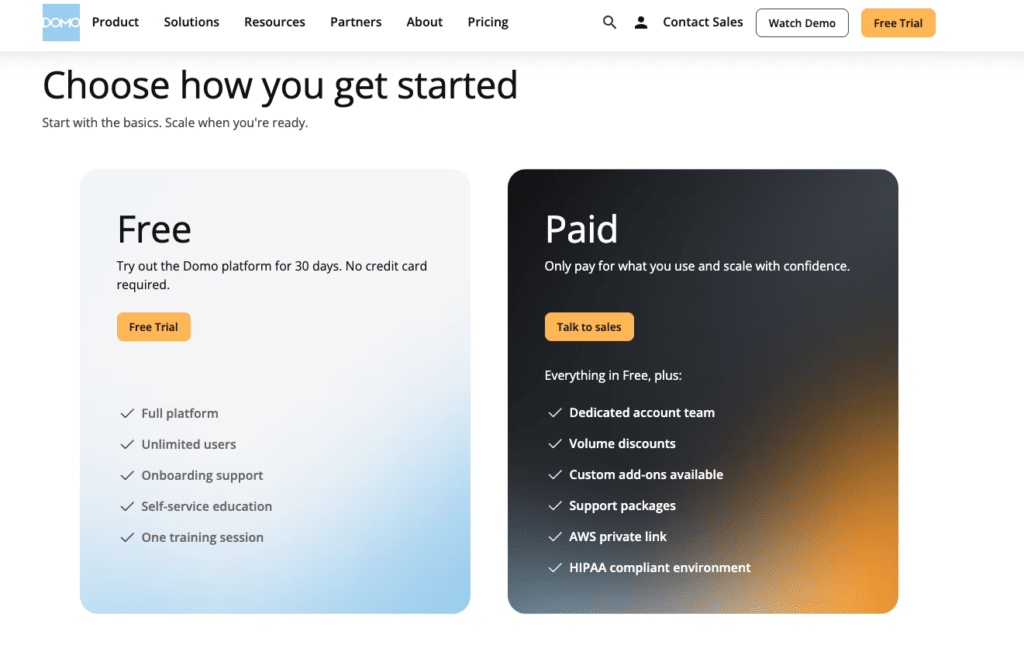
Entry-level tier for small to mid-sized teams. Includes core dashboard creation, a limited connector set and shared support. Most customers report finding Standard insufficient for real-world deployments and upgrading to Enterprise within the first contract term.
Enterprise
The most common tier for mid-market organisations. Adds volume discounts on credits, a dedicated account team, Domo AI features, enterprise-grade governance and priority support. Most mid-market deployments sit here at $100K to $150K/year for 50 to 100 users.
Business Critical
The highest standard tier. Adds AWS Private Link, full HIPAA compliance, dedicated infrastructure and white-glove support. Targets regulated industries where data residency requirements justify the premium. Typical range: $200K to $500K+/year.
30-Day Free Trial
Full platform access with unlimited users and onboarding support. There is no permanent free tier. After the trial, all usage requires a negotiated paid contract.
The Credit Consumption Model: Where Costs Add Up
Credit consumption is the most cited frustration in Domo user reviews on G2, more so than the base license fee. Here is how credits burn:
- Materialised storage: Data stored in Domo permanently consumes roughly 1 credit per million storage rows per month.
- ETL double-billing: Domo’s Magic ETL charges credits on both the input data ingestion and the output transformation. The same dataset effectively costs twice.
- No hard caps: Unlike AWS or Azure, Domo does not allow hard credit limits. Overages accumulate without warning and appear as end-of-quarter bills.
- Renewal escalation: One verified G2 reviewer reported their renewal price increasing 1,120% with two months’ notice, for the same number of users and lower actual consumption than the prior year.
Hidden Costs to Budget For
Beyond the base license, customer reviews on Capterra and G2 consistently surface the same categories of unexpected spend:
| Cost Category | Typical Amount | What to Watch For |
|---|---|---|
| Connector overages | $5,000 to $15,000/year | Exceeding connector limits in your package |
| Storage overages | $10,000 to $20,000+/year | Data volume exceeding plan allocation |
| Implementation and professional services | $20,000 to $100,000 | Domo encourages onboarding services and they are often necessary |
| Training per power user | $2,000 to $4,000/user | The learning curve requires formal training investment |
| Support upgrades | 15 to 20% of license fee | Priority or dedicated support is a paid add-on |
| Annual renewal increases | Reported up to 1,120% | Contract language may allow significant price escalation at renewal |
Domo Customer Reviews: What Users Actually Say
Domo holds a 4.4/5 rating on G2 across several thousand reviews and 4.2/5 on Capterra. Praise centres on ease of use for non-technical users, Magic ETL for data transformation and the breadth of pre-built connectors. Criticism concentrates on cost and the credit model.
Consistent positives:
- Intuitive dashboard builder accessible to non-technical users without SQL knowledge.
- Strong pre-built connector library covering 1,000+ data sources.
- Mobile-first design well suited to executive and field team consumption.
Consistent complaints:
- Unpredictable costs. One verified G2 reviewer wrote: “We were notified two months before our renewal that next year’s price was going to be 1,120% more than our last renewal price. This is with the same number of users and a decrease in consumption.”
- No semantic layer. G2 reviewers flag the absence of a Looker-style LookML equivalent, making metric governance difficult across large organisations.
- Performance at scale. Large reports run slower than comparable tools, and all data must land in Domo’s proprietary Data Vault before querying, creating duplicate storage costs.
Domo vs Coefficient: Pricing Comparison
For mid-market teams using Domo primarily for operational reporting, the credit model and minimum contract size are difficult to justify. Coefficient connects Google Sheets and Excel to 100+ business systems with scheduled auto-refresh, two-way sync and AI-assisted analysis. Vibe Reporting generates live, shareable web dashboards from spreadsheet data via a plain-English description. No BI platform license. No credit model. Paid plans from $49/month.
| Feature | Domo (Est. $100K to $150K/year) | Coefficient Starter ($49/month) | Coefficient Pro ($99/month) |
|---|---|---|---|
| Data sources | 1,000+ pre-built connectors | 3 sources included | Unlimited sources |
| Setup cost | $20,000 to $100,000 services | $0 self-service | $0 self-service |
| Implementation time | Weeks to months | Same day | Same day |
| Pricing model | Credits + user license | Flat monthly | Flat monthly |
| Live web dashboards | Yes (native) | Yes via Vibe Reporting | Yes via Vibe Reporting |
| Two-way data sync | Limited writeback | Yes (Salesforce, HubSpot, QB) | Yes (Salesforce, HubSpot, QB) |
| AI features | Domo AI (credit-based) | AI Sheets Assistant included | AI Sheets Assistant included |
| Transparent pricing | No | Yes | Yes |
| Annual cost | $30,000 to $500,000+ | $588 | $1,188 |
*Excluding implementation and professional services costs for Domo.
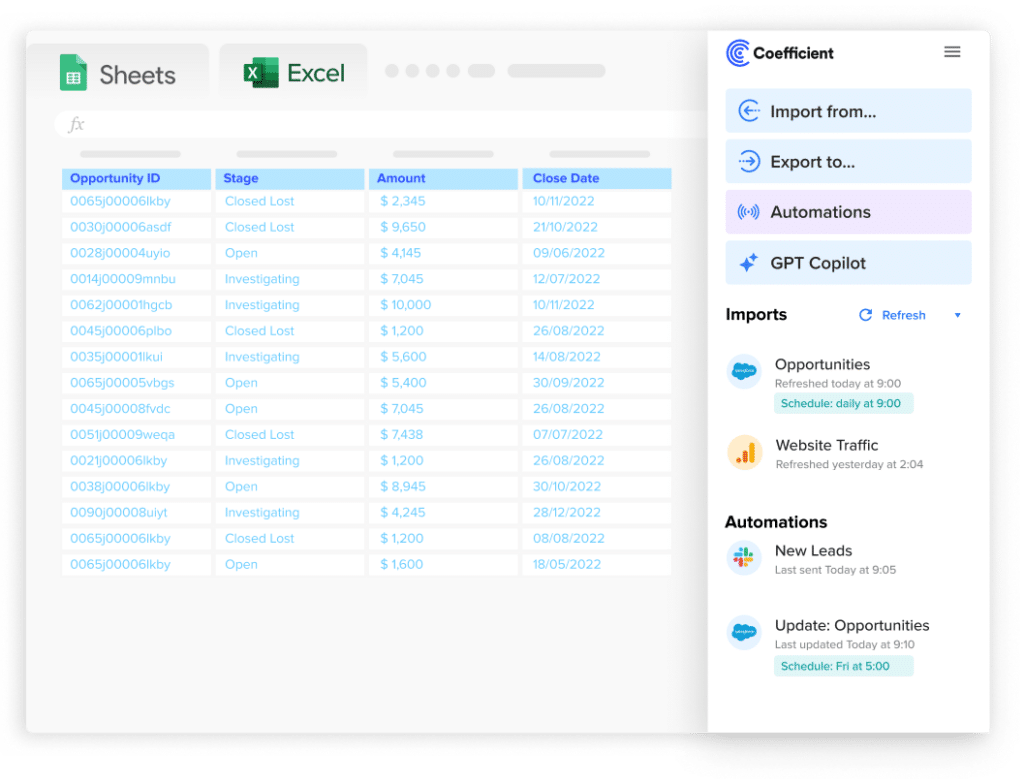
Stop exporting data manually. Sync data from your business systems into Google Sheets or Excel with Coefficient and set it on a refresh schedule.
Get Started
Why Teams Choose Coefficient Over Domo
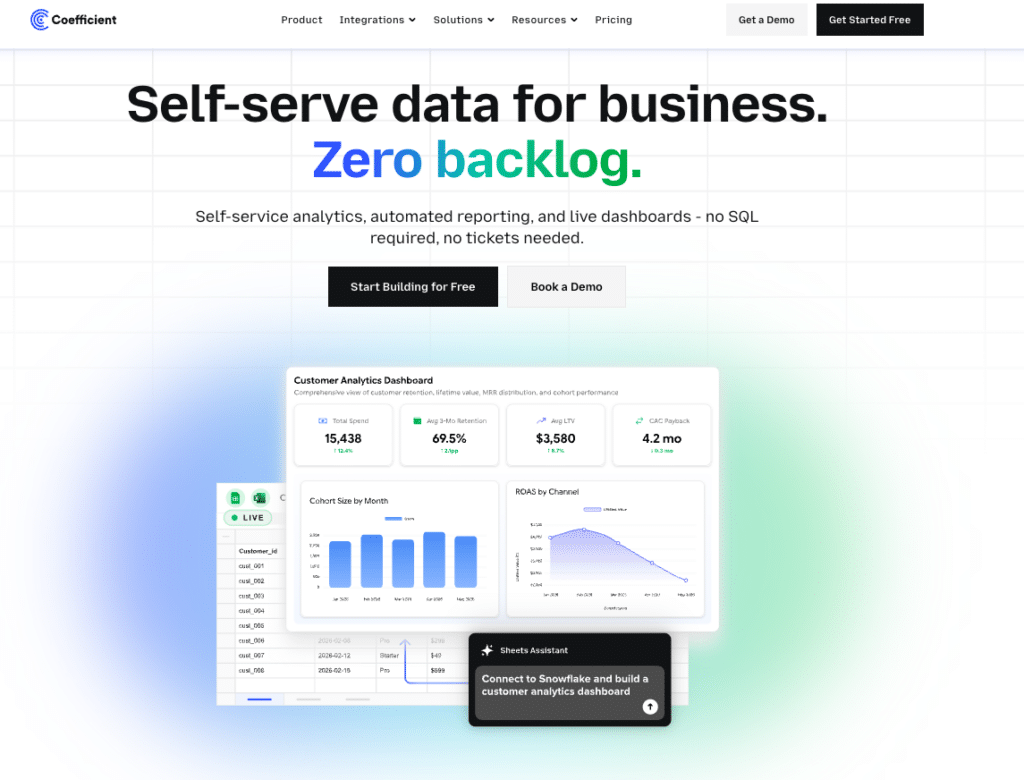
The economics are direct. Domo’s typical mid-market deployment costs $100,000 to $150,000 annually before implementation. Coefficient Pro delivers live data connectivity, AI-assisted analysis and shareable web dashboards for $1,188/year. That is a saving of over $100,000 annually for teams whose core need is operational reporting rather than an enterprise BI platform.
Beyond pricing, the operational difference is meaningful. Domo requires data to land in its proprietary Data Vault before it can be queried, adding duplicate storage costs and locking teams into a single vendor’s ecosystem. Coefficient reads live from source systems via direct API connections and writes back without intermediary storage. Finance managers, RevOps leads and ops teams get live data in the tools they already use, without a BI platform to learn or a credit model to manage.
Coefficient’s Vibe Reporting closes the last gap. Teams describe the dashboard they want in plain English and get a shareable live link that updates automatically as the underlying spreadsheet data refreshes. The output is BI-quality. The workflow stays in Google Sheets or Excel.
| “Coefficient automated everything. Instead of manually exporting data every day, I just sit back and watch the data update automatically.” Christian Budnik, FP&A Analyst, Solv |
Is Domo Right for Your Team?
Domo makes sense for organisations that need an all-in-one platform combining data integration, ETL, mobile-first dashboards and embedded analytics, and have the budget and internal resources to operate it. Enterprise teams running hundreds of data sources, with dedicated BI engineers and annual budgets above $150K, get genuine value from the platform.
For mid-market teams where the core need is live, shareable reporting from a handful of systems, the credit model and minimum contract size are difficult to justify. The per-user economics improve at scale, but the minimum viable deployment cost stays fixed regardless of how little of the platform you actually use.
Negotiating Domo Pricing
Domo pricing is negotiable. A few levers that consistently move the number:
- Commit to a multi-year term (2 to 3 years) in exchange for a fixed annual price and protection against mid-contract credit rebalancing.
- Negotiate a hard cap or credit rollover clause before signing. Without this, end-of-quarter overage bills are common.
- Benchmark against alternatives and bring that comparison into the negotiation. Domo’s sales team will discount when they perceive a credible switch risk.
- Clarify exactly which user types and actions consume credits before signing. The definitions matter and are not always spelled out in the standard contract.
Frequently Asked Questions
How does Domo pricing compare to Coefficient?
Domo’s mid-market contracts typically run $100,000 to $150,000/year plus $20,000 to $100,000 in implementation costs. Coefficient Pro costs $1,188/year with no setup fees. For teams whose primary need is live operational reporting rather than an enterprise BI platform, the difference is substantial.
Does Domo have a free plan?
No permanent free plan. Domo offers a 30-day free trial with full platform access and unlimited users. After the trial, all usage requires a paid contract negotiated with the sales team.
What is the minimum cost for Domo?
Based on Vendr transaction data and verified customer reports, the minimum viable Domo deployment starts at approximately $30,000/year for small teams of 10 to 25 users. Most mid-market deployments land between $100,000 and $150,000/year.
Which plan is best for small teams?
For small teams under 25 users, Domo’s minimum contract starts at $30,000/year before implementation costs. Coefficient Starter at $49/month ($588/year) provides live data connectivity, AI-assisted analysis and Vibe Reporting for shareable live dashboards with no setup fees and no credit model.
How does Domo’s credit model work?
Domo sells pre-purchased credits that are consumed by every platform action, including data storage, ETL transformations, dashboard refreshes and AI queries. Unlike cloud providers that allow hard budget caps, Domo allows credits to be exceeded, resulting in overage bills at the end of each quarter. This makes cost forecasting difficult for teams with variable data workloads.