Choosing between financial reporting platforms shouldn’t feel like betting your career on a spreadsheet error. Yet here you are, trying to decide between Datarails’ sophisticated FP&A workflows and FathomHQ’s polished QuickBooks analytics. Both promise to transform your financial reporting, but they approach the problem from completely different angles—and both leave significant gaps that could hamper your team’s effectiveness.
This comparison cuts through the marketing noise to examine what each platform actually delivers. You’ll learn:
- Where Datarails and FathomHQ excel
- Where they fall short
- Why you might need to consider a third option that delivers financial excellence without forcing you into a narrow, finance-only corner
Datarails Overview

Datarails has built its reputation as “The #1 AI-powered Excel-native FP&A platform” specifically for finance teams that refuse to abandon Excel. With a 4.6/5 rating across 213 G2 reviews, Datarails delivers sophisticated financial planning and analysis capabilities that sit directly inside Microsoft Excel through their FinanceOS add-in.

The platform targets mid-market to enterprise finance teams—CFOs, FP&A managers, financial analysts—who need advanced budgeting, forecasting, and consolidation without the six-month implementation nightmare of traditional FP&A platforms like Adaptive Insights or Planful. Datarails promises two-week implementations instead of six months, which explains testimonials like this from Charlotte Kelly, Head of FP&A at Butternut Box: “We’ve cut our weekly reporting time in half.”
Where Datarails genuinely shines is its deep financial capabilities. You get:
- Automated multi-entity consolidation with currency translation and intercompany eliminations
- Budget collection workflows
- Rolling forecasts
- Scenario analysis
- Version control that prevents what Samantha Cassidy at Empower Healthcare Solutions calls “potentially catastrophic mistakes”
Datarails connects to 200+ data sources, though this number deserves scrutiny. The integration focus skews heavily toward accounting and ERP systems:
- QuickBooks, NetSuite, Xero, Sage Intacct
- Microsoft Dynamics 365, SAP Business One
The platform technically supports CRM systems like Salesforce and HubSpot, but only for pulling financial data—you won’t use these for sales operations analysis. Marketing platforms, operational tools, and HR systems remain largely absent from Datarails’ integration catalog.
You won’t find transparent pricing on their website—every deal requires custom quotes based on:
- User count
- Integration needs
- Product tier selection

But third-parties tell us similar things: The pricing structure reflects Datarails’ enterprise positioning: $3,000-5,000+ per month, translating to $36,000-60,000+ annually.For context, that’s roughly 30-50x more expensive than Datarails’ nearest SMB competitor.
Datarails’ Genius AI feature is genuinely impressive for FP&A-specific tasks. You can:
- Ask conversational questions about financial data
- Build scenario models through natural language
- Create board presentation storyboards
This innovation goes beyond most FP&A platforms. Barry Lin, Director of FP&A at Guesty, captures the impact: “I have more time to do things that I didn’t have the capacity to even consider doing, and now I’m doing it.”
The limitation isn’t that Datarails fails at FP&A—it excels there. The challenge emerges when finance teams need context beyond accounting systems. Modern financial forecasting requires:
- Sales pipeline data from CRM systems
- Marketing ROI from advertising platforms
- Operational efficiency metrics from project management tools
Datarails simply wasn’t built for cross-functional analysis.
FathomHQ Overview

FathomHQ takes a dramatically different approach to financial reporting. Rather than positioning itself as an FP&A platform, FathomHQ markets “all-in-one reporting, analysis & forecasting” specifically for accounting professionals and small business finance teams. With 95,000+ businesses worldwide and adoption by all Big 4 accounting firms (Deloitte, PwC, KPMG, BDO), FathomHQ has carved out a distinct niche.
The platform’s integration philosophy stands in stark contrast to Datarails’ 200+ connectors. FathomHQ supports exactly six accounting platforms:
- QuickBooks Desktop
- QuickBooks Online
- Xero
- MYOB
- Sage
- Access Financials UK
That’s it. No NetSuite, no Microsoft Dynamics, no SAP. For systems outside these six, you manually import Excel or Google Sheets files.
This narrow focus allows FathomHQ to deliver exceptional depth where it matters. The platform provides:
- Transaction-level detail from accounting systems
- Complex chart of accounts structures handling
- Sophisticated financial data quality
You’re not getting surface-level summary data—you’re getting the full accounting picture from supported systems.
Where FathomHQ genuinely impresses is cash flow forecasting. David Maher, Director at Right Brain Insights, calls it “absolutely world class—incredibly powerful and incredibly valuable.” FathomHQ offers true three-way forecasting that integrates:
- Profit and loss
- Balance sheet
- Cash flow scenarios across 36-month periods
You can build driver-based models, test assumptions, and generate forecasts that actually account for working capital changes—not just revenue projections.
The reporting capabilities deserve recognition too. FathomHQ provides:
- 90+ ready-to-use charts and visualizations
- Professional formatting that impresses boards and investors
- White-label branding for accounting firms
- Xero Practice Manager integration
- Group benchmarking features
Tricia O’Connor, Founder of O’Connor CPA Firm, calls FathomHQ “a game changer for businesses that are ready to propel their growth and profitability.”
FathomHQ’s pricing reflects its accounting firm orientation.

You pay per company (one QuickBooks/Xero/MYOB file), not per user:
- $53/month: One company
- $280/month (Silver): Ten companies
- $400/month (Gold): 25 companies
- $720/month (Platinum): 50 companies
- $500/month (Portfolio): Unlimited companies for accounting firms
The unlimited user model makes FathomHQ attractive for:
- Accounting firms with multiple staff accessing client financials
- Franchise networks where many locations need financial visibility
Every plan includes unlimited reports, all features, multi-currency support, and full customer support—no tiered feature restrictions.
But here’s where FathomHQ’s limitations become apparent. The platform operates as a standalone web application, not a spreadsheet add-in. You:
- Log into FathomHQ’s interface
- View reports
- Build forecasts
- Analyze KPIs—all outside Excel or Google Sheets
For finance professionals who live in spreadsheets, this creates friction. You can’t build custom analyses in your familiar spreadsheet environment. You’re learning a new interface and working in a separate system.
More critically, FathomHQ serves only accounting data. Robin Joe Kong at NBC praises it as “simple to use, even for people with no financial background,” which speaks to FathomHQ’s usability. But simplicity comes at a cost: you can’t analyze financial results alongside:
- Sales pipeline data
- Marketing campaign performance
- Operational efficiency metrics
- Product usage trends
FathomHQ answers financial questions exceptionally well. It can’t answer cross-functional business questions at all.
Head-to-Head Comparison
Where They Overlap (and Where Coefficient Joins the Conversation)
Both Datarails and FathomHQ target finance teams seeking better financial reporting and forecasting than what accounting systems provide natively. They both:
- Connect to QuickBooks and Xero
- Offer automated financial report generation
- Provide budgeting and forecasting capabilities
- Handle multi-entity consolidation
- Don’t require writing code or SQL to extract financial data
The shared philosophy is clear: finance teams deserve purpose-built tools that understand financial concepts like chart of accounts, fiscal periods, and consolidation rules. Both platforms deliver on this promise within their respective approaches—Datarails through Excel enhancement, FathomHQ through specialized web application.
Data Source Connectors
Datarails markets 200+ integrations, but this number requires context. The vast majority focus on financial and accounting systems—QuickBooks, NetSuite, Xero, Sage Intacct, Microsoft Dynamics, SAP Business One, and similar ERP platforms.
Datarails does technically connect to Salesforce and HubSpot, but these integrations serve financial reporting purposes: pulling closed deals for revenue recognition, not analyzing sales pipeline health. Marketing platforms like Google Ads, Facebook Ads, and LinkedIn Ads remain absent. Operational tools like Jira, Asana, and Zendesk don’t appear in Datarails’ catalog either.
FathomHQ takes the opposite approach with just six integrations, all accounting platforms. This makes FathomHQ’s integration story straightforward: if your company uses QuickBooks, Xero, MYOB, Sage, or Access Financials UK, you’re covered. If you use NetSuite as your ERP, FathomHQ can’t help. The platform excels at deep accounting system integration but offers zero connectivity beyond accounting software.
The practical limitation both platforms share: modern financial analysis rarely stays within accounting system boundaries. When you’re building Q4 revenue forecasts, you need:
- Accounting history from QuickBooks
- Sales pipeline probabilities from Salesforce
- Marketing lead trends from HubSpot
When calculating true customer acquisition cost, you need:
- Subscription revenue from Stripe
- Marketing spend from Google Ads
- Customer success costs from operational systems
Neither Datarails nor FathomHQ can deliver this cross-functional analysis.
FP&A and Modeling Capabilities
Datarails dominates this category with purpose-built FP&A functionality. You get:
- Sophisticated budget collection workflows where department heads submit budgets through structured processes
- Automated consolidation that rolls up submissions into enterprise-wide plans
- Rolling forecasts that update dynamically as actuals flow in
- Scenario analysis with side-by-side comparisons
The platform handles complex corporate structures with intercompany eliminations and multi-currency translation. Version control ensures audit trails for every change, addressing compliance requirements that generic spreadsheets can’t satisfy.
Steven Carkey, VP Finance Operations at Butternut Box, quantifies Datarails’ impact on FP&A capacity: “Without Datarails, I would’ve needed to double my current team of three just to produce what we’re delivering today.” That’s a powerful testament to Datarails’ FP&A efficiency.
FathomHQ approaches forecasting differently but delivers impressive capabilities within its scope. The platform’s three-way forecasting—simultaneously modeling P&L, balance sheet, and cash flow—represents sophisticated financial modeling that many competitors lack. You build:
- Driver-based models where assumptions like customer growth rates or pricing changes flow through all three financial statements
- 36-month forecasting periods
- Scenario testing for sensitivity analysis
For QuickBooks and Xero users, this forecasting depth exceeds what’s typically available at FathomHQ’s price point.
The limitation? FathomHQ’s forecasts rely entirely on accounting system data plus manual assumptions. You can’t:
- Automatically pull sales pipeline data to inform revenue forecasts
- Import marketing funnel metrics to estimate customer acquisition trends
Forecasting remains an accounting exercise rather than a cross-functional planning process.
Reporting and Analytics
Both platforms deliver strong financial reporting, but their approaches differ fundamentally. Datarails generates:
- Financial statements—P&L, balance sheet, cash flow—automatically from connected systems
- Excel-based dashboards that maintain full Excel functionality
- Custom analyses on top of standardized reports
- Shareable reports through Datarails’ distribution capabilities
The reporting stays Excel-native, which means zero learning curve for Excel-proficient finance teams.
FathomHQ’s reporting strength lies in visual polish and pre-built analytics. The platform provides:
- 90+ professional charts covering profitability, liquidity, efficiency, and growth metrics
- 50+ pre-configured financial KPIs that calculate automatically from accounting data
- White-label branding that transforms reports into client-ready deliverables
- Group benchmarking to compare multiple entities side-by-side
What neither platform addresses: contextual reporting that combines financial results with operational drivers. When your CFO asks why gross margin decreased 3% last quarter, the answer rarely lives in accounting data alone. You need:
- Financial results from NetSuite
- Sales mix changes from Salesforce
- Pricing adjustments from your data warehouse
- Customer support costs from Zendesk
Neither Datarails nor FathomHQ can assemble this cross-functional narrative.
Pricing and Value Proposition
Datarails occupies the premium tier with $3,000-5,000+ per month ($36,000-60,000+ annually) and opaque pricing requiring sales engagement before you understand total cost. This makes sense for:
- Enterprise finance teams with complex consolidation needs
- Budgets accommodating specialized FP&A platforms
- Organizations where Datarails delivers ROI through time savings and improved financial planning
FathomHQ’s per-company pricing model creates interesting dynamics:
- Solo companies: $53/month—very affordable for small businesses
- Ten companies: $280/month (Silver tier)
- 25 companies: $400/month (Gold tier)
- 50 companies: $720/month (Platinum tier)
For accounting firms managing many clients or franchise networks with many locations, this becomes expensive relative to per-user models. The unlimited user benefit helps, but you’re still paying for every company file you connect.
Platform and Collaboration
Platform flexibility represents a critical but often overlooked differentiator. Datarails works exclusively in Microsoft Excel through their FinanceOS add-in. If your organization uses Google Workspace—approximately 40% of businesses—Datarails simply isn’t an option. This Excel-only approach makes sense given Datarails’ target market (mid-market to enterprise finance teams where Excel dominates), but it creates real limitations for:
- Companies committed to Google Workspace
- Teams split between platforms
FathomHQ operates as a standalone web application—you access everything through your browser using FathomHQ’s interface. The platform isn’t spreadsheet-native. While this enables beautiful, purpose-designed interfaces, it forces finance teams to work outside their natural spreadsheet environment. You can export data to Excel or Google Sheets, but you lose the live connectivity and automated refresh that makes modern financial reporting efficient.
Collaboration features reflect each platform’s architecture:
- Datarails: Version control, audit trails, controlled sharing within Excel environments
- FathomHQ: Unlimited users per company, automated report scheduling, white-label branding for client-facing deliverables
Both platforms enable multi-user access, but neither empowers cross-functional teams beyond finance.
The Limitations Both Platforms Share
Despite their different approaches, Datarails and FathomHQ share fundamental limitations that constrain their utility for modern finance teams.
Both platforms exist in finance-only silos:
- Datarails: Connects primarily to accounting and ERP systems with token CRM connectivity for financial reporting
- FathomHQ: Connects exclusively to six accounting platforms
Neither platform can answer cross-functional business questions that require data beyond finance systems. When your CFO asks why revenue missed forecast by 8%, the answer requires:
- Accounting data (what actually closed)
- Sales pipeline data (which deals slipped)
- Marketing data (whether lead quality deteriorated)
- Operational data (whether delivery issues caused churn)
Neither Datarails nor FathomHQ can assemble this complete picture.
Platform lock-in constrains team flexibility:
- Datarails: Requires Microsoft 365 and Excel, excluding Google Workspace users entirely
- FathomHQ: Operates as a standalone web application outside the spreadsheet environments where finance teams actually work
Modern organizations need tools that meet users where they are, not force platform migrations or separate systems that fragment workflows.
Neither platform offers two-way sync or write-back capabilities. Both are fundamentally extraction and reporting tools—they pull data from source systems into their respective destinations (Excel for Datarails, FathomHQ’s web app for analytics), but they can’t push data back. Modern workflows increasingly require bidirectional data flow:
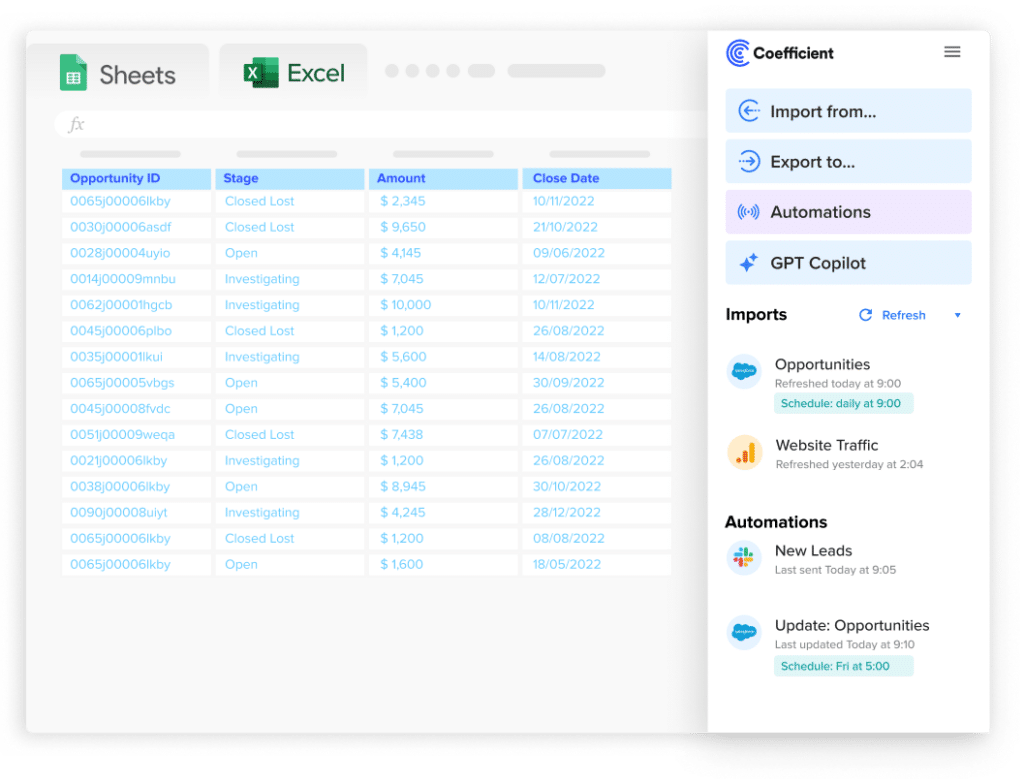
Stop exporting data manually. Sync data from your business systems into Google Sheets or Excel with Coefficient and set it on a refresh schedule.
Get Started
- Updating Salesforce opportunity stages after pipeline reviews
- Pushing calculated fields back to data warehouses for downstream consumption
- Enriching customer records based on financial analysis
One-way extraction limits these platforms to reporting functions rather than operational workflows.
Both platforms struggle with modern data stack integration:
- Data warehouses like Snowflake, BigQuery, and Databricks increasingly centralize organizational data
- Operational databases like PostgreSQL, MySQL, and MongoDB store critical business context
Neither platform prioritizes these connections. Finance teams building sophisticated analyses need to query these systems directly, not rely solely on accounting software exports.
AI capabilities remain basic or absent:
- Datarails: Offers Genius AI for FP&A-specific conversational queries—genuinely useful but narrowly scoped
- FathomHQ: Advertises no AI capabilities
Neither platform provides:
- AI-powered SQL generation for database queries
- Automated dashboard construction
- Intelligent analysis across multiple data types
Modern AI should empower finance teams to build complex reports without technical expertise, not just answer predefined financial questions.
The scalability problem becomes acute as organizations grow. Finance teams start with finance-only needs, but business complexity quickly demands broader visibility:
- Sales needs pipeline analysis
- Marketing needs ROI tracking
- Operations needs efficiency metrics
- Product needs unit economics
When finance tools can’t expand beyond finance use cases, organizations face uncomfortable choices:
- Buy separate tools for each department (expensive, inconsistent)
- Build custom solutions (requires engineering resources)
- Leave teams without self-service data access (creates bottlenecks)
Neither Datarails nor FathomHQ scales to cross-functional business intelligence.
Enter Coefficient: A Superior Alternative

What if your financial reporting platform didn’t force you to choose between FP&A sophistication and cross-functional flexibility? What if you could start with excellent financial connectivity but expand seamlessly to sales, marketing, operations, and database access as your needs evolve?
Coefficient delivers exactly this approach. The platform begins with robust financial system integration—QuickBooks, NetSuite, Xero, Sage Intacct, Stripe, Chargebee, and other accounting platforms—providing the financial data foundation that Datarails and FathomHQ prioritize. But Coefficient doesn’t stop there. The same platform connects 70+ business systems across every department, enabling the cross-functional analysis that modern finance teams increasingly require.
The architectural advantage starts with dual-platform support. Coefficient works identically in both Microsoft Excel and Google Sheets, eliminating platform lock-in entirely:
- Finance teams comfortable in Excel continue working in Excel
- Collaborative teams using Google Workspace work in Google Sheets
- Cross-platform organizations use both
Unlike Datarails’ Excel-only approach or FathomHQ’s standalone web application, Coefficient meets users in their natural environment.
Two-way sync capabilities distinguish Coefficient from both competitors. The platform offers bidirectional connectivity with:
- Salesforce
- HubSpot
- Snowflake
- MySQL, PostgreSQL, SQL Server
You don’t just pull data—you make changes in spreadsheets and push updates back, transforming spreadsheets from static reports into operational interfaces.
Sam Sholeff, Director of Finance at Cyrq Energy, captures Coefficient’s implementation speed advantage: “I was able to start working with Coefficient out of the box and recall information instantly. This took us months to do with another NetSuite data connector.” While Datarails requires two-week implementations and FathomHQ needs setup time, Coefficient delivers same-day productivity for motivated users.

Why Coefficient Outperforms Both
Advantages Over Datarails
While Coefficient matches Datarails on financial system connectivity—both connect QuickBooks, NetSuite, Xero, and Sage Intacct—it dramatically exceeds Datarails on breadth and flexibility. Where Datarails stops at finance-adjacent integrations, Coefficient continues to 70+ business systems spanning:
- CRM
- Marketing
- Operations
- Databases
- Data warehouses
The Google Sheets advantage eliminates a massive blind spot. Approximately 40% of businesses use Google Workspace as their productivity platform. Datarails simply doesn’t serve this market. Coefficient provides identical functionality in Google Sheets and Excel, doubling addressable market and enabling cross-platform collaboration that Datarails can’t match.
Pricing transparency and affordability matter enormously for mid-market teams:
- Datarails: $36,000-60,000+ annual cost with opaque custom quotes makes ROI conversations difficult before sales engagement
- Coefficient: Transparent per-user pricing ($49-99/user/month) with published feature tiers lets finance leaders calculate costs and budget accurately from the start
For teams that don’t need Datarails’ specialized FP&A workflows, Coefficient delivers financial data connectivity at a fraction of the cost.

Two-way sync provides operational capabilities that Datarails can’t replicate. Coefficient’s bidirectional connectivity with Salesforce, HubSpot, Snowflake, and databases transforms spreadsheets from reporting tools into operational interfaces. Finance teams can update source systems directly from their analysis environment—impossible with Datarails’ read-only architecture.

Advantages Over FathomHQ
Coefficient surpasses FathomHQ on integration breadth, spreadsheet-native architecture, and scalability. FathomHQ’s six accounting integrations serve QuickBooks, Xero, and MYOB users well but exclude NetSuite entirely—a critical gap for mid-market companies. Coefficient connects to all major accounting platforms plus 65+ additional business systems that FathomHQ simply can’t access.

The spreadsheet-native advantage addresses a fundamental workflow issue:
- FathomHQ: Requires finance teams to log into a separate web application, learn FathomHQ’s interface, and work outside their familiar spreadsheet environment
- Coefficient: Operates inside Excel and Google Sheets where finance professionals already spend their days
There’s no context switching, no separate platform to master, no friction between analysis environment and reporting destination.
Platform scalability becomes critical as organizations grow beyond basic financial reporting:
- FathomHQ: Serves accounting-focused use cases excellently but can’t expand to cross-functional business intelligence
- Coefficient: Starts with financial excellence but scales naturally to sales analytics, marketing ROI, operational efficiency, and database analysis
Teams don’t outgrow the platform or need to migrate as business complexity increases.
The per-user vs. per-company pricing model creates different value propositions for different scenarios:
- FathomHQ’s per-company model: Benefits accounting firms managing many clients or franchises with many locations
- Coefficient’s per-user model: Benefits growing teams where user count matters more than company count
For typical mid-market scenarios (5-10 finance team members, one company), Coefficient’s pricing proves more scalable.
Unique Features Neither Competitor Offers
Coefficient’s AI Sheets Assistant operates across all connected data sources, not just finance systems. You can ask it to:
- Build SQL queries for Snowflake
- Generate dashboards combining QuickBooks and Salesforce data
- Create pivot tables analyzing Google Ads spend against Stripe revenue
- Suggest insights from operational databases
This AI breadth exceeds Datarails’ finance-specific Genius AI and FathomHQ’s absent AI capabilities.
Data snapshots preserve point-in-time data for historical trending and period-over-period analysis. You can:
- Capture data on specific dates
- Compare current state against historical snapshots
- Build trending reports that track changes over time
Neither Datarails nor FathomHQ emphasizes this historical preservation functionality.
Alerts and notifications trigger based on metric thresholds, distributing via Slack or email when conditions are met. Finance teams can:
- Monitor key metrics automatically
- Receive alerts when attention is required—no manual report checking needed
This proactive notification exceeds the scheduled email reports that Datarails and FathomHQ provide.
The Verdict
Datarails and FathomHQ both serve finance teams well within their respective niches:
- Datarails: Delivers sophisticated FP&A capabilities for mid-market to enterprise finance teams willing to pay premium prices for Excel-native workflows
- FathomHQ: Provides polished financial reporting and world-class cash flow forecasting for QuickBooks and Xero users, especially accounting firms managing multiple clients
But both platforms share a critical limitation: they trap finance teams in finance-only silos. Modern financial analysis increasingly requires context beyond accounting systems:
- Sales pipeline data to inform forecasts
- Marketing ROI to understand customer economics
- Operational metrics to explain financial results
Neither Datarails nor FathomHQ can deliver this cross-functional analysis.
Coefficient offers a fundamentally different approach. You get:
- Excellent financial system connectivity that matches Datarails and FathomHQ on core accounting integration
- Extensions to 70+ additional systems spanning every business function
- Work in spreadsheets you already use—Excel or Google Sheets—without platform lock-in or separate applications
- Two-way sync for operational workflows that both competitors lack
- Transparent per-user pricing that scales predictably as your team grows
The competitive advantage isn’t just features—it’s architectural philosophy:
- Datarails and FathomHQ: Optimize for finance-only use cases within narrow boundaries
- Coefficient: Optimizes for finance excellence first, then empowers teams to expand as business needs evolve
Finance teams don’t stay static. Your reporting platform shouldn’t either.
Ready to experience financial reporting that grows with your business? Get started with Coefficient today and discover what cross-functional financial analysis actually feels like.