You need Salesforce data in Google Sheets. Two options exist: Salesforce’s native Data Connector or Coefficient.
Salesforce Data Connector is a free native tool that moves Salesforce data to Google Sheets. It handles basic reports with a 2,000-row limit and 4-hour minimum refresh intervals. One-way sync only.
Coefficient is a spreadsheet automation platform that connects Salesforce and 70+ other systems to Excel and Google Sheets. It offers unlimited rows, hourly refreshes, two-way sync, and AI-powered query building.
The core difference: The native connector works for small, static reports. Coefficient works for teams that need real-time analysis and data workflows.
- Coefficient vs Salesforce Data Connector: Core capabilities
- Coefficient vs Salesforce Data Connector: Integration capabilities
- Coefficient vs Salesforce Data Connector: Data limits and refresh
- Coefficient vs Salesforce Data Connector: Features and functionality
- Coefficient vs Salesforce Data Connector: User experience
- Coefficient vs Salesforce Data Connector: Pricing
- Coefficient vs Salesforce Data Connector: Support and resources
- Coefficient vs Salesforce Data Connector: Security and compliance
- The final verdict
- Start with Coefficient today
Coefficient vs Salesforce Data Connector: Core capabilities
What is Salesforce Data Connector?
The native connector pulls Salesforce data into Google Sheets through a basic configuration interface. Select your Salesforce objects, choose fields, set a refresh schedule, and the data appears in your sheet.
Key limitations:
- 2,000-row maximum – Imports stop at row 2,000 regardless of record count
- 4-hour minimum refresh – No hourly or real-time options
- One-way sync only – Cannot push updates back to Salesforce
The tool includes no advanced features. No custom queries, no AI assistance, no multi-source reporting. It’s designed for simple data viewing, not analysis.
What is Coefficient?

Coefficient transforms spreadsheets into live reporting tools connected to your entire data stack. The Salesforce connector is one of 70+ integrations.
Core capabilities:
- Unlimited data volume – Import hundreds of thousands of rows
- Hourly automatic refresh – Keep data current for real-time decisions
- Two-way sync – Update Salesforce directly from spreadsheet edits
- AI-powered queries – AI Sheets Assistant translates natural language to queries
- Custom SOQL support – Write advanced queries for complex data needs
- Multi-source reports – Combine Salesforce with other platforms in one sheet
The tool works entirely within your spreadsheet. No separate platform to learn.
Target users
| Salesforce Data Connector | Coefficient |
| Small teams with simple reporting needs | Revenue teams, analysts, and operations professionals |
| Reports under 2,000 rows | Large datasets requiring full record access |
| Users who can tolerate 4-hour data delays | Teams needing current data for daily decisions |
| Read-only data viewing | Workflows requiring bidirectional sync |
Coefficient vs Salesforce Data Connector: Integration capabilities
Salesforce Data Connector’s scope
The native connector does one thing: Salesforce to Google Sheets. No other integrations exist. You cannot connect additional data sources.
If you need HubSpot marketing data alongside Salesforce opportunities, you must use a separate tool. If you need database queries or analytics platform data, you export manually and combine in the spreadsheet.
Coefficient’s integrations

Coefficient connects 70+ systems across six categories:
| Category | Example Connections |
| CRM | Salesforce, HubSpot, Pipedrive, Zendesk |
| Finance/Accounting | NetSuite, QuickBooks, Stripe, Xero |
| Database/Warehouse | Snowflake, MySQL, PostgreSQL, BigQuery |
| Marketing | Google Ads, Facebook Ads, LinkedIn Ads, Mailchimp |
| BI/Analytics | Tableau, Looker, Google Analytics 4 |
| Other Tools | Jira, Asana, Intercom, Gmail |
This enables cross-system reporting. Combine Salesforce pipeline data with Google Ads spend and Stripe revenue in one report. No manual exports required.
Setup comparison:
| Aspect | Salesforce Data Connector | Coefficient |
| Initial configuration | 15-20 minutes | 2-3 minutes |
| Authentication method | OAuth through Google | OAuth (same security) |
| Additional sources | Not supported | 70+ available |
| IT support needed | No | No |
Coefficient vs Salesforce Data Connector: Data limits and refresh
Row limits
Salesforce Data Connector stops at 2,000 rows. If your Opportunities object contains 8,000 records, you see only the first 2,000. The tool provides no warning, no error message, and no workaround.
This breaks reporting for growing companies. Your sales team closes deal #2,001 and it never appears in your report. You don’t know what you’re missing.
Coefficient has no row limits. Import 100,000 records if needed. The only constraint is Google Sheets’ 10 million cell limit—far beyond what most users encounter.
Refresh frequency
| Feature | Salesforce Data Connector | Coefficient |
| Fastest refresh | 4 hours | 1 hour (or 15 minutes for critical reports) |
| Scheduled options | 4hr, 8hr, 24hr | Hourly, daily, weekly with custom times |
| Manual refresh | Available | Available via button or sidebar |
| Automatic detection | No | Optional for new rows or value changes |
The 4-hour minimum creates stale data problems. If deals close throughout the day, your pipeline report stays outdated until the next scheduled refresh. You make decisions on old information.
Coefficient’s hourly refresh keeps data current enough for operational decisions. Configure 15-minute intervals for dashboards that need near-real-time updates.
Data sync direction
Salesforce Data Connector is strictly one-way. Data flows from Salesforce to Sheets only.
If you clean data in Sheets—fixing typos, enriching records, or updating fields—you must manually export and re-import to Salesforce. This creates duplicate work and version control problems.
Coefficient offers two-way sync. Update values in Google Sheets and push changes back to Salesforce automatically. This enables:
- Bulk data cleaning workflows
- Collaborative editing that syncs to CRM
- Spreadsheet-based data enrichment
- Quick corrections without opening Salesforce

Coefficient vs Salesforce Data Connector: Features and functionality
Data handling
| Feature | Salesforce Data Connector | Coefficient |
| Formula fields | Dropped without notice | Fully supported |
| Custom objects | Supported | Supported |
| Field selection | Manual selection only | Visual picker + AI assistance |
| Related objects | Limited | Full lookup support |
| Data types | Standard types only | All Salesforce field types |
The native connector drops formula fields silently. Your custom calculations for deal scoring, days to close, or revenue projections won’t appear in Sheets. Users discover this only after noticing missing data.
Coefficient preserves all field types including formulas.
It also provides four dedicated Salesforce functions:
Coefficient’s Salesforce formulas:
- =salesforce_search – Query objects with filters
- =salesforce_lookup – Pull specific field values by matching criteria
- =salesforce_report_search – Fetch data from saved reports
- =salesforce_report_lookup – VLOOKUP-style queries on reports
These formulas support complex filtering, batch operations, and related object fields. Non-technical users get AI assistance to build queries without learning SOQL syntax.
Query capabilities
Salesforce Data Connector offers basic field selection through a checklist interface. No custom query support exists. You cannot write filters, join related objects, or apply complex logic.
Coefficient provides three query methods:
- Visual query builder – Point-and-click interface for common queries
- AI-powered requests – Natural language like “show me closed-won opportunities from Q4 with values over $50K”
- Custom SOQL – Write advanced queries directly for power users
The AI assistant handles query syntax automatically. You describe what you need, it generates the proper SOQL, and you preview results before importing.
Automation features
| Feature | Salesforce Data Connector | Coefficient |
| Scheduled refresh | Yes (4hr minimum) | Yes (1hr minimum) |
| Alert notifications | No | Yes – Slack and email |
| Report distribution | No | Yes – scheduled sends |
| Snapshots | No | Yes – preserve historical data |
| Formula auto-fill | No | Yes – extends formulas to new rows |
Coefficient adds workflow automation beyond simple refresh. Set up Slack alerts when pipeline drops below threshold, email reports to stakeholders weekly, or preserve monthly snapshots while live data refreshes.
Coefficient vs Salesforce Data Connector: User experience
Interface and workflow
Salesforce Data Connector provides a basic configuration screen. You select objects and fields from dropdown menus, set a refresh schedule, and click connect. The interface hasn’t been updated in years.
When problems occur, you get no meaningful error messages. The connection simply stops working and you start over from scratch.
Coefficient uses a sidebar interface within Google Sheets. The workflow:
- Click Coefficient icon in sidebar
- Select Salesforce from source list
- Choose import method (Objects & Fields, Existing Report, or Custom SOQL)
- Build query using visual builder or AI assistance
- Preview data before importing
- Adjust and import
The visual builder shows available objects, fields, and relationships. You see what you’re querying before running it. Filters use plain English instead of SOQL syntax.
Learning curve
| Aspect | Salesforce Data Connector | Coefficient |
| Time to first import | 20-30 minutes | 5-10 minutes |
| Training needed | Self-taught (sparse docs) | Guided setup + templates |
| Advanced features | None available | Learn incrementally as needed |
| Troubleshooting | Trial and error | Chat support + knowledge base |
The native connector requires learning its limitations through experience. You discover the 2,000-row limit when your report is incomplete. You learn about dropped formula fields when data is missing.
Coefficient provides guided setup and templates for common use cases. The AI Sheets Assistant handles complex tasks through natural language, removing the need to master every feature upfront.
Reliability
User reports on the native connector indicate frequent sync failures. Connections break without notice, requiring reconfiguration. Reddit discussions describe it as unreliable for production use.
Coefficient maintains stable connections with error notifications when issues occur. The system alerts you to authentication problems, rate limits, or data changes that require attention.
Coefficient vs Salesforce Data Connector: Pricing
Salesforce Data Connector cost
The native connector is free. No subscription, no per-user fees, no usage charges.
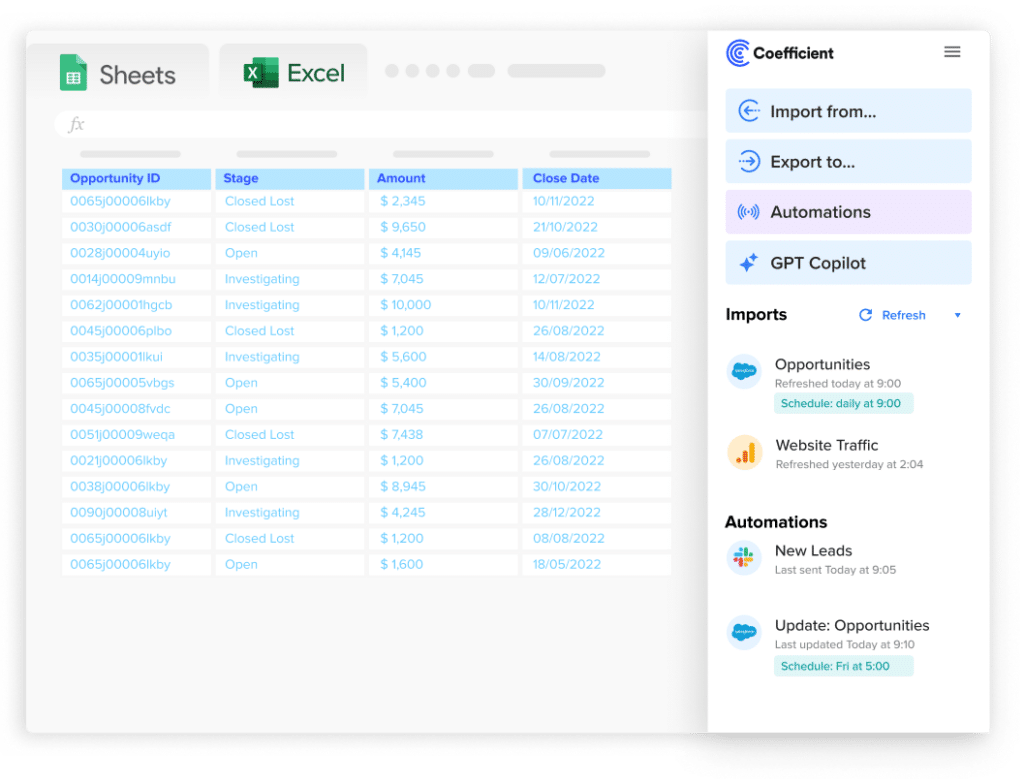
Stop exporting data manually. Sync data from your business systems into Google Sheets or Excel with Coefficient and set it on a refresh schedule.
Get Started
But “free” doesn’t account for time cost. The 2,000-row limit forces manual exports for larger datasets. The 4-hour refresh delay means stale data. The one-way sync requires duplicate data entry.
Time cost example:
- Manual exports for data beyond 2,000 rows: 2 hours/week
- Waiting for delayed refreshes: 3 hours/week
- Manually syncing cleaned data back to Salesforce: 2 hours/week
- Total: 7 hours/week per user
At $50/hour (conservative analyst rate), that’s $350/week or $18,200/year in lost productivity per user. The “free” tool has hidden costs.
Coefficient pricing

Coefficient uses seat-based pricing with three tiers:
| Plan | Monthly Cost | Key Features | Best For |
| Free | $0 | 2 imports, manual refresh, 50 rows | Testing |
| Starter | $59 | Unlimited imports, scheduled refresh, 10K rows | Individual users |
| Pro | $119 | Two-way sync, snapshots, alerts, 50K rows | Teams and power users |
Enterprise pricing available for large organizations requiring SSO, advanced security, and dedicated support.
Annual cost comparison (single user):
- Native connector: $0 subscription + $18,200 time cost = $18,200 total
- Coefficient Pro: $1,428 subscription + minimal time cost = $1,428 total
The paid tool saves 10x its cost in recovered productivity.
Value calculation
The decision comes down to opportunity cost. What could your team accomplish with 7 extra hours per week?
- Close more deals
- Analyze deeper trends
- Build better forecasts
- Support more customers
Coefficient eliminates manual workarounds so you can focus on work that drives revenue.
Coefficient vs Salesforce Data Connector: Support and resources
Customer support
Salesforce Data Connector has no dedicated support team. You submit a ticket to general Salesforce support and wait 2-3 days for a response. Community forums contain unanswered questions about sync failures and data limitations.
Coefficient provides:
- Live chat support – Average response time under 2 hours
- Email support – Same-day responses
- Knowledge base – Step-by-step guides and video tutorials
- Template library – Pre-built reports for common use cases
Data specialists who understand both Salesforce and Google Sheets handle support requests. They can troubleshoot queries, suggest optimizations, and help build complex reports.
Documentation quality
| Aspect | Salesforce Data Connector | Coefficient |
| Setup guides | Basic configuration only | Comprehensive with screenshots |
| Troubleshooting | Minimal | Common issues + solutions |
| Best practices | None published | Updated monthly |
| Video tutorials | Not available | Full library |
The native connector’s documentation covers basic setup but provides little help for troubleshooting or optimization. Coefficient maintains current documentation with real-world examples.
Onboarding
Salesforce Data Connector offers no onboarding. You configure it yourself using sparse documentation.
Coefficient includes:
- Guided setup wizard
- Pre-built templates for common reports
- Proactive tips based on your use case
- Optional onboarding call for team plans
Coefficient vs Salesforce Data Connector: Security and compliance
Authentication and encryption
Both tools use OAuth authentication through Google’s standard flow. Neither requires storing Salesforce credentials separately.
Both encrypt data in transit using TLS. Data at rest in Google Sheets uses Google’s standard encryption.
Enterprise security features
Salesforce Data Connector relies on Google Sheets’ native security. No additional security layer exists.
Coefficient adds enterprise features:
| Feature | Description |
| SSO integration | Okta, Azure AD, Google Workspace |
| Audit logs | Track all data access and exports |
| Field-level encryption | Additional protection for sensitive data |
| Row-level permissions | Respect Salesforce sharing rules |
| PII detection | Automatic identification of sensitive fields |
Compliance certifications
| Certification | Salesforce Data Connector | Coefficient |
| SOC 2 Type II | Inherits from Salesforce | Independent certification |
| GDPR | Covered by Salesforce | Compliant with documentation |
| HIPAA | Not certified | Available for Enterprise |
Coefficient maintains independent security certifications and provides documentation to support enterprise security reviews.
The final verdict
Choose Salesforce Data Connector if you:
- Have fewer than 2,000 total records
- Update reports once per day or less frequently
- Need read-only data viewing
- Never need to push updates back to Salesforce
- Use only Salesforce (no other data sources)
This describes very small teams with minimal reporting needs.
Choose Coefficient if you:
- Have more than 2,000 records in any object
- Need hourly or faster refresh rates
- Want to update Salesforce from spreadsheet edits
- Combine Salesforce with other data sources
- Build automated workflows with alerts and distribution
- Value your team’s time at more than $59/month
This describes most growing companies with active sales teams.
Decision framework
The native connector has three hard limits. If you hit any of them, you cannot use the tool:
| Limitation | Affects You If… |
| 2,000-row limit | Any Salesforce object exceeds 2,000 records |
| 4-hour minimum refresh | You need current data for same-day decisions |
| One-way sync only | You update or clean data in spreadsheets |
Most teams hit at least one limit. Coefficient removes all three.
Start with Coefficient today
Coefficient connects Salesforce to your spreadsheets in minutes. Import unlimited data, refresh hourly, and sync changes back automatically.
Get started with the free plan. Connect Salesforce and see the difference immediately.