Choosing the wrong data integration platform for your finance team doesn’t just slow you down—it fundamentally limits what your business can achieve with its data.
While both Coefficient and Liveflow promise to end your CSV export nightmare, they take radically different approaches. Coefficient connects 100+ business systems to your spreadsheets, including robust financial consolidation capabilities that rival specialized tools. Liveflow focuses exclusively on multi-entity financial reporting—but forgets the fact that seeing the full picture of your business requires more than just data from your finance systems.
Here’s the surprising truth: Coefficient handles 90% of what Liveflow does for financial reporting, plus serves big picture strategic thinking with data from any system so you can see the full picture. Why pay premium prices for a single-purpose tool when you can get nearly identical financial features plus comprehensive business intelligence?
- Coefficient vs Liveflow: Core Differences
- Coefficient vs Liveflow: Integration Ecosystem
- Coefficient vs Liveflow: Features and Functionality
- Coefficient vs Liveflow: Pricing Comparison
- Coefficient vs Liveflow: User Experience
- Coefficient vs Liveflow: Customer Support
- The Verdict: Why Coefficient Wins for Most Businesses
- Ready to Get More Than Just Financial Consolidation?
Coefficient vs Liveflow: Core Differences
Here’s the fundamental question you need to answer: Do you want a platform that handles most of your financial consolidation needs plus everything else, or one that handles every possible financial edge case but nothing more?
What is Coefficient?
Think of Coefficient as the central hub for your business data. It transforms your spreadsheets into a command center with data synced data from every department and business system. Where multiple finance, sales, marketing, operations data coexists and interacts. With an overall G2 rating of 4.8 out of 5 stars, users praise its versatility and power.
You can consolidate financial data from multiple QuickBooks accounts, but you can also place that data alongside your sales pipeline from Salesforce and marketing spend from Google Ads. This is Coefficient’s core value proposition: providing a 360-degree view of your business.
This isn’t just a hypothetical benefit. Take SolvHealth, for example. They leveraged Coefficient to automate their accounting close process, creating a single source of truth for financial reporting. The result? They saved “at least a full day of work each month.” This is the power of a unified data platform in action.

Alt text – How Solv saved 364 Hrs using Coefficient for Accounting Efficiency
What is Liveflow?
Liveflow takes an entirely different philosophy. Instead of trying to serve multiple needs, it’s chosen to perfect one specific thing: multi-entity financial consolidation with every conceivable bell and whistle you can think of with the learning curve of a new platform.
If you’re managing financial data across multiple subsidiaries with complex elimination requirements, minority interests, and sophisticated currency hedging scenarios, Liveflow speaks your language fluently. They’ve built features for financial edge cases that most businesses will never encounter—automated consolidation journals for 20+ entities, complex ownership structures with multiple tiers, specialized regulatory reporting formats.
But that laser focus comes with massive trade-offs. Liveflow has essentially built a Ferrari that can only drive to one destination. Meanwhile, you’re still manually exporting CSVs from sales CRMs, data warehouses, payment systems, and ads platforms to track other finance data in separate silos.
Coefficient vs Liveflow: Integration Ecosystem
Let’s address the elephant in the room: while Liveflow goes deep on financial systems, Coefficient goes deep on financial systems AND everything else, eliminating data silos and giving you the full picture of your business.
Coefficient Integrations: 100+ Business Systems
Alt text – List of Integrations in Coefficient.io
Here’s what most comparisons miss: Coefficient’s 2-way QuickBooks integration is remarkably advanced. You can connect multiple QuickBooks accounts, consolidate data across entities, handle multi-currency transactions, and build most of the financial reports Liveflow produces. The difference? You’re also connected to everything else.
Pull Advanced reports & metrics from Finance systems: Connect multiple QuickBooks Online accounts simultaneously. Pull data from different entities, apply consolidation rules using familiar spreadsheet formulas, and generate consolidated financial statements. Yes, you can create variance analyses and rolling forecasts. Coefficient also connects to Stripe, Chargebee, Xero, NetSuite, and other finance platforms.
Universal Data Connector for your Spreadsheets: Here’s where Coefficient leaves Liveflow in the dust. Your consolidated P&L can sit next to real-time sales pipeline data from Salesforce. Your cash flow forecast can incorporate marketing spend from Google Ads and projected revenue from your CRM. Your board report can include operational KPIs from Jira, customer satisfaction scores from Zendesk, and headcount data from your HRIS—all updating automatically.
360o Data Access: When a board member asks why revenue is down, Liveflow can show you the consolidated numbers. Coefficient can show you the numbers AND the marketing campaigns that underperformed, the sales deals that slipped, and the customer churn that accelerated—all in the same report.
Liveflow Integrations: Financial Systems Only
Liveflow’s QuickBooks Online integration is admittedly impressive. Every financial nuance, every custom field, every specialized report comes through perfectly. They handle complex consolidation scenarios—multiple reporting currencies, minority interests, complex ownership structures—with genuine sophistication.
But that’s where the story ends. No CRM connections. No marketing data. No operational metrics. If you want to understand what’s driving your financial results, you’ll need another platform. And another subscription. And another implementation project.
Coefficient vs Liveflow: Features and Functionality
Features are where the “depth vs. breadth” narrative falls apart. Coefficient matches most of Liveflow’s financial features while adding capabilities Liveflow can’t touch.
Coefficient Features: Financial Depth Plus Everything Else
Multi-Entity Financial Consolidation That Works Here’s something that might surprise you: Coefficient handles multi-entity consolidation remarkably well. Connect multiple QuickBooks accounts, map your chart of accounts, define consolidation rules, and watch as consolidated statements generate themselves.
You can create consolidation adjustment entries, eliminate inter-company transactions, and generate every financial statement you need.
AI-Powered Financial Intelligence This is where Coefficient completely outclasses Liveflow. Get Coefficient’s AI Assistant help in Google Sheets to “create a consolidated P&L with variance analysis” and it doesn’t just pull the data, it helps you build the entire report, applies the consolidation rules, calculates variances, and even suggests areas of concern while you just give instructions in simple english.
Cross-Functional Financial Analysis Want to see how marketing spend impacts EBITDA? How sales pipeline velocity affects cash flow? How operational efficiency drives gross margins? Coefficient makes these analyses trivial because all your data lives in one place. Liveflow can’t even attempt this—it literally doesn’t have access to the data.

Alt text – Connecting Stripe, Salesforce, Quickbooks data in Sheets using Coefficient
Bidirectional Sync for Everything Update consolidated budgets and push them back to individual entities. Modify forecast assumptions and sync them across systems. This works for financial data AND operational data. Liveflow’s sync is one-way only—always pulling, never pushing.

Alt text – Exporting finance data back to QuickBooks from Excel using Coefficient
Liveflow Features: Specialized but Limited
Advanced Consolidation Edge Cases To be fair, Liveflow does excel at complex financial edge cases. If you’re dealing with partial acquisitions, complex minority interest calculations, or specialized regulatory reporting requirements.
Standardized Financial Templates Liveflow provides more complex out-of-the-box financial statement formats. If you need ASC 842 lease accounting templates or specific GAAP consolidation workflows, they’re ready to go. Coefficient also has pre-built financial templates but for more common dashboards and reports.
Coefficient vs Liveflow: Pricing Comparison
Let’s talk about what you’re really paying for with each platform.
Coefficient Pricing: Comprehensive Value

Alt text – Coefficient Pricing
When you understand that Coefficient delivers 90% of Liveflow’s financial capabilities plus complete business intelligence, the pricing difference becomes almost comical.
Free Plan: Three data sources—including QuickBooks Online for basic consolidation testing. You can literally test multi-entity consolidation for free. Liveflow charges $8,500 minimum before you can even try it.
Starter Plan ($49/month): This handles most SMB consolidation needs. Connect your QuickBooks entities, create consolidated reports, automate the process. For less than Liveflow’s implementation fee alone, you get a year of comprehensive business intelligence.
Pro Plan ($99/user/month): Full financial consolidation capabilities, hourly refresh for real-time reporting, advanced automation. Most mid-size companies find everything they need here—including sophisticated multi-entity consolidation that Liveflow charges $500+/month to deliver.
Liveflow Pricing: Premium for Diminishing Returns
Alt text – LiveFlow Pricing Page
First of all, they don’t share their pricing plans publicly on their site and you’re expected to talk to a sales person. When you realize Liveflow only marginally improves on what Coefficient already does for financial consolidation while offering a little bit more, their pricing might seem excessive for you. Based on the web, here’s pricing range of Liveflow
- Monthly minimum: Around $500 (10x Coefficient’s Starter plan)
- Required implementation: Around $2,500 (for features Coefficient provides self-service)
- First-year minimum: Around $8,500 (enough to buy Coefficient Pro for 7 users)
- No free trial (because the value proposition falls apart when compared directly)
You’re paying premium prices for that last 5-10% of specialized financial features that most businesses never use, while sacrificing access to all other business data.
Coefficient vs Liveflow: User Experience
The best features don’t matter if people won’t use them. Let’s explore what daily life looks like with each platform.
Coefficient User Experience: Familiar and Powerful

Alt text – Live Coefficient QuickBooks Dashboard
Caption – Live Coefficient QuickBooks Dashboard
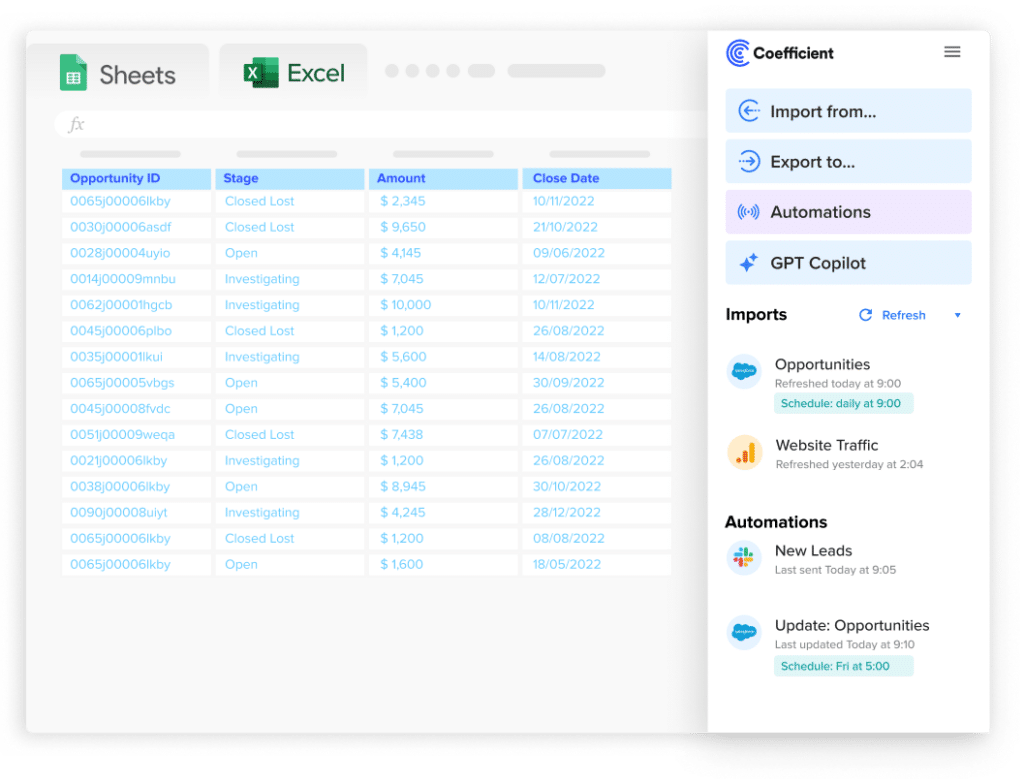
Stop exporting data manually. Sync data from your business systems into Google Sheets or Excel with Coefficient and set it on a refresh schedule.
Get Started
There’s something beautiful about achieving complex financial consolidation in a spreadsheet you already understand. You’re using SUMIFS to consolidate entities, VLOOKUP to map accounts, and pivot tables to summarize results. Yes, you’re doing sophisticated financial reporting—but with tools you’ve mastered over years.
The learning curve for financial consolidation in Coefficient is whatever time it takes to understand your consolidation rules. If you can explain your consolidation logic, you can build it in Coefficient using formulas you already know. One controller told us: “I thought I needed specialized software for consolidation until I realized it’s just math—and Excel is really good at math.”
Liveflow User Experience: Powerful but Isolating
Liveflow is undeniably powerful for financial consolidation, but it creates a new silo. Your finance team learns a specialized platform that no one else in the organization can access or understand.
The platform requires specialized training for not just the software, but on their specific approach to consolidation. It’s basically mandatory training because the platform is too complex to figure out yourself.
Coefficient vs Liveflow: Customer Support
When dealing with critical financial and business data, the quality and nature of customer support are paramount. Both Coefficient and Liveflow are highly rated, but they offer different support models that cater to different user needs.
Coefficient: A Multi-Layered Support Ecosystem
Coefficient structures its support around user enablement, offering multiple avenues for assistance. This approach is designed to provide quick answers while also empowering users to become self-sufficient.
- Fact-Based Performance: Coefficient earns a 9.9 out of 10 for Quality of Support on G2. This high rating is backed by users who praise the team’s responsiveness and resourcefulness. One G2 review notes, “The support team is incredible…They are very responsive and were even willing to jump on a quick call to help me troubleshoot an issue.”
- Resource-Driven Support: Beyond direct support, Coefficient maintains a comprehensive Help Center and an active Slack Community where users can get help from peers and the Coefficient team.
- Proven Customer Success: This support model helps customers achieve significant efficiency. For example, SolvHealth automated their accounting close process with Coefficient, saving “at least a full day of work each month” by building a single source of truth for financial reporting directly in their spreadsheets.
Liveflow: High-Touch, Dedicated Assistance
Liveflow’s support is characterized by a more hands-on, dedicated approach, which users find essential for navigating the platform’s specialized functionalities.
- Fact-Based Performance: Liveflow also receives excellent marks for support, with a 9.8 out of 10 for Quality of Support on G2. Reviewers frequently highlight the value of having a dedicated customer success manager.
- Hands-On Guidance: Users consistently praise the team’s availability. As one G2 reviewer states, “…whenever we have issues we chat with customer support and they always hop on a Zoom call with us which is much appreciated when working against a deadline.” This high-touch model is often cited as crucial for initial setup and handling complex consolidation scenarios within the platform.
Both platforms provide world-class support. The key difference lies in the philosophy: Coefficient provides a comprehensive ecosystem of tools and community resources aimed at user empowerment, while Liveflow offers a dedicated, hands-on support model essential for its specialized and complex platform.
Coefficient vs Liveflow: Which Should You Choose?
After comparing every angle, including the crucial financial consolidation capabilities, the choice becomes even clearer.
Choose Coefficient If:
You want professional financial consolidation without the enterprise price tag. Coefficient handles multi-entity consolidation, cashflow forecasting, and financial reporting at a level that satisfies most CFOs. Unless you’re dealing with extremely complex ownership structures or specialized regulatory requirements, Coefficient’s financial capabilities are more than sufficient.
You understand that financial data needs context. Numbers without narrative are just digits. When your consolidated P&L sits next to pipeline data, marketing metrics, and operational KPIs, you don’t just see what happened—you understand why.
You value solutions that grow with you. Start with financial consolidation, add sales analytics next quarter, integrate marketing data next year. Coefficient grows with your needs rather than locking you into a single use case.
Choose Liveflow Only If:
You have extremely complex consolidation requirements. If you’re dealing with 20+ entities, multi-tiered ownership structures, complex minority interests, and specialized regulatory reporting, Liveflow’s edge cases might matter. But ask yourself: do you really need those features, or are you paying for complexity you’ll never use?
You’re willing to maintain data silos. If you’re comfortable with finance having their platform while everyone else continues exporting CSVs, Liveflow works. But in an era where data silos kill companies, this seems shortsighted.
Budget is genuinely of no concern. If you can afford to spend heavily for a single-purpose tool when a $99 alternative does 80%-90% of the same thing plus infinitely more in other aspects, perhaps the premium is worth it for that last 10%.
The Verdict: Why Coefficient Wins for Most Businesses
When you can achieve 80-90% of Liveflow’s core functionality for 10% of the price while also getting a comprehensive stage to set up your business intelligence, the choice is obvious. You’re not compromising on financial features, you’re refusing to compromise on everything else.
The real question isn’t whether Coefficient can handle your financial consolidation. It’s whether you want financial consolidation in isolation or as part of a comprehensive data strategy.
Ready to Get More Than Just Financial Consolidation?
Your finance team deserves powerful consolidation tools that work across different systems.
Stop settling for specialized tools that solve one problem while ignoring ten others. Stop creating new data silos in the name of solving old ones.
Coefficient brings financial consolidation to spreadsheets you already love, plus connections to every other system that matters. One platform, one price, infinite possibilities.
Get started with Coefficient today—free to try, powerful enough for complex consolidation, comprehensive enough for your entire organization.
Because the best financial reporting doesn’t just show you the numbers. It shows you the complete story behind them.