If you’re reading this, you’ve probably reached that moment of clarity: manually exporting QuickBooks reports into spreadsheets every single month is not a sustainable strategy. You’ve already accepted that you need a tool to automate financial reporting in Google Sheets. Now comes the harder question—which one?
Both Coefficient and G-Accon promise to connect your accounting data to Google Sheets automatically, saving hours on financial reporting. They both offer two-way sync, multi-entity consolidation, and automated refresh capabilities. On the surface, they might seem similar.
But here’s what sets them apart: G-Accon is laser-focused on accounting workflows, connecting 5-6 accounting systems with deep integration quality. Coefficient connects those same financial systems plus 70+ other business platforms—from Salesforce to Snowflake to Google Ads—enabling finance teams to build reports that combine P&L data with sales pipeline forecasts, marketing spend, and operational metrics in one place.
This comparison will help you understand which tool matches your actual needs: a specialized accounting-only platform or a comprehensive data connector that starts with finance but extends across your entire business.
- Coefficient vs G-Accon: Core differences
- Coefficient vs G-Accon: Integration capabilities
- Coefficient vs G-Accon: Key features
- Coefficient vs G-Accon: User experience
- Coefficient vs G-Accon: Pricing comparison
- Coefficient vs G-Accon: Customer support
- Coefficient vs G-Accon: Real-world use cases
- The verdict: Finance first, not finance only
- Transform your financial reporting today
Coefficient vs G-Accon: Core differences
The fundamental difference comes down to specialization versus extensibility. Both platforms excel at connecting accounting data to spreadsheets. The question is whether your finance team needs only accounting data or something more comprehensive.
What is G-Accon?

G-Accon has built their entire platform around one promise: become the “#1 Google Sheets Platform for Financial Reporting & Automation Built for Accountants & Finance Teams.” And they’ve largely succeeded at that mission.
Their QuickBooks integration is genuinely impressive. Every transaction detail, custom field, and specialized accounting report comes through with remarkable fidelity. They’ve earned Platinum Intuit Partner status—the highest recognition QuickBooks offers—which reflects the quality of their integration work. The same depth applies to their Xero connector, where they hold Premium Partner status.
G-Accon excels at multi-entity consolidation, a critical capability for organizations managing multiple QuickBooks or Xero organizations. They automatically handle:
- Chart of account mapping across entities
- Currency conversion for 170+ currencies
- Complex intercompany eliminations
One customer, Michael King (CFO at KFE Solutions), calls it “the most valuable, the most effective, the highest ROI we have on any of our tech platforms” and says it saves them 40 hours per month. For pure accounting workflows, G-Accon has thought through the details.
They’ve built robust two-way sync that doesn’t just pull data from accounting systems but pushes updates back. Need to bulk-edit 200 invoice records? Make changes in Google Sheets and sync them back to QuickBooks. This bidirectional capability closes the loop on accounting workflows.
The platform offers 100+ pre-built accounting templates designed specifically for financial reporting—profit and loss statements, balance sheets, cash flow analysis, and revenue recognition schedules.
G-Accon’s specialization creates a critical trade-off: they only connect to accounting systems. Their complete list includes QuickBooks, Xero, FreshBooks, Sage, and Xero Practice Manager. That’s it. If you want to understand what’s driving your financial results—why revenue dropped, which marketing campaigns underperformed, which sales territories are struggling—you need to export data from other systems manually or purchase additional tools.
What is Coefficient?

Coefficient started with a different question: What if finance teams could access all their business data in one place, not just accounting systems?
The result is a platform that connects 70+ business systems directly to Google Sheets and Excel, including robust integrations with QuickBooks, NetSuite, Xero, and Sage Intacct. But Coefficient extends far beyond finance into Salesforce for sales data, HubSpot for pipeline forecasts, Google Ads for marketing analytics, and Snowflake for data warehouse connections.
Coefficient focuses on making spreadsheets as powerful as dedicated BI tools. Serving 50,000+ companies and 500,000+ users, Coefficient has earned an overall G2 rating of 4.7 out of 5 stars, plus Best Relationship and Fastest Implementation awards.
Take Christian Budnik at Solv as an example.
His FP&A team needed to combine QuickBooks financial data with Salesforce pipeline metrics and Looker analytics. Using Coefficient, they connected all three systems to Google Sheets with automatic refreshes, creating unified dashboards that gave leadership real-time visibility across finance, sales, and operations.

The result? They saved 364 hours per year—52 hours per analyst across seven team members.
The philosophy is fundamentally different:
- G-Accon says: “We’ll give you the deepest possible accounting integration and nothing else”
- Coefficient says: “We’ll give you excellent financial integration plus connections to every other system that drives your business”
Coefficient vs G-Accon: Integration capabilities
This is where the most significant gap exists between these platforms.
G-Accon: Deep but narrow
G-Accon connects to 5-6 accounting platforms with admittedly deep integrations. They capture every financial nuance, support complex multi-entity scenarios, and maintain excellent data quality. They’ve invested heavily in making these accounting connections best-in-class.
| Integration Type | Available Systems |
| Accounting Platforms | QuickBooks Online (Platinum Partner), Xero (Premium Partner), FreshBooks, Sage Cloud Accounting, Xero Practice Manager |
| CRM Systems | None |
| Marketing Platforms | None |
| Databases/Warehouses | None |
| Operational Tools | None |
| Total Integrations | 5-6 systems |
This creates silos. Your finance team works in G-Accon with accounting data. Your sales team works separately with CRM exports. Marketing manually pulls campaign data. When the CFO asks to see a unified dashboard combining P&L trends, pipeline forecasts, and marketing spend—impossible without extensive manual work.
Coefficient: Financial depth plus breadth
Coefficient takes a different approach: robust financial integration plus comprehensive business system connectivity.
| Integration Category | Available Systems |
| Finance & Accounting | QuickBooks (Online and Desktop), NetSuite, Xero, Sage Intacct, Stripe, Chargebee, Zoho Books, Square |
| CRM & Sales | Salesforce (with two-way sync), HubSpot (with two-way sync), Pipedrive, Zoho CRM |
| Marketing Platforms | Google Ads, Facebook Ads, LinkedIn Ads, Instagram Insights, Pinterest Ads, Mailchimp, ActiveCampaign |
| Databases & Warehouses | Snowflake (with two-way sync), MySQL (with two-way sync), PostgreSQL (with two-way sync), BigQuery, Redshift, MongoDB |
| Operations & Project Management | Jira, Asana, ClickUp, Zendesk, Intercom |
| Total Integrations | 70+ systems |
The strategic value becomes clear when you consider real use cases:
Revenue forecasting: When forecasting Q4 revenue, you need current P&L data from QuickBooks AND weighted pipeline data from Salesforce. Coefficient connects both systems into a single Google Sheet. G-Accon can only pull the QuickBooks data—you’re left manually exporting Salesforce.
Marketing ROI: When calculating marketing ROI, you need ad spend from Google Ads and closed revenue from your accounting system. Coefficient connects both. G-Accon forces you to export Google Ads data manually and reconcile it separately.
Executive dashboards: When building executive dashboards, you need P&L trends (QuickBooks), sales pipeline velocity (Salesforce), marketing performance (Google Ads), and customer support metrics (Zendesk). Coefficient enables this unified view. G-Accon provides only the P&L data.
One platform connects 70+ systems across your entire business. The other connects 5 accounting systems. For finance teams that live exclusively in accounting software, G-Accon’s narrow focus works fine. For teams that need broader visibility—which increasingly describes modern finance—Coefficient’s extensibility becomes essential.
Coefficient vs G-Accon: Key features
Both platforms offer robust features for financial reporting, but they diverge significantly in scope and approach.
Multi-entity consolidation capabilities
This is where G-Accon truly shines—and where the comparison gets interesting.
G-Accon’s strength: Their multi-entity consolidation is sophisticated and purpose-built. Jake Russell, Co-Founder at Goodbrother, calls it “a swiss army knife of accounting, reporting, automation, and dashboards.” The platform automatically handles:
- Chart of account mapping
- Intercompany eliminations
- Multi-currency conversion across 170+ currencies
For accounting firms managing 25+ client organizations, G-Accon’s native workflows save substantial time.
Coefficient’s approach: Coefficient handles multi-entity consolidation through parallel imports and spreadsheet formulas. You connect multiple QuickBooks accounts simultaneously, pull financial data into worksheets, and map accounts using standard spreadsheet functions. You create elimination entries using formulas you control and generate consolidated statements using templates you design.
Is this as automated as G-Accon’s one-click consolidation? No—you’re building the logic yourself using familiar spreadsheet functions. But for finance teams comfortable with Excel or Google Sheets, this flexibility is actually powerful. You can implement any consolidation methodology your business requires without being constrained by platform-specific workflows.
Two-way sync and data write-back
The platforms take fundamentally different approaches to bidirectional data flow.
| Feature | G-Accon | Coefficient |
| Accounting Systems Sync | Full two-way for all 5 systems | One-way read for QuickBooks/Xero |
| CRM Systems Sync | Not available (no CRM connections) | Two-way for Salesforce and HubSpot |
| Database Sync | Not available (no database connections) | Two-way for Snowflake, MySQL, PostgreSQL |
| Bulk Editing | Edit accounting records in Sheets, push back | Edit CRM/database records in Sheets, push back |
For pure accounting workflows that require writing data back to QuickBooks, G-Accon’s approach is more comprehensive. For cross-functional workflows that involve updating CRM records or database tables, Coefficient’s two-way sync covers different (and arguably more strategic) use cases.

AI-powered capabilities
This is where Coefficient pulls ahead dramatically.
Coefficient’s AI Sheets Assistant doesn’t just import data—it helps you analyze it. Ask it to “Build me a P&L dashboard from QuickBooks with variance analysis” and it generates the report structure, applies formulas, and creates visualizations. The AI:
- Writes SQL queries for database connections
- Builds pivot tables and generates charts
- Creates complex formulas without manual coding
The SQL Builder is particularly powerful: describe what data you need in plain English, and it generates optimized queries. No SQL expertise required.
G-Accon’s AI capabilities: G-Accon doesn’t mention AI capabilities in their product marketing, focusing instead on accounting automation rather than AI-powered analysis. For finance teams wanting faster report building and data analysis, this represents a meaningful capability gap.
Platform support and templates
| Feature | G-Accon | Coefficient |
| Platform Support | Google Sheets only | Google Sheets AND Excel |
| Pre-Built Templates | 100+ accounting-specific templates | Extensive library covering finance, sales, marketing, operations |
| Template Focus | Deep accounting (P&L, balance sheets, cash flow) | Broader business (QuickBooks dashboards, Salesforce forecasting, ad performance) |
Many finance professionals have spent decades mastering Excel and don’t want to switch to Google Sheets exclusively. Coefficient accommodates both preferences, while G-Accon forces a Google Sheets-only workflow.
Coefficient vs G-Accon: User experience
How you interact with these platforms day-to-day differs substantially.
G-Accon: Accounting-first interface
G-Accon provides a sidebar interface within Google Sheets specifically designed for accounting workflows. The interface guides you through connecting accounting systems, selecting reports, configuring multi-entity consolidation, and setting refresh schedules.
For accountants and bookkeepers, the terminology and workflow feel native. You’re selecting accounts, classes, departments—all the financial dimensions you work with daily. The learning curve is minimal if you understand accounting concepts.
Customer reviews highlight that setup requires some initial training, particularly for complex multi-entity scenarios. But G-Accon offers white-glove support to help customers through implementation.
Coefficient: Spreadsheet-native experience
Coefficient works inside Google Sheets and Excel as a sidebar panel, but it’s designed for data connection rather than accounting-specific workflows. You select a data source (QuickBooks, Salesforce, Snowflake), choose what data to import, apply filters, and data populates your spreadsheet.

Live Coefficient QuickBooks Dashboard
The interface is simpler and more general-purpose because it serves 70+ different systems, not just accounting software. You’re not navigating accounting-specific terminology—you’re selecting objects and fields from whatever system you’re connecting.
For finance teams already comfortable with spreadsheets, Coefficient’s approach feels natural. You’re just adding live data feeds to spreadsheets you already know how to build.
Plus, Coefficient offers an active Slack community for users to get inspiration from!
Coefficient vs G-Accon: Pricing comparison
Let’s talk about cost, because price matters when evaluating tools.
G-Accon pricing structure

G-Accon uses per-product, per-month pricing. Each accounting integration requires a separate subscription.
| Tier | Annual Price | Monthly Price | Companies | Users |
| Business | $50/month | $60/month | Up to 3 | 1 |
| Accountant | $125/month | $150/month | Up to 25 | 5 |
| Advisor | $250/month | $300/month | Up to 50 | 10 |
| Enterprise | $375/month | $450/month | Up to 250 | Unlimited |
Key consideration: The per-product model means if you need both QuickBooks and Xero connections, you’re paying for two separate subscriptions. For accounting firms managing multiple client accounting systems, costs scale with company count rather than user count.
Coefficient pricing structure

Coefficient uses transparent per-user pricing with all integrations included.
| Plan | Price | Users | Data Sources | Key Features |
| Free | $0 | 1 | 3 | Basic features, manual refresh |
| Starter | $49/month | 1 | 5 | Daily auto-refresh |
| Pro | $99/user/month | Up to 10 | 6 per user | Hourly auto-refresh, unlimited rows, shared connections |
| Enterprise | Custom | Unlimited | Unlimited | Custom SSO, dedicated support |
Key difference: Coefficient’s pricing includes ALL 70+ integrations in one subscription. Connect QuickBooks, Salesforce, Google Ads, Snowflake, and Jira—same price. You’re not paying separately for each system.
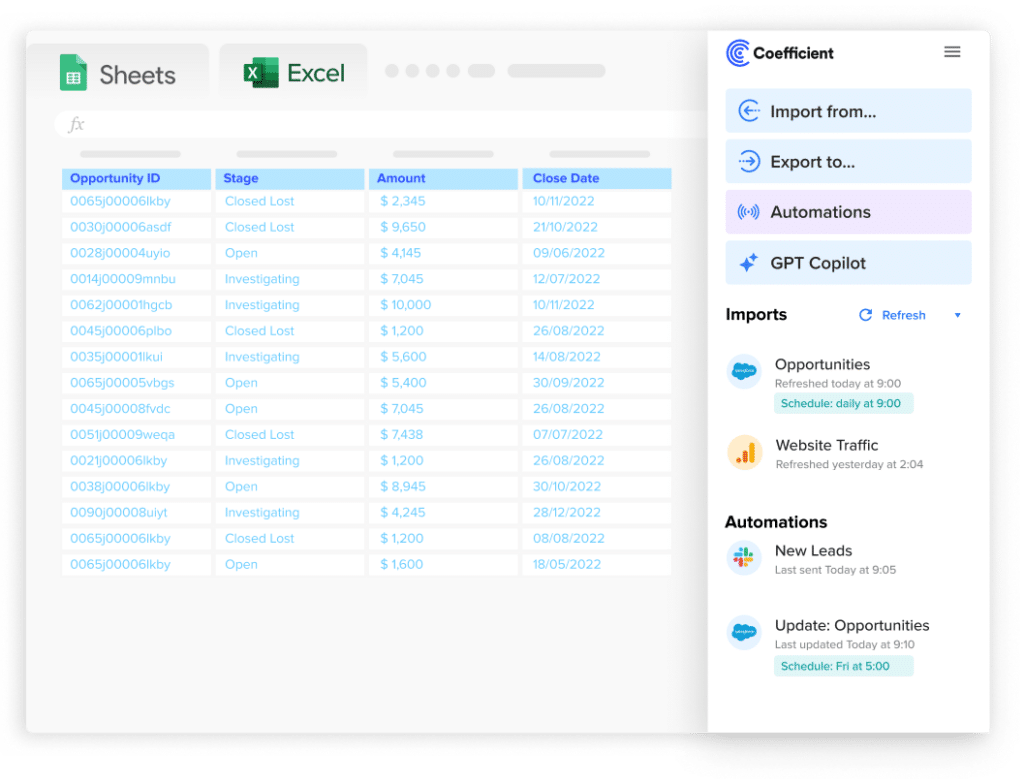
Stop exporting data manually. Sync data from your business systems into Google Sheets or Excel with Coefficient and set it on a refresh schedule.
Get Started
Value analysis
For a single user needing QuickBooks reporting, both platforms start around $49-50/month. But if you want to add Salesforce data or Google Ads metrics, Coefficient costs the same. G-Accon can’t connect those systems at any price.
G-Accon provides better value for:
- Accounting firms managing many companies (25+) under one subscription
- Teams who only need accounting data
- Users who use Google Sheets exclusively
Coefficient provides better value for:
- Teams needing accounting data plus other business systems
- Platform flexibility (Sheets + Excel)
- Cross-functional reporting capabilities
Coefficient vs G-Accon: Customer support
Both platforms recognize that implementation support matters.
G-Accon support approach
G-Accon emphasizes white-glove support with 30-second average response times (claimed), dedicated onboarding assistance, and regular training webinars for accounting firms. Customer reviews consistently praise support quality, noting that G-Accon’s team helps with complex consolidation scenarios and troubleshooting.
For customers implementing sophisticated multi-entity workflows, this hands-on support is valuable.
Coefficient support approach
Coefficient provides a 9.9/10 support quality rating on G2, responsive email and live chat, comprehensive help center and documentation, and video tutorials for each integration. Enterprise customers receive dedicated success managers.
The support philosophy differs: Coefficient enables self-sufficiency through excellent documentation and intuitive design. G-Accon provides more hands-on guidance for complex implementations.
Marcelle Ehlers, Head of Digital Marketing, notes: “Absolutely STUNNING! The hourly schedule option for imports means I don’t have to manually build out reports. It’s so good.”
Coefficient vs G-Accon: Real-world use cases
Understanding when to choose each tool requires examining concrete scenarios.
When G-Accon makes perfect sense
Scenario 1: Accounting firm managing client books
An accounting practice manages 20 QuickBooks Online clients, generating monthly financial reports and consolidating data for benchmarking. They work exclusively in Google Sheets and never need CRM, marketing, or operational data. G-Accon’s Accountant tier ($125/month) handles up to 25 companies with accounting-specific templates perfectly aligned to their workflow.
Scenario 2: Single-entity finance team with pure accounting needs
A small business finance team manages one QuickBooks Online account, needing automated P&L reports, budget-to-actual comparisons, and cash flow dashboards. They’re comfortable with Google Sheets only and never need sales pipeline, marketing metrics, or operational data. G-Accon’s Business tier ($50/month) provides exactly what they need.
When Coefficient becomes essential
Scenario 1: CFO building executive dashboards
A CFO needs a board-ready dashboard combining:
- P&L actuals from QuickBooks
- Sales pipeline forecast from Salesforce
- Customer acquisition cost from Google Ads + QuickBooks
This unified view is impossible with G-Accon because it only connects QuickBooks. Coefficient connects all five systems into one Google Sheet with automatic refreshes, giving the board a comprehensive performance snapshot.
Scenario 2: FP&A team forecasting revenue
The finance team is building Q4 revenue forecasts. They need:
- Current P&L performance (QuickBooks)
- Weighted sales pipeline (Salesforce)
- Historical win rates (Salesforce)
G-Accon provides only the QuickBooks data. Coefficient provides all four data sources in one place, enabling accurate forecasting without manual exports and data reconciliation.
This is exactly what Christian Budnik at Solv accomplished. By connecting QuickBooks, Salesforce, and Looker through Coefficient, his team saved 364 hours per year and gained real-time visibility into metrics that inform better decision-making.
Scenario 3: Finance team using NetSuite
A mid-market company uses NetSuite for financial management. They need automated financial reporting in spreadsheets. G-Accon doesn’t integrate with NetSuite at all. Coefficient offers NetSuite integration, making it the only viable option in this comparison.
The verdict: Finance first, not finance only
After examining integration capabilities, features, pricing, usability, and real-world applications, here’s the decision framework.
Choose G-Accon if:
You’re an accounting firm managing client books exclusively. If your practice manages 25+ QuickBooks or Xero clients and your work revolves entirely around accounting data, G-Accon’s accounting-firm-specific features (like Xero Practice Manager integration) and per-company pricing model make sense.
You have zero need for non-accounting data. If you’re certain you’ll never need sales forecasts, marketing analytics, operational metrics, or database connections, G-Accon’s narrow focus becomes irrelevant rather than limiting.
You only use Google Sheets and never use Excel. If your organization is Google Workspace exclusive and has no Microsoft 365 users, Coefficient’s Excel support provides no additional value.
Choose Coefficient if:
You need financial data plus broader business context. Modern finance increasingly requires understanding not just what happened (P&L actuals) but why it happened and what’s coming next (pipeline forecasts, marketing performance, operational efficiency). Coefficient connects accounting systems plus 70+ other data sources that provide this strategic context.
You use or plan to use NetSuite. G-Accon doesn’t support NetSuite. If you’re using NetSuite for financial management or considering migrating from QuickBooks, Coefficient is your only option.
You want platform flexibility. If your team uses both Google Sheets and Excel, or if you want the freedom to choose your preferred environment, Coefficient works identically in both platforms.
You’re a growing organization. If you might start with accounting data today but need sales analytics next quarter and marketing ROI analysis next year, choosing Coefficient prevents switching costs. G-Accon will never extend beyond accounting, forcing you to adopt additional tools as needs expand.
Transform your financial reporting today
Your finance team deserves tools that match how modern businesses operate—where financial results connect to sales performance, marketing investment, and operational efficiency in unified dashboards that tell complete stories.
G-Accon built an excellent accounting-only platform for teams that exclusively work with accounting data. If that describes your needs, they’re worth evaluating.
But most finance teams need more. They need to:
- Forecast revenue using CRM pipeline data
- Calculate customer acquisition cost using marketing spend and closed deals
- Build executive dashboards combining financial and operational metrics
Coefficient delivers finance excellence plus cross-functional power. Connect QuickBooks, NetSuite, Xero, or Sage Intacct for robust financial reporting. Then add Salesforce, Google Ads, Snowflake, and Jira—all in the same platform, included in the same subscription, updating automatically in spreadsheets your team already loves.Get started with Coefficient today. Free to try, transparent pricing starting at $49/month, and 70+ integrations that grow with your needs.