Zapier has ruled workflow automation for years, but it’s not the only game in town. Rising costs, limited features, and specific needs push many teams to explore other options.
Smart businesses know that the right automation platform can save hours daily while cutting costs by thousands.
We’ll walk through the top Zapier alternatives, from budget-friendly options to enterprise powerhouses. You’ll discover which platforms fit your team size, budget, and technical skills.
What is Zapier?
Zapier connects over 8,000 apps through simple trigger-action workflows called “Zaps.” When something happens in one app, Zapier triggers an action in another. Think of it as the digital glue between your business tools.
Key Zapier features:
- Connects 8,000+ applications
- Serves 3.4 million businesses globally
- Drag-and-drop interface for non-technical users
- Advanced features for enterprise needs
- Workflows range from simple email automation to complex multi-step processes
Why look for Zapier alternatives?
Cost concerns top the list
Zapier’s task-based pricing can shock teams with high-volume workflows. A single form submission might trigger five actions, using five tasks from your monthly limit.
Speed matters more each day
- Free plan: Checks every 15 minutes
- Paid plans: 1-2 minute intervals
- Alternative platforms: Often offer real-time triggers at lower costs
Feature gaps hurt productivity
Teams need:
- Advanced data transformation capabilities
- Better error handling mechanisms
- Specific integrations Zapier lacks
- Platforms that excel where Zapier falls short
Technical flexibility drives choice
Developers want:
- Custom code capabilities
- Self-hosting options
- Deeper API access
- Open-source alternatives with more control
Top 10 Zapier alternatives
1. Microsoft Power Automate

Best for: Organizations using Microsoft 365 and Azure
Microsoft Power Automate brings automation directly to your Office apps. It connects 1,300+ services with native integration across Teams, SharePoint, and Outlook.
Key strengths:
- Seamless Microsoft ecosystem integration
- AI-powered Copilot assistance
- Desktop flows for robotic process automation (RPA)
- Business process flows for structured workflows
- Serves 56 million users monthly
Pricing:
- Cloud flows: $15 per user monthly
- RPA capabilities: $40 per user monthly
- Per-flow option: $500 monthly for up to 5 automated processes
Best fit: Microsoft-heavy environments with existing Office 365 investments. Teams get instant value from pre-built templates and native connectors.
Limitations: Complex licensing structure and occasional performance issues under heavy load.
2. Make (formerly Integromat)

Best for: Visual learners who need complex workflows
Make transforms automation into a visual experience. Its drag-and-drop scenario builder shows exactly how data flows between apps.
Advanced features:
- Iterator modules: Process lists item by item
- Aggregator modules: Combine data from multiple sources
- Router modules: Create branching logic
- Custom JavaScript functions: Handle unique requirements
- 2,500+ integrations serving 350,000 customers
Pricing:
- Starter: $9 monthly for 10,000 operations
- Free plan: 1,000 monthly credits with 15-minute intervals
- Credits system eliminates per-task limits for complex scenarios
Best fit: Technical users who appreciate visual workflows and European businesses needing GDPR compliance.
Limitations: Steep learning curve for beginners.
3. N8n

Best for: Technical teams wanting full control
n8n delivers open-source automation with zero vendor lock-in. Self-hosted deployments offer unlimited workflows and executions.
Technical flexibility:
- Custom nodes: Extend functionality beyond standard connectors
- HTTP modules: Integrate any REST API
- Database nodes: Connect directly to PostgreSQL, MySQL, MongoDB
- JavaScript customization: Code-level control
- Version control: Git integration for workflow management
Pricing:
- Community edition: Free for self-hosted setups
- Cloud hosting: Starts at $24 monthly
- Infrastructure costs: $300-500 for production environments
- Unlimited usage removes task-based billing concerns
Best fit: Development teams with DevOps capabilities who need maximum flexibility.
Limitations: Requires technical expertise for setup and maintenance.
4. Pabbly Connect

Best for: Cost-conscious small businesses
Pabbly Connect targets SMBs seeking Zapier-level features at lower costs. The platform connects 2,000+ applications with multi-step workflows and real-time triggers.
Value proposition:
- Flat monthly rates: Unlimited automation runs
- Multi-step workflows: Don’t multiply costs
- Real-time triggers: No delays
- Lifetime deals: Eliminate recurring costs
Pricing:
- Basic: $19 monthly for 12,000 tasks
- Premium plans: Add priority support and advanced features
- Lifetime options: One-time payment eliminates subscriptions
- Unlimited workflows across all plans
Best fit: Small businesses wanting predictable costs and unlimited task execution.
Limitations: Lacks enterprise features like advanced governance and audit trails.
5. Workato

Best for: Large enterprises with complex integration needs
Workato serves as an enterprise integration platform (iPaaS) with 1,200+ connectors. It handles both simple automation and complex B2B integrations.
Enterprise features:
- Recipe lifecycle management: Development, testing, production deployments
- Embedded integration platform: Software vendors build automation into products
- Advanced security: Enterprise-grade compliance
- Professional services: Implementation support
- Fortune 500 company adoption
Pricing:
- Custom quotes: Mid-five figures annually
- Implementation: $50,000-$200,000 for complex projects
- Professional services: Ensures successful deployments
Best fit: Large enterprises needing mission-critical workflows and complex B2B integrations.
Limitations: Prohibitive costs for small businesses.
6. IFTTT (If This Then That)

Best for: Personal productivity and IoT automation
IFTTT pioneered consumer automation with simple “if this, then that” logic. The platform connects 1,000+ services with 27 million global users.
IoT integration strengths:
- Smart home devices: Lights, thermostats, security systems
- Location-based triggers: Activate when arriving/leaving
- Consumer services: Social media, weather, news
- Mobile app: iOS and Android support
Pricing:
- Free plan: 3 applets (automations)
- Pro subscription: $5.99 monthly for unlimited applets
- Enterprise plans: Business use cases
- Faster execution on paid plans
Best fit: Personal users and smart home enthusiasts seeking simple automation.
Limitations: Limited business features beyond basic trigger-action pairs.
7. Integrately

Best for: Quick setup with pre-built automations
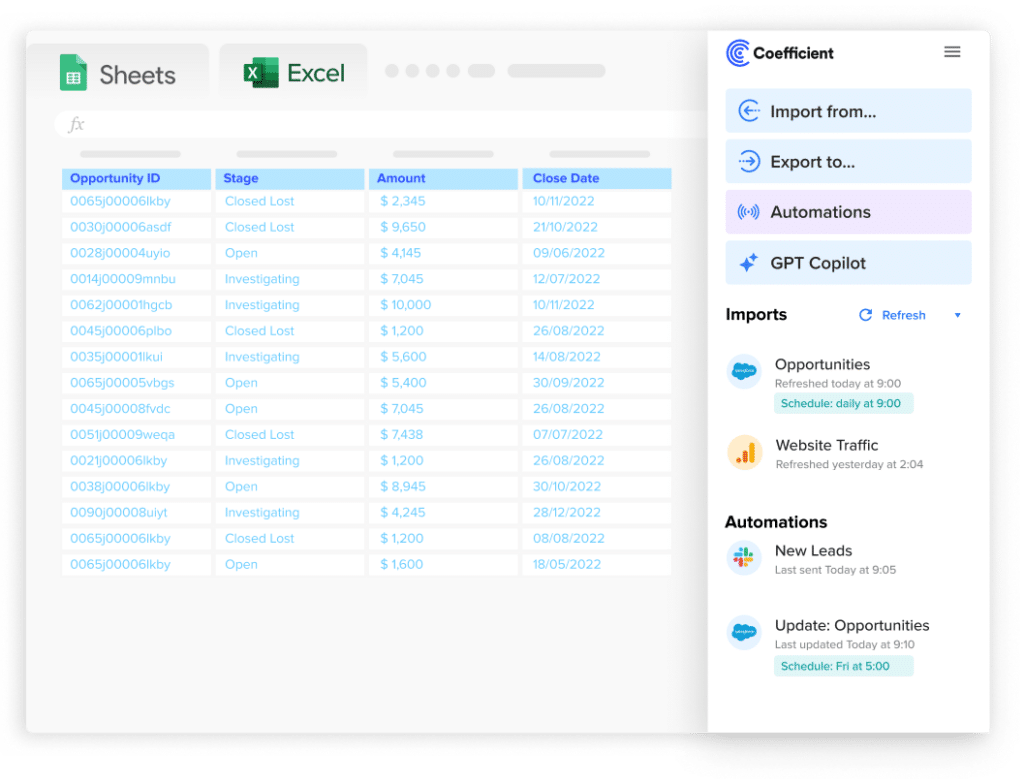
Stop exporting data manually. Sync data from your business systems into Google Sheets or Excel with Coefficient and set it on a refresh schedule.
Get Started
Integrately promises “1-click automation” with 20 million ready-made workflows. The platform connects 1,300+ applications with minimal setup required.
One-click automation features:
- Pre-built workflows: Browse by category or integration
- Instant activation: Click to activate without configuration
- Custom workflows: Support unique requirements
- Template library: 20 million ready-made automations
Pricing:
- Starter: $19.99 monthly for 8,000 tasks
- Higher tiers: Advanced features and increased limits
- Free plan: 100 monthly tasks
- Unlimited integrations across all plans
Best fit: Teams needing quick results and minimal setup time.
Limitations: Customization options lag behind more flexible platforms.
8. Automate.io

Best for: Simple workflows with excellent support
Automate.io focuses on user-friendly automation with 100+ integrations. The platform emphasizes customer support and ease-of-use over feature depth.
User-friendly features:
- Drag-and-drop interface: Low complexity
- Multi-step bots: Sequential actions
- Custom triggers: Unique workflows
- Excellent support: Email and chat with quick response
- Simple setup: Minimal learning curve
Pricing:
- Free plan: 300 monthly actions
- Starter: $9.99 for 3,000 actions monthly
- Premium tiers: Advanced features and increased limits
Best fit: Small teams wanting simple automation without complex platform learning.
Limitations: Limited integration options may restrict growth potential.
9. Tray.io

Best for: Enterprise teams needing technical flexibility
Tray.io combines visual workflow building with enterprise-grade capabilities. The platform handles complex data transformations and integrations.
Advanced capabilities:
- JavaScript helpers: Custom code integration
- Complex branching logic: Sophisticated decision trees
- Custom connectors: Build unique integrations
- AI-powered agents: Automate decision-making
- Visual interface: Maintains accessibility for technical users
Pricing:
- Enterprise pricing: Custom quotes based on usage
- Implementation: Often requires technical expertise
- Professional services: Available for complex deployments
Best fit: Developer-friendly IT teams needing visual design with technical power.
Limitations: Complex and expensive for small businesses.
10. Power Platform (bonus enterprise option)

Best for: Microsoft-centric enterprises needing comprehensive automation
Beyond Power Automate, Microsoft’s Power Platform includes Power Apps (custom applications) and Power BI (business intelligence).
Platform integration benefits:
- Power Apps: Custom mobile and web applications
- Power BI: Business intelligence and dashboards
- SharePoint integration: Lists become databases
- Unified licensing: Enterprise agreement benefits
- Single platform: Automation, apps, and analytics
Licensing considerations:
- Per-user options: Individual licensing
- Per-app options: Application-specific licensing
- Premium connectors: Additional costs
- Enterprise agreements: Often include Power Platform licenses
Best fit: Organizations with Microsoft enterprise agreements seeking comprehensive business platforms.
Limitations: Licensing complexity and learning curve can overwhelm smaller teams.
How to choose the right Zapier alternative
Assess your technical comfort level
- Non-technical teams: Integrately, Pabbly Connect, IFTTT
- Technical teams: n8n, Make, Tray.io
- Mixed teams: Microsoft Power Automate, Workato
Calculate true costs beyond monthly fees
Consider these factors:
- Task-based billing: Multiplies with workflow complexity
- Flat-rate alternatives: May cost less for high-volume automation
- Setup time: Learning curves impact productivity
- Hidden costs: Infrastructure, professional services, training
Match features to your workflows
- Simple trigger-action: Any platform works
- Complex data transformation: Make, n8n, Tray.io
- Enterprise governance: Workato, Power Automate
- IoT and consumer apps: IFTTT
Consider your existing ecosystem
- Microsoft shops: Power Automate integration benefits
- Google Workspace: Various options work well
- Existing tool investments: Influence platform choice
- API requirements: Some platforms offer better connectivity
Plan for growth and scalability
- Current simple workflows: Often become complex processes
- Platform scalability: Choose solutions that grow with needs
- Vendor lock-in: Consider long-term flexibility
- Feature roadmaps: Evaluate future development plans
Transform your workflow automation strategy
The right automation platform transforms how teams work. Whether you choose a budget-friendly alternative or enterprise powerhouse, automation pays for itself quickly through time savings and error reduction.
But automation is just one piece of the productivity puzzle. While these platforms move data between applications, decision-makers need fresh, accurate data exactly where they work best.
Coefficient complements workflow automation by handling the data layer. Connect live data from 70+ business systems directly into Excel and Google Sheets. Build real-time dashboards, automate reporting, and push updates back to source systems.
While Zapier alternatives move information around, Coefficient ensures your spreadsheet workflows have the live data foundation they need to drive better decisions.
Start building with live data connections that transform your spreadsheet workflows today.