Marketing attribution is broken.
You’re running campaigns across Google Ads, Facebook, LinkedIn, and TikTok. But your data lives in silos. Attribution models conflict. ROI calculations don’t add up.
Sound familiar?
Windsor.ai promises to solve these problems with unified marketing attribution and data integration. But it’s not the only solution. And depending on your team’s specific needs, it might not be the best one.
This guide explores 9 Windsor alternatives. Each offers different approaches to marketing data consolidation, attribution modeling, and campaign optimization.
What is Windsor.ai?
Windsor.ai is a marketing attribution and data integration platform designed for digital marketers and data analysts. It connects over 325 data sources to help businesses track customer journeys and optimize ad spend.
The platform combines three core functions:
Data integration:
- Extract marketing data from ad platforms, analytics tools, and CRM systems
- Send it to data warehouses, BI tools, or spreadsheets
Attribution modeling:
- Track multi-touch customer journeys across channels
- Assign conversion credit to the touchpoints that matter most
Campaign optimization:
- Get actionable insights on budget allocation and performance
- Platform recommends where to invest ad dollars for maximum ROI
Pricing and features:
- Plans range from free (limited features) to $598/month for enterprise needs
- Includes SQL workbench for custom analysis
- Supports both cloud and on-premises deployments
Why look for Windsor alternatives?
Windsor.ai works well for many teams. But several factors might drive you toward alternatives:
Black box attribution
Windsor’s attribution calculations aren’t transparent. Teams that need to understand exactly how attribution credits are assigned may prefer more explainable models.
Pricing structure
- Costs can escalate quickly with more data sources and destinations
- Enterprise plans reach $598/month before custom pricing kicks in
Learning curve
The platform requires technical knowledge to:
- Set up complex attribution models
- Write custom SQL queries
- Configure advanced integrations
Integration limitations
While Windsor supports 325+ data sources:
- Some platforms or custom systems may not be included
- API limitations may restrict data granularity
Workflow preferences
Teams that prefer working in spreadsheets or existing BI tools might want more flexible solutions.
The right alternative depends on your team size, technical expertise, budget, and specific use cases.
Top Windsor alternatives
1. Supermetrics

Supermetrics pioneered marketing data extraction for spreadsheets and BI tools. It’s the most established player in the space, with over 1 million users pulling data from 150+ marketing platforms.
Key strengths:
- Simple, reliable data connections – Connect Google Ads to Google Sheets in minutes
- Three main products: Core (spreadsheet add-on), Hub (data warehouse connector), and BI (direct integrations)
- Automatic handling of API changes, rate limiting, and data formatting
- Non-technical setup – Marketers can set up data pipelines without coding
Pricing:
Starts at $99/month for the Core product, with volume discounts available for agencies and enterprises.
Best for:
Teams wanting reliable data extraction without complex setup requirements.
Limitations:
- Doesn’t include built-in attribution modeling like Windsor
- Lacks advanced transformation capabilities
- Primarily focused on data extraction and loading
2. Funnel.io

Funnel.io targets mid-market and enterprise marketing teams that need robust data transformation alongside extraction. The platform connects 500+ data sources and includes built-in data cleaning, transformation, and modeling features.
Key strengths:
- Data quality focus – Automatically detects and flags data inconsistencies, missing values, and tracking errors
- Automated normalization – Currency conversions, consistent naming conventions, and duplicate record merging
- Flexible data modeling – Custom calculated fields, business rule segmentation, and unified reporting schemas
- Basic attribution capabilities – First-touch, last-touch, or linear attribution models
Pricing:
Custom-quoted based on data volume and features needed. Expect $1,000-$5,000+ monthly for mid-market deployments.
Best for:
Teams with complex data quality challenges or those needing custom transformation logic.
Trade-off:
Higher cost reflects enterprise focus and hands-on support model. Smaller teams might find it over-engineered for basic reporting needs.
3. Coefficient
Coefficient takes a different approach: bringing live business data directly into Google Sheets and Excel. Rather than learning another platform, you work with marketing data in the spreadsheet tools your team already knows.
Key strengths:
- Spreadsheet-native approach – Work in familiar Google Sheets and Excel environments
- Real-time data sync – Data refreshes automatically on schedules you set (hourly, daily, weekly)
- AI capabilities – Built-in GPT Copilot analyzes marketing data, suggests insights, and writes formulas
- Two-way sync – Update records in Salesforce directly from your spreadsheet
- 70+ business system connections including all major advertising platforms, CRM tools, and analytics systems
Unique attribution approach:
- Build custom attribution models using spreadsheet formulas
- Leverage GPT Copilot to create sophisticated multi-touch attribution calculations
- Complete transparency and customization (unlike Windsor’s black box approach)
- Blend marketing data with financial forecasts and custom visualizations
Data sources include:
- Advertising platforms: Google Ads, Facebook, LinkedIn, TikTok
- CRM systems: Salesforce, HubSpot, Pipedrive
- Analytics tools: Google Analytics, Mixpanel, Amplitude
- Financial data: Stripe revenue, QuickBooks accounting
Pricing:
- Generous free tier available
- Paid plans: Starting at $49/month per user
- Particularly attractive for spreadsheet-based workflows
Best for:
Teams that prefer spreadsheet-based workflows or need marketing data accessible to non-technical stakeholders.
Advantage:
Preserves spreadsheet flexibility while providing enterprise-grade data capabilities and transparent attribution modeling.
4. Improvado

Improvado positions itself as a comprehensive marketing intelligence platform for enterprise teams. It combines data extraction, transformation, and visualization in a single solution designed to handle large-scale marketing operations.
Key strengths:
- 300+ data source connections with sophisticated data transformation capabilities
- Automatic data mapping – Fields across platforms, business rules, and unified reporting schemas
- Marketing-specific focus – Pre-built dashboards for campaign analysis, customer journey mapping, and ROI calculation
- Advanced attribution modeling – First-touch, last-touch, linear, time-decay, and custom attribution models
- Automatic metric calculation – ROAS, LTV, and conversion rates across channels
Pricing:
- Plans start around $2,000/month
- Can reach $10,000+ for large deployments
- Includes dedicated customer success support and custom onboarding
Best for:
Enterprise marketing teams with complex multi-channel campaigns and substantial data volumes.
Trade-off:
Smaller teams will likely find the platform over-engineered and expensive for their needs.
5. Adverity

Adverity targets mid-market and enterprise teams that need both marketing intelligence and general business intelligence capabilities. The platform combines marketing data integration with broader BI functionality.
Key strengths:
- 600+ data source connections extending beyond marketing to sales, finance, and operations
- Cross-functional analysis capabilities – Correlate marketing campaigns with sales outcomes and financial performance
- Built-in visualization and dashboard creation tools eliminate need for separate BI software
- Data science capabilities – Machine learning models for forecasting and anomaly detection
- Custom attribution logic using SQL or Python for advanced attribution approaches
Pricing:
Custom-quoted based on data sources and user count. Expect enterprise-level pricing – typically $3,000-$10,000+ monthly.
Best for:
Organizations that want to centralize both marketing and business intelligence in one platform.
Consideration:
Teams focused solely on marketing might prefer more specialized alternatives.
6. Fivetran

Fivetran takes a pure data integration approach. It’s a cloud-based ETL platform that focuses on reliably moving data from sources to warehouses, without built-in analytics or visualization layers.
Key strengths:
- 300+ data source connections using pre-built connectors
- “Set and forget” reliability – Handles API changes, schema evolution, and error handling automatically
- Minimal maintenance once configured
- Focus on analysis rather than data engineering
Attribution approach:
- Doesn’t include attribution modeling features
- Build attribution logic in your data warehouse using SQL or dbt
- Use specialized attribution tools downstream
Pricing:
- Consumption-based pricing starting at $120/month for small data volumes
- Costs scale with monthly active rows (MAR)
- Can become expensive for high-volume marketing data
Best for:
Teams with data engineering resources who want to build custom analytics on top of reliable data infrastructure.
Trade-off:
Marketing teams without technical support might prefer more complete solutions.
7. Stitch Data

Stitch Data (now part of Talend) offers a similar pure ETL approach to Fivetran but with more developer-friendly features and open-source components.
Key strengths:
- 130+ data source connections to data warehouses
- Singer taps for custom integrations
- Open architecture makes it easier to build custom connectors
- Flexible deployment – Both hosted and self-managed options
Technical approach:
- Focuses purely on data movement without built-in analytics
- Requires separate tools for visualization and attribution modeling
- Appeals to teams with specific integration requirements
Pricing:
- Hosted service: Starts at $100/month
- Open-source version: Free but requires more technical setup and maintenance
Best for:
Technically sophisticated teams that want control over their data infrastructure.
Reality check:
Most marketing teams will prefer more complete solutions with built-in analytics capabilities.
8. Hevo Data

Hevo Data offers a no-code approach to data integration, targeting teams that need ETL capabilities without technical complexity. The platform combines ease of use with enterprise-grade reliability.
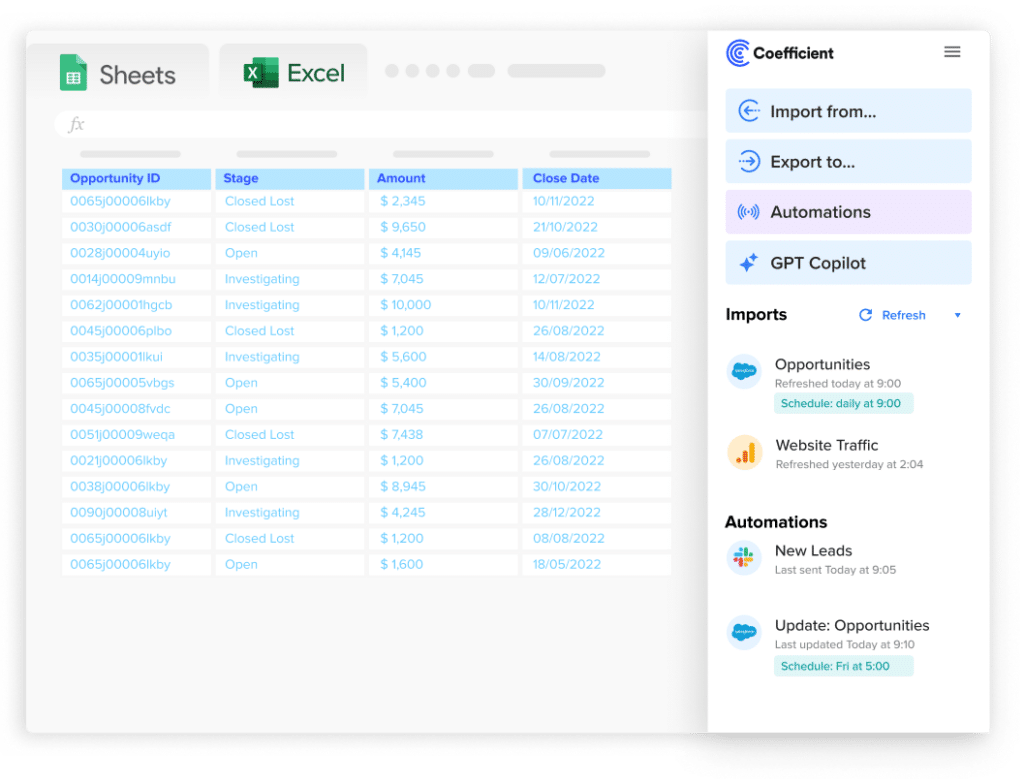
Stop exporting data manually. Sync data from your business systems into Google Sheets or Excel with Coefficient and set it on a refresh schedule.
Get Started
Key strengths:
- 150+ data source connections through pre-built connectors
- Drag-and-drop transformation features for non-technical users
- Data quality monitoring and alerting features
- Automatic detection of schema changes, data anomalies, and pipeline failures
- No coding required for data pipeline creation
Marketing team benefits:
- Middle ground between complex platforms like Fivetran and simple tools like Supermetrics
- Reliable data integration with enough transformation capabilities
- Prepares data for analysis without technical barriers
Limitations:
Doesn’t include attribution modeling or marketing-specific analytics – requires separate tools for advanced analysis.
Pricing:
- Starts at $239/month for the standard plan
- Custom pricing for enterprise features
- 14-day free trial available
9. Rivery
Rivery combines data integration with basic transformation and orchestration features in a user-friendly package. The platform targets mid-market teams that need more than simple ETL but less than full data engineering platforms.
Key strengths:
- 200+ data source connections with visual workflow builder
- Complex data pipeline creation without writing code
- Data activation features – Send processed data back to operational systems
- Marketing use cases – Sync audience segments to ad platforms, update CRM records
- Basic data science capabilities – Python and SQL transformation steps
Attribution capabilities:
- Supports custom attribution modeling through flexible workflow builder
- Advanced marketing calculations possible through Python/SQL steps
- Visual interface makes complex attribution logic accessible
Pricing:
- Starts at $0.75 per credit (roughly equivalent to data volume processed)
- Volume discounts available
- Consumption model helps control costs for variable data volumes
Best for:
Growing marketing teams that need more sophistication than basic ETL tools but aren’t ready for enterprise platforms.
Advantage:
Visual workflow builder makes it accessible to non-technical users while supporting advanced use cases.
How to choose the right Windsor alternative
Selecting the best Windsor alternative depends on five key factors:
Technical expertise
Non-technical teams:
- Platforms like Supermetrics and Coefficient work well
- Visual interfaces and spreadsheet integration
- Minimal setup and maintenance requirements
Technical teams:
- Fivetran and Stitch require data engineering skills
- Greater customization and control options
- Complex attribution modeling capabilities
Match platform complexity to your team’s actual capabilities.
Workflow preferences
Spreadsheet lovers:
- Coefficient brings data directly to Google Sheets and Excel
- Familiar interface with advanced capabilities
BI tool users:
- Platforms that integrate with Tableau, Power BI, Looker
- Dedicated dashboards and visualization tools
Custom solutions:
- Data warehouse integration for SQL-based analysis
- API access for custom applications
Choose platforms that integrate with your existing workflow rather than forcing changes.
Attribution requirements
Built-in modeling needed:
- Improvado and Adverity offer pre-built attribution models
- Windsor-style multi-touch attribution capabilities
Custom attribution preferred:
- Coefficient with GPT Copilot for transparent, customizable models
- SQL-based solutions for complete control
Basic attribution sufficient:
- First-touch, last-touch models available in most platforms
- Simple conversion tracking for straightforward campaigns
Data volume and complexity
High-volume operations:
- Enterprise platforms with robust infrastructure (Improvado, Adverity)
- Scalable pricing models that handle growth
Small to medium teams:
- Cost-effective solutions (Coefficient, Supermetrics)
- Simple setup without enterprise overhead
Complex transformations:
- Platforms with advanced data processing capabilities
- Custom logic and sophisticated data modeling
Budget constraints
Budget-friendly options:
- Coefficient: $49/month starting price
- Supermetrics: $99/month for basic plans
Mid-range solutions:
- Hevo Data: $239/month
- Rivery: Credit-based pricing
Enterprise investments:
- Improvado: $2,000+ monthly
- Adverity: $3,000-$10,000+ monthly
Factor in total cost of ownership, including setup and training time.
Evaluation process:
- Identify must-have features based on your specific requirements
- Evaluate 2-3 platforms that meet those requirements
- Test with actual data using free trials or demos
- Consider long-term scalability and team growth
Time to fix your attribution headaches
Windsor.ai offers powerful marketing attribution and data integration features. But it’s not the only solution for marketing data consolidation challenges.
The right alternative depends on your team’s specific needs:
- Coefficient excels for spreadsheet-based workflows and offers transparent, customizable attribution modeling with AI assistance
- Supermetrics provides reliable, simple data connections for established workflows
- Enterprise platforms like Improvado and Adverity offer comprehensive marketing intelligence for larger organizations
- Pure ETL tools like Fivetran work for technical teams building custom solutions
Key decision factors:
- Match platform capabilities to your actual requirements
- Consider team technical skills and workflow preferences
- Evaluate total costs including setup, training, and scaling
- Test attribution transparency and customization options
The key is matching platform capabilities to your actual requirements rather than choosing based on features alone.
Ready to consolidate your marketing data in Google Sheets? Get started with Coefficient and connect your first data source in under 60 seconds.