Managing data across multiple tools has become a daily headache for modern teams. You’re copying information between Notion and Salesforce, manually updating spreadsheets from project management tools, and watching critical data go stale across platforms. Sound familiar?
Unito has built a solid reputation as a no-code integration platform that creates two-way syncs between 60+ business applications. But it’s not the only player in this space, and it might not be the perfect fit for your specific needs.
This guide covers the 8 best alternatives to Unito, each with unique strengths that could better serve your integration requirements.
What is Unito?
Unito operates as a workflow automation platform focused on keeping data synchronized across business applications. The platform specializes in two-way syncing, meaning changes in one tool automatically update in connected applications – no manual data entry required.
Core functionality revolves around creating “flows” that connect different tools. For example, you can sync Asana tasks with Monday.com projects, ensuring both teams stay updated regardless of which platform they prefer.
Unito handles the heavy lifting of:
- Field mapping between different systems
- Data transformation and formatting
- Real-time updates across platforms
The platform serves mid-market to enterprise teams who need sophisticated integration capabilities without extensive technical knowledge. Here’s how different teams use it:
- Marketing teams sync campaign data between HubSpot and project management tools
- Product teams keep Jira issues synchronized with roadmap planning in Notion
- Finance teams connect invoicing systems with accounting software for seamless data flow
Pricing starts at $19 per month for the Starter plan, which includes 2 users and basic integrations. Professional plans scale to $59 per month for 5 users, while Enterprise pricing reaches $311+ monthly for advanced features and unlimited users.
Key strengths include:
- User-friendly interface
- Reliable two-way sync capabilities
- Strong enterprise security features
- Complex field mapping capabilities
- Good visibility into sync status and error reporting
However, limitations exist:
- The 60+ integration library is smaller than competitors like Zapier
- Pricing can become prohibitive for larger teams
- Some users report occasional sync delays
- Limited customization options for complex business logic
Why look for Unito alternatives?
Price sensitivity drives many teams to explore alternatives. Unito’s per-user pricing model becomes expensive quickly for larger organizations. A 20-person team faces $1,000+ monthly costs, which often exceeds budget constraints for integration tools.
Specialized needs often require different approaches:
- Teams focused heavily on spreadsheet-based workflows need deeper Excel and Google Sheets integration
- Data teams require ETL capabilities and direct database connections
- Marketing teams might need more advanced automation logic and conditional workflows
Integration breadth matters significantly. While Unito’s 60+ connectors cover popular business tools, teams often need specific integrations that aren’t available:
- Developer teams might require API-first platforms
- Enterprise organizations need more robust governance and compliance features
Workflow complexity varies dramatically across organizations. Some teams need simple data syncing, while others require complex multi-step automations with conditional logic, error handling, and advanced data transformations that exceed Unito’s current capabilities.
Top 8 Unito alternatives
1. Coefficient

Coefficient takes a spreadsheet-first approach to data integration that resonates strongly with data-driven teams. Rather than focusing on app-to-app workflows, Coefficient makes Google Sheets and Excel the central hub for business data and automation.
Live data connections pull information directly from 60+ business systems:
- Salesforce, HubSpot, NetSuite integration
- MySQL and Snowflake database connections
- Data refreshes automatically on schedules you set
- Reports and dashboards always reflect current information without manual updates
Best for data analysts, finance teams, and operations professionals who live in spreadsheets but need access to real-time business data. The platform eliminates the painful process of exporting CSV files and manually updating reports every week.
AI Sheets assistant goes beyond simple data import:
- Builds dashboards and creates pivot tables
- Analyzes trends with natural language requests
- Writes SQL queries based on your questions
- Transforms spreadsheets into powerful analytical tools without technical expertise
Data push-back capabilities enable two-way workflows:
- Update Salesforce records directly from Google Sheets
- Bulk update inventory in NetSuite
- Sync financial data back to accounting systems
- Keep spreadsheets as authoritative data sources
Pricing structure:
- Starts free for basic connections
- Paid plans begin at $39 monthly for advanced features and more data sources
- Enterprise features include audit trails, user management, and enterprise-grade security
2. Zapier

Zapier dominates the automation space with over 8,000 integrations and a user base exceeding 2 million businesses. The platform pioneered the “trigger and action” automation model that most competitors now follow.
Core strength lies in its massive integration ecosystem:
- Nearly every business tool has a Zapier connector
- Covers major platforms like Salesforce and HubSpot
- Includes niche industry-specific applications
- Multi-step Zaps create complex workflows with chained actions
Best for teams needing broad integration coverage and simple to moderate automation complexity:
- Marketing teams love Zapier for lead routing, content distribution, and campaign automation
- Small businesses appreciate the extensive app library and straightforward setup process
Pricing structure:
- Starts at $29.99 per month for 750 tasks
- Professional plans at $73.50 monthly for 2,000 tasks
- Enterprise pricing reaches $599 monthly for advanced features and higher task limits
Limitations include:
- Occasional reliability issues with complex Zaps
- Limited data transformation capabilities
- Task limits can be restrictive for data-heavy workflows
- Two-way syncing requires separate Zaps for each direction, unlike Unito’s native bidirectional approach
3. Microsoft Power Automate

Microsoft Power Automate leverages deep integration with the Microsoft ecosystem while extending to 400+ third-party connectors. The platform combines workflow automation with robotic process automation (RPA) capabilities.
Enterprise advantages:
- Seamless Office 365 integration
- Advanced security controls
- Governance features that enterprise IT departments demand
- AI Builder capabilities for document processing, form recognition, and predictive models
Best for organizations heavily invested in Microsoft tools:
- Teams using SharePoint, Teams, Outlook, and Dynamics benefit from native integrations
- Unified user management across Microsoft ecosystem
- Included licensing with many Microsoft subscriptions provides excellent value
Pricing options:
- $15 per user monthly for basic automation
- $40 per user for premium features
- Per-flow pricing at $100 monthly for specific use cases
- Many features included with existing Microsoft 365 subscriptions
RPA capabilities distinguish Power Automate from pure integration platforms:
- Desktop flows automate legacy applications
- Screen scraping functionality
- Complex desktop processes that web-based tools cannot handle
Challenges include:
- Complexity for non-technical users
- Limited third-party integration quality compared to dedicated platforms
- Dependency on Microsoft ecosystem for maximum value realization
4. Make (Integromat)

Make (formerly Integromat) positions itself as the visual automation platform for complex workflows. The drag-and-drop interface resembles a flowchart, making it easier to understand and modify sophisticated automation logic.
Visual scenario builder excels at complex, multi-branch workflows:
- Conditional routing and iterators
- Aggregators for advanced data processing
- HTTP modules and webhooks for custom integrations
- Visual flowchart approach makes logic clear
Best for technical teams and agencies managing complex client automations:
- Visual approach helps non-developers understand workflow logic
- Provides enough power for sophisticated use cases
- Digital agencies appreciate the client management features
Operations-based pricing charges for individual actions rather than monthly subscriptions:
- $9 monthly for 1,000 operations
- $16 for 10,000 operations
- $29 for 40,000 operations
- Benefits teams with predictable, moderate usage volumes
Advanced features:
- Data stores for temporary information
- Scheduling tools for time-based automation
- Extensive filtering and routing capabilities
- Superior JSON parsing and API interactions
Learning curve considerations:
- Requires more time investment than simpler platforms
- Visual interface can become cluttered for very complex scenarios
- Documentation quality varies across different integrations
5. Workato

Workato targets enterprise customers with sophisticated automation needs and governance requirements. The platform combines integration capabilities with workflow automation and business process management.
Enterprise focus shows in key features:
- Centralized recipe management
- Role-based access controls
- Comprehensive audit logging
- IT teams appreciate governance capabilities while business users benefit from low-code interface
Best for large organizations with complex business processes and compliance requirements:
- Financial services companies
- Healthcare organizations
- Manufacturing companies with security features and high-volume, mission-critical integrations
Recipe marketplace provides pre-built integrations:
- Templates developed by Workato and partners
- Accelerates implementation for common business processes
- Order-to-cash and procure-to-pay workflows
Pricing follows enterprise models:
- Custom quotes based on usage and features required
- Typical implementations start around $2,000 monthly
- Accessible primarily to larger organizations with substantial automation needs
Bot platform enables AI-powered workflows:
- Chatbot integrations
- Natural language processing capabilities
- Automates customer service and internal helpdesk scenarios
Complexity and cost limit Workato’s appeal:
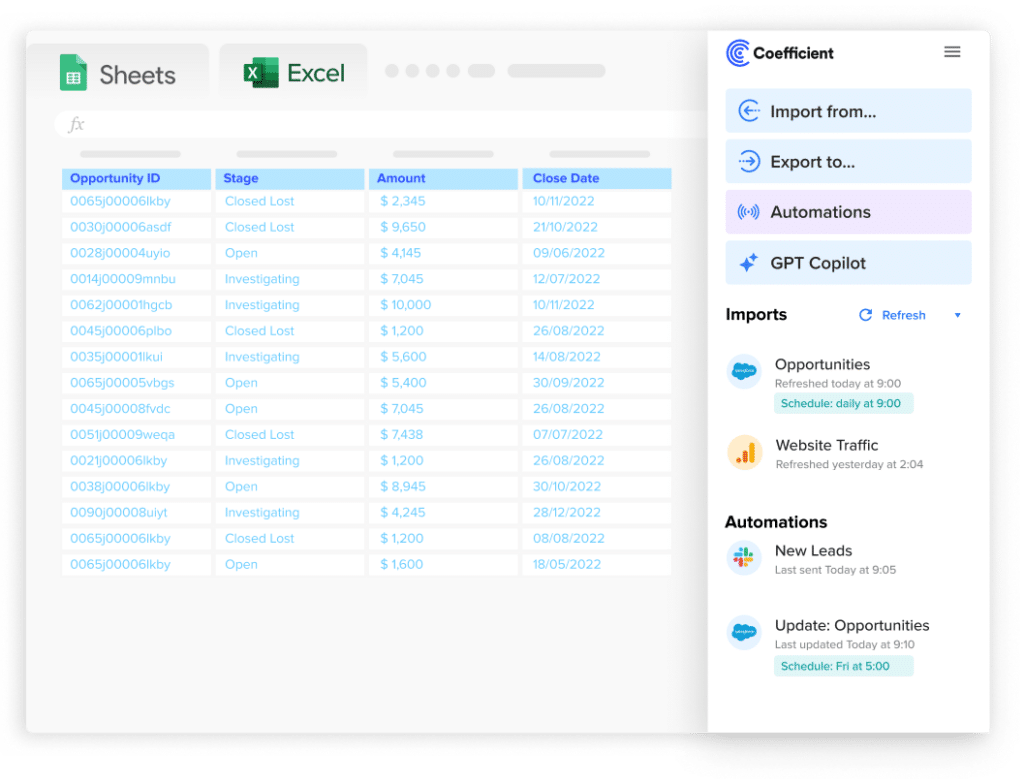
Stop exporting data manually. Sync data from your business systems into Google Sheets or Excel with Coefficient and set it on a refresh schedule.
Get Started
- Requires significant time investment to master
- Premium pricing needs justification through extensive automation usage
6. Tray.io
Tray.io positions itself as the general automation platform for complex enterprise workflows. Gartner recognizes Tray as a Visionary in the Enterprise Integration Platform as a Service category.
Low-code approach balances ease of use with advanced capabilities:
- Business users can build simple workflows
- Developers can create sophisticated integrations using custom code
- APIs and advanced data transformation logic available
Best for mid-market to enterprise companies requiring both simple automations and complex business process integration. The platform scales from basic workflow automation to enterprise-grade data processing and system integration.
Elastic scaling handles varying workload demands:
- Processes millions of operations monthly without performance degradation
- Suitable for high-volume scenarios that overwhelm simpler tools
- Automatic scaling without manual intervention
Advanced features:
- Version control for workflows
- Comprehensive testing environments
- Sophisticated error handling
- API management capabilities extend beyond simple integration to full-scale API lifecycle management
Enterprise focus considerations:
- Smaller teams may find Tray.io overpowered for basic needs
- Learning curve requires significant time investment to realize full platform value
- Pricing transparency remains limited with custom enterprise quotes required
7. MuleSoft

MuleSoft operates as an API-first integration platform designed for enterprise digital transformation initiatives. The platform focuses on creating reusable APIs and managing complex system integration architectures.
Anypoint Platform provides comprehensive API lifecycle management:
- Design and development tools
- Deployment and monitoring capabilities
- Treats integration as an enterprise architecture challenge
Best for large enterprises with complex system landscapes:
- Financial institutions
- Telecommunications companies
- Large retailers with mission-critical integration projects
- Organizations with dedicated development teams
API management capabilities:
- Security policies and rate limiting
- Analytics and comprehensive monitoring
- Creates APIs that multiple applications can consume
- Promotes reusability and standardization
Pricing reflects enterprise positioning:
- Costs starting around $20,000 annually for basic implementations
- Full platform usage often requires six-figure budgets
- Accessible primarily to large organizations with substantial IT investments
DataWeave transformation language:
- Powerful data mapping and transformation capabilities
- Exceeds simple field mapping found in workflow automation tools
- Complex data restructuring and format conversions
Technical complexity considerations:
- Requires dedicated development resources
- Significant time investment needed
- Targets IT departments rather than business users
- Unsuitable for teams seeking simple automation solutions
8. Celigo

Celigo specializes in iPaaS (Integration Platform as a Service) with particular strength in business application integration. The platform earned the #1 position in G2’s iPaaS category through consistent customer satisfaction ratings.
Prebuilt integrations for popular business applications:
- NetSuite, Salesforce, Shopify, and Amazon integrations
- Accelerate implementation timelines
- Handle common business processes like order synchronization, customer data management, and financial reporting
Best for growing businesses needing reliable integration between core business systems:
- E-commerce companies particularly benefit from retail and ERP integration expertise
- Focus on practical business application connections
Transparent pricing structure:
- Starts at $399 monthly for basic integration capabilities
- Scales to $999 for advanced features and higher transaction volumes
- Clear pricing structure helps budget planning without extensive custom quotes
Integration marketplace:
- Additional prebuilt connectors and workflow templates
- Developed by Celigo and partners
- Templates reduce implementation time for standard business processes
Data transformation capabilities:
- Complex field mapping
- Data validation and business logic implementation
- Processes high-volume data flows reliably without performance issues
Focus considerations:
- Excels at ERP, CRM, and e-commerce integrations
- Fewer options for productivity tools and marketing applications compared to general automation platforms
How to choose the right alternative
Start with your primary use case:
- Teams focused on spreadsheet-based reporting and data analysis benefit most from Coefficient’s native Excel and Google Sheets integration
- Organizations needing broad app connectivity should prioritize Zapier or Make
- Enterprise teams with complex compliance requirements need Workato or MuleSoft
Consider your technical resources:
- Non-technical teams succeed with Zapier’s simple interface and extensive templates
- Technical teams can leverage Make’s visual workflows or MuleSoft’s API-first approach
- Mixed teams often prefer platforms like Tray.io that offer both low-code and advanced capabilities
Evaluate pricing models carefully:
- Task-based pricing (Zapier, Make) suits teams with predictable, moderate usage
- Per-user pricing (Power Automate, Unito) works for smaller teams but scales poorly
- Enterprise platforms (Workato, MuleSoft) require substantial budgets but provide comprehensive capabilities
Integration breadth considerations:
- Count the specific applications you need to connect
- Verify availability on each platform
- Quality matters as much as quantity – test critical integrations during evaluation periods
Plan for growth and complexity:
- Start with platforms that can evolve with your needs
- Simple tools work initially but become limiting as automation requirements grow
- Enterprise platforms provide room for growth but may be overkill for current needs
Transform your data workflows today
Choosing the right integration platform depends on your specific needs, technical resources, and growth plans. Zapier offers unmatched breadth for general automation. Microsoft Power Automate provides excellent value within the Microsoft ecosystem. Enterprise platforms like Workato and MuleSoft handle complex business process automation with governance features that IT departments require.
For teams who live in spreadsheets and need access to live business data, Coefficient offers a unique approach that eliminates the manual export-import cycle entirely. Real-time data connections, powerful automation capabilities, and AI-powered analysis transform Excel and Google Sheets into dynamic business intelligence platforms.
The best integration platform is the one that fits naturally into your existing workflows while providing room for growth as your automation needs evolve.
Start your free trial and see how the right integration platform can transform your team’s productivity in minutes, not months.