You’re evaluating enterprise BI platforms because your team needs better data access, and you’re tired of manually exporting reports from NetSuite or Salesforce every time someone needs updated data.
Tableau, Qlik, and Looker keep appearing in your research—they’re the established names in business intelligence, trusted by Fortune 500 companies, and they promise powerful visualizations and self-service analytics.
Here’s what most comparison articles won’t tell you upfront: you’re comparing three platforms that typically cost $50,000-$200,000+ annually, require 3-6 months to implement, and need dedicated BI teams to maintain. They’re built for enterprise data teams with six-figure budgets, not mid-market finance teams who need live data in the spreadsheets they already use.
This guide breaks down how Tableau, Qlik, and Looker actually differ from each other, what they genuinely excel at, and where they all fall short. We’ll look at:
- Pricing transparency (or lack thereof)
- Implementation timelines
- Learning curves
- Whether you really need an enterprise BI tool at all
By the end, you’ll understand which platform makes sense for your specific needs—and discover why many teams are choosing a completely different approach that costs 10-100x less and takes minutes to implement instead of months.
Tableau: the visualization leader with Salesforce muscle

Tableau has been the gold standard for data visualization since 2003, and Salesforce’s $15.7 billion acquisition in 2019 only reinforced its market dominance. When people think “business intelligence,” Tableau is often the first name that comes to mind—and for good reason.
The platform’s drag-and-drop interface genuinely revolutionized how analysts create visualizations. Before Tableau, building interactive dashboards required custom coding or clunky report builders. Tableau changed that by letting users intuitively drag dimensions and measures onto canvases, creating beautiful charts in minutes instead of hours. This visual approach to analytics became the template that competitors would spend years trying to replicate.
Tableau offers comprehensive analytics through:
- Desktop: Authoring environment
- Server/Cloud: Deployment platform
- Prep Builder: Data preparation tools
For Salesforce customers, CRM data flows directly into dashboards without complex ETL. The platform connects to 80+ data sources—cloud warehouses, databases, and SaaS applications. Mobile apps deliver full analytics on iOS and Android.
Pricing is relatively transparent:
- Creator: $75/user/month
- Explorer: $42/user/month
- Viewer: $15/user/month
- Enterprise Edition: Adds 50%+ to these rates
A 25-user mid-market team costs $25,000-$35,000 annually for licenses alone. Add implementation ($20,000-$100,000+), training, and maintenance, and first-year costs reach $50,000-$100,000+.

According to SoftwareReviews, Tableau maintains an impressive 8.9/10 composite score across 2,000+ reviews. Users consistently praise the visualization capabilities and the large community of Tableau experts. The platform has earned its reputation as the enterprise standard for a reason—when you need sophisticated data visualization across hundreds or thousands of employees, Tableau’s capabilities justify the investment.
Qlik: the associative analytics engine that thinks differently

Qlik takes a fundamentally different approach to business intelligence, and that’s not just marketing speak. While Tableau and Looker follow traditional query-based models where you define relationships upfront, Qlik’s associative engine indexes all possible relationships in your data dynamically. It’s the platform’s defining characteristic and the reason organizations with complex data exploration needs choose Qlik over competitors.
The associative model indexes all data relationships dynamically. Click a product category and Qlik’s interface shows:
- Green: What’s filtered
- White: What’s related
- Gray: What’s unrelated
Revealing not just what’s included but what’s excluded and why. For analysts exploring unfamiliar datasets, it’s genuinely powerful.
Owned by Thoma Bravo, Qlik evolved into Qlik Sense with AI-powered Insight Advisor and Qlik Talend Cloud for enterprise data integration. For companies with complex SAP or Oracle pipelines, Qlik’s integration depth advantages Tableau’s connector approach.
Qlik connects to 80+ data sources including:
- Enterprise databases
- Cloud data warehouses
- SaaS applications
- Real-time streaming data
The platform offers flexible deployment through Qlik Cloud Analytics or on-premises Qlik Sense Enterprise on Windows for regulated industries that require on-site infrastructure.
Pricing is capacity-based:
- $200/month (10 users, too limited for real use)
- $825/month Standard
- $2,750/month Premium
Mid-market deployments typically cost $50,000-$80,000 annually. Add implementation ($30,000-$150,000+), training ($10,000-$30,000), and ongoing support (20-22% of licenses). Total first-year: $100,000-$250,000+.

Qlik earned the #1 ranking in G2’s Embedded Business Intelligence Summer 2024 report and maintains approximately 4.3-4.4/5 stars across 800+ G2 reviews. Users praise the associative engine’s power and the robust data integration capabilities, though many note the steep learning curve and complexity of the platform.
Looker: code-based modeling for the engineering-minded

Looker occupies a unique position among enterprise BI platforms—it’s the tool engineers build for business users, rather than a business tool that engineers have to support. Google Cloud acquired Looker in 2020 for $2.6 billion, betting that its code-first approach and embedded analytics capabilities would differentiate it in an increasingly crowded BI market.
LookML is Looker’s proprietary modeling language—simultaneously its greatest strength and biggest barrier. Developers define metrics as code, providing:
- Git-based version control
- Single source of truth for metrics
- Consistent calculations across the organization
When your CFO asks for “annual recurring revenue,” everyone gets the same calculation, defined once in LookML rather than calculated differently in twenty spreadsheets.
For SaaS companies building embedded analytics into their products, Looker genuinely excels. The platform offers industry-leading:
- White-labeling capabilities
- SSO integration
- API control that lets you embed analytics dashboards
Customer-facing analytics that other platforms struggle with—things like letting each customer see only their data with custom branding—are table stakes for Looker.
Looker’s Google Cloud integration is seamless, particularly with BigQuery. The platform queries data in place rather than extracting and loading it, which means dashboards always show current data without ETL lag. This real-time approach has tradeoffs though—query-heavy dashboards can drive up data warehouse costs significantly if you’re not careful with BigQuery or Snowflake spend.
The platform connects to 60+ data sources, primarily focusing on SQL-based databases and cloud data warehouses like BigQuery, Snowflake, Redshift, Azure Synapse, and Databricks. Unlike Tableau and Qlik, Looker has limited direct SaaS connectors—integrating data from tools like Salesforce or HubSpot typically requires custom API work or intermediate staging in your data warehouse.
Pricing is entirely quote-based with no public rates. Third-party sources cite:
- $60,000 minimum annually
- $100,000-$150,000 for mid-market deployments
- $200,000-$500,000+ for enterprises
Add implementation ($50,000-$200,000+), dedicated LookML developers ($100,000-$150,000 salary), training ($15,000-$40,000), and premium support (20-30% of licenses). First-year costs commonly exceed $200,000-$300,000.
Looker maintains approximately 4.4-4.5/5 stars across 600+ G2 reviews. Technical teams and data engineers rate it highly, praising the code-based governance and embedded analytics capabilities. Business users offer more mixed reviews, often noting the steep learning curve and dependency on engineering teams for changes.
Head-to-head comparison
Here’s a reformatted version with the key comparisons in a clear table format:
Now let’s dig into how these three platforms actually differ when you’re making a purchasing decision. We’ll compare them across the factors that matter most to mid-market teams evaluating BI tools, and show how each approaches common business intelligence challenges.
| Factor | Tableau | Qlik | Looker |
| Data Source Integrations | 80+ connectors across warehouses, databases, and SaaS apps (Salesforce, SAP, Google Analytics). Financial teams access QuickBooks and NetSuite through native connectors or ODBC, though setup requires IT. | 80+ sources plus Qlik Talend Cloud for enterprise data integration with change data capture. Deep integration advantages for SAP or Oracle pipelines. NetSuite and Sage Intacct work well, though configuration is complex. | 60+ SQL data sources—primarily warehouses like BigQuery, Snowflake, Redshift. No direct SaaS connectors; requires loading business data into warehouses first via separate ETL tools. |
| Ease of Use & Learning Curve | Drag-and-drop interface intuitive for basics. Mastering advanced capabilities (LOD expressions, table calculations) requires 40-80 hours of training per power user. Skilled developer status takes weeks to months. | Green-white-gray associative model powerful but confusing for new users. Plan for weeks of formal training before business users can explore independently. Worthwhile for complex analytics, overkill for standard reports. | Steepest curve. LookML requires coding skills and SQL knowledge. Business users can’t build models—only explore what developers create. Training costs $15,000-$40,000. |
| Self-Service Capabilities | Explorer users build workbooks from published data sources without IT. New data sources, custom prep, or complex calculations require BI team tickets. “Self-service” becomes semi-self-service. | Insight Advisor adds AI-driven suggestions. Users explore data within apps developers build. Creating new apps or adding sources requires Qlik experts. Good for exploration within existing apps, not true self-service for new needs. | Explicitly rejects self-service for governed, code-defined analytics. Business users explore what developers build via Explore interface. Any model changes require LookML code updates through Git workflows. |
| Pricing & Total Cost | $75/user/month Creator, $42 Explorer, $15 Viewer (Enterprise adds 50%+). 50-person team: $158,000 annual licenses. Add implementation ($30,000-$100,000), training. First-year costs exceed $200,000. | Quote-based despite published cloud plans. Mid-market: $50,000-$150,000+ annually. Add implementation ($30,000-$150,000+), training ($10,000-$30,000). Total first-year: $100,000-$250,000+. | Entirely quote-based. $60,000 minimum, typically $100,000-$150,000 for mid-market. Add implementation ($50,000-$200,000+), LookML developers ($100,000-$150,000 salary), training ($15,000-$40,000), support (20-30%). First-year costs exceed $200,000-$300,000. |
| Implementation Timeline | 3-4 months for small deployments, 4-6 months for mid-market (50-100 users). Sequential nature—can’t train before building, can’t build before connecting data—creates unavoidable dependencies. | 3-6 months for mid-market. Associative model adds complexity. Qlik talent scarcity extends timelines if consultants aren’t immediately available. | Often exceeds 6 months. LookML semantic layer requires Git workflows, naming conventions, governance setup before business user access. BigQuery users: 3-4 months. Teams restructuring data warehouses: 9-12 months. |
| Spreadsheet Integration | Exports to static CSV files—filters disappear, interactivity lost. Value prop explicitly moves users away from spreadsheets into BI dashboards. Creates workflow friction for Excel-dependent finance teams. | Exports are static snapshots. Associative capabilities (green-white-gray relationships, interactive filtering) disappear in spreadsheets. Expects users to transition from spreadsheets to Qlik apps. | Virtually no spreadsheet integration. Philosophy emphasizes centralized analytics over distributed spreadsheet analysis. Users export static CSVs with no live connection or auto-refresh. |
The limitations all three platforms share
When you compare these three closely, they’re remarkably similar in their limitations despite different approaches. They’re all enterprise BI platforms designed for large organizations with dedicated BI teams and six-figure budgets.
- Cost: Tableau runs $25,000-$100,000+ annually for mid-market teams. Qlik costs $50,000-$150,000+. Looker starts at $60,000 and commonly reaches $100,000-$200,000+. All are 10-100x more expensive than spreadsheet alternatives.
- Implementation: 3-6 months typical for all three. Looker often exceeds 6 months. None offer quick wins—you’re committing to multi-month projects before seeing value.
- Technical expertise: Tableau needs Tableau developers. Qlik requires Qlik-specific expertise. Looker demands LookML coding and SQL proficiency. Business users can’t independently add data sources or build dashboards—you’re hiring specialized talent.
- Learning curves and training: Tableau requires 40-80 hours per power user. Qlik needs weeks of formal training. Looker costs $15,000-$40,000 for training. The “easy BI” promise doesn’t match extensive training reality.
IT dependency: All three force business users to rely on BI teams for:
- New connections
- Dashboard modifications
- Troubleshooting
Your finance team views dashboards but can’t quickly add NetSuite expense categories without IT requests.
- Not spreadsheet-native: Standalone tools requiring context-switching from Excel/Sheets where teams actually work. Exports produce static CSVs, not live connections.
- No two-way sync: All pull data but don’t write back. Tableau can’t update Salesforce. Qlik has limited write-back requiring custom dev. Looker triggers webhooks but no direct updates. Operational workflows require manual data entry in separate systems.
- Overkill for standard reporting: If you need financial reports from NetSuite and sales dashboards from Salesforce, you’re paying for advanced statistical functions, predictive modeling, and enterprise infrastructure you’ll never use.
- Ongoing maintenance: All require continuous support for updates, troubleshooting, and optimization. Budget 15-25% of annual costs for maintenance—additional money and headcount beyond initial investment.
Enter Coefficient: a simpler alternative

Here’s the fundamental question that most BI comparison articles ignore: do you actually need an enterprise BI platform at all?
If you’re a 10,000-person Fortune 500 company with hundreds of dashboards, complex data governance requirements, and a dedicated 20-person BI team, then yes—Tableau, Qlik, or Looker might make sense.
But if you’re a mid-market company where finance, operations, and sales teams work primarily in Google Sheets or Excel, spending $50,000-$200,000 annually on infrastructure that forces them into unfamiliar tools is solving the wrong problem.
Coefficient takes a completely different approach: instead of building a separate BI platform, it brings live data directly into the spreadsheets your team already uses. Connect:
- NetSuite, Salesforce, Snowflake, QuickBooks, HubSpot
- Any of 100+ data sources to Google Sheets or Excel
- Data refreshes automatically on schedules you define—hourly, daily, or on-demand
Build financial reports, sales dashboards, and operational metrics using spreadsheet formulas, pivot tables, and charts your team already understands.
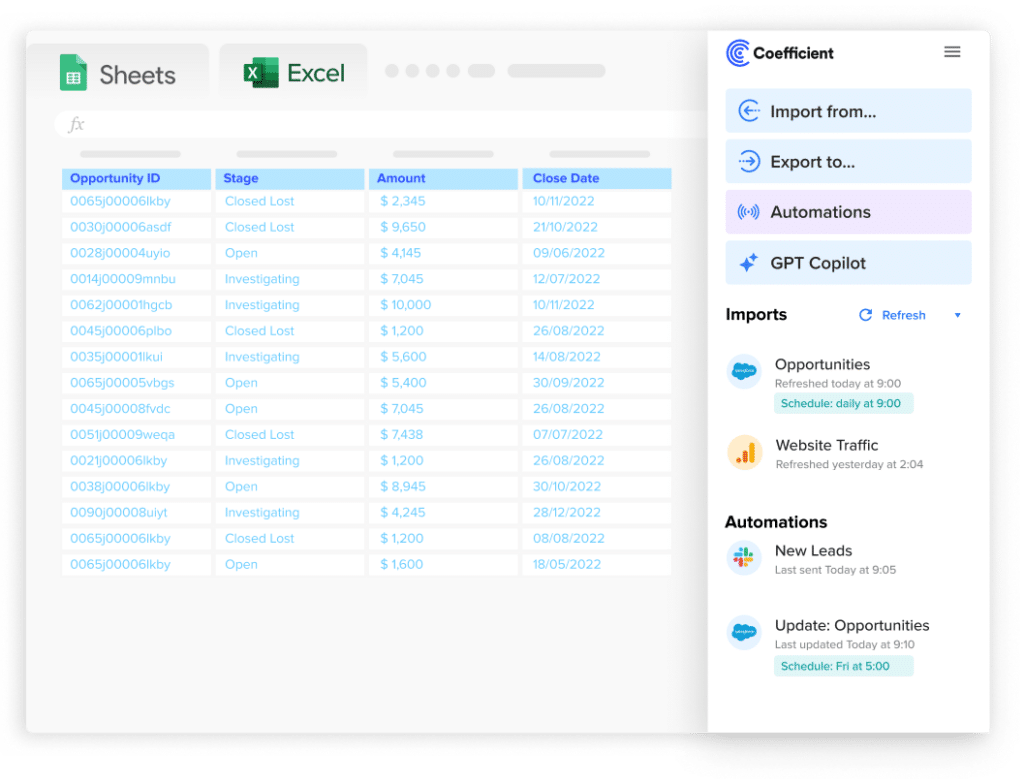
Stop exporting data manually. Sync data from your business systems into Google Sheets or Excel with Coefficient and set it on a refresh schedule.
Get Started
The value proposition becomes clear when you look at actual customer outcomes rather than vendor marketing.
Christian Budnik at Solv Health was manually exporting data from Salesforce, Looker, and QuickBooks multiple times daily for FP&A forecasting and revenue tracking. After implementing Coefficient, he automated all data imports and saved 364 hours per year—essentially a full day of work each month across the FP&A team.

As he describes it: “Before Coefficient, I was doing multiple data pulls a day. After setting up Coefficient, I instantly felt an incredible amount of peace of mind. All I had to do was click a button, and in seconds, all my Salesforce data appeared in Google Sheets.”
Coefficient competes in a fundamentally different category. It’s spreadsheet-native data connectivity and automation for teams that prefer working in familiar tools rather than learning complex BI platforms. The pricing reflects that positioning:
- Free plan for individuals
- Starter: $49/month
- Pro: $99/user/month for teams
- Enterprise: Custom pricing
A 25-person team costs approximately $30,000 annually—5-10x cheaper than Tableau and 10-20x cheaper than Looker.
Why Coefficient outperforms Tablaue, Qlik and Looker
Let’s be specific about where Coefficient provides advantages over enterprise BI platforms, particularly for mid-market teams evaluating their analytics options.
Setup and implementation time
Coefficient connects your first data source and imports data into Google Sheets in minutes, not months. There’s no discovery phase, no data modeling workshops, no dashboard development sprints.
Sam Sholeff at Cyrq Energy captures the difference: “I was able to start working with Coefficient out of the box and recall information instantly. This took us months to do with another NetSuite data connector.”
Most teams:
- Build production reports within days
- Scale to full deployment within weeks
- Compare that to 3-6 months for Tableau, Qlik, or Looker implementations that require project teams, consultants, and formal rollout plans
Genuine self-service for business users
Coefficient eliminates IT dependency because business users work in spreadsheets they already understand:
- Finance analysts connect new data sources themselves using point-and-click imports
- Operations teams build dashboards with familiar pivot tables and charts
- No ticketing system, no development backlog, no waiting for BI teams to prioritize requests
Evan Cover, Director of BI Engineering at Klaviyo, explains why his team chose Coefficient: “Coefficient takes a tool everyone is familiar with and combines it with the power of a database.” When self-service works within tools people already know, adoption happens naturally rather than requiring change management programs.
True two-way data sync
Coefficient is the only platform among these four that offers bidirectional data sync for major systems:
- Update Salesforce opportunity stages
- Modify HubSpot contact fields
- Change database records directly from spreadsheets
- Push changes back to source systems automatically
This transforms spreadsheets from read-only reporting tools into operational platforms. Finance teams can:
- Analyze NetSuite transactions
- Make adjustments
- Update records without context-switching
Sales operations can clean CRM data, enrich records, and maintain data quality through spreadsheet workflows. Tableau, Qlik, and Looker are visualization-only—you can see data but can’t update source systems.
Affordable pricing at 10-100x lower cost

A 25-person team using Coefficient Pro costs approximately $2,500/month ($30,000 annually). The equivalent:
- Tableau deployment runs $25,000-$50,000+
- Qlik costs $50,000-$80,000+
- Looker typically exceeds $100,000
Coefficient’s pricing exists in a fundamentally different budget category. Instead of six-figure enterprise software requiring CFO approval, you’re looking at departmental-level SaaS tools that finance managers can approve and expense. There are no:
- Hidden implementation costs (setup is self-service)
- Training expenses (it’s spreadsheets)
- Ongoing maintenance fees
ROI payback typically occurs within weeks rather than years.
Faster time to value with immediate insights
- Michael Kolodin at Cyrq Energy rebuilt NetSuite reports in days rather than months
- Christian Budnik at Solv automated daily data pulls within weeks
- Alexander Bugajski at Miro built complex forecasting models combining Snowflake, Salesforce, and Looker data in the time it would have taken to complete discovery for a traditional BI project
When implementation takes minutes instead of months, you’re analyzing real business problems and generating insights while competitors are still negotiating statements of work with consulting firms.
Superior integration coverage with 100+ connectors

Coefficient connects to more data sources than Tableau (80+), Qlik (80+), or Looker (60+). The integration strategy prioritizes:
- Financial systems first: QuickBooks, NetSuite, Sage Intacct, Xero
- Sales platforms: Salesforce, HubSpot
- Marketing tools: Google Analytics, Facebook Ads
- Data warehouses: Snowflake, BigQuery, Redshift
- Operational tools: Jira, Asana
Two-way sync works for Salesforce, HubSpot, MySQL, PostgreSQL, and SQL Server. For teams needing to blend data from multiple systems, Coefficient’s breadth eliminates the need for intermediate ETL layers or data warehouses that BI platforms often require.
The verdict
Tableau, Qlik, and Looker are powerful platforms. Tableau excels at visualization. Qlik’s associative model offers unique exploration. Looker provides best-in-class code-based governance.
But they share fundamental limitations for mid-market teams:
- $25,000-$200,000+ annually
- 3-6 months to implement
- Dedicated expertise required
- Built for enterprise budgets—not growing companies where teams work in spreadsheets
The question is: “Do you need one at all?”
Choose BI platforms if you’re:
- 1,000+ employees with complex governance needs
- Managing hundreds of dashboards
- Have dedicated BI teams
- Control six-figure budgets
Choose Coefficient if:
- Finance builds P&L reports in Excel
- Operations tracks KPIs in Sheets
- Sales wants Salesforce data without CSV exports
- You need live connectivity, automated refreshes, and self-service analytics in spreadsheets—at 10-100x lower cost and minutes of setup versus months
Get started with Coefficient for free—no credit card required. Connect your first data source, import live data, and build automated reports this afternoon. Join thousands of mid-market teams that chose spreadsheet-native analytics over expensive BI platforms.