Liveflow vs G-accon: Which Multi-Entity Finance Platform is Right for You?
Managing financial reporting across multiple entities is one of those challenges that seems straightforward until you’re actually doing it. You’ve got:
- Subsidiaries running on different accounting systems
- Franchise locations with non-matching chart of accounts
- Portfolio companies that all report differently
And a board meeting next week where everyone expects consolidated numbers. Suddenly you’re spending three full days every month manually copying data from QuickBooks, wrestling with Excel formulas, and double-checking that your consolidation actually balances.
This is exactly the problem Liveflow and G-accon were built to solve. Both platforms promise to automate multi-entity consolidation, eliminate manual data entry, and transform spreadsheets into live financial command centers. But they take fundamentally different approaches. Liveflow positions itself as a purpose-built FP&A platform specializing in multi-entity consolidation, claiming to consolidate 50+ entities in under three minutes. G-accon, by contrast, transforms Google Sheets itself into a financial automation platform with two-way sync capabilities, serving 20,000+ businesses with 600+ reviews across app stores.
So which one should you choose? More importantly, does either platform fully solve your needs when finance teams increasingly need more than just accounting data?
In this comprehensive comparison, we’ll examine what each tool does well, where they fall short, and why you might need to look beyond both options to find a solution built for how modern finance teams actually work.
Liveflow overview

Liveflow has carved out a clear position in the FP&A market: multi-entity consolidation for finance teams managing complex organizational structures. The platform’s mission is specific and unapologetic—if you’re running finance for a private equity firm with portfolio companies, a franchise organization with dozens of locations, or a construction company with project-based entities, Liveflow wants to be your consolidation backbone.
The numbers tell the story of rapid adoption. With a 4.9/5 rating on G2 based on 300 reviews and a 99% customer satisfaction score, Liveflow has clearly resonated with its target audience. The platform’s support quality earns particularly high marks—a 9.8 out of 10 score on G2, backed by advertised response times under 30 seconds.

That premium support model matters enormously when you’re troubleshooting consolidation issues the day before board reporting deadlines.
What makes Liveflow distinctive is its consolidation-first architecture. The platform can:
- Handle 50+ entities simultaneously, as demonstrated by ETS Performance’s case study
- Manage multi-currency consolidation across 180+ currencies
- Accommodate non-matching chart of accounts through automated mapping
- Provide drill-down capability into transaction-level detail
Liveflow claims consolidation happens in under three minutes—a speed that represents meaningful progress when your alternative is spending three full days manually consolidating in Excel.
The platform works with both Excel and Google Sheets, a dual-platform approach that sets it apart from competitors locked into single spreadsheet environments.
Users access Liveflow’s features through the platform’s interface, which includes:
- Built-in dashboards for real-time financial visualization
- A budgeting product called FinanceIQ for collaborative planning
- Automated report updates that eliminate the manual refresh cycle
- A template library for common reports
- Consolidation-specific features like intercompany eliminations and entity-by-entity reporting views
On the integration front, Liveflow takes a focused approach. QuickBooks Online and Xero are fully mature integrations. NetSuite support is currently in beta testing. That’s it. The platform doesn’t connect to Sage, FreshBooks, QuickBooks Desktop, or other accounting systems. This narrow integration scope reflects Liveflow’s specialization strategy—go deep on the platforms most commonly used by their target customers rather than spreading resources across every possible accounting system.
Customers report substantial time savings:
- Roberto Carroz, Head of Finance at Nelo, saves three full days every month on consolidation with Liveflow—72 hours that now go toward strategic analysis instead of manual data wrangling
- Flux Accounting increased their client capacity by 50% after implementing the platform
- Yehuda Tenenbaum at Kalshi explains simply: “LiveFlow is the only product I’ve found that does consolidation easily”
But here’s what Liveflow doesn’t offer: transparent pricing.

This contact-sales model creates a barrier for smaller businesses wanting to self-evaluate costs. The platform also appears to be import-only based on documentation—there’s no mention of two-way sync or the ability to push data back to accounting systems.
And while Liveflow excels at financial consolidation, it doesn’t connect to sales, marketing, or operational systems. When your CFO asks why revenue changed and needs context from marketing spend and sales pipeline alongside the accounting data, Liveflow can’t provide that cross-functional view.
For finance teams focused exclusively on multi-entity consolidation who use QuickBooks or Xero, Liveflow delivers genuine value. The question is whether consolidation alone addresses the full scope of modern finance team needs.
G-accon overview

G-accon has been solving accounting automation challenges since 2017 with a radically different philosophy: make Google Sheets itself the platform. Rather than building a separate application that happens to work with spreadsheets, G-accon transforms Google Sheets into a native financial automation and reporting environment through deep integration with the Google Workspace ecosystem.
The company’s market presence is substantial. G-accon serves 20,000+ businesses worldwide with 600+ total reviews distributed across multiple app stores:
- 200+ on QuickBooks
- 150+ on Xero
- Approximately 150 on G2
The platform holds a 4.8/5 rating on G2 and earned 44 badges in G2’s Spring 2025 Reports, including Leader status in the Financial Analysis category and recognition for Best Estimated ROI, Fastest Implementation, and Most Implementable for Mid-Market companies.

Partnership credentials underscore G-accon’s deep accounting system integration. The platform holds:
- Platinum Partner status with Intuit (the highest tier in their partner program)
- Premium Partner designation from Xero (also top tier)
These aren’t marketing badges—they represent technical certification and direct support relationships that enable deeper integration capabilities than standard API connections provide.
G-accon’s core strength is two-way sync. Unlike platforms that only extract data from accounting systems, G-accon can read AND write. That means finance teams can:
- Pull data into Google Sheets for analysis
- Make changes or updates in the spreadsheet
- Push those modifications back to QuickBooks, Xero, FreshBooks, Sage, or Xero Practice Manager
This bidirectional flow enables workflows like bulk invoice creation from spreadsheets, mass customer record updates, and batch transaction corrections—all without logging into multiple accounting interfaces.
The integration breadth is wider than Liveflow’s focused approach. G-accon supports five accounting systems:
- QuickBooks Online
- Xero
- Sage Cloud Accounting
- FreshBooks
- Xero Practice Manager
This variety matters for accounting firms managing clients across different platforms or organizations with legacy systems. However, G-accon is exclusively a Google Sheets tool—there’s no Excel support. Teams committed to Microsoft’s ecosystem need to look elsewhere.
Feature depth extends beyond basic sync. G-accon includes:
- 100+ pre-built report templates
- Automated workflows with scheduled data refresh and alert triggers
- Multi-entity consolidation with intercompany eliminations
- A specialized cash flow forecasting product called G-CashFlow
- Currency conversion across 170+ currencies
- A report designer for styling dashboards with logos and branding
- Scheduled email distribution of reports
- Automated backups
- Integration with Looker/Data Studio for visualization
Customer testimonials emphasize substantial ROI. Michael King, CFO at KFE Solutions, reports the platform saves his team 40 hours per month and delivers “the highest ROI we have on any of our tech platforms.” The Hot Toast case study is particularly compelling:
- The accounting firm reduced reporting time by over 50%
- Completed one client’s month-end close in 24 hours instead of the previous one-week process (an 86% time reduction)
- Finished a major four-entity consolidation project in half the time of alternative tools
Where G-accon particularly shines is flexibility. User after user in G2 reviews describes it as a “swiss army knife” for accounting automation. James Hogan at LV Hogan explains: “This App not only downloads any QBO module to Google Sheets; you can also design layouts to send data back into QBO in bulk. No need to layout CSV or XLS files to match the QBO Import feature.” That customization capability means power users can build precisely the workflows they need rather than conforming to rigid templates.
Pricing is transparent and accessible:
- Business plan: $50/month annually ($60 monthly) for three companies and one user
- Accountant tier: $125/month ($150 monthly) supports 25 companies and five users
- Advisor tier: $250/month ($300 monthly) handles 50 companies with 10 users
- Enterprise: $375/month ($450 monthly) covers 250 companies with unlimited users
All tiers include all integrations—there are no source restrictions by plan level. A 14-day free trial requires no credit card.

Security compliance includes SOC 2 Type 1 certification and GDPR compliance, important for firms handling sensitive financial data across jurisdictions.
But G-accon’s Google Sheets exclusivity is a real limitation. Excel teams can’t use the platform at all. The tool is also fundamentally focused on accounting data—when finance teams need sales pipeline visibility or marketing spend context alongside accounting numbers, G-accon doesn’t provide those integrations. And like Liveflow, G-accon operates on scheduled refresh intervals rather than live data connections. You set up automatic updates, but there’s inevitably lag between when transactions occur and when your dashboards reflect them.
For accounting firms managing multiple clients across different accounting platforms, or finance teams deeply invested in the Google Workspace ecosystem who need flexible two-way sync, G-accon offers compelling value. The question is whether accounting-only data and scheduled updates serve teams that increasingly need cross-functional, real-time visibility.
Head-to-head comparison
Data source connectors
Liveflow’s integration strategy is deliberately narrow. The platform connects to:
- QuickBooks Online with full maturity
- Xero as of August 2024
- NetSuite in beta testing
That’s the complete list. There’s no Sage support, no FreshBooks, no QuickBooks Desktop, no specialized vertical accounting platforms. This focused approach reflects their positioning—go deep on the platforms most commonly used by PE firms, franchises, and multi-entity organizations rather than chasing breadth. For companies already standardized on QuickBooks or Xero across all entities, this focus works. For organizations with mixed environments or legacy systems, the limited options create immediate barriers.
G-accon offers broader accounting coverage:
- QuickBooks Online
- Xero
- Sage Cloud Accounting
- FreshBooks
- Xero Practice Manager
That additional breadth matters particularly for accounting firms whose clients span multiple platforms. A firm managing 25 client companies might have 15 on QuickBooks, 8 on Xero, and 2 on FreshBooks—G-accon can handle all three, while Liveflow couldn’t serve the FreshBooks clients at all. The Platinum Intuit and Premium Xero partnership designations also suggest deeper technical integration than standard API connections provide.
Data destinations and flexibility
Liveflow works with both Microsoft Excel and Google Sheets, providing platform flexibility that matters for organizations with mixed spreadsheet preferences or finance teams who prefer Excel’s advanced features. The dual support means you’re not locked into one ecosystem. However, Liveflow is fundamentally a separate application that sends data to spreadsheets rather than living natively inside them. Users access the platform’s interface for configuration, then data populates into their chosen spreadsheet destination. This architecture treats spreadsheets as outputs rather than the primary workspace.
G-accon takes the opposite approach—Google Sheets IS the platform. The tool installs as a Google Workspace add-on that becomes part of the Sheets interface itself. There’s no separate application to learn, no external configuration panel. You work directly in Sheets with G-accon’s features accessible through native menus. This Google Sheets exclusivity is both strength and weakness:
- Teams already living in Google Workspace love the seamless integration
- Excel users are simply shut out
- The platform cannot serve them at all, regardless of need or budget
Features and functionality
Both platforms excel at their core missions, but those missions differ fundamentally. Liveflow is built for consolidation workflows. The platform automates multi-entity aggregation with features like:
- Automated chart of accounts mapping across dissimilar systems
- Multi-currency handling for 180+ currencies with real-time exchange rates
- Intercompany eliminations
- Entity-by-entity drill-down to transaction detail
- Trailing period analysis
The built-in dashboard interface provides financial visualization without requiring external BI tools. FinanceIQ adds collaborative budgeting where department heads can submit their budgets within the platform. The consolidation speed claim—under three minutes for complex multi-entity structures—represents the platform’s performance focus.
G-accon’s feature set centers on flexibility and automation:
- The 100+ pre-built report templates cover standard financial statements, departmental reports, and specialized analyses
- The workflow automation engine schedules data refreshes, triggers email alerts when metrics hit thresholds (like overdue invoices or low cash balances)
- The report designer lets users style dashboards with company branding, logos, and custom formatting
- G-CashFlow provides specialized cash flow forecasting beyond standard reporting
- The two-way sync enables operational workflows—like bulk creating invoices in QuickBooks from a Sheets template or mass updating customer credit limits
User experience
Liveflow requires learning the platform’s interface, which operates separately from your spreadsheet environment. Users configure consolidation rules, entity mappings, and report definitions in Liveflow’s application, then data flows to Excel or Sheets. The learning curve is moderate, particularly for teams managing many entities with complex consolidation logic.
Once set up, the automated refreshes run without intervention, but the initial configuration demands understanding Liveflow’s specific workflow approach. G2 reviews note the platform “takes some time to get used to” and can feel like “yet another tool to manage” alongside existing systems. The premium support model (9.8/10 rating, <30 second response times) helps mitigate learning curve challenges through white-glove assistance.
G-accon wins consistent praise for ease of use within its Google Sheets context. Because the tool operates as a native Sheets add-on, users work in their familiar spreadsheet environment with G-accon’s capabilities accessible through menus they already know. Christina Kostelecky at Pasa describes the experience: “With three clicks I have my reports updating google sheets and automatically refreshing.” That simplicity is G-accon’s calling card:
- Non-technical accountants can build automated workflows without IT support
- No extensive training required
- However, the depth of features means there’s still learning involved in leveraging advanced capabilities
Pricing and value proposition
Liveflow’s pricing model is opaque. The pricing page states “Pricing is tailored to what you need” with a “Book a Demo” call-to-action rather than published tiers or starting prices. This contact-sales approach:
- Creates uncertainty for smaller businesses trying to budget tool costs
- Might enable volume discounts for enterprise customers
- Erects barriers for teams that want to self-evaluate affordability
Recent market positioning suggests Liveflow operates as a premium solution, but without transparent pricing, total cost of ownership remains unclear until deep in the evaluation process.
G-accon’s pricing is refreshingly transparent:
- Business plan: $50/month annually ($60 monthly) serves three companies with one user—the lowest entry point for enterprise-grade financial automation
- Accountant tier: $125/month annually ($150 monthly) scales to 25 companies and five users
- Advisor plan: $250/month annually ($300 monthly) handles 50 companies with 10 users
- Enterprise: $375/month annually ($450 monthly) covers 250 companies with unlimited users
Additional companies cost $10/month each or $50/month for 50 more companies. All tiers include all five accounting system integrations with no source restrictions by plan. The 14-day free trial requires no credit card, enabling true risk-free evaluation.
Performance and reliability
Both Liveflow and G-accon operate on scheduled refresh models. Liveflow’s documentation doesn’t specify exact refresh frequencies, but the architecture relies on periodic data synchronization rather than continuous connectivity. Users configure when reports update, and the platform pulls fresh data at those intervals. The consolidation speed claim—under three minutes—refers to how fast the platform processes consolidation logic once data is available, not to data freshness. G2 reviews note occasional issues with consolidation accuracy requiring support intervention, though the 9.8/10 support score suggests those issues get resolved quickly.
G-accon offers scheduled auto-refresh with frequencies determined by user configuration:
- You set when reports update—daily, weekly, hourly
- G-accon pulls fresh data at those times
- The platform operates on batch processing like most accounting integrations
There’s inevitable lag between when transactions occur in source systems and when reports reflect them. G2 reviews consistently praise reliability: “I absolutely recommend!” and “very high dependable” appear frequently. The 4.8/5 rating with 600+ total reviews across platforms suggests strong satisfaction with uptime and data accuracy.
The limitations both platforms share
Despite their different approaches—Liveflow’s standalone FP&A platform versus G-accon’s Google Sheets-native tool—both share critical gaps that neither fully addresses.
Finance-only focus leaves teams working blind. Both platforms excel at accounting data but stop there. When your CFO asks “Why did customer acquisition cost increase 30% this quarter?”—a question requiring:
- Marketing spend data from Google Ads
- Sales efficiency metrics from Salesforce
- Revenue data from QuickBooks analyzed together
Neither platform provides those integrations. Marketing teams use different tools. Sales teams need different visibility. Operations managers track different metrics. Finance teams who need to connect financial performance to sales pipeline health, marketing campaign ROI, or operational capacity constraints are stuck stitching together data from multiple tools. The single-function focus creates information silos when modern finance teams need cross-functional context.
Limited accounting system coverage. Liveflow supports only QuickBooks Online, Xero, and NetSuite (beta). G-accon expands to five systems including Sage and FreshBooks. But neither connects to:
Stop exporting data manually. Sync data from your business systems into Google Sheets or Excel with Coefficient and set it on a refresh schedule.
Get Started
- Vertical-specific accounting platforms
- International systems common outside the US
- Legacy on-premise installations that many large enterprises still run
Organizations with mixed accounting environments or systems outside these core platforms hit immediate walls. When one subsidiary runs on a supported system and another uses something else, the consolidation promise breaks down.
Platform constraints limit flexibility. Liveflow works in both Excel and Sheets but requires learning their separate application interface. G-accon lives natively in Google Sheets but excludes Excel users entirely—no Excel support at any price point. Both constraints force teams to adapt their workflows to tool limitations rather than tools adapting to how teams actually work:
- Finance professionals who prefer Excel’s advanced features can’t use G-accon
- Teams who want spreadsheet-native experience in Liveflow still need to context-switch to the platform’s interface for configuration
Scheduled updates, not live data. Both platforms operate on batch processing with scheduled refresh intervals. Data is current as of the last refresh, not current as of right now:
- For month-end close that might be sufficient
- For real-time operational dashboards tracking today’s sales performance or current cash position, the lag creates blind spots
Neither platform offers live connections that update as transactions occur. You’re always working with data that’s minutes, hours, or even days old depending on refresh schedules.
No AI assistance for insight generation. Neither platform offers:
- AI-powered analysis
- Dashboard building
- Query assistance
Users must manually build reports, create formulas, construct charts, and interpret trends without intelligent assistance. Modern AI can build full dashboards from natural language requests, flag anomalies automatically, explain trend drivers, and write complex SQL queries—capabilities that dramatically accelerate financial analysis. Neither Liveflow nor G-accon provides this layer of intelligence.
Write-back limitations restrict workflows. G-accon offers two-way sync, but only with accounting systems. Liveflow appears to be import-only with no write-back at all. When finance teams:
- Analyze sales pipeline in spreadsheets and need to update opportunity stages in Salesforce
- Need to push forecast updates to data warehouses
- Want to modify operational planning in project management tools
Neither platform enables those workflows. The data flow is inbound to spreadsheets only, with manual re-entry required to action insights in source systems.
These shared limitations reveal a fundamental constraint: both platforms were built for consolidation and reporting, not for the cross-functional, real-time, operationally integrated finance workflows that modern teams require.
Enter Coefficient: a superior alternative

What if you could get Liveflow’s multi-entity consolidation power without the limited integrations and platform constraints? What if you could get G-accon’s two-way sync flexibility and transparent pricing but with Excel support and cross-functional data? What if you could combine financial, sales, marketing, and operations data in one spreadsheet-native platform without scheduled batch lag?
That’s exactly what Coefficient delivers.
Coefficient is built with a finance-first philosophy that extends far beyond accounting systems. The platform connects directly to financial systems like:
- NetSuite
- QuickBooks
- Sage Intacct
- Xero
- Stripe
This enables finance teams to build live P&L reports, cash flow dashboards, and consolidated financial statements. But unlike tools that stop at finance data, Coefficient also connects to 100+ systems including:
- Salesforce for sales pipeline
- HubSpot for marketing data
- Google Ads and Facebook Ads for campaign performance
- Snowflake for data warehouse access
- Jira for operational metrics
- Asana for project tracking
This cross-functional approach recognizes reality: finance questions rarely have finance-only answers. When your CFO wants to:
- Understand customer acquisition costs → needs marketing spend data AND revenue data in the same analysis
- Forecast cash flow → needs accounts payable from QuickBooks AND operational expenses from project management tools
- Analyze retention → needs product usage patterns AND sales performance trends together
Coefficient is designed specifically for these cross-functional questions that require connecting dots across departments.
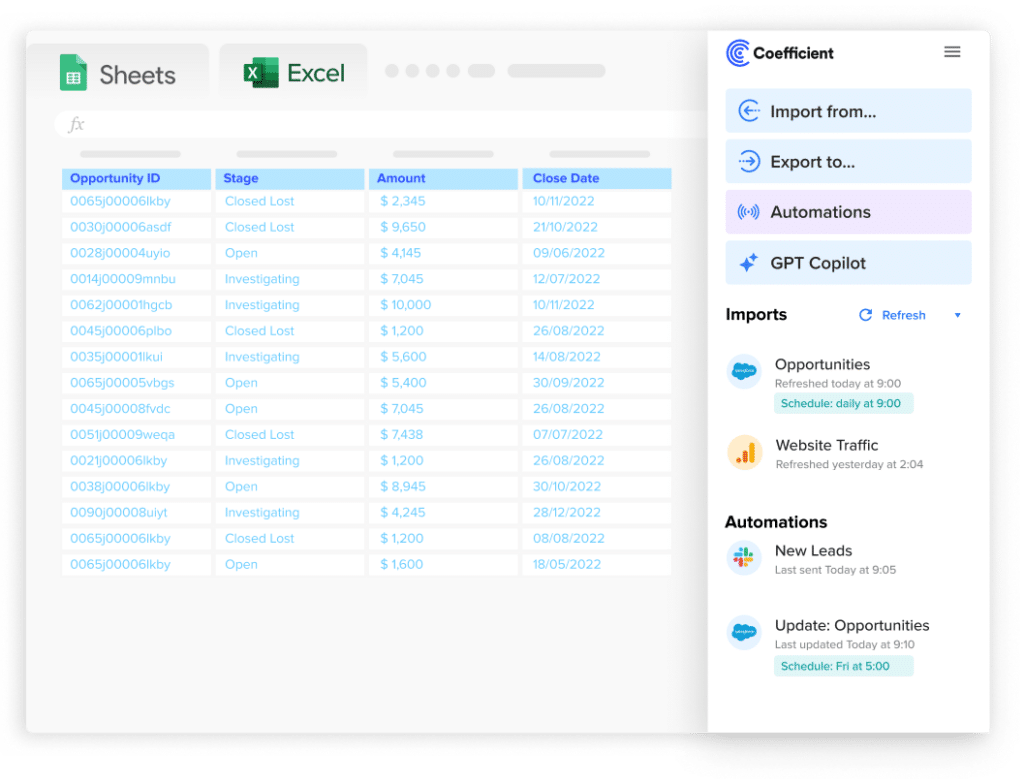
The platform lives as sidebar panels inside Google Sheets and Microsoft Excel. Click the Coefficient icon, select your system, choose what to import, and live data appears in seconds. No separate platform to learn, no web interface for pipeline configuration, no context-switching between tools. Brian Chalif, Head of BizOps at Mutiny, explains the reliability: “I never worry about reports being up-to-date and accurate anymore. At this point, after setting it up, Coefficient does most of the heavy lifting.”
With 500,000+ users across 50,000+ companies, Coefficient holds a 4.7-/5 rating on G2 with 143 reviews.

Earning awards including Best Relationship 2025, Fastest Implementation, and Users Love Us badges.
Why Coefficient outperforms both
Multi-entity consolidation meets cross-functional breadth. Liveflow specializes in consolidation. G-accon offers flexible sync. Coefficient delivers both PLUS the ability to incorporate sales, marketing, and operations data into consolidated views. When you’re consolidating five subsidiaries and need to analyze:
- Consolidated revenue by sales region
- By marketing channel
- By product line
All requiring data from different systems—Coefficient’s breadth becomes essential. At Solv Healthcare, seven FP&A analysts automated Salesforce, Looker, and QuickBooks imports, saving 364 hours per year. That’s the power of cross-functional data integration.
Two-way sync across ALL business systems, not just accounting. G-accon offers write-back to QuickBooks, Xero, Sage, and FreshBooks. Coefficient offers bidirectional connectivity with:
- Salesforce
- HubSpot
- Snowflake
- MySQL, PostgreSQL, SQL Server

Analyze sales pipeline in your spreadsheet alongside financial forecasts, then push opportunity stage updates back to Salesforce directly from your analysis. Update HubSpot records after reviewing marketing ROI. Push forecast updates to Snowflake after board review. Modify database tables based on operational planning. Neither Liveflow nor G-accon enables finance teams to operationalize insights across non-finance systems.
Truly live data, not scheduled batches. While Liveflow and G-accon both operate on scheduled refresh intervals, Coefficient provides live connections that update within seconds:
- Sales leaderboards reflect deals as they close
- Financial dashboards show today’s transactions, not data from last night’s batch job
- The Pro plan at $99/user includes hourly auto-refresh that runs continuously throughout the day
For finance teams tracking daily sales performance, monitoring current cash position, or running real-time operational dashboards, this responsiveness eliminates the blind spots that batch processing creates.

Native spreadsheet experience in BOTH Excel and Sheets. Liveflow requires learning their separate platform interface. G-accon works only in Google Sheets, excluding Excel teams entirely. Coefficient embeds as sidebar panels in BOTH Excel and Google Sheets:
- You work in the spreadsheet environment you already know
- Coefficient is just there when you need it
- For finance teams who prefer Excel’s advanced features or organizations with mixed spreadsheet preferences, this platform flexibility removes adoption barriers completely
Finance systems listed first, always. Under “integrations,” Coefficient leads with:
- NetSuite
- QuickBooks
- Sage Intacct
- Xero
Then extends to sales, marketing, and operations. In use cases, finance scenarios come first. In testimonials, CFOs and finance managers lead. This isn’t marketing positioning—it’s product philosophy. Sam Sholeff, CFO at Cyrq Energy, needed NetSuite connectivity and found Coefficient worked “out of the box” while another NetSuite connector “took us months.” That finance-first commitment means the integrations finance teams need are mature, supported, and prioritized.
AI that builds, not just answers. Neither Liveflow nor G-accon offers AI assistance. The AI Sheets Assistant in Coefficient doesn’t just respond to questions—it creates what you need using your business data:
- Ask it to “build a cash flow dashboard using QuickBooks data” and watch it construct the full dashboard with charts, pivots, and conditional formatting
- “Write a SQL query to find our top customers by revenue” and it generates executable code
- “Explain why gross margin changed” and it analyzes trends with context
Neither competitor offers this depth of AI-powered assistance.

Transparent pricing that scales predictably. Liveflow requires contacting sales. G-accon’s per-company pricing can escalate quickly for high-entity-count firms. Coefficient uses simple per-user licensing:
- Free plan with three sources
- Starter at $49/month with daily refresh
- Pro at $99/user/month with hourly refresh and live data
- Enterprise with custom volume discounts
No per-destination fees, no source restrictions, no hidden costs. Annual billing provides 17% off. Total cost scales with team size, not with number of entities or systems.
Proven ROI with quantified results. At Solv Healthcare, automation saved 364 hours annually across seven analysts—one full hour per week per person. Christian Budnik reports saving “at least a full day of work each month” on the accounting close. At Miro, Alexander Bugajski scaled RevOps from supporting 200 employees to 1,800 as the company grew 9x, with tasks that “once consumed hours each week accomplished in minutes.” These aren’t theoretical benefits—they’re documented time savings and business impact from finance, RevOps, and operations teams.
Enterprise security with both spreadsheet platforms. SOC 2 and ISO 27001 certifications provide enterprise-grade security. Support for both Google Sheets and Excel means organizations aren’t locked into single spreadsheet ecosystems. Admin controls, shared connections, and audit trails enable governance at scale. Coefficient meets the security, compliance, and manageability requirements that enterprise finance teams demand.
The verdict
Liveflow excels at purpose-built multi-entity consolidation. If you’re a private equity firm managing 30+ portfolio companies, a franchise organization with complex entity structures, or a construction company with project-based accounting—and your entire finance workflow centers on QuickBooks or Xero consolidation—Liveflow’s specialized approach delivers genuine value. The 4.9/5 G2 rating, premium support model, and customer testimonials about three-day time savings demonstrate real impact for their target audience.
G-accon offers flexible two-way sync for Google Sheets users. If you’re an accounting firm managing 25-50 client companies across QuickBooks, Xero, Sage, and FreshBooks—and your entire workflow lives in Google Workspace—G-accon’s native Sheets integration, transparent $125-250/month pricing, and bidirectional sync provide compelling value. The 20,000+ businesses and 600+ reviews across platforms reflect strong product-market fit for their positioning.
But both platforms share fundamental limitations:
- Neither offers cross-functional integrations beyond accounting systems
- Neither provides truly live data—only scheduled batch refreshes
- Neither is spreadsheet-native in both Excel and Sheets (Liveflow requires separate interface; G-accon excludes Excel)
- Neither offers AI assistance for dashboard building or insight generation
- Neither enables finance teams to operationalize insights by pushing updates back to CRM, data warehouses, or operational systems
When finance teams need sales pipeline context from Salesforce, marketing spend visibility from Google Ads, or operational metrics from Jira alongside accounting data, neither platform can help.
Coefficient addresses every gap:
- Live data connections update within seconds, eliminating batch lag
- Two-way sync works across Salesforce, HubSpot, Snowflake, and databases—not just accounting systems
- Spreadsheet-native sidebar panels in BOTH Excel and Google Sheets eliminate separate platforms to learn
- Finance-first positioning with NetSuite, QuickBooks, and Sage Intacct leads the integration list, then extends to 100+ systems spanning sales, marketing, and operations
- AI-powered assistance builds dashboards, writes queries, and explains trends
- Transparent per-user pricing scales predictably
Get started with Coefficient and experience what’s possible when your spreadsheet becomes your most powerful financial platform—with multi-entity consolidation, live connections, two-way sync, and cross-functional intelligence built specifically for finance teams that need the complete picture.