When you’re shopping for financial reporting software built specifically for QuickBooks and Xero, two names keep appearing: Liveflow and FathomHQ.
Both promise to streamline your multi-entity consolidation and automate your financial reporting. Both have passionate users and impressive capabilities. Yet they couldn’t be more different in their approach, pricing, or target audience.
Liveflow positions itself as the premium consolidation specialist:
- Commands $500+ per month with white-glove support
- Offers sophisticated automation for complex multi-entity scenarios
- Targets CFOs managing 15+ subsidiaries with regulatory complexity
FathomHQ takes the opposite approach:
- Beautiful pre-built dashboards starting at just $53 per month
- Designed for accounting firms and small business CFOs
- Emphasizes simplicity over sophistication
One tool is a Ferrari built for complex consolidation; the other is a reliable Toyota that gets most teams where they need to go.
But here’s what most comparison articles won’t tell you: both platforms share critical limitations that might make neither the right choice for your team. In this analysis, we’ll break down what each tool does well, where they fall short, and introduce a third option that combines financial reporting capabilities with cross-functional business intelligence—all within the spreadsheet environment your team already uses.
Liveflow overview

Liveflow has made a deliberate strategic choice: become the absolute best at multi-entity financial consolidation, even if it means doing nothing else. This laser focus has created a platform optimized for CFOs with genuinely complex consolidation requirements:
- Private equity firms managing portfolio companies
- Franchise networks with 15+ locations
- Mid-sized businesses with multi-tier ownership structures
The platform connects to QuickBooks Online and Xero, capturing every financial nuance with remarkable depth. When you link multiple entities, Liveflow automatically:
- Maps your charts of accounts across different entity structures
- Identifies inter-company transactions for elimination
- Handles currency translation across 160+ currencies with customizable exchange rates
What would typically take your senior accountant three hours of manual consolidation work happens in seconds with one click.
This sophistication extends to edge cases that make other platforms stumble:
- Complex ownership structures with minority interests? Liveflow calculates these automatically
- Multi-tier subsidiaries requiring sophisticated elimination logic? The platform handles it
- Regulatory reporting with specific formatting requirements? Liveflow generates consolidated financial statements ready for review
Customers consistently report saving 3-25 hours monthly, with Milk Moovement achieving a 4X faster month-end close after implementation.
The support experience matches the premium positioning. Liveflow provides:
- White-glove onboarding with dedicated success managers
- 9.8/10 support quality score on G2
- 30-second average response times for critical issues
This level of hand-holding matters when you’re implementing complex consolidation rules that directly impact regulatory reporting and board materials. The platform has earned a 4.9/5 rating across 300 G2 reviews, with customers praising the consolidation automation that previously consumed days of manual effort.
However, this specialization comes with significant constraints. Liveflow connects to exactly two accounting platforms—QuickBooks Online and Xero:
- No NetSuite support (critical for mid-market companies)
- No Sage Intacct or other ERP systems
- No connection to any CRM system, marketing platform, operational tool, or database
The platform excels at answering “what happened” in your financial statements but can’t explain “why it happened” because it lacks access to sales pipeline data, marketing performance metrics, or operational efficiency indicators. For finance teams who never need data beyond their accounting system, this limitation might not matter. For everyone else, it’s a fundamental constraint.
Pricing reflects the premium positioning but lacks transparency. You’ll need to schedule a demo to talk to sales. That said, third-parties tell us:
- Published estimates suggest $500+ per month in subscription fees
- Implementation costs around $2,500
- First-year total costs: $8,500-10,000+

That’s roughly 10x the cost of entry-level alternatives—justified if you genuinely need Liveflow’s sophisticated consolidation capabilities, but expensive if you’re looking for more comprehensive financial intelligence that extends beyond pure accounting data.
FathomHQ overview

FathomHQ takes a radically different approach to financial reporting: make accounting-only analysis accessible, beautiful, and affordable. Rather than building for complex edge cases, FathomHQ focuses on:
- Delivering pre-built dashboards ready to use
- Providing world-class cash flow forecasting
- Offering professionally formatted reports that accounting firms can white-label for clients
The result is a platform that 95,000+ businesses worldwide have adopted, including all of the Big 4 accounting firms—Deloitte, PwC, KPMG, and BDO.
The platform’s strength lies in visual polish and ready-to-use financial analytics. You get:
- 90+ pre-configured charts covering everything from profitability trends to liquidity ratios
- 50+ pre-built financial KPIs that track efficiency, growth, and performance automatically
- Professionally formatted reports investor-ready right out of the box
Reports are white-label ready with branding options that accounting firms use to create impressive client deliverables. As Robin Joe Kong, Advisor at NBC, notes: “A great product, simple to use, even for people with no financial background.”
Where FathomHQ truly shines is cash flow forecasting. The platform offers what customers describe as “absolutely world-class” three-way forecasting:
- Integrates P&L, balance sheet, and cash flow projections into unified scenarios
- Extends up to 36 months ahead for long-term planning
- Driver-based models where assumptions like customer growth rates or pricing changes flow through all three financial statements automatically
You can test sensitivity and plan for multiple scenarios. David Maher, Director at Right Brain Insights, calls it “incredibly powerful and incredibly valuable.”
Multi-entity consolidation capabilities are surprisingly robust for a platform at this price point. FathomHQ handles:
- Up to 300 entities with 95+ currency support
- Automatic chart of accounts mapping and intercompany elimination workflows
- Group benchmarking to compare and rank companies side-by-side
All of this comes with unlimited users at every pricing tier, making it economical for accounting firms with multiple staff members accessing client data.
Integration coverage includes six accounting platforms:
- QuickBooks Desktop
- QuickBooks Online
- Xero
- MYOB
- Sage
- Access Financials UK
The connections pull transaction-level detail with sophisticated handling of complex chart of accounts structures, giving you the full accounting picture rather than surface-level summary data. However, “full accounting picture” is precisely the constraint—FathomHQ connects exclusively to accounting software and nothing else.
Pricing follows a per-company model:
- Starter plan: $53/month for one company
- Silver plan: $280/month for 10 companies
- Gold plan: $400/month for 25 companies
- Platinum plan: $720/month for 50 companies

Accounting firms benefit from Portfolio pricing:
- $62/month for 100 companies
- $370/month for 300 companies
- $500/month for unlimited companies
Every plan includes unlimited users, unlimited reports, and full feature access—no tiered restrictions or add-on fees.
The platform operates as a standalone web application requiring its own login and interface. You’re not working in Excel or Google Sheets; you’re working in FathomHQ’s specialized financial reporting environment:
- You can export data to spreadsheets, but you lose live connectivity
- You lose the automated refresh capabilities that make the platform valuable
- For finance teams who spend most of their day in spreadsheets, this represents friction and context switching
Head-to-head comparison
Data source support
The integration landscape reveals each platform’s strategic priorities.
Liveflow connects to exactly two accounting systems:
- QuickBooks Online with exceptionally deep integration
- Xero with strong but slightly less mature support
- Both capture custom fields, specialized reports, transaction details, and complex account structures
FathomHQ casts a slightly wider net with six accounting platform connections:
- QuickBooks Desktop and Online
- Xero
- MYOB (popular in Australia/New Zealand)
- Sage
- Access Financials UK (UK market)
Like Liveflow, these connections pull transaction-level detail with sophisticated handling of financial data quality. You’re getting the full accounting picture, not surface-level summaries.
What neither platform connects to is far more significant than what they support:
- Neither integrates with NetSuite—a critical gap for mid-market companies
- Neither touches CRM systems (Salesforce, HubSpot)
- Neither connects to marketing platforms (Google Ads, Facebook)
- Neither accesses operational tools (Jira, Zendesk)
- Neither links to databases (PostgreSQL, MySQL) or data warehouses (Snowflake, BigQuery)
Both exist in accounting-only silos.
Multi-entity/company reporting
Both platforms excel at multi-entity consolidation but take distinctly different approaches.
Liveflow builds consolidation automation for complex scenarios:
- Multi-tier ownership structures with sophisticated elimination logic
- Regulatory reporting requirements that demand precision
- Automatic chart of accounts mapping even when they differ across subsidiaries
- 160+ currencies with customizable exchange rates and automatic translation
Customers like Roberto Carroz report saving three days monthly on consolidation work that now completes in seconds.
FathomHQ provides robust consolidation:
- Up to 300 entities with 95+ currency support
- Automatic chart mapping for standard scenarios
- Group benchmarking to compare and rank companies side-by-side
While it lacks some of Liveflow’s sophistication around minority interests and multi-tier structures, it handles the consolidation scenarios that 90% of businesses actually face. The group benchmarking feature adds unique value—perfect for franchise networks or accounting firm portfolios.
The pricing models reflect their consolidation philosophies:
Liveflow:
- Premium subscription fees ($500+ monthly)
- Covers unlimited entities within your consolidation package
FathomHQ:
- Scales per company: one company at $53/month, 10 at $280/month, 25 at $400/month
- Portfolio pricing: $500/month for unlimited companies (highly economical for accounting firms)
Reporting capabilities
Liveflow focuses on delivering consolidated financial statements:
- P&L, balance sheet, and cash flow with polish and precision
- Board-ready presentations and regulatory filing formats
- Professional-grade financials ready for review
- FinanceIQ budgeting workflows for variance analysis
FathomHQ dominates the visual reporting category:
- 90+ ready-to-use charts covering profitability, liquidity, efficiency, and growth
- 50+ pre-configured financial KPIs tracking key metrics automatically
- White-label branding for accounting firms creating client-ready deliverables
- Automated scheduling sends reports via email on any cadence
As Tricia O’Connor, Founder of O’Connor CPA Firm, notes: “A game changer for businesses that are ready to propel their growth and profitability.”
FathomHQ’s standout capability is cash flow forecasting:
- Three-way forecasting integrates P&L, balance sheet, and cash flow
- 36-month scenarios for long-term strategic planning
- Driver-based models where assumptions flow through all statements automatically
- Sensitivity testing across multiple scenarios
Liveflow offers basic forecasting and budgeting but can’t match FathomHQ’s forecasting depth.
Pricing and value
The pricing gap between these platforms is dramatic.
Liveflow operates at premium positioning:
- $500+ monthly subscription (estimates)
- $2,500 implementation fees
- First-year total costs: $8,500-10,000+
- Pricing isn’t published transparently; you contact sales for quotes
This premium reflects specialized consolidation automation, white-glove support, and sophisticated edge case handling. If you’re managing 15+ subsidiaries with complex ownership structures and regulatory reporting requirements, the ROI calculation might justify this investment.
FathomHQ provides transparent per-company pricing:
- $53/month for one company
- $280/month for 10 companies
- $400/month for 25 companies
- $720/month for 50 companies
Accounting firms benefit from Portfolio pricing:
- $500/month for unlimited companies
Every plan includes:
- Unlimited users
- Unlimited reports
- Full feature access
There are no tiered restrictions, add-on fees, or hidden costs.
Platform and user experience
Both Liveflow and FathomHQ operate as standalone web applications:
- Require separate logins and platform-specific interfaces
- You’re not working in your familiar spreadsheet environment
- You’re working in specialized financial reporting platforms
This architecture offers advantages:
- Purpose-built interfaces optimized for financial workflows
- No spreadsheet performance limitations
- Visual polish that’s difficult to achieve in Excel or Google Sheets
But it also introduces friction:
- Context switching between tools
- Platform learning curves
- Inability to blend financial analysis with other spreadsheet-based work
Liveflow’s interface focuses on consolidation workflows:
- Dashboards displaying consolidated financials, elimination entries, and variance analysis
- Requires substantial training according to customer reviews
- White-glove onboarding with dedicated success managers helps teams get up to speed
FathomHQ emphasizes visual simplicity:
- Pre-built dashboards and charts require minimal configuration
- Earns praise for being “simple to use, even for people with no financial background”
- Multi-channel support: email, live chat, phone
- Comprehensive documentation and regular training webinars
Automation and refresh
Both platforms rely on scheduled batch processing for data updates.
Liveflow:
- Consolidations run on schedules or on-demand
- Pulling fresh data from QuickBooks and Xero when triggered
- The consolidation automation itself happens in seconds
- You’re always working with data as of the last refresh—not real-time activity
For month-end close workflows and periodic financial reporting, this scheduled approach works well. For real-time monitoring of current business performance, it’s limiting.
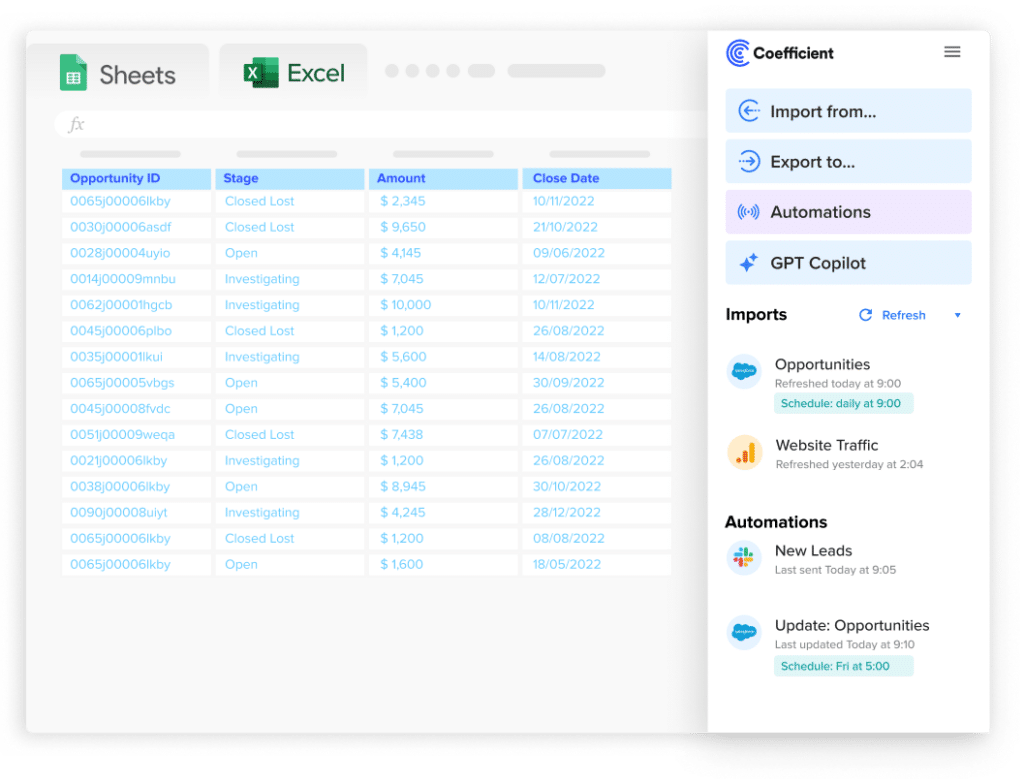
Stop exporting data manually. Sync data from your business systems into Google Sheets or Excel with Coefficient and set it on a refresh schedule.
Get Started
FathomHQ:
- Uses scheduled syncs based on accounting software API availability
- Your dashboards and reports reflect data from the last sync
- Emphasizes automated report scheduling—delivering formatted financial reports via email
- This automation eliminates manual report distribution but doesn’t provide truly live data connectivity
Neither platform offers two-way sync or write-back capabilities:
- Both are fundamentally extraction and reporting tools
- They pull data from accounting systems into their respective platforms
- They can’t push data back to source systems
- You can’t push approved budgets back to QuickBooks or update financial plans in your ERP
The limitations both platforms share
Despite their different approaches and price points, Liveflow and FathomHQ share several fundamental constraints that limit their utility for modern finance teams.
Both operate as standalone platforms rather than spreadsheet-native tools:
- This creates inevitable friction: you log into separate systems
- You learn platform-specific interfaces
- You work outside the spreadsheet environment where you spend most of your day
- When you need to combine financial analysis with other spreadsheet-based work, you’re forced to export data and manually bridge between systems
The integration scope represents an even more significant limitation:
- Liveflow connects to two accounting systems
- FathomHQ connects to six accounting systems
- Neither platform extends beyond accounting software to touch CRM, marketing, operations, databases, or data warehouses
Modern financial analysis rarely stays within accounting system boundaries. When you’re building Q4 revenue forecasts, you need:
- Accounting history from QuickBooks
- Sales pipeline probabilities from Salesforce
- Marketing lead trends from HubSpot
- Customer usage patterns from your data warehouse
Neither Liveflow nor FathomHQ can answer cross-functional business questions that require blending financial, sales, marketing, and operational data.
NetSuite support represents a critical gap for both platforms:
- Mid-market companies adopt NetSuite specifically for multi-entity consolidation
- They need international operations and sophisticated financial reporting
- Companies graduate from QuickBooks to NetSuite and suddenly discover that neither Liveflow nor FathomHQ can connect
- The platforms become unusable at the exact moment when growing businesses need them most
Neither platform offers AI capabilities:
- No AI copilot to generate formulas
- No conversational query interface to ask business questions in natural language
- No automated insight generation to flag trends or anomalies
- You’re building everything manually using platform-specific workflows
Both platforms operate on scheduled batch processing:
- Your dashboards show data as of the last refresh
- Adequate for retrospective analysis but limiting for real-time monitoring
- You can’t see current-state business performance
- You’re always working with slightly stale data
Enter Coefficient: a superior alternative

What if you didn’t have to choose between Liveflow’s consolidation sophistication and FathomHQ’s affordability? What if one platform delivered:
- Professional-grade financial reporting
- Cross-functional intelligence that neither specialized tool provides
- All within the spreadsheet environment your team already uses
Coefficient takes a fundamentally different approach to financial analysis. Rather than building another standalone platform, Coefficient works as a native add-on directly inside Google Sheets and Excel:
- Connects live data from 100+ business systems
- Includes financial, CRM, marketing, operational, and database sources
- You build reports and dashboards using spreadsheet skills your team already has
- Pull fresh data from QuickBooks, NetSuite, Salesforce, and dozens of other systems without leaving your familiar spreadsheet environment
The platform handles multi-entity financial consolidation through flexible spreadsheet formulas:
- Import data from each QuickBooks or NetSuite entity
- Use standard consolidation techniques to aggregate and eliminate inter-company transactions
- This approach requires more initial setup than Liveflow’s one-click consolidation
- But provides complete transparency and flexibility at a fraction of the cost
What Coefficient adds beyond financial reporting is comprehensive business intelligence:
- Connect QuickBooks for financial actuals
- Add Salesforce for sales pipeline forecasts
- Layer in HubSpot for marketing lead trends
- Include Google Analytics for conversion metrics
- Pull Stripe for subscription revenue patterns
All in one spreadsheet dashboard. When revenue declines 12%, you don’t just see the financial result; you understand the operational drivers because sales, marketing, and financial data sit together in unified analysis.
Christian Budnik, FP&A Analyst at Solv, saved 364 hours annually by automating Salesforce-to-Google Sheets integration with Coefficient: “Instantly felt an incredible amount of peace of mind. All I had to do was click a button, and in seconds, all my Salesforce data appeared.” That’s the value of cross-functional connectivity that finance-only tools fundamentally cannot deliver.

Why Coefficient outperforms both
Advantages over Liveflow
Coefficient matches Liveflow’s financial consolidation capabilities for the 90% of scenarios that don’t require extreme edge case handling, while adding comprehensive cross-functional intelligence at a fraction of the cost.
Pricing advantage:
- Liveflow charges $500+ monthly plus $2,500 implementation fees
- Coefficient delivers transparent per-user pricing starting at $49/month with no implementation costs
- A five-person finance team pays approximately $4,956 annually versus Liveflow’s $8,500-10,000+ first year
- You get 100+ integrations instead of two

NetSuite integration represents a critical advantage:
- Coefficient connects to NetSuite (Premium tier)
- Liveflow does not support NetSuite
- For mid-market finance teams who’ve graduated from QuickBooks to NetSuite, Liveflow’s inability to connect is a dealbreaker
As Michael Kolodin at Cyrq Energy discovered, Coefficient’s NetSuite integration with automated refresh delivered “$50,000+ annual savings” compared to enterprise alternatives.
Beyond financial systems, Coefficient extends to:
- CRM: Salesforce, HubSpot, Pipedrive
- Marketing: Google Ads, Facebook, LinkedIn
- Operations: Jira, Asana, Zendesk
- Databases: Snowflake, PostgreSQL, BigQuery, MySQL
Liveflow exists in a finance-only silo; Coefficient enables comprehensive business intelligence. When you need to understand not just what happened financially but why it happened operationally, that cross-functional breadth becomes essential.
The spreadsheet-native architecture eliminates Liveflow’s platform learning curve:
- You work directly in Excel or Google Sheets using formulas and techniques your team already knows
- Sam Sholeff at Cyrq Energy: “Coefficient worked right out of the box. It was immediately clear how to use it without needing extensive training or support”
- A stark contrast to Liveflow’s substantial training requirements and white-glove onboarding dependency
Advantages over FathomHQ
Coefficient extends beyond FathomHQ’s six accounting-only integrations:
- Connects financial, sales, marketing, operational, and database systems
- Where FathomHQ provides beautiful pre-built dashboards focused exclusively on accounting metrics
- Coefficient enables custom cross-functional dashboards that blend financial results with operational context

Platform flexibility advantage is significant:
- FathomHQ operates as a standalone web application
- Coefficient works natively in both Excel and Google Sheets with identical functionality
- Organizations split between platforms don’t need to choose—Coefficient serves both equally
- You’re not learning a new interface; you’re enhancing the spreadsheet environment where you already spend your time
Two-way sync capabilities set Coefficient apart fundamentally:
- FathomHQ is strictly read-only extraction
- Coefficient offers bidirectional connectivity with Salesforce, HubSpot, Snowflake, and databases
You can:
- Update CRM opportunity stages after pipeline reviews
- Push budget scenarios to data warehouses
- Write calculated fields to operational systems
- Close loops between spreadsheet planning and system execution
FathomHQ pulls data; Coefficient enables operational workflows.
AI capabilities:
- FathomHQ advertises no AI capabilities
- Coefficient’s AI Sheets Assistant provides copilot functionality:
- Generates formulas from natural language
- Writes SQL queries for database connections
- Builds pivot tables and dashboards automatically
- Suggests insights with context
This democratizes data access for team members who lack advanced spreadsheet or SQL skills.
Unique features neither competitor offers
Coefficient delivers capabilities that neither Liveflow nor FathomHQ can match:
- NetSuite integration on the Premium tier—critical for mid-market companies that both competitors abandon
- Two-way sync with six major systems transforms spreadsheets from reporting tools into operational interfaces
- AI Sheets Assistant accelerates analysis and democratizes access
- Hourly auto-refresh plus on-demand manual refresh provides near-real-time data versus scheduled batch processing
- Works identically in Excel and Google Sheets, serving organizations regardless of their spreadsheet preference
The verdict
Liveflow and FathomHQ excel within narrow boundaries:
Liveflow:
- Delivers the most sophisticated consolidation automation for complex edge cases at premium pricing
- Best for CFOs managing 15+ subsidiaries with regulatory complexity
FathomHQ:
- Provides beautiful financial reporting and world-class cash flow forecasting at accessible costs
- Best for accounting professionals who need visual polish and unlimited user access
Both serve specific audiences well. But both exist in accounting-only silos that increasingly limit their value:
- Neither connects beyond financial systems to CRM, marketing, operations, or databases
- Neither supports NetSuite, creating dealbreaker gaps for mid-market growth
- Neither offers spreadsheet-native workflows, AI capabilities, or two-way sync
For finance teams who need comprehensive business intelligence rather than accounting-only reporting, these limitations become insurmountable.
Coefficient reframes the comparison entirely:
Rather than choosing between consolidation sophistication and reporting simplicity, you get:
- Professional-grade financial capabilities that handle what 90% of teams actually need
- Cross-functional intelligence that neither specialized platform provides
- Work in spreadsheets your team already knows
- Access 100+ integrations at mid-range per-user pricing with complete transparency
Modern finance teams don’t just need to know what happened—they need to understand why it happened and what’s coming next. That requires:
- Financial data from QuickBooks or NetSuite
- Sales pipeline context from Salesforce
- Marketing performance indicators from Google Ads
- Operational metrics from Jira or Zendesk
One platform can deliver all of it, natively in your spreadsheets, with live data and AI assistance.
Get started with Coefficient and experience what’s possible when your spreadsheet becomes your most powerful data platform—with live connections, two-way sync, and comprehensive business intelligence that goes far beyond what specialized financial reporting tools can deliver.
Connect your first data source in minutes. No implementation fees. No platform training. No constraints.