Data teams face a tough choice today. You need to move data fast and clean. But most tools make you pick between simple or powerful.
Integrate.io tries to solve this. It offers drag-and-drop ease with serious ETL power. But its $1,999 monthly price tag hits hard. The learning curve still exists. And some teams need different approaches entirely.
Here’s what you’ll find: Nine strong alternatives that match different needs, budgets, and team types. Some cost less. Others offer more power. A few work in totally new ways.
What is Integrate.io?
Integrate.io is a cloud-based data integration platform. It was built in 2012 to make ETL work simpler. The company focuses on low-code data pipelines that both tech and business users can manage.
Core features
200+ connectors link to databases, cloud storage, SaaS apps, and analytics platforms:
- Databases: MySQL, PostgreSQL, Oracle, SQL Server
- Cloud storage: AWS S3, Google Cloud Storage, Azure Blob
- SaaS applications: Salesforce, HubSpot, Zendesk, Shopify
- Analytics platforms: Google Analytics, Adobe Analytics, Mixpanel
Drag-and-drop interface lets you build pipelines without coding:
- Visual pipeline builder with pre-built components
- Point-and-click data mapping and transformation
- Template library for common integration patterns
- No SQL or programming knowledge required for basic pipelines
220+ transformation options handle data cleaning and reshaping:
- Data type conversions and format standardization
- Field mapping and column renaming
- Filtering, aggregation, and calculation functions
- Custom business logic through visual interfaces
The platform supports ETL, ELT, reverse ETL, and change data capture (CDC) for comprehensive data movement scenarios.
Real-time processing handles everything from small datasets to billions of rows:
- Streaming data ingestion with sub-second latency
- Batch processing for large historical datasets
- Incremental updates to minimize processing overhead
- Auto-scaling infrastructure for variable workloads
Enterprise security includes:
- SOC 2 Type II compliance certification
- GDPR and HIPAA compliance features
- Data encryption in transit and at rest
- Role-based access controls and audit logging
Pricing model
Integrate.io uses fixed-fee pricing starting at $1,999 per month:
- Unlimited data volume and pipeline processing
- Unlimited users and concurrent pipelines
- All 200+ connectors included
- 14-day free trial with full feature access
- Custom enterprise plans add advanced security and compliance features
Typical use cases
Marketing teams sync Salesforce data with Google Ads for better attribution:
- Lead scoring and campaign performance optimization
- Customer journey tracking across multiple touchpoints
- ROI analysis combining CRM and advertising data
Sales operations teams create automated pipeline reports:
- Real-time sales performance dashboards
- Territory analysis and quota tracking
- Commission calculations with automated data feeds
Finance departments consolidate data from Stripe, QuickBooks, and other systems:
- Revenue reporting and financial close automation
- Cash flow forecasting with real-time transaction data
- Compliance reporting for audit requirements
Customer success teams build 360-degree customer views:
- Combining CRM, support ticket, and product usage data
- Churn prediction and customer health scoring
- Automated renewal and upsell opportunity identification
Why look for Integrate.io alternatives?
Despite its strengths, Integrate.io has clear limitations that push teams toward alternatives.
High fixed costs
$1,999 monthly minimum works well for high-volume users but creates challenges for smaller teams:
- Smaller teams or seasonal businesses pay too much for limited usage
- No usage-based pricing options for cost optimization
- Competitors offer more flexible pricing that scales with actual needs
- ROI justification becomes difficult for moderate data volumes
Documentation and learning curve
Fragmented documentation slows new user adoption:
- Generic error messages make troubleshooting difficult
- Learning resources scattered across multiple platforms
- Low-code promise still requires technical knowledge for complex transformations
- User onboarding takes longer than expected
Limited flexibility
The fixed-fee model doesn’t fit all scenarios:
- Some teams need pay-as-you-go pricing for variable workloads
- Others want more granular cost control by data source or pipeline
- One-size-fits-all approach misses diverse business requirements
- Limited customization options for unique use cases
Platform complexity
While easier than traditional ETL tools, Integrate.io still requires dedicated platform learning:
- Business users must context-switch between daily tools and integration platform
- Setup and maintenance require ongoing technical attention
- Complex transformations still need significant technical expertise
- User adoption challenges across non-technical teams
Scalability concerns
Some users report performance issues at extreme volumes:
- Platform works well within normal ranges but hits limits with massive datasets
- Complex transformations can slow processing significantly
- Limited optimization options for high-performance scenarios
- Support response times vary for performance issues
Top 9 Integrate.io alternatives
1. Fivetran – The ELT-first enterprise choice

Fivetran leads the automated data integration market. Founded in 2012, it focuses on fully automated ELT with minimal maintenance needs.
Core capabilities:
- 700+ connectors cover every major data source and destination
- Automatic schema detection and drift handling
- Sync frequencies down to one-minute intervals for enterprise customers
- All major data warehouses and lakes supported as destinations
Automated reliability sets Fivetran apart:
- Platform handles connector maintenance and API changes automatically
- Schema drift managed without manual intervention
- “Set it and forget it” approach appeals to analysis-focused data teams
- High uptime and reliability for mission-critical data pipelines
Pricing structure:
- Uses Monthly Active Rows (MAR) charged per connector
- Free tier includes 500K MAR and 5K monthly model runs
- Standard plans start at $500 for the first million MAR
- Enterprise plans begin at $666.67 with one-minute syncs and priority support
Target audience:
- Data-mature organizations with technical teams and substantial data volumes
- Companies prioritizing automation over customization
- Enterprise customers with complex compliance needs
- Teams focused on analysis rather than pipeline management
Best for: Enterprise-scale automation with proven reliability when budget allows for premium data integration.
Strengths:
- Largest connector library in the market
- Proven reliability and uptime track record
- Minimal maintenance requirements
- Strong enterprise features and security
- Market leadership position with extensive customer base
Weaknesses:
- Higher costs at scale compared to alternatives
- Limited customization options for unique requirements
- Per-connector pricing complexity and unpredictability
- Primarily ELT-only approach limits flexibility
- Less suitable for non-technical users
2. Airbyte – The open-source flexibility champion

Airbyte disrupts traditional data integration with open-source foundation and community-driven development. Founded in 2020, it quickly gained traction with engineering-first teams.
Core capabilities:
- 600+ connectors (550+ on cloud) provide extensive source coverage
- Open-source core allows complete customization and eliminates vendor lock-in
- Flexible deployment options include self-hosted, cloud, and enterprise versions
- Singer framework integration provides additional flexibility
Community-driven development:
- Community contributions drive rapid connector development
- Engineers can build custom connectors or modify existing ones
- Active GitHub community with regular updates and improvements
- Singer framework integration provides additional connector options
Pricing structure:
- Open-source version completely free but requires self-hosting
- Cloud version uses usage-based credits starting at $10 monthly
- Database processing costs $10 per GB
- File processing also runs $10 per GB
Target audience:
- Engineering-first organizations with strong technical capabilities
- Cost-conscious teams seeking flexibility and control
- Companies requiring custom connectors or specialized processing logic
- Teams comfortable with open-source infrastructure management
Best for: Technical teams wanting maximum flexibility with cost control and customization options.
Strengths:
- No vendor lock-in with open-source foundation
- Large connector ecosystem with active development
- Flexible deployment options (self-hosted, cloud, hybrid)
- Lower costs for technical teams willing to self-manage
- Active community development and support
Weaknesses:
- Requires technical expertise for setup and maintenance
- Self-hosted infrastructure management responsibilities
- Varying connector quality across community contributions
- Limited business user friendliness
- Steeper learning curve compared to managed platforms
3. Coefficient – The spreadsheet-native data integration solution

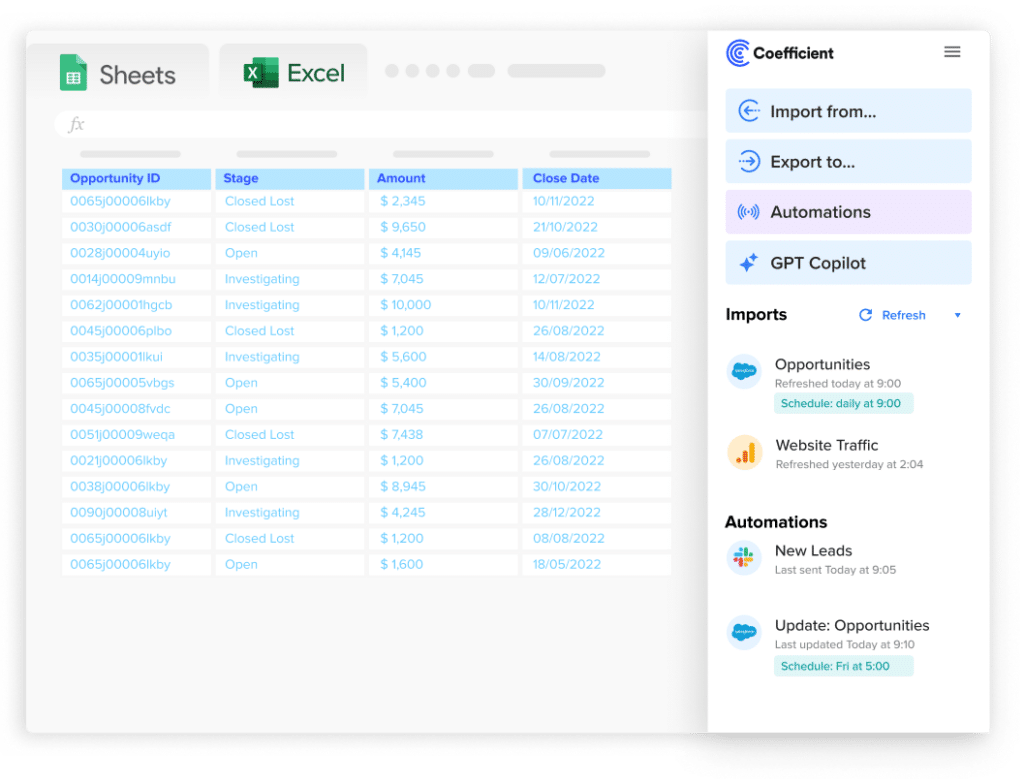
Coefficient takes a completely different approach to data integration. Instead of forcing teams to learn new platforms, it brings live data directly into Excel and Google Sheets.
Core capabilities:
- 70+ business system connectors include Salesforce, HubSpot, Stripe, Google Analytics, and other popular tools
- Real-time data refresh keeps spreadsheets updated automatically on scheduled intervals
- No-code formula-based transformations work within familiar spreadsheet functions
- Native integration with existing spreadsheet workflows and formulas
AI-powered features:
- AI Sheets assistant provides instant analysis and insights on connected data
- Natural language queries for data exploration and analysis
- Automated reporting creates dashboards and summaries without leaving spreadsheet environment
- Intelligent chart and visualization suggestions based on data patterns
Spreadsheet-native approach:
- Eliminates context switching entirely between tools and platforms
- Teams work in tools they already know and use daily
- Learning curve approaches zero because interface is Excel or Google Sheets
- Native collaboration through spreadsheet sharing and commenting
Real-world applications:
- Marketing managers get live campaign data in their Excel reports
- Sales ops teams build pipeline forecasts with real-time Salesforce data
- Finance departments create budgets with automated data feeds from accounting systems
- Executive teams access live KPI dashboards without new tool adoption
Business user accessibility:
- No technical setup required for end users
- Teams work in familiar spreadsheet interfaces they use daily
- Instant adoption without training or onboarding
- Self-service data access without IT bottlenecks
Pricing structure:
- Starts at $99 per month per user with transparent, predictable costs
- No minimum commitments or hidden usage fees
- Enterprise plans add advanced security and administration features
- Free tier available for basic connections and testing
Target audience:
- Business users, analysts, and teams who live in spreadsheets daily
- Marketing managers building campaign reports and performance dashboards
- Sales operations teams creating pipeline analysis and territory reporting
- Finance departments managing budgets, forecasts, and financial reporting
- Executive teams wanting live KPI dashboards without platform complexity
Customer success examples:
- Marketing teams automate monthly performance reports by connecting Google Ads, Facebook, and Salesforce data directly to existing Excel templates
- Sales operations creates live pipeline forecasts that update automatically as deals progress in CRM
- Finance departments build rolling budgets with real-time expense data from accounting systems
- Executive dashboards display live business metrics without learning new BI tools
Best for: Teams who live in spreadsheets and want live data without platform complexity, training requirements, or expensive minimums.
Strengths:
- Zero learning curve for spreadsheet users
- Eliminates context switching between tools
- Works in familiar Excel and Google Sheets interfaces
- Transparent pricing without usage complexity
- Instant team adoption without training
- AI-powered analysis and insights
- Real-time collaboration through native spreadsheet features
Weaknesses:
- Limited to spreadsheet environments and capabilities
- Advanced ETL transformations may require additional tools
- Focused on business users rather than data engineers
- Newer platform with growing but smaller connector library
- Large dataset handling constrained by spreadsheet limitations
4. Stitch Data – The simple, affordable ELT option

Stitch Data offers developer-friendly ETL/ELT with Singer framework integration. Owned by Talend (now part of Qlik), it targets mid-market teams seeking simplicity.
Core capabilities:
- 130+ connectors built on Singer framework provide solid source coverage
- Batch processing handles data movement with 30-minute minimum intervals
- API access enables programmatic pipeline management and automation
- 11 major data warehouse destinations cover most common requirements
Technical approach:
- Singer integration allows custom connector development and modifications
- Developer-focused approach appeals to technical teams comfortable with code
- JSON-based configuration provides flexibility for custom requirements
- Talend backing provides enterprise support and roadmap stability
Pricing structure:
- Generous free tier with 5 million rows monthly processing
- Standard plans start at $100 monthly ($83.33 annually)
- Advanced tier costs $1,250 monthly ($1,041.67 annually)
- Premium reaches $2,500 monthly ($2,083.33 annually)
Target audience:
- Mid-market companies with moderate technical capabilities
- Teams using Singer ecosystem find natural integration
- Organizations needing simple, predictable ETL without complexity
- Developers comfortable with JSON configuration and API management
Best for: Simple, affordable ETL with developer-friendly tools and Singer framework compatibility.
Strengths:
- Singer framework flexibility and ecosystem compatibility
- Competitive mid-market pricing with transparent tiers
- Developer-friendly tools and API access
- Qlik enterprise backing provides stability
- Solid documentation and community support
Weaknesses:
- Batch-only processing without real-time capabilities
- Manual schema drift handling requires ongoing maintenance
- Fewer connectors than market leaders
- Limited scalability for high-volume scenarios
- Pricing escalates quickly for large data volumes
5. Matillion – The cloud data warehouse specialist
Matillion focuses on cloud-native ETL/ELT with AI-powered automation. Founded in 2011, it targets modern data stack organizations.
Core capabilities:
- Extensive connector library covers major cloud and SaaS platforms
- AI integration through Maia automates pipeline creation and optimization
- Visual drag-and-drop interface combines with code options for flexibility
- Purpose-built for cloud data platforms like Snowflake, BigQuery, and Redshift
Advanced features:
- Both ETL and ELT processing adapts to different use cases and requirements
- SQL, Python, and dbt integration provides multiple development options
- Cloud-native architecture scales automatically with processing needs
- Advanced transformation capabilities for complex business logic
Pricing structure:
- Credit-based pricing starts with Developer tier at $2.50 per credit for 2 users
- Basic tier adds standard support for 5 users
- Advanced tier includes enhanced features for growing businesses
- Enterprise tier provides custom pricing with advanced governance
Target audience:
- Cloud-first organizations with modern data warehouse investments
- Data teams seeking both visual and code-based development options
- Companies requiring AI-powered automation and optimization
- Teams heavily invested in cloud data platforms
Best for: Organizations heavily invested in cloud data warehouses who want AI-powered pipeline automation.
Strengths:
- Strong cloud-native architecture and performance
- AI-powered pipeline creation and optimization
- Flexible development options (visual and code)
- Excellent cloud data platform integration
- Modern interface with good user experience
Weaknesses:
- Credit-based pricing unpredictability
- Complex features require significant learning curve
- Primarily cloud-focused with limited on-premises support
- Newer AI features may have limitations
- Higher costs than simpler alternatives
6. Hevo Data – The no-code automation leader
Hevo Data provides automated data pipelines with maximum business user friendliness. Founded in 2017, it targets teams wanting Fivetran capabilities at lower costs.
Core capabilities:
- 150+ pre-built connectors cover major business applications and databases
- Automated ELT processing includes real-time streaming capabilities
- No-code pipeline setup requires no technical expertise or configuration
- Python and dbt transformations add flexibility when advanced logic needed
Automation features:
- Automated schema management handles drift and changes automatically
- GUI-based transformations work alongside code options for flexibility
- Real-time monitoring provides alerts and pipeline health visibility
- Error handling and retry logic built into platform
Pricing structure:
- Free tier includes 1 million events monthly with limited connectors
- Starter and Professional tiers both cost $499 monthly ($599 without annual discount)
- Business Critical tier uses custom pricing for advanced security needs
- Transparent pricing without hidden usage fees
Target audience:
- Growing companies with moderate data volumes and budget constraints
- Non-technical teams requiring automated solutions without complexity
- Organizations seeking cost-effective Fivetran alternatives
- Teams prioritizing ease of use over advanced customization
Best for: Maximum automation with business-user friendliness at competitive prices.
Strengths:
- True no-code experience for business users
- Competitive mid-market pricing with transparent tiers
- Good customer support and documentation
- Automated schema management reduces maintenance
- Growing connector library with regular additions
Weaknesses:
- Fewer connectors than market leaders
- Limited customization options for complex requirements
- Less enterprise-grade features compared to larger platforms
- Smaller market presence and customer base
- Advanced transformations require technical knowledge
7. Talend – The enterprise open-source veteran
Talend offers comprehensive data integration with enterprise governance features. Acquired by Qlik in 2023 for $2.4 billion, it targets large organizations with complex needs.
Core capabilities:
Stop exporting data manually. Sync data from your business systems into Google Sheets or Excel with Coefficient and set it on a refresh schedule.
Get Started
- Extensive data integration capabilities span ETL/ELT across cloud, on-premises, and hybrid environments
- Data quality tools include profiling, cleansing, and monitoring features
- Governance capabilities provide lineage, cataloging, and compliance management
- Comprehensive data management beyond simple integration
Platform options:
- Open-source core (Talend Open Studio) provides free basic functionality
- Enterprise versions add advanced features, cloud capabilities, and support
- Qlik integration enables seamless analytics workflows
- Hybrid deployment supports complex enterprise infrastructure
Pricing structure:
- Open-source version free but limited in capabilities
- Cloud Starter ranges $12,000-$30,000 annually
- Cloud Premium reaches $50,000-$100,000 yearly
- Enterprise Data Fabric costs $150,000-$500,000+ depending on scope
Target audience:
- Large enterprises with complex data environments and governance requirements
- Organizations requiring comprehensive data management platforms
- Companies with hybrid cloud/on-premises infrastructure
- Teams needing advanced compliance and audit capabilities
Best for: Large enterprises needing comprehensive data management with strong governance and compliance features.
Strengths:
- Comprehensive data management platform beyond ETL
- Strong enterprise governance and compliance features
- Hybrid deployment support for complex environments
- Qlik analytics integration for end-to-end workflows
- Mature feature set with extensive capabilities
Weaknesses:
- Complex pricing with large cost jumps between tiers
- Steep learning curve for full platform utilization
- Higher costs than pure ETL tools
- May be overkill for simple integration needs
- Lengthy implementation and setup processes
8. Rivery – The DataOps-focused platform
Rivery provides cloud-native ELT with transparent usage-based pricing. Founded in 2018 and acquired by Boomi in 2024, it targets organizations seeking cost predictability.
Core capabilities:
- 200+ pre-built connectors cover major data sources and destinations
- ELT-focused processing uses SQL and Python transformations
- Visual pipeline builder combines with code options for flexibility
- Workflow orchestration handles dependencies and automation
Pricing approach:
- Usage-based pricing charges $0.75 per credit per 100MB of data processed
- No minimum commitments allow true pay-as-you-go usage
- Free tier helps new users get started without initial cost
- Transparent pricing without hidden fees or complex calculations
Target audience:
- Organizations with variable data processing needs requiring flexible pricing
- Teams requiring both visual and code-based development capabilities
- Cloud-first companies appreciating native architecture
- Cost-conscious teams wanting predictable usage-based billing
Best for: Transparent, usage-based pricing with good balance of automation and flexibility.
Strengths:
- Transparent usage-based pricing without minimums
- Strong cloud-native architecture and performance
- Good balance of visual and code capabilities
- Automated workflow orchestration
- Boomi backing provides enterprise stability
Weaknesses:
- Limited real-time streaming capabilities
- Primarily batch processing focus
- Cloud-only deployment options
- Smaller connector library than market leaders
- Usage costs can become unpredictable at scale
9. Pentaho – The comprehensive BI and integration suite
Pentaho combines business intelligence with data integration in a single platform. Owned by Hitachi Vantara, it targets enterprises needing integrated analytics and ETL capabilities.
Core capabilities:
- Comprehensive ETL/ELT capabilities handle complex data processing needs
- Built-in business analytics includes reporting and visualization tools
- Both batch and real-time processing accommodate different use cases
- Cloud and on-premises deployment options provide infrastructure flexibility
Integrated platform approach:
- Combines data integration with BI tools in unified environment
- Enterprise-grade security includes governance and compliance features
- Hitachi backing provides enterprise support and long-term stability
- End-to-end analytics workflows from data ingestion to visualization
Pricing structure:
- Community edition provides free access to core features
- Enterprise pricing uses custom quotes based on deployment scope
- Cloud subscriptions offer usage-based alternatives
- Professional services packages include implementation support
Target audience:
- Enterprises seeking integrated BI and ETL in single platform
- Organizations with established Hitachi relationships
- Companies needing end-to-end analytics solutions
- Teams wanting comprehensive data management capabilities
Best for: Integrated BI and data integration with strong on-premises support and enterprise features.
Strengths:
- Integrated BI and data integration capabilities
- Strong on-premises support for enterprise environments
- Comprehensive data processing and analytics features
- Enterprise security and governance capabilities
- Hitachi enterprise backing and support
Weaknesses:
- Complex platform with steep learning curve
- Higher costs for full feature utilization
- Less modern interface compared to cloud-native competitors
- Limited cloud optimization and modern architectures
- Lengthy setup and implementation processes
How to choose the right Integrate.io alternative
Selecting the best alternative depends on your team, use case, and budget. Here’s a framework to guide your decision.
Assess your user profile
Technical teams with data engineering expertise:
- Can handle complex platforms like Airbyte or Talend
- Benefit from customization options and open-source flexibility
- Comfortable with infrastructure management and technical setup
- Value control and flexibility over ease of use
Business users need simpler options:
- Coefficient, Hevo, or user-friendly platforms work best
- Require minimal technical setup and maintenance
- Prefer familiar interfaces like spreadsheets over new platforms
- Need self-service capabilities without IT dependency
Mixed teams benefit from platforms offering both approaches:
- Matillion provides both no-code and code options
- Flexible platforms accommodate different skill levels
- Growing teams need solutions that scale with technical maturity
Team size considerations:
- Small teams need cost-effective solutions with minimal setup
- Large enterprises can invest in comprehensive platforms with advanced features
- Growing teams need pricing that scales reasonably with usage
Define your use case requirements
Data volume and frequency drive platform selection:
- High-volume, real-time needs require enterprise platforms like Fivetran or Talend
- Moderate volumes work well with mid-market options like Hevo or Stitch
- Variable volumes benefit from usage-based pricing like Rivery or Airbyte
Transformation complexity requirements:
- Simple data movement works with most platforms
- Complex transformations need code-capable platforms like Matillion or Talend
- Business user transformations work best with spreadsheet-native or GUI-based tools
Integration patterns:
- Point-to-point connections suit simpler platforms
- Complex data flows require advanced orchestration capabilities
- Real-time streaming needs specialized platform features
Evaluate budget and pricing models
Fixed-fee pricing (like Integrate.io):
- Provides cost predictability for budgeting
- May be expensive for low usage scenarios
- Works well for high-volume, consistent usage
- Eliminates usage monitoring complexity
Usage-based pricing:
- Scales with actual needs and data volumes
- Creates cost uncertainty for budgeting
- Better for variable or growing workloads
- Requires usage monitoring and optimization
Per-user pricing (like Coefficient):
- Offers predictable costs for team-based usage
- Scales linearly with team growth
- Simplifies budgeting for user-focused platforms
- May become expensive for large teams
Total cost of ownership considerations:
- Implementation time and complexity add significant costs
- Training needs and learning curves affect productivity
- Maintenance requirements consume ongoing resources
- Quick deployment options like Coefficient reduce hidden expenses
Match integration and deployment needs
Cloud-first organizations:
- Benefit from cloud-native platforms like Fivetran or Matillion
- Avoid infrastructure management overhead
- Access latest features and automatic updates
- Scale automatically with usage demands
Hybrid environments:
- Need platforms supporting both cloud and on-premises like Talend
- Require flexible deployment options
- Complex security requirements may mandate on-premises components
- Integration with existing infrastructure systems
Existing tool ecosystems:
- Influence compatibility requirements and integration patterns
- Spreadsheet-heavy organizations benefit from Coefficient’s native approach
- Data warehouse investments favor warehouse-optimized platforms
- CRM-centric teams need strong business application connectivity
Security and compliance needs:
- Healthcare and finance require advanced compliance features
- Smaller organizations can use platforms with basic security
- Enterprise features like SSO and audit logging add costs but provide necessary governance
- Regulatory requirements may mandate specific certifications
Quick selection guide
Choose Coefficient if:
- Your team lives in spreadsheets and needs live data access
- You want zero learning curve and instant adoption
- You prefer transparent per-user pricing without usage complexity
- You need AI-powered analysis within familiar interfaces
Choose Fivetran if:
- You need enterprise-scale automation with proven reliability
- You have substantial data volumes and budget for premium integration
- You prioritize hands-off operation over cost optimization
- You require extensive connector library and enterprise features
Choose Airbyte if:
- You want open-source flexibility and customization control
- You have strong technical capabilities for self-management
- You need custom connector development or specialized processing
- You prioritize cost control and avoid vendor lock-in
Choose Stitch if:
- You need simple, affordable ETL for moderate workloads
- You prefer developer-friendly tools with transparent pricing
- You’re comfortable with Singer ecosystem and JSON configuration
- You want reliable data replication without complex features
Choose Matillion if:
- You’re heavily invested in cloud data warehouses
- You want AI-powered pipeline automation and optimization
- You need both visual and code-based development options
- You have budget for sophisticated cloud-native capabilities
Choose Hevo if:
- You want maximum automation with business-user friendliness
- You need competitive mid-market pricing with good support
- You prefer no-code setup with optional technical capabilities
- You’re seeking cost-effective alternative to enterprise platforms
Making data integration work for your team
The data integration landscape offers solutions for every team type and budget. Integrate.io’s fixed-fee model works well for high-volume users but misses smaller teams and specialized needs.
Your choice depends on three key factors: user technical level, data processing requirements, and budget constraints. Technical teams benefit from flexible platforms like Airbyte or Matillion. Business users need accessible options like Coefficient or Hevo. Enterprise organizations require comprehensive solutions like Fivetran or Talend.
Consider your existing workflows too. Teams living in spreadsheets benefit from spreadsheet-native solutions like Coefficient. Data warehouse-focused organizations need cloud-native platforms like Matillion. Mixed environments require flexible deployment options like Talend.
Start with clear requirements. Define your data sources, processing needs, and user types. Test multiple options through free trials or demos to understand real-world fit. Calculate total cost of ownership including implementation time, training requirements, and ongoing maintenance.
The right platform reduces complexity rather than adding it. Your data integration tool should accelerate analysis and decision-making, not create new bottlenecks. Choose the solution that fits your team’s natural workflow and technical capabilities rather than forcing workflow changes.
Ready to see how live data works in your spreadsheets? Get started with Coefficient and connect your first data source in minutes.